This comprehensive analysis evaluates TrustSwap (SWAP) as an investment opportunity, examining the Ethereum-based payment platform launched in July 2020. The article details SWAP's current market position with a $4.68 million market cap and $0.04678 price, representing a 99% decline from its $5.00 all-time high in April 2021. The analysis covers core investment factors including near-complete token circulation eliminating dilution risk, ecosystem utility through automated payments and LaunchPad services, and moderate holder adoption of 17,637 accounts. Price forecasts project $0.055-$0.080 by 2031 under base scenarios, while addressing substantial risks including high volatility, limited liquidity, and regulatory uncertainty. The article provides tailored investment strategies for different investor profiles—from conservative dollar-cost averaging approaches to active trading methodologies—alongside essential risk management protocols including secure cold storage on hardware wallets and portfolio allocation
Introduction: TrustSwap (SWAP) Investment Position and Market Outlook
TrustSwap (SWAP) is a notable asset in the cryptocurrency space, launched in July 2020 as a payment platform designed to facilitate secure and reliable fund exchanges. As of January 29, 2026, SWAP maintains a market capitalization of approximately $4.68 million, with a circulating supply of around 99.996 million tokens, and the current price hovering near $0.04678. Positioned as a platform enabling automated and time-based payment solutions using Ethereum-based tokens, TrustSwap has attracted attention among holders numbering over 17,600. With its focus on decentralized payment infrastructure, SWAP has become a subject of discussion when investors consider "Is TrustSwap (SWAP) a good investment?" This article comprehensively analyzes SWAP's investment characteristics, historical price movements, future price projections, and associated investment risks to provide reference for potential investors.
I. TrustSwap (SWAP) Price History and Current Investment Landscape
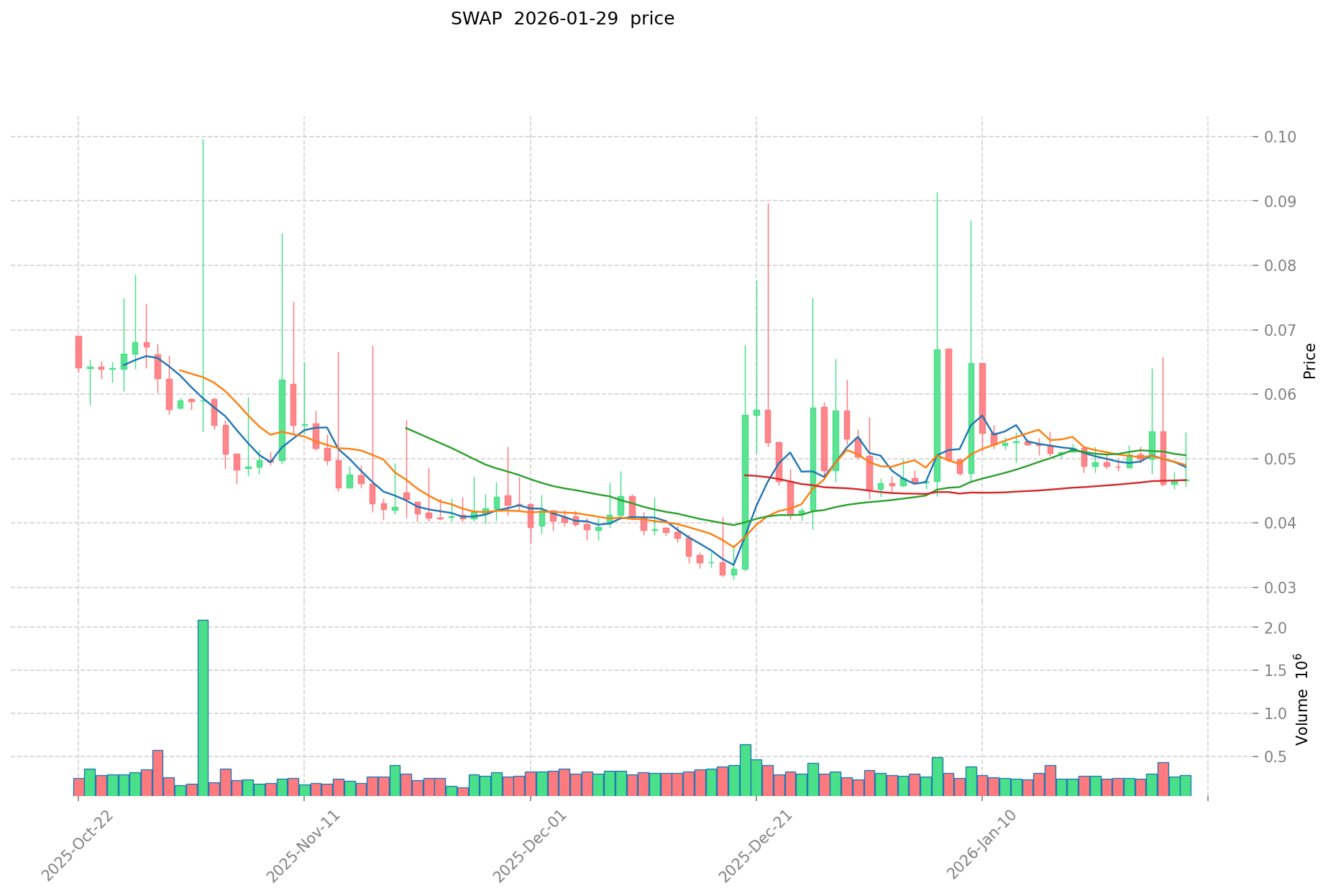
TrustSwap (SWAP) has experienced significant price volatility since its launch in July 2020. The token reached its peak valuation of $5.00 on April 16, 2021, during the broader cryptocurrency market bull run. Subsequently, the asset has undergone substantial corrections, with the price declining to $0.04678 as of January 29, 2026, representing a decline of approximately 99% from its all-time high.
The token's price trajectory reflects broader market cycles and project-specific developments:
- 2020-2021: Initial launch period saw SWAP trading from its all-time low of $0.03124961 (July 10, 2020) to significant appreciation during the 2021 crypto market expansion
- 2021-2022: Following the April 2021 peak, the token entered a prolonged downtrend aligned with overall cryptocurrency market corrections
- 2022-2026: Extended consolidation phase with the token stabilizing in lower price ranges
Current Market Status (January 2026)
- Current Price: $0.04678
- 24-Hour Trading Volume: $13,419.01
- Market Capitalization: $4,677,814.89
- Circulating Supply: 99,996,042.95 SWAP (99.996% of maximum supply)
- 24-Hour Price Range: $0.04561 - $0.05404
Recent Price Performance:
- 1-Hour Change: +0.24%
- 24-Hour Change: +0.71%
- 7-Day Change: -4.06%
- 30-Day Change: -11.05%
- 1-Year Change: -73.91%
The token currently ranks #1571 by market capitalization with a fully diluted valuation matching its market cap at $4,677,814.89, indicating nearly complete token circulation. SWAP is actively traded on 5 exchanges and has approximately 17,637 holders.
Click to view real-time SWAP market price
II. Core Factors Affecting Whether SWAP is a Good Investment (Is TrustSwap(SWAP) a Good Investment)
Supply Mechanism and Scarcity (SWAP Investment Scarcity)
- Total Supply and Circulation: TrustSwap has a maximum supply of 100,000,000 SWAP tokens, with approximately 99,996,042.95 tokens currently in circulation, representing a circulating ratio of nearly 100%. This relatively fixed supply structure may contribute to potential scarcity dynamics in the market.
- Market Cap and Dilution: With a market capitalization to fully diluted valuation ratio of 100%, SWAP currently has minimal dilution risk from additional token releases.
- Investment Significance: The near-complete circulation of tokens means that supply-side factors have largely stabilized, potentially reducing supply-driven volatility in the long term.
Institutional Investment and Mainstream Adoption (Institutional Investment in SWAP)
- Ecosystem Utilization: SWAP tokens are utilized within the TrustSwap ecosystem for paying network fees, staking, governance, and participating in LaunchPad services. LaunchPad supports new projects with fundraising, smart contract development, token launches, and marketing activities.
- Holder Base: As of the latest data, TrustSwap has approximately 17,637 token holders, indicating a moderate level of community participation.
- Market Position: SWAP is listed on 5 exchanges and has achieved Gate.com trading availability, providing accessibility for potential investors.
Macroeconomic Environment Impact on SWAP Investment
- Market Sentiment: Current technical analysis indicates a bearish outlook for TrustSwap in 2026, with some forecasts suggesting continued downward pressure. The token has experienced a significant decline of approximately 73.91% over the past year.
- Trading Volume: The 24-hour trading volume stands at approximately $13,419, reflecting relatively modest market activity compared to larger cryptocurrency assets.
- Price Performance: Recent short-term performance shows a 0.71% increase over 24 hours and a 0.24% increase over 1 hour, though the token has declined 4.06% over the past 7 days and 11.05% over the past 30 days.
Technology and Ecosystem Development (Technology & Ecosystem for SWAP Investment)
- Platform Functionality: TrustSwap operates as a payment platform designed to facilitate secure and reliable fund exchanges. The platform enables automated, time-based payment delivery to predetermined recipients through batch processing.
- Token Standards and Integration: SWAP operates on the Ethereum blockchain with a contract address at 0xCC4304A31d09258b0029eA7FE63d032f52e44EFe. The platform supports various Ethereum-based tokens for payments, including TUSD and DAI.
- Ecosystem Services: TrustSwap's LaunchPad service provides comprehensive support for emerging projects, offering fundraising capabilities, smart contract development assistance, token launch infrastructure, and marketing resources. These services aim to attract DeFi traders and crypto project creators to the ecosystem.
- Recent Developments: According to available information, TrustSwap has been working on strengthening its ecosystem through user experience improvements and enhanced security measures.
III. SWAP Future Investment Forecast and Price Outlook (Is TrustSwap(SWAP) worth investing in 2026-2031)
Short-term Investment Forecast (2026, short-term SWAP investment outlook)
- Conservative forecast: $0.0318104 - $0.04678
- Neutral forecast: $0.04678 - $0.0542648
- Optimistic forecast: $0.0542648 and above
Mid-term Investment Outlook (2027-2029, mid-term TrustSwap(SWAP) investment forecast)
- Market stage expectation: The token may experience gradual growth with potential price fluctuations as it seeks broader market adoption and ecosystem development.
- Investment return forecast:
- 2027: $0.039912696 - $0.061132104
- 2028: $0.0307049886 - $0.06531788484
- 2029: $0.0417950722098 - $0.0835901444196
- Key catalysts: Platform adoption rates, technological developments within the TrustSwap ecosystem, and overall crypto market sentiment.
Long-term Investment Outlook (Is SWAP a good long-term investment?)
- Base scenario: $0.055502644443246 - $0.080731119190176 (assuming steady platform development and moderate market growth through 2030)
- Optimistic scenario: $0.071821863536688 - $0.080990612073287 (assuming enhanced ecosystem adoption and favorable market conditions through 2031)
- Risk scenario: Below $0.0318104 (under adverse market conditions or regulatory challenges)
Click to view SWAP long-term investment and price forecast: Price Prediction
2026-01-29 to 2031 Long-term Outlook
- Base scenario: $0.04678 - $0.0720813564198 USD (corresponding to steady progress and gradual mainstream application enhancement)
- Optimistic scenario: $0.076406237804988 - $0.080990612073287 USD (corresponding to large-scale adoption and favorable market environment)
- Transformative scenario: Above $0.080990612073287 USD (if the ecosystem achieves breakthrough progress and mainstream adoption)
- 2031-12-31 forecast high: $0.080990612073287 USD (based on optimistic development assumptions)
Disclaimer: The above forecasts are based on historical data analysis and predictive models. Cryptocurrency markets are highly volatile and subject to numerous unpredictable factors. These projections should not be construed as investment advice. Investors should conduct thorough research and consider their risk tolerance before making any investment decisions.
| Year |
Predicted High Price |
Predicted Average Price |
Predicted Low Price |
Price Change |
| 2026 |
0.0542648 |
0.04678 |
0.0318104 |
0 |
| 2027 |
0.061132104 |
0.0505224 |
0.039912696 |
8 |
| 2028 |
0.06531788484 |
0.055827252 |
0.0307049886 |
19 |
| 2029 |
0.0835901444196 |
0.06057256842 |
0.0417950722098 |
29 |
| 2030 |
0.080731119190176 |
0.0720813564198 |
0.055502644443246 |
54 |
| 2031 |
0.080990612073287 |
0.076406237804988 |
0.071821863536688 |
63 |
IV. TrustSwap Investment Strategy and Risk Management (How to invest in DeFi Payment Tokens)
Investment Methodology (TrustSwap investment strategy)
Long-term Holding (HODL TrustSwap)
Long-term holding may be suitable for conservative investors who believe in the fundamental value proposition of decentralized payment solutions. This approach involves accumulating SWAP tokens during market downturns and maintaining positions through volatility cycles. Given TrustSwap's focus on automated payment systems and token-based transactions, investors adopting this strategy should monitor the platform's user adoption metrics and transaction volume growth.
Active Trading
Active trading strategies rely on technical analysis and swing trading opportunities. With SWAP showing a 24-hour price range between $0.04561 and $0.05404, traders may identify entry and exit points based on support and resistance levels. The token's daily trading volume of approximately $13,419 suggests moderate liquidity, which traders should consider when executing positions. Price volatility indicators show 0.24% movement in 1-hour periods and 0.71% in 24-hour periods, offering potential opportunities for short-term traders.
Risk Management (Risk management for TrustSwap investment)
Asset Allocation Ratios
- Conservative Investors: Allocate 1-3% of crypto portfolio to DeFi payment tokens like SWAP, maintaining majority positions in established assets
- Aggressive Investors: May allocate 5-10% to emerging DeFi projects with higher growth potential but increased risk exposure
- Professional Investors: Could consider 3-7% allocation with active rebalancing based on technical and fundamental indicators
Risk Hedging Solutions
Investors should implement multi-asset portfolio strategies that combine:
- Diversification across different DeFi sectors (payment, lending, DEX)
- Stablecoin positions to preserve capital during downturns
- Correlation analysis to avoid concentrated exposure to similar risk factors
Secure Storage
Since SWAP operates on the Ethereum blockchain (contract address: 0xCC4304A31d09258b0029eA7FE63d032f52e44EFe), investors should utilize:
Cold Storage Options:
- Hardware wallets (Ledger, Trezor) for long-term holdings
- Multi-signature wallets for institutional amounts
Hot Wallet Considerations:
- MetaMask or similar Ethereum-compatible wallets for active trading
- Keep only necessary amounts for immediate transactions
- Enable two-factor authentication and transaction confirmations
V. TrustSwap Investment Risks and Challenges (Risks of investing in DeFi Payment Tokens)
Market Risks
High Volatility
TrustSwap has experienced considerable price fluctuations, with the token declining 73.91% over the past year. The 7-day performance shows a -4.06% decline, while the 30-day period reflects an -11.05% decrease. The current price of $0.04678 represents a significant distance from the historical high of $5.00 reached in April 2021, indicating substantial downside risk materialization.
Price Manipulation Concerns
With a relatively modest market capitalization of approximately $4.68 million and daily trading volume around $13,419, the token may be susceptible to price manipulation by large holders. The market dominance of 0.00014% suggests limited liquidity depth, which could amplify price swings during large transactions.
Regulatory Risks
Policy Uncertainty Across Jurisdictions
DeFi payment platforms operate in a complex regulatory environment:
- Different countries maintain varying stances on decentralized finance protocols
- Payment-related tokens may face additional scrutiny under money transmission regulations
- Cross-border transaction capabilities could trigger compliance requirements in multiple jurisdictions
- Regulatory clarity remains evolving, creating uncertainty for long-term project viability
Technical Risks
Network Security Vulnerabilities
As an Ethereum-based token, SWAP inherits both the security benefits and potential vulnerabilities of the Ethereum network. Smart contract risks include:
- Potential coding vulnerabilities in payment automation mechanisms
- Dependency on Ethereum network security and consensus mechanisms
- Risk of protocol-specific exploits affecting automated payment functions
Upgrade and Development Risks
Technical development challenges may include:
- Implementation failures in platform upgrades
- Integration issues with evolving Ethereum infrastructure
- Competition from alternative payment solutions with superior technology
VI. Conclusion: Is DeFi Payment Token a Good Investment?
Investment Value Summary
TrustSwap presents a specialized use case in decentralized payment automation, operating within the broader DeFi ecosystem. The token's significant decline from its historical high of $5.00 to the current price of $0.04678 reflects challenging market conditions and competitive pressures. While the platform offers automated payment functionality across Ethereum-based tokens, the investment carries considerable risk factors including high volatility, limited liquidity, and uncertain long-term adoption prospects.
Investor Recommendations
✅ Beginners:
- Consider dollar-cost averaging with very small position sizes (maximum 1-2% of crypto portfolio)
- Prioritize secure storage using hardware wallets
- Thoroughly research the platform's actual usage and adoption metrics before investing
- Start with established cryptocurrencies before exploring smaller DeFi projects
✅ Experienced Investors:
- Employ swing trading strategies during volatility periods, utilizing technical analysis
- Maintain diversified portfolio allocation across multiple DeFi sectors
- Monitor on-chain metrics including transaction volume and holder distribution
- Set strict stop-loss parameters due to limited liquidity conditions
✅ Institutional Investors:
- Conduct comprehensive due diligence on platform security audits and development activity
- Consider strategic allocation only as part of broader DeFi sector exposure
- Implement risk management protocols accounting for liquidity constraints
- Evaluate regulatory compliance status across operating jurisdictions
⚠️ Disclaimer: Cryptocurrency investments involve substantial risk, including potential loss of principal. This analysis is provided for informational purposes only and does not constitute financial, investment, or trading advice. Investors should conduct independent research and consult qualified financial advisors before making investment decisions. Past performance does not guarantee future results.
VII. FAQ
Q1: What makes TrustSwap different from other DeFi payment platforms?
TrustSwap specializes in automated, time-based payment delivery through smart contracts on the Ethereum blockchain. Unlike conventional payment platforms, TrustSwap enables batch processing of predetermined payments to multiple recipients, supporting various Ethereum-based tokens including TUSD and DAI. The platform's LaunchPad service additionally provides comprehensive infrastructure for emerging projects, offering fundraising capabilities, smart contract development assistance, and marketing resources. This combination of automated payment solutions with project incubation services differentiates TrustSwap from standard DeFi payment protocols that focus solely on transaction processing.
Q2: Is TrustSwap (SWAP) suitable for long-term investment?
TrustSwap carries significant risks for long-term investors. The token has declined approximately 99% from its all-time high of $5.00 (April 2021) to the current price of $0.04678, with a 73.91% decrease over the past year alone. The modest market capitalization of $4.68 million and daily trading volume of only $13,419 indicate limited liquidity and potential vulnerability to price manipulation. While price projections suggest potential recovery ranging from $0.055 to $0.080 by 2030-2031, these forecasts depend on uncertain factors including platform adoption rates and favorable market conditions. Conservative investors should limit allocation to 1-3% of their crypto portfolio, while recognizing the high-risk nature of this investment.
Q3: How does the nearly complete token circulation affect SWAP's investment potential?
TrustSwap's circulating supply represents 99.996% of the maximum 100 million tokens, meaning virtually all tokens are already in circulation. This near-complete distribution eliminates future dilution risk from additional token releases, providing supply-side stability. The fully diluted valuation matching the current market cap at $4,677,814.89 indicates no significant overhang from locked or unvested tokens. From an investment perspective, this reduces supply-driven volatility and means price movements will primarily reflect demand factors such as platform adoption, trading activity, and overall market sentiment rather than new token issuance. However, the substantial existing supply also means upward price pressure requires genuine demand growth rather than artificial scarcity.
Q4: What are the main risks associated with investing in TrustSwap?
TrustSwap investment carries multiple risk dimensions. Market risks include extreme volatility evidenced by the 99% decline from historical highs, limited liquidity with only $13,419 daily trading volume, and susceptibility to price manipulation given the modest market cap. Regulatory risks stem from evolving DeFi regulations across jurisdictions, with payment-related tokens potentially facing scrutiny under money transmission laws. Technical risks include smart contract vulnerabilities in automated payment mechanisms, dependency on Ethereum network security, and competition from alternative payment solutions. Additionally, the token's 73.91% decline over the past year and bearish technical outlook for 2026 suggest continued downward pressure potential. Investors should implement strict risk management, including position sizing below 5% of portfolio, secure cold storage, and comprehensive due diligence on platform development activity.
Q5: What trading strategy works best for SWAP given its current market conditions?
Given SWAP's high volatility and limited liquidity, active trading strategies require careful execution. The 24-hour price range between $0.04561 and $0.05404 offers approximately 18% swing potential for experienced traders. Short-term traders can capitalize on hourly fluctuations averaging 0.24% and daily movements around 0.71%, using technical analysis to identify support and resistance levels. However, the modest daily trading volume of $13,419 necessitates smaller position sizes to avoid slippage. For long-term holders, dollar-cost averaging during market downturns (particularly during the observed 7-day and 30-day decline periods) may accumulate positions at favorable prices while managing risk. All traders should implement stop-loss orders given the token's capacity for sudden price movements, and maintain holdings on secure hardware wallets when not actively trading.
Q6: How does TrustSwap's LaunchPad service impact the token's investment value?
TrustSwap's LaunchPad service provides infrastructure for emerging blockchain projects, offering fundraising platforms, smart contract development, token launch capabilities, and marketing support. This service creates utility for the SWAP token within the ecosystem, as projects may require SWAP for accessing LaunchPad features, paying platform fees, or participating in governance. Successful project launches through the LaunchPad could drive demand for SWAP tokens and increase platform transaction volume. However, the investment value depends on LaunchPad adoption rates, quality of projects launched, and overall success of supported ventures. With approximately 17,637 token holders and presence on 5 exchanges, the current ecosystem size suggests moderate adoption. Investors evaluating SWAP should monitor LaunchPad activity metrics, including number of projects supported, capital raised, and post-launch project performance as indicators of genuine platform utility.
Q7: What price levels should investors watch for TrustSwap in 2026?
Key price levels for TrustSwap in 2026 include the current support zone around $0.0318104 (conservative forecast low), which represents approximately 32% below current prices. Breaking below this level could trigger further downside toward historical lows near $0.031. On the upside, resistance exists at $0.0542648 (optimistic forecast high), representing approximately 16% above current prices. The neutral forecast range between $0.04678 and $0.0542648 encompasses likely trading boundaries absent significant catalysts. Given the 73.91% annual decline and bearish technical outlook, investors should prioritize downside protection through stop-loss orders near support levels. For accumulation strategies, the $0.03-$0.04 range may offer entry opportunities if broader crypto markets stabilize. However, these technical levels depend on overall market sentiment, Ethereum network performance, and platform-specific developments that could override purely technical considerations.
Q8: How should institutional investors approach TrustSwap allocation decisions?
Institutional investors evaluating TrustSwap should conduct comprehensive due diligence exceeding standard retail investor requirements. Critical assessment areas include security audit verification for smart contracts, on-chain analysis of actual transaction volumes versus claimed usage, development team credentials and project roadmap execution history, and regulatory compliance status across operating jurisdictions. Given the limited liquidity (approximately $13,419 daily volume), institutional positions could significantly impact market prices, requiring gradual accumulation strategies. Allocation should represent only a minor component of broader DeFi sector exposure, likely below 1-2% of crypto allocations, with strict risk management protocols including position limits, liquidity thresholds, and exit strategies. Institutions should evaluate correlation with larger DeFi assets to avoid concentrated risk exposure, and maintain secure custody through institutional-grade solutions rather than standard hot wallets. The modest market cap and holder base suggest TrustSwap remains an emerging project requiring heightened risk assessment compared to established DeFi protocols.
* The information is not intended to be and does not constitute financial advice or any other recommendation of any sort offered or endorsed by Gate.