This comprehensive analysis evaluates whether UMA is a sound investment by examining its market position, historical performance, and future outlook through 2031. As of January 2026, UMA trades at $0.7783 with a market cap of $69.63 million, maintaining presence on 34 exchanges including Gate. The article addresses critical investment considerations including UMA's unlimited supply mechanism, current market liquidity of approximately $25.87 million, and ecosystem development as a decentralized financial contract platform on Ethereum. Key sections cover price trends showing both -72.78% one-year decline and +12.97% recent momentum, multiple investment scenarios ranging from conservative to optimistic through 2031, diversified strategies for different investor profiles, and comprehensive risk assessments covering market, regulatory, and technical factors. Essential storage and security guidance helps investors protect holdings via cold wallets, hardware wallets, or Gate trading platforms while managing volatile
Introduction: UMA's Investment Position and Market Outlook
UMA is a significant asset in the cryptocurrency sector, launched in 2020 as a decentralized financial contract platform. The protocol enables parties to design and create unique financial contracts through an open-source framework, facilitating various innovations in the financial derivatives space. As of January 18, 2026, UMA maintains a market capitalization of approximately $69.63 million, with a circulating supply of about 89.46 million tokens, and a current trading price around $0.7783. With its positioning as a platform for creating standardized financial products and contracts, UMA has become a subject of interest when investors evaluate "Is UMA a good investment?" This article provides a comprehensive analysis of UMA's investment characteristics, historical price movements, future price projections, and associated risks to serve as a reference for investors.
I. UMA Token Price History Review and Current Investment Landscape
- 2020 (Project Launch): UMA Protocol launched at an initial price of $1.1627, establishing its positioning as a decentralized financial contracts platform.
- 2021 (February Peak): On February 4, 2021, UMA reached a notable price level of $41.56, representing significant appreciation from its launch price.
- 2020-2025 Period: Following the February 2021 peak, the token experienced substantial fluctuation, declining to $0.7783 by January 2026.
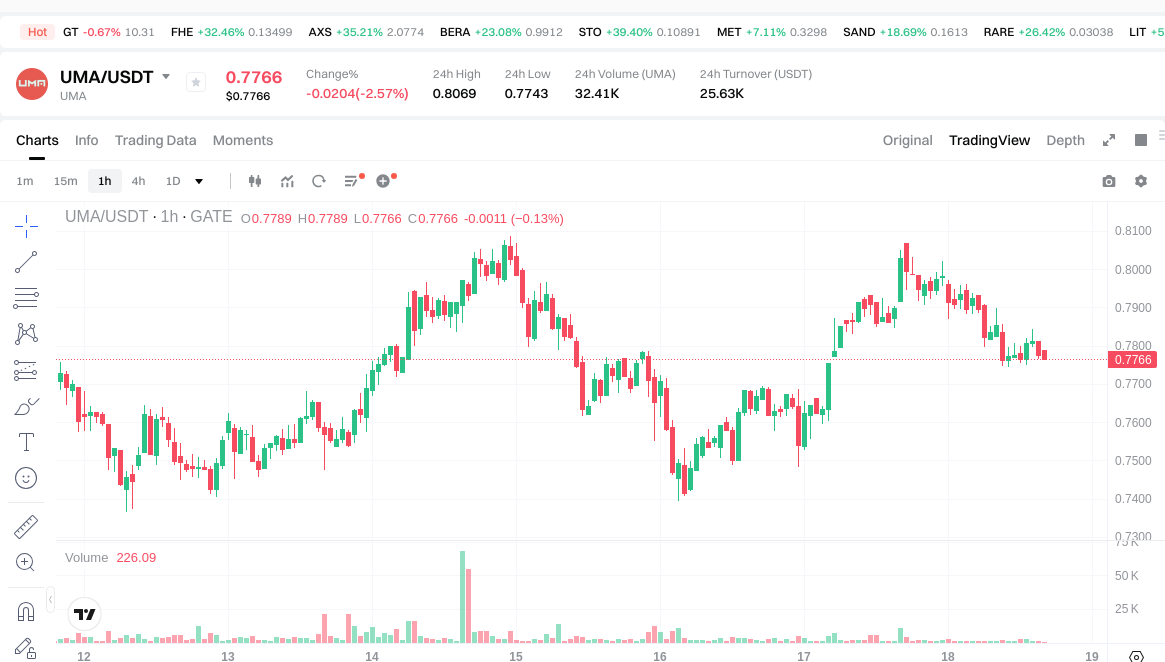
Current UMA Investment Market Status (January 2026)
- Current UMA Price: $0.7783
- 24-Hour Trading Volume: Approximately $25.87 million
- Market Capitalization: $69.63 million (circulating supply-based)
- Circulating Supply: 89.46 million tokens (approximately 78.07% of total supply)
- Token Holders: 24,529 addresses
Click to view real-time UMA market price
II. Core Factors Influencing Whether UMA Is a Good Investment
Supply Mechanism and Scarcity (UMA Investment Scarcity)
- UMA's supply mechanism features an unlimited maximum supply (∞), with a current circulating supply of approximately 89.46 million tokens and a total supply of 127.34 million tokens. The circulating supply represents approximately 78.07% of the total supply, indicating a relatively high circulation ratio. The unlimited supply structure may present considerations regarding long-term scarcity dynamics.
- Historical data shows UMA's price reached $41.56 in February 2021, while the current price stands at $0.7783 as of January 18, 2026, representing a significant decrease from previous levels. The token's price volatility has demonstrated the impact of market cycles on valuation.
- Investment significance: The unlimited supply model differentiates UMA from assets with hard caps, potentially influencing long-term value considerations for investors evaluating scarcity-based investment strategies.
Institutional Investment and Mainstream Adoption (Institutional Investment in UMA)
- Market data indicates UMA is listed on 34 exchanges, with a 24-hour trading volume of approximately $25,868, suggesting moderate liquidity in the current market environment.
- The token maintains a market capitalization of approximately $69.63 million, ranking 440th in the cryptocurrency market, with a market dominance of 0.0029%. These metrics reflect UMA's position within the broader digital asset landscape.
- UMA holds approximately 24,529 token holders according to available data, indicating a established user base participating in the protocol's ecosystem.
Macroeconomic Environment's Impact on UMA Investment
- As a decentralized financial contract platform, UMA's investment profile may be influenced by broader cryptocurrency market conditions and regulatory developments affecting DeFi protocols.
- Market performance data shows UMA experienced a -72.78% change over the one-year period ending January 18, 2026, while demonstrating a 12.97% increase over the 30-day period, reflecting varying performance across different timeframes.
- The token's fully diluted valuation stands at approximately $99.11 million, with the market cap representing 78.07% of this figure, indicating the relationship between current circulation and potential dilution effects.
Technology and Ecosystem Development (Technology & Ecosystem for UMA Investment)
- UMA functions as a decentralized financial contract platform utilizing an open-source protocol that enables parties to design and create customized financial contracts. This design pattern supports the creation of standardized products within the DeFi ecosystem.
- The protocol's architecture focuses on facilitating financial innovation through its contract design framework, allowing for various derivative and synthetic asset applications.
- UMA's smart contract infrastructure is deployed on Ethereum (contract address: 0x04Fa0d235C4abf4BcF4787aF4CF447DE572eF828), positioning it within the Ethereum DeFi ecosystem. The protocol's technological foundation supports its role in decentralized finance applications, though specific recent technical upgrades are not detailed in the provided materials.
III. UMA Future Investment Forecast and Price Outlook (Is UMA(UMA) worth investing in 2026-2031)
Short-term Investment Outlook (2026, short-term UMA investment outlook)
- Conservative forecast: $0.69 - $0.78
- Neutral forecast: $0.78 - $0.85
- Optimistic forecast: $0.85 - $0.90
Mid-term Investment Outlook (2027-2029, mid-term UMA(UMA) investment forecast)
- Market stage expectation: The mid-term period may witness gradual price appreciation as the DeFi sector continues to evolve and UMA's protocol adoption potentially expands.
- Investment return forecast:
- 2027: $0.59 - $1.17
- 2028: $0.64 - $1.37
- 2029: $1.09 - $1.40
- Key catalysts: Expansion of synthetic asset creation, potential protocol upgrades, broader DeFi market recovery, and increased institutional interest in decentralized financial contracts.
Long-term Investment Outlook (Is UMA a good long-term investment?)
- Base scenario: $0.84 - $1.77 (assuming steady protocol development and moderate DeFi sector growth)
- Optimistic scenario: $1.53 - $1.77 (assuming accelerated adoption of synthetic assets and favorable regulatory environment for DeFi)
- Risk scenario: Below $0.84 (in case of intensified competition, technical vulnerabilities, or adverse regulatory developments)
Click to view UMA long-term investment and price forecast: Price Prediction
2026-01-18 to 2031 Long-term Outlook
- Base scenario: $0.84 - $1.53 USD (corresponding to steady progress and gradual increase in mainstream application)
- Optimistic scenario: $1.53 - $1.77 USD (corresponding to large-scale adoption and favorable market conditions)
- Transformational scenario: Above $1.77 USD (in case of breakthrough progress in ecosystem development and mainstream popularization)
- 2031-12-31 forecast high: $1.60 USD (based on optimistic development assumptions)
Disclaimer: These price forecasts are based on technical analysis and market trend projections. Cryptocurrency markets are highly volatile and influenced by numerous unpredictable factors. Historical performance does not guarantee future results. This content is for informational purposes only and does not constitute investment advice.
| Year |
Predicted High Price |
Predicted Average Price |
Predicted Low Price |
Price Change |
| 2026 |
0.900856 |
0.7766 |
0.691174 |
0 |
| 2027 |
1.1742192 |
0.838728 |
0.5871096 |
7 |
| 2028 |
1.368804096 |
1.0064736 |
0.644143104 |
29 |
| 2029 |
1.40141384064 |
1.187638848 |
1.09262774016 |
52 |
| 2030 |
1.7735010917184 |
1.29452634432 |
0.841442123808 |
66 |
| 2031 |
1.595374266739968 |
1.5340137180192 |
1.1505102885144 |
97 |
IV. UMA Investment Strategy and Risk Management (How to invest in cryptocurrency)
Investment Strategy (UMA investment strategy)
Long-term Holding (HODL UMA)
For conservative investors, a long-term holding strategy may be considered. UMA, as a decentralized financial contract platform, has shown certain price volatility historically. The token was launched in April 2020 with an initial price of $1.1627. As of January 18, 2026, the price stands at $0.7783, representing a decline from its launch price. Investors adopting this approach should be prepared for potential price fluctuations and conduct thorough research on the project's fundamental development.
Active Trading
Active trading strategies rely on technical analysis and swing trading techniques. UMA has demonstrated notable price movements across different timeframes:
- 1-hour change: +0.22%
- 24-hour change: -2.39%
- 7-day change: +2.23%
- 30-day change: +12.97%
- 1-year change: -72.78%
The 24-hour trading range fluctuated between $0.7743 and $0.8069, with a total trading volume of $25,868.30. These metrics suggest active market participation, which may provide opportunities for traders who monitor short-term price patterns.
Risk Management (Risk management for UMA investment)
Asset Allocation Ratios
- Conservative investors: May consider allocating a smaller portion of their portfolio to UMA, given the cryptocurrency's volatility and year-over-year decline of 72.78%
- Moderate investors: Could maintain a balanced position while monitoring project developments and market conditions
- Professional investors: May employ more sophisticated allocation strategies based on comprehensive market analysis and risk tolerance
Risk Hedging Solutions
- Multi-asset portfolio diversification across different cryptocurrency categories and traditional assets
- Consideration of hedging instruments available in the cryptocurrency markets
- Regular portfolio rebalancing based on market conditions and investment objectives
Secure Storage
UMA is an ERC-20 token deployed on the Ethereum blockchain (contract address: 0x04Fa0d235C4abf4BcF4787aF4CF447DE572eF828). Storage options include:
- Cold wallets: Offline storage solutions for long-term holdings
- Hot wallets: Online wallets for active trading, though with higher security considerations
- Hardware wallets: Physical devices offering enhanced security for cryptocurrency storage
Investors should verify contract addresses through official sources like Etherscan before conducting transactions.
V. UMA Investment Risks and Challenges (Risks of investing in cryptocurrency)
Market Risk
The cryptocurrency market is characterized by significant volatility. UMA's price history illustrates this volatility:
- Historical high: $41.56 (reached on February 4, 2021)
- Historical low: $0.303625 (reached on April 30, 2020)
- Current price: $0.7783 (as of January 18, 2026)
The substantial gap between historical highs and current levels demonstrates the potential for significant price swings. The 24-hour price fluctuation and year-over-year decline further emphasize the volatile nature of this asset.
Regulatory Risk
Cryptocurrency regulations vary significantly across jurisdictions and continue to evolve. Regulatory developments can impact:
- Trading accessibility on various platforms
- Tax treatment of cryptocurrency transactions
- Legal status of decentralized financial contracts
- Compliance requirements for platforms and users
Investors should stay informed about regulatory changes in their respective jurisdictions that may affect UMA holdings.
Technical Risk
As a decentralized financial contract platform, UMA faces several technical considerations:
- Network security vulnerabilities on the Ethereum blockchain
- Smart contract risks associated with the protocol's open-source design
- Potential challenges in protocol upgrades or implementations
- Dependencies on Ethereum network performance and gas fees
The platform's open-source protocol (available on GitHub: https://github.com/UMAprotocol/protocol) allows for community scrutiny but also requires careful attention to technical developments and security audits.
VI. Conclusion: Is Cryptocurrency a Good Investment?
Investment Value Summary
UMA presents itself as a decentralized financial contract platform that enables the creation of standardized financial products. With a market capitalization of approximately $69.63 million and a circulating supply representing 78.07% of the total supply (89.46 million out of 127.34 million tokens), the project maintains an established market presence.
However, the price performance shows mixed signals. While short-term metrics indicate some positive momentum (30-day gain of 12.97%), the long-term trend shows a significant decline of 72.78% over one year. The current price of $0.7783 remains substantially below both the launch price ($1.1627) and the historical high ($41.56).
Investor Recommendations
✅ Beginners: Consider dollar-cost averaging strategies combined with secure wallet storage. Start with thorough research on the platform's functionality and ecosystem before making investment decisions.
✅ Experienced Investors: May explore swing trading opportunities based on technical analysis, while maintaining a diversified portfolio that includes UMA as one component among multiple assets.
✅ Institutional Investors: Could evaluate UMA within the context of broader DeFi exposure, considering factors such as liquidity (currently listed on 34 exchanges), holder base (24,529 holders), and platform development trajectory.
⚠️ Important Notice: Cryptocurrency investments carry substantial risk due to market volatility, regulatory uncertainty, and technical factors. This content is provided for informational purposes only and does not constitute investment advice. Investors should conduct independent research and consider their financial situation, risk tolerance, and investment objectives before making any investment decisions. Past performance does not guarantee future results.
VII. FAQ
Q1: What is UMA and how does its decentralized financial contract platform work?
UMA is a decentralized protocol that enables users to design and create customized financial contracts using an open-source framework. Launched in April 2020, UMA operates on the Ethereum blockchain (contract address: 0x04Fa0d235C4abf4BcF4787aF4CF447DE572eF828) and specializes in facilitating the creation of synthetic assets and financial derivatives. The platform allows parties to establish standardized financial products without traditional intermediaries, supporting innovation in the DeFi space through its contract design infrastructure.
Q2: What was UMA's historical price performance and what is its current market position?
UMA reached its historical high of $41.56 on February 4, 2021, and experienced a historical low of $0.303625 on April 30, 2020. As of January 18, 2026, UMA trades at $0.7783 with a market capitalization of approximately $69.63 million, ranking 440th in the cryptocurrency market. The token has shown mixed performance across different timeframes: a 12.97% gain over 30 days but a -72.78% decline over one year. With 24,529 token holders and listings on 34 exchanges, UMA maintains an established market presence, though its current price remains significantly below both its launch price ($1.1627) and historical peak.
Q3: What are the key factors to consider when evaluating UMA as an investment?
Several critical factors should be evaluated: First, UMA features an unlimited maximum supply with approximately 89.46 million tokens currently in circulation (78.07% of total supply), which may impact long-term scarcity considerations. Second, the platform's technological foundation as a DeFi protocol creates dependencies on Ethereum network performance and smart contract security. Third, market liquidity is moderate with a 24-hour trading volume of approximately $25,868. Fourth, regulatory developments affecting DeFi protocols could significantly influence UMA's operational environment. Finally, competition within the synthetic assets and derivatives space may affect adoption rates and market positioning.
Q4: What are the projected price forecasts for UMA through 2031?
Short-term forecasts for 2026 range from $0.69-$0.90 depending on market scenarios. Mid-term projections show potential appreciation: 2027 ($0.59-$1.17), 2028 ($0.64-$1.37), and 2029 ($1.09-$1.40). Long-term outlook through 2031 presents varied scenarios: a base scenario of $0.84-$1.77, an optimistic scenario of $1.53-$1.77, and a risk scenario below $0.84. The 2031 forecast high stands at approximately $1.60 under optimistic development assumptions. However, these forecasts are based on technical analysis and market projections, and cryptocurrency markets remain highly volatile and influenced by unpredictable factors. Historical performance does not guarantee future results.
Q5: What investment strategies are suitable for different types of UMA investors?
Conservative investors may consider long-term holding (HODL) strategies with smaller portfolio allocations, acknowledging the -72.78% year-over-year decline and preparing for potential volatility. Active traders can utilize technical analysis focusing on short-term price movements, with UMA showing fluctuations between $0.7743 and $0.8069 in 24-hour periods and a trading volume of approximately $25,868. Moderate investors might maintain balanced positions while monitoring project developments. Professional investors could employ sophisticated allocation strategies incorporating hedging instruments. All strategies should include secure storage solutions such as hardware wallets or cold storage, proper verification of the contract address through official sources like Etherscan, and regular portfolio rebalancing based on market conditions.
Q6: What are the primary risks associated with investing in UMA?
Market risk represents the most visible challenge, with UMA demonstrating significant volatility—declining from $41.56 (February 2021) to $0.7783 (January 2026). Regulatory risk stems from evolving cryptocurrency regulations that vary across jurisdictions and could affect trading accessibility, tax treatment, and legal status of decentralized financial contracts. Technical risks include potential smart contract vulnerabilities, dependencies on Ethereum network security and performance, and challenges related to protocol upgrades. Additionally, competition within the DeFi sector, potential network security breaches, and Ethereum gas fee fluctuations present ongoing considerations. The platform's open-source nature (available on GitHub: https://github.com/UMAprotocol/protocol) allows community scrutiny but requires careful attention to security audits and technical developments.
Q7: How does UMA's supply mechanism affect its investment characteristics?
UMA's unlimited maximum supply (∞) distinguishes it from cryptocurrencies with hard caps, potentially affecting long-term scarcity dynamics and value considerations. Currently, 89.46 million tokens are in circulation out of a total supply of 127.34 million, representing a 78.07% circulation ratio—relatively high compared to many projects. The fully diluted valuation stands at approximately $99.11 million, with current market cap representing 78.07% of this figure. This supply structure means additional tokens could enter circulation, potentially creating dilution effects. Investors should consider how this unlimited supply model contrasts with scarcity-based investment strategies and may influence long-term price dynamics compared to assets with fixed supply caps.
Q8: What security measures should investors implement when holding UMA tokens?
As an ERC-20 token on Ethereum, UMA requires proper security practices: First, verify the official contract address (0x04Fa0d235C4abf4BcF4787aF4CF447DE572eF828) through trusted sources like Etherscan before transactions. Second, choose appropriate storage solutions—cold wallets for long-term holdings offering offline security, hardware wallets providing physical device protection, or hot wallets for active trading with heightened security awareness. Third, implement multi-factor authentication on exchange accounts and wallet interfaces. Fourth, maintain secure backups of wallet recovery phrases in physically secure locations. Fifth, regularly update wallet software and security protocols. Sixth, avoid sharing private keys or sensitive information through unsecured channels. Proper security implementation is essential for protecting UMA holdings from unauthorized access and potential losses.
* The information is not intended to be and does not constitute financial advice or any other recommendation of any sort offered or endorsed by Gate.