This comprehensive comparison examines LIME and XTZ as distinct cryptocurrency assets with different market positioning and investment profiles. LIME, launched in June 2021, integrates Telegram communication with DeFi tools for accessible cryptocurrency management, while XTZ, introduced in October 2017, powers the Tezos blockchain with formal verification and proof-of-stake consensus. The article analyzes historical price trends, tokenomics, institutional adoption, and technical ecosystems to address investor concerns about asset selection. With LIME currently trading at $0.004149 and XTZ at $0.5067, the comparison evaluates liquidity profiles, risk management strategies, and regulatory considerations across different investor types. By examining supply mechanisms, ecosystem development, and macroeconomic factors, this guide enables informed investment decisions on both emerging and established blockchain platforms through detailed price predictions and strategic allocation recommendations for Gate trading op
Introduction: LIME vs XTZ Investment Comparison
In the cryptocurrency market, the comparison between LIME and XTZ remains a topic of ongoing interest for investors. The two assets demonstrate notable differences in market cap ranking, application scenarios, and price performance, representing distinct positioning within the crypto asset landscape.
iMe Lab (LIME): Launched in June 2021, this project positions itself as an intelligent platform integrating Telegram-based communication software, crypto wallet, and DeFi tools, aiming to empower Telegram users with accessible cryptocurrency management capabilities.
Tezos (XTZ): Introduced in October 2017, this decentralized blockchain has established itself as a self-amending cryptographic ledger with formal verification capabilities, designed to enhance smart contract security through mathematical proof of transaction code accuracy.
This article examines the investment value comparison between LIME and XTZ through multiple dimensions including historical price trends, supply mechanisms, adoption patterns, technical ecosystems, and market positioning, addressing a key question many investors consider:
"Which asset aligns better with different investment objectives and risk profiles?"
I. Historical Price Comparison and Current Market Status
LIME (Coin A) and XTZ (Coin B) Historical Price Trends
- 2021: LIME experienced notable price activity following its launch in June 2021, with an initial offering price of $0.01.
- 2021: XTZ was influenced by broader market conditions, with price movements reflecting the cryptocurrency market cycle of that period.
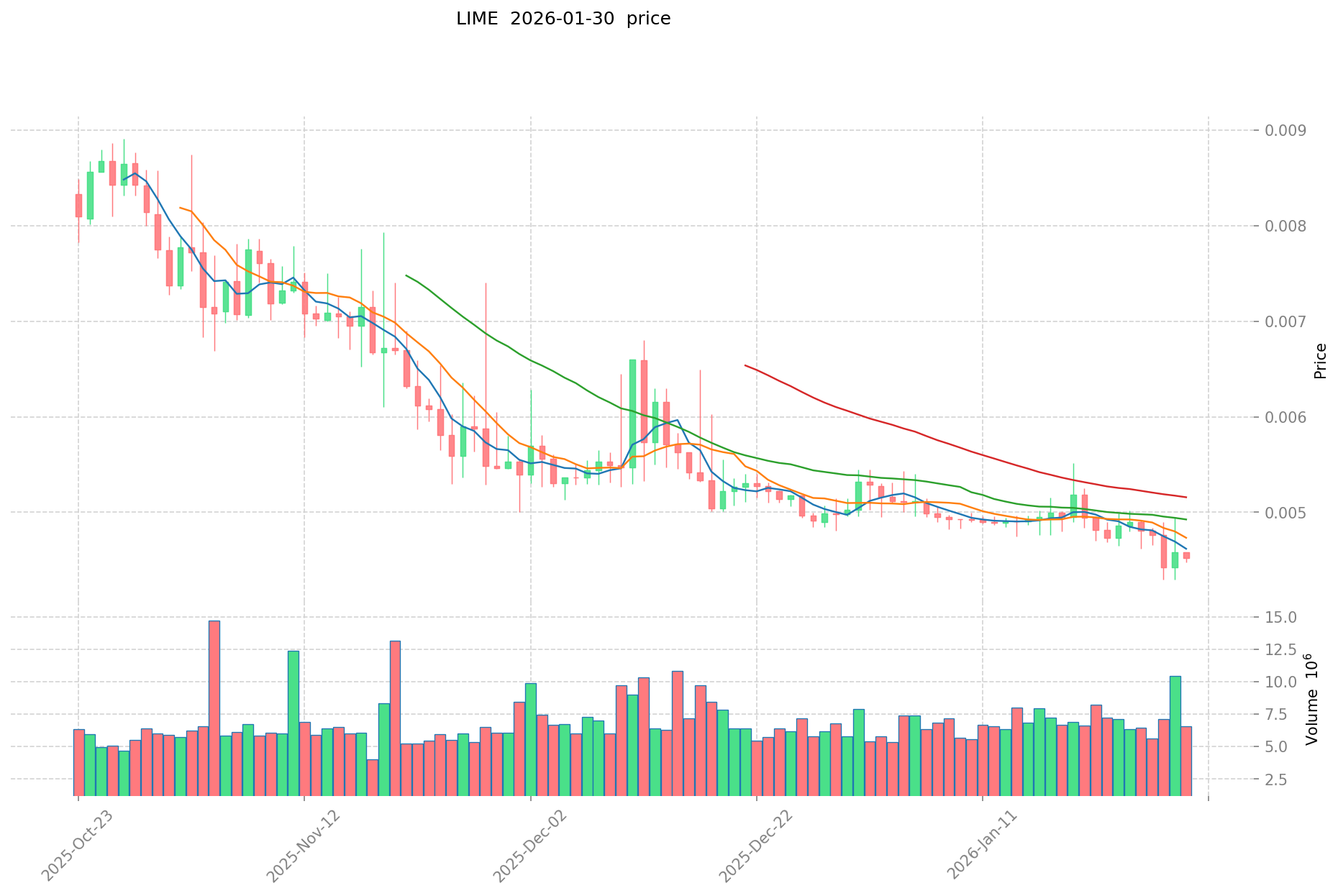
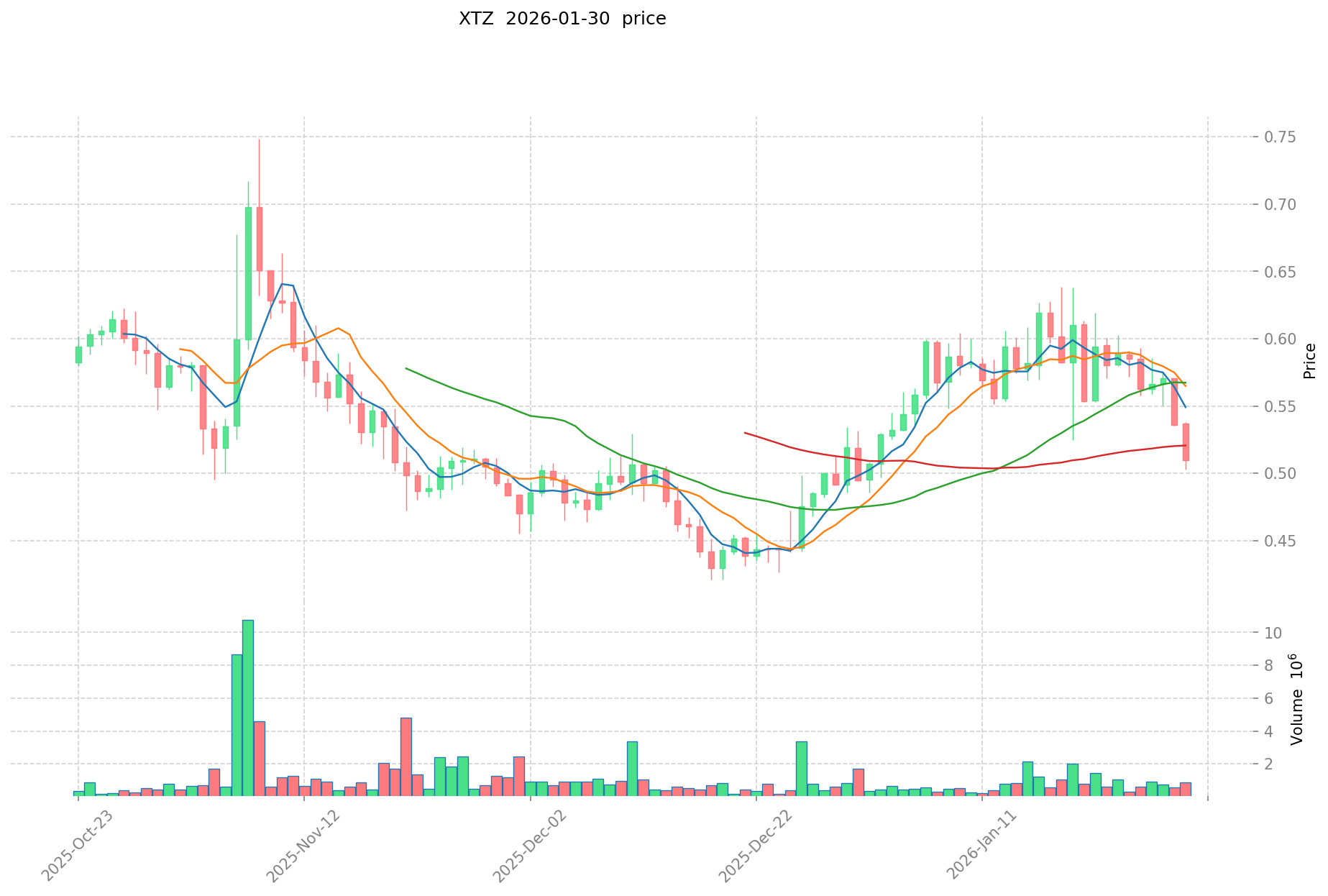
- Comparative analysis: During market fluctuations, LIME moved from a peak level of $0.271381 in November 2021 to a lower point of $0.00400618 in November 2022, while XTZ demonstrated its own pattern of volatility within the same timeframe.
Current Market Situation (January 31, 2026)
- LIME current price: $0.004149
- XTZ current price: $0.5067
- 24-hour trading volume: LIME $36,210.55 vs XTZ $528,566.65
- Market Sentiment Index (Fear & Greed Index): 16 (Extreme Fear)
View real-time prices:
- View LIME current price Market Price
- View XTZ current price Market Price
II. Core Factors Influencing LIME vs XTZ Investment Value
Supply Mechanism Comparison (Tokenomics)
- LIME: The token operates within a blockchain-based framework, though specific supply mechanism details require further technical documentation for comprehensive analysis.
- XTZ: As the native token of the Tezos blockchain, XTZ employs a proof-of-stake consensus mechanism with inflationary characteristics designed to incentivize network participation and validation activities.
- 📌 Historical Pattern: Supply mechanisms play a significant role in shaping price cycles, with tokens featuring clear emission schedules and staking rewards often demonstrating distinct volatility patterns compared to fixed-supply assets.
Institutional Adoption and Market Application
- Institutional Holdings: Market data suggests varying degrees of institutional interest in both assets, influenced by factors including regulatory clarity, infrastructure maturity, and governance frameworks.
- Enterprise Adoption: Both LIME and XTZ serve different roles within the cryptocurrency ecosystem, with applications potentially spanning payment systems, decentralized applications, and blockchain-based services, though specific enterprise partnerships vary.
- National Policy: Regulatory approaches toward blockchain tokens differ across jurisdictions, with some regions implementing clearer frameworks for proof-of-stake networks while maintaining cautious stances toward emerging token projects.
Technology Development and Ecosystem Building
- LIME Technology Evolution: As a blockchain-based token, ongoing development activities and protocol enhancements may influence its utility and market positioning.
- XTZ Technology Development: The Tezos network continues to implement protocol upgrades through its on-chain governance system, enabling technical improvements while maintaining network stability.
- Ecosystem Comparison: Both assets participate in different segments of the blockchain ecosystem, with varying degrees of integration into DeFi protocols, NFT platforms, payment infrastructure, and smart contract applications.
Macroeconomic Environment and Market Cycles
- Performance in Inflationary Environments: Digital assets generally demonstrate varying responses to inflationary pressures, with characteristics influenced by supply dynamics, adoption rates, and market sentiment rather than intrinsic inflation-hedging properties.
- Macroeconomic Monetary Policy: Interest rate adjustments, dollar index movements, and central bank policies impact cryptocurrency markets broadly, affecting both established and emerging tokens through liquidity conditions and risk appetite shifts.
- Geopolitical Factors: Cross-border transaction demand, international regulatory developments, and geopolitical tensions can influence cryptocurrency adoption patterns and market dynamics across different regions and use cases.
III. 2026-2031 Price Prediction: LIME vs XTZ
Short-term Prediction (2026)
- LIME: Conservative $0.00252-$0.00413 | Optimistic $0.00413-$0.00520
- XTZ: Conservative $0.345-$0.507 | Optimistic $0.507-$0.735
Medium-term Prediction (2028-2029)
- LIME may enter a gradual growth phase, with estimated price ranging from $0.00324 to $0.00812
- XTZ may enter a consolidation and expansion phase, with estimated price ranging from $0.362 to $0.897
- Key drivers: institutional capital inflows, ETF developments, ecosystem expansion
Long-term Prediction (2030-2031)
- LIME: Baseline scenario $0.00494-$0.00716 | Optimistic scenario $0.00678-$0.0117
- XTZ: Baseline scenario $0.607-$0.798 | Optimistic scenario $0.885-$1.19
View detailed price predictions for LIME and XTZ
Disclaimer
LIME:
| Year |
Predicted High Price |
Predicted Average Price |
Predicted Low Price |
Price Change |
| 2026 |
0.00519876 |
0.004126 |
0.00251686 |
0 |
| 2027 |
0.0054549846 |
0.00466238 |
0.0044758848 |
12 |
| 2028 |
0.007335089335 |
0.0050586823 |
0.003237556672 |
21 |
| 2029 |
0.008117920420925 |
0.0061968858175 |
0.0054532595194 |
49 |
| 2030 |
0.008803605836631 |
0.007157403119212 |
0.004938608152256 |
72 |
| 2031 |
0.011731341582545 |
0.007980504477921 |
0.006783428806233 |
92 |
XTZ:
| Year |
Predicted High Price |
Predicted Average Price |
Predicted Low Price |
Price Change |
| 2026 |
0.734715 |
0.5067 |
0.344556 |
0 |
| 2027 |
0.6703641 |
0.6207075 |
0.3724245 |
22 |
| 2028 |
0.897294762 |
0.6455358 |
0.361500048 |
27 |
| 2029 |
0.82541435067 |
0.771415281 |
0.64027468323 |
52 |
| 2030 |
1.04592340874385 |
0.798414815835 |
0.6067952600346 |
57 |
| 2031 |
1.189598154853358 |
0.922169112289425 |
0.885282347797848 |
81 |
IV. Investment Strategy Comparison: LIME vs XTZ
Long-term vs Short-term Investment Strategies
- LIME: May align with investors interested in emerging DeFi integration platforms and Telegram-based cryptocurrency accessibility, noting the higher risk profile associated with newer market entrants
- XTZ: May suit investors seeking exposure to established proof-of-stake networks with on-chain governance capabilities and formal verification features
Risk Management and Asset Allocation
- Conservative Investors: LIME 5-10% vs XTZ 15-25% (within overall cryptocurrency allocation)
- Aggressive Investors: LIME 15-25% vs XTZ 25-35% (within overall cryptocurrency allocation)
- Hedging Tools: stablecoin allocation, diversified token portfolios, position sizing based on volatility metrics
V. Potential Risk Comparison
Market Risk
- LIME: Higher volatility characteristics with 24-hour trading volume of $36,210.55, indicating lower liquidity conditions that may amplify price movements during market stress periods
- XTZ: Moderate volatility profile with 24-hour trading volume of $528,566.65, demonstrating relatively higher liquidity while remaining subject to broader cryptocurrency market cycles
Technical Risk
- LIME: Platform dependency on Telegram infrastructure, integration complexity across wallet and DeFi functionalities, potential scalability considerations as user base expands
- XTZ: Network upgrade execution through on-chain governance, validator participation dynamics, smart contract security maintenance through formal verification processes
Regulatory Risk
- Global regulatory frameworks continue evolving, with proof-of-stake networks like XTZ potentially facing different compliance requirements compared to application-layer tokens like LIME across various jurisdictions
VI. Conclusion: Which Is the Better Buy?
📌 Investment Value Summary:
- LIME Characteristics: Integration of communication and DeFi functionalities within Telegram ecosystem, earlier development stage with corresponding risk-return profile
- XTZ Characteristics: Established blockchain infrastructure with self-amending protocol capabilities, formal verification approach to smart contract security, proof-of-stake consensus mechanism
✅ Investment Considerations:
- New Investors: Consider starting with smaller allocations to established networks like XTZ while developing understanding of cryptocurrency market dynamics and risk management principles
- Experienced Investors: May evaluate both assets within diversified portfolios based on individual risk tolerance, investment horizon, and conviction in respective technological approaches
- Institutional Investors: Conduct thorough due diligence on governance structures, regulatory positioning, custody solutions, and liquidity profiles before determining allocation strategies
⚠️ Risk Disclaimer: Cryptocurrency markets exhibit high volatility. This content does not constitute investment advice. Conduct independent research and consult qualified financial professionals before making investment decisions.
VII. FAQ
Q1: What are the main differences between LIME and XTZ in terms of their core functionalities?
LIME serves as a Telegram-integrated platform combining communication, crypto wallet, and DeFi tools, while XTZ operates as the native token of a self-amending blockchain with formal verification capabilities. LIME focuses on accessibility for Telegram users, launched in June 2021 with an initial price of $0.01, targeting simplified cryptocurrency management within a messaging environment. XTZ, introduced in October 2017, powers the Tezos blockchain infrastructure, emphasizing smart contract security through mathematical proof verification and implementing protocol upgrades via on-chain governance mechanisms rather than application-layer integration.
Q2: How do the liquidity profiles of LIME and XTZ compare as of January 2026?
XTZ demonstrates significantly higher liquidity with a 24-hour trading volume of $528,566.65 compared to LIME's $36,210.55 as of January 31, 2026. This substantial difference—approximately 14.6 times greater volume for XTZ—indicates that XTZ offers better price stability during market stress periods and lower slippage for larger transactions. The lower liquidity of LIME may result in amplified price movements and challenges executing substantial position changes without material market impact, making it more suitable for smaller allocation strategies within diversified portfolios.
Q3: What role do supply mechanisms play in the price projections for LIME versus XTZ?
XTZ employs a proof-of-stake consensus with inflationary characteristics designed to incentivize network validation, creating ongoing token issuance that must be balanced by adoption demand to maintain price appreciation. The price predictions show XTZ potentially reaching $0.507-$0.735 in 2026 and $0.885-$1.19 by 2031 under optimistic scenarios. LIME's supply mechanism details require further documentation for comprehensive analysis, with projections ranging from $0.00413-$0.00520 in 2026 to $0.00678-$0.0117 by 2031. Historical patterns suggest tokens with clear emission schedules and staking rewards demonstrate distinct volatility characteristics compared to fixed-supply assets.
Q4: Which asset aligns better with conservative versus aggressive investment strategies?
For conservative investors, XTZ may warrant 15-25% allocation within cryptocurrency holdings due to its established infrastructure, higher liquidity, and four-year operational history, while LIME might represent 5-10% given its earlier development stage. Aggressive investors seeking higher risk-return profiles could consider 25-35% XTZ and 15-25% LIME allocations, recognizing LIME's potential growth from Telegram ecosystem integration balanced against execution risks. These percentages assume cryptocurrency represents an appropriate portion of overall portfolio diversification, with specific allocations depending on individual risk tolerance, investment horizon, and conviction in respective technological approaches.
Q5: How do regulatory considerations differ between LIME and XTZ?
XTZ, as a proof-of-stake network, may face different compliance requirements related to staking rewards classification, validator responsibilities, and securities law interpretations across jurisdictions, with some regions developing clearer frameworks for established blockchain infrastructure. LIME, operating as an application-layer token integrated with Telegram, encounters regulatory considerations around payment functionality, DeFi integration, and platform dependency on existing communication infrastructure. Both assets remain subject to evolving global regulatory frameworks, with institutional investors requiring thorough evaluation of governance structures, regulatory positioning, and jurisdiction-specific compliance obligations before determining allocation strategies.
Q6: What technical risks should investors consider when comparing LIME and XTZ?
LIME faces platform dependency risks on Telegram infrastructure, integration complexity across wallet and DeFi functionalities, and potential scalability considerations as user adoption expands, creating execution challenges that could impact utility delivery. XTZ encounters technical considerations around network upgrade execution through on-chain governance, validator participation dynamics affecting network security, and maintaining smart contract security through formal verification processes requiring specialized mathematical expertise. Both assets require ongoing development activities, though XTZ's four-year operational history provides greater evidence of technical execution capability compared to LIME's shorter track record since June 2021.
Q7: How have LIME and XTZ performed during different market conditions?
LIME experienced significant volatility following its June 2021 launch, moving from a peak of $0.271381 in November 2021 to $0.00400618 in November 2022—representing approximately 98.5% decline during market downturn conditions. XTZ demonstrated its own volatility pattern during the same timeframe, influenced by broader cryptocurrency market cycles. As of January 31, 2026, LIME trades at $0.004149 while XTZ trades at $0.5067, with the current market sentiment index showing 16 (Extreme Fear), indicating continued risk-off conditions affecting both assets. These patterns suggest both tokens remain highly correlated with broader market cycles while exhibiting distinct volatility profiles based on liquidity and adoption characteristics.
Q8: What factors should institutional investors prioritize when evaluating LIME versus XTZ?
Institutional investors should conduct thorough due diligence on governance structures, with XTZ's on-chain governance providing transparent decision-making processes compared to LIME's platform-dependent model. Custody solution availability, regulatory positioning across target jurisdictions, and liquidity profiles represent critical evaluation criteria—XTZ's higher trading volume offering advantages for position management. Additional considerations include smart contract audit histories, validator infrastructure for XTZ staking operations, Telegram integration dependencies for LIME, insurance availability, counterparty risk assessment, and alignment with institutional investment mandates. The maturity differential—XTZ's October 2017 launch versus LIME's June 2021 introduction—provides different track records for evaluating operational resilience and development execution capabilities.
* The information is not intended to be and does not constitute financial advice or any other recommendation of any sort offered or endorsed by Gate.