This comprehensive analysis compares LSK and VET, two distinct blockchain platforms offering different investment propositions in 2024. LSK operates as a decentralized application ecosystem using sidechain technology with JavaScript-based development tools, targeting gaming and dApp developers. VET focuses on enterprise-grade supply chain solutions with established institutional partnerships including Walmart and DNV. The article examines historical price trends, tokenomics, institutional adoption, and technical ecosystems to address critical investment questions. Detailed price forecasts through 2031 suggest LSK's potential growth trajectory alongside VET's enterprise positioning. Investment strategies tailored for conservative and aggressive investors are provided, emphasizing risk management and allocation frameworks. View real-time market data and price predictions on Gate to make informed investment decisions based on your risk tolerance and portfolio objectives.
Introduction: LSK vs VET Investment Comparison
In the cryptocurrency market, the comparison between LSK vs VET continues to draw investor attention. Both assets differ significantly in market cap ranking, application scenarios, and price performance, representing distinct positioning within the crypto landscape.
LSK (Lisk): Launched in 2016 after splitting from the Crypti blockchain project, it aims to build a decentralized application ecosystem based on sidechain technology, similar to an App Store for blockchain applications. The project focuses on JavaScript-based development, offering developers a familiar environment for building decentralized applications.
VET (VeChain): Founded in 2015 by Sunny Lu, VeChain initially focused on supply chain transparency and anti-counterfeiting solutions. It evolved into VeChainThor, an enterprise-grade Layer-1 blockchain network, with partnerships spanning organizations such as DNV, Walmart, and Boston Consulting Group.
This article will analyze LSK vs VET across historical price trends, supply mechanisms, institutional adoption, technical ecosystems, and future projections, addressing the key question investors ask:
"Which is the better buy right now?"
By examining market data as of January 20, 2026, we will provide a comprehensive comparison to help investors understand the distinct characteristics and potential considerations associated with each asset.
I. Historical Price Comparison and Current Market Overview
Historical Price Trends of LSK (Coin A) and VET (Coin B)
- 2018: LSK recorded an all-time high of $34.92 on January 7, 2018, during the cryptocurrency market boom, but subsequently experienced a significant price correction.
- 2021: VET reached its all-time high of $0.280991 on April 19, 2021, driven by increased adoption in enterprise blockchain applications and partnerships with organizations such as DNV and Walmart.
- Comparative Analysis: During the 2021-2026 market cycle, LSK declined from its historical peak of $34.92 to a current level of approximately $0.1879, representing a decline of over 99%. In contrast, VET decreased from $0.280991 to approximately $0.011003, reflecting a decline of approximately 96%.
Current Market Status (2026-01-20)
- LSK Current Price: $0.1879
- VET Current Price: $0.011003
- 24-Hour Trading Volume: LSK approximately $217,869.73 vs VET approximately $720,114.15
- Market Sentiment Index (Fear & Greed Index): 44 (Fear)
View real-time prices:
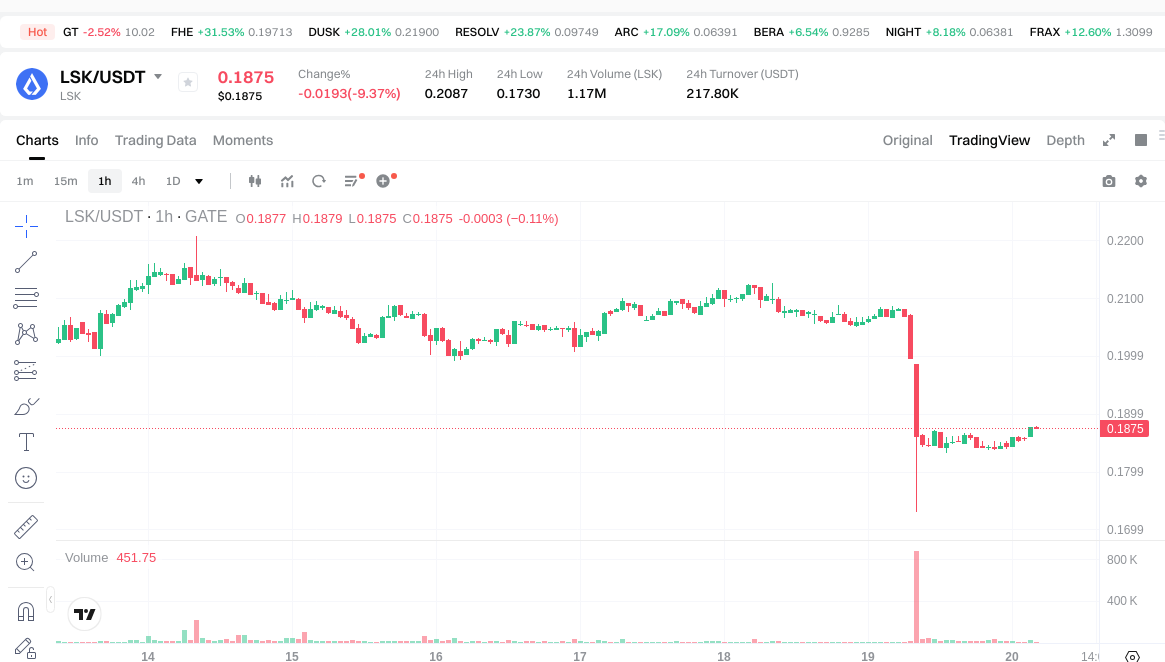
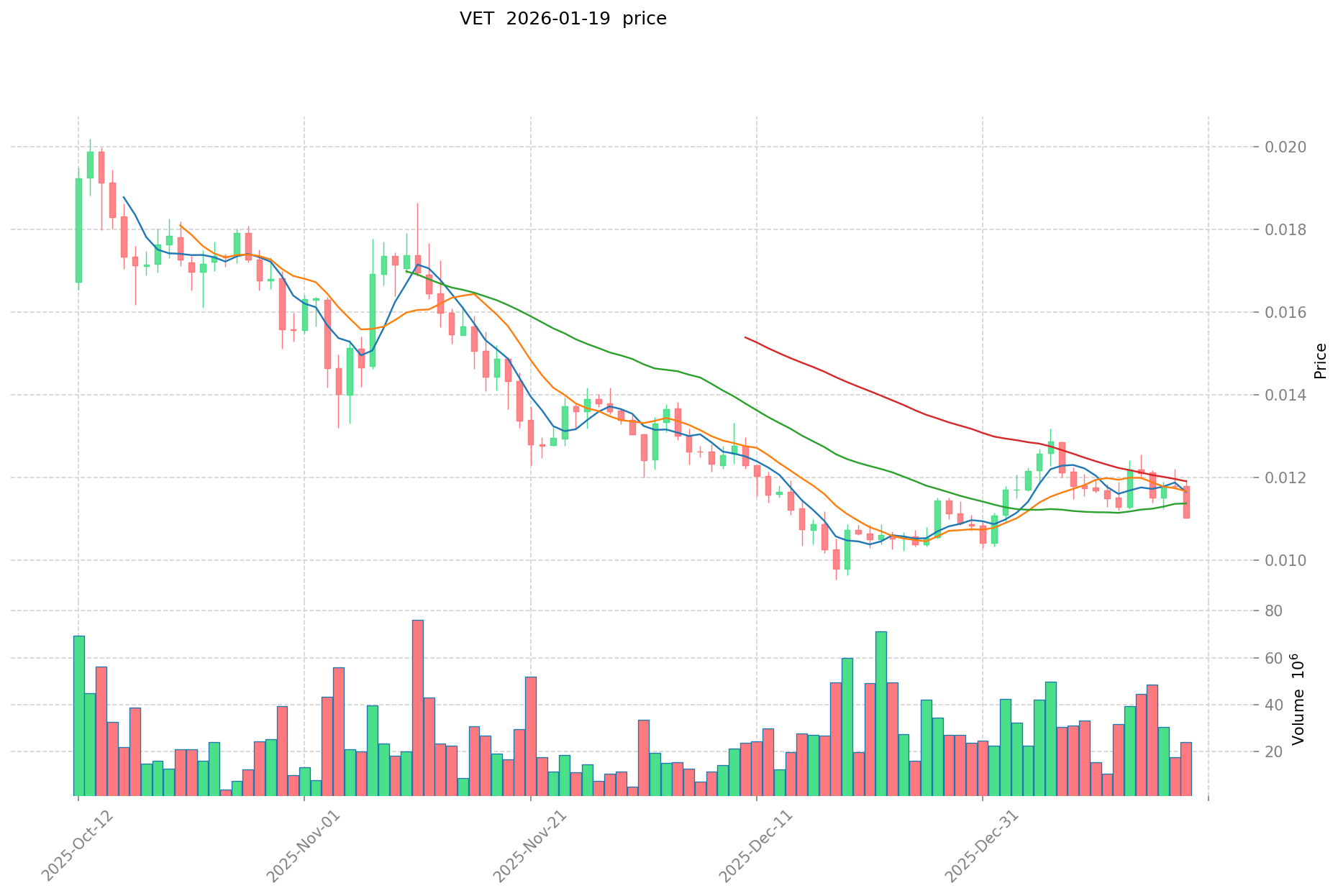
II. Core Factors Influencing LSK vs VET Investment Value
Tokenomics Comparison
- LSK: Operates within the Loom Network ecosystem, utilizing a sidechain architecture to address Ethereum scalability issues. The token serves as a staking and hosting mechanism for dApps on the network.
- VET: Functions within the Kyber Network framework, focusing on liquidity provision through token swap mechanisms and interest payment structures in DeFi applications.
- 📌 Historical Pattern: Supply mechanisms influence price cycles through network utility expansion and liquidity dynamics, with development-stage projects showing higher volatility.
Institutional Adoption and Market Application
- Institutional Holdings: Neither token shows significant institutional concentration based on available data.
- Enterprise Adoption: LSK targets game platform developers and large-scale dApp deployment scenarios; VET focuses on DeFi protocol integration and cross-protocol liquidity solutions.
- Regulatory Environment: Both projects operate under evolving blockchain regulations, with no specific jurisdictional preferences indicated in available materials.
Technology Development and Ecosystem Building
- LSK Technology: Loom Network implements multiple sidechains per dApp to reduce mainchain congestion, targeting low-fee and high-speed transaction environments. The platform has released various dApps including CryptoZombies.
- VET Technology: Kyber Network develops infrastructure for liquidity provision across the entire dApp ecosystem, enabling seamless integration with native protocols for blockchain applications.
- Ecosystem Comparison: LSK emphasizes gaming and dApp development tools; VET focuses on DeFi mechanisms and protocol-level liquidity solutions. Both projects remain in active development phases.
Macroeconomic Context and Market Cycles
- Inflation Environment: As utility tokens tied to specific platform development, both assets show limited correlation with traditional inflation hedging characteristics.
- Monetary Policy Impact: Interest rate changes and dollar index movements may indirectly affect capital flows into crypto development projects, though direct relationships remain unclear.
- Geopolitical Factors: Cross-border transaction demand and international regulatory developments may influence adoption rates for both blockchain platforms.
III. 2026-2031 Price Forecast: LSK vs VET
Short-term Forecast (2026)
- LSK: Conservative $0.159 - $0.188 | Optimistic $0.188 - $0.266
- VET: Conservative $0.008 - $0.011 | Optimistic $0.011 - $0.013
Mid-term Forecast (2028-2029)
- LSK may enter a growth phase, with projected prices ranging from $0.230 to $0.410
- VET may enter a consolidation phase, with projected prices ranging from $0.006 to $0.017
- Key drivers: institutional capital inflows, ETF developments, ecosystem expansion
Long-term Forecast (2030-2031)
- LSK: Baseline scenario $0.238 - $0.346 | Optimistic scenario $0.346 - $0.539
- VET: Baseline scenario $0.008 - $0.015 | Optimistic scenario $0.015 - $0.020
View detailed price predictions for LSK and VET
Disclaimer
LSK:
| Year |
Predicted High Price |
Predicted Average Price |
Predicted Low Price |
Price Change |
| 2026 |
0.266392 |
0.1876 |
0.15946 |
0 |
| 2027 |
0.283745 |
0.226996 |
0.11576796 |
21 |
| 2028 |
0.3064446 |
0.2553705 |
0.237494565 |
36 |
| 2029 |
0.410125023 |
0.28090755 |
0.230344191 |
50 |
| 2030 |
0.383523078015 |
0.3455162865 |
0.238406237685 |
84 |
| 2031 |
0.5394891297411 |
0.3645196822575 |
0.258808974402825 |
94 |
VET:
| Year |
Predicted High Price |
Predicted Average Price |
Predicted Low Price |
Price Change |
| 2026 |
0.01305073 |
0.010967 |
0.00811558 |
0 |
| 2027 |
0.01236913095 |
0.012008865 |
0.01068788985 |
9 |
| 2028 |
0.01377356771175 |
0.012188997975 |
0.006338278947 |
10 |
| 2029 |
0.01661604203952 |
0.012981282843375 |
0.010904277588435 |
17 |
| 2030 |
0.017758394929737 |
0.014798662441447 |
0.007695304469552 |
34 |
| 2031 |
0.02034816085699 |
0.016278528685592 |
0.010906614219346 |
47 |
IV. Investment Strategy Comparison: LSK vs VET
Long-term vs Short-term Investment Strategies
- LSK: May appeal to investors focused on application development ecosystems and sidechain technology adoption, particularly those interested in gaming and dApp platform growth. The JavaScript-based development environment targets a specific developer community, which may influence ecosystem expansion timelines.
- VET: May appeal to investors interested in enterprise blockchain applications and supply chain solutions, particularly those tracking institutional partnerships and DeFi liquidity infrastructure development. The focus on cross-protocol integration represents a different market positioning.
Risk Management and Asset Allocation
- Conservative Investors: A potential allocation framework might consider LSK: 20-30% vs VET: 30-40%, with remaining capital in established assets, reflecting the developmental stage of both projects and their distinct market volatilities.
- Aggressive Investors: A potential allocation framework might consider LSK: 40-50% vs VET: 30-40%, acknowledging higher risk tolerance for ecosystem growth potential, though individual risk assessment remains essential.
- Hedging Tools: Stablecoin allocation for volatility management, options strategies where available, cross-asset diversification across different blockchain use cases.
V. Potential Risk Comparison
Market Risks
- LSK: Price volatility associated with development-stage blockchain platforms, dependency on gaming and dApp adoption rates, competitive pressure from alternative Layer-2 and sidechain solutions, liquidity constraints reflected in trading volume metrics.
- VET: Enterprise adoption timeline uncertainties, competition within supply chain blockchain space, dependency on partnership execution and institutional integration progress, market correlation with broader enterprise blockchain sector performance.
Technical Risks
- LSK: Sidechain architecture scalability as ecosystem grows, network stability during high-traffic dApp deployments, developer adoption rates for JavaScript-based tools, ongoing maintenance of multiple parallel sidechains.
- VET: Protocol integration complexity across different blockchain environments, liquidity mechanism performance during market stress, smart contract security considerations in DeFi applications, cross-chain bridge vulnerabilities.
Regulatory Risks
- Global regulatory developments may affect both projects differently based on their distinct use cases: LSK's gaming and application focus may face varying content and platform regulations across jurisdictions, while VET's enterprise and supply chain applications may encounter different compliance frameworks related to business operations and data management. Both remain subject to evolving cryptocurrency classification and taxation policies.
VI. Conclusion: Which Is the Better Buy?
📌 Investment Value Summary:
- LSK Characteristics: Sidechain technology positioning, JavaScript developer environment, gaming and dApp ecosystem focus, current price represents significant decline from historical levels, development-stage platform with ecosystem expansion potential.
- VET Characteristics: Enterprise blockchain positioning, supply chain and anti-counterfeiting applications, institutional partnership framework, DeFi liquidity infrastructure focus, established presence in corporate blockchain sector.
✅ Investment Considerations:
- New Investors: May consider starting with smaller position sizes across both assets while monitoring ecosystem development progress, partnership announcements, and technical milestone achievements. Focus on understanding the distinct use cases and market positioning of each platform.
- Experienced Investors: May evaluate allocation based on portfolio exposure to gaming/dApp ecosystems versus enterprise blockchain sectors, considering correlation with existing holdings and individual risk tolerance for development-stage platforms.
- Institutional Investors: May assess based on enterprise adoption trajectories, regulatory clarity in target jurisdictions, partnership quality and execution capability, and alignment with broader blockchain infrastructure investment theses.
⚠️ Risk Disclosure: The cryptocurrency market exhibits high volatility characteristics. This analysis does not constitute investment advice. Both assets have experienced substantial declines from historical price levels. Investors should conduct independent research, assess personal risk tolerance, and consider consulting qualified financial professionals before making investment decisions. Past performance does not indicate future results.
VII. FAQ
Q1: What are the main differences between LSK and VET in terms of their core use cases?
LSK (Lisk) focuses on building a decentralized application ecosystem using sidechain technology with JavaScript-based development tools, primarily targeting gaming platforms and dApp developers. VET (VeChain), in contrast, concentrates on enterprise-grade blockchain solutions for supply chain management, anti-counterfeiting, and transparency applications, with established partnerships including DNV, Walmart, and Boston Consulting Group. LSK emphasizes developer accessibility through familiar programming environments, while VET prioritizes institutional adoption and real-world business integration.
Q2: How do the historical price performances of LSK and VET compare?
Both assets have experienced substantial declines from their all-time highs. LSK peaked at $34.92 on January 7, 2018, and has declined over 99% to its current price of approximately $0.1879 as of January 20, 2026. VET reached its all-time high of $0.280991 on April 19, 2021, and has declined approximately 96% to its current price of around $0.011003. While both have undergone significant corrections, VET's peak occurred during the 2021 bull market, whereas LSK's peak aligned with the broader 2017-2018 cryptocurrency boom.
Q3: What are the projected price ranges for LSK and VET through 2031?
For LSK, conservative 2026 estimates range from $0.159-$0.188, with optimistic scenarios reaching $0.188-$0.266. By 2031, baseline projections suggest $0.238-$0.346, with optimistic scenarios potentially reaching $0.346-$0.539. For VET, conservative 2026 estimates range from $0.008-$0.011, with optimistic scenarios at $0.011-$0.013. By 2031, baseline projections indicate $0.008-$0.015, with optimistic scenarios potentially reaching $0.015-$0.020. These forecasts depend on ecosystem development, institutional adoption, and broader market conditions.
Q4: Which investment strategy is more suitable for conservative versus aggressive investors?
Conservative investors might consider an allocation framework of LSK: 20-30% versus VET: 30-40%, with remaining capital in established assets, reflecting the developmental stage and distinct volatilities of both projects. Aggressive investors might consider LSK: 40-50% versus VET: 30-40%, acknowledging higher risk tolerance for ecosystem growth potential. However, individual risk assessment remains essential, and investors should employ hedging tools such as stablecoin allocation for volatility management and cross-asset diversification across different blockchain use cases.
Q5: What are the primary technical risks associated with LSK and VET?
LSK faces technical risks related to sidechain architecture scalability as the ecosystem grows, network stability during high-traffic dApp deployments, developer adoption rates for JavaScript-based tools, and ongoing maintenance of multiple parallel sidechains. VET confronts challenges including protocol integration complexity across different blockchain environments, liquidity mechanism performance during market stress, smart contract security considerations in DeFi applications, and cross-chain bridge vulnerabilities. Both projects require continuous technical development to address these challenges and maintain competitive positioning.
Q6: How do regulatory considerations differ between LSK and VET?
LSK's gaming and application focus may encounter varying content and platform regulations across different jurisdictions, while VET's enterprise and supply chain applications may face compliance frameworks related to business operations and data management. Both remain subject to evolving cryptocurrency classification and taxation policies globally. VET's institutional partnerships may provide more direct exposure to corporate compliance requirements, whereas LSK's developer-focused ecosystem may navigate different regulatory landscapes depending on the applications built on its platform.
Q7: What factors should investors monitor when comparing LSK and VET?
Key monitoring factors include ecosystem development progress for both platforms, partnership announcements (particularly institutional partnerships for VET), technical milestone achievements, developer adoption rates for LSK's JavaScript environment, enterprise integration progress for VET's supply chain solutions, trading volume trends, market correlation patterns with broader crypto sectors, regulatory developments in key jurisdictions, and competitive positioning relative to alternative Layer-2 solutions (for LSK) and enterprise blockchain platforms (for VET). Regular assessment of these factors can inform ongoing investment decisions.
* The information is not intended to be and does not constitute financial advice or any other recommendation of any sort offered or endorsed by Gate.