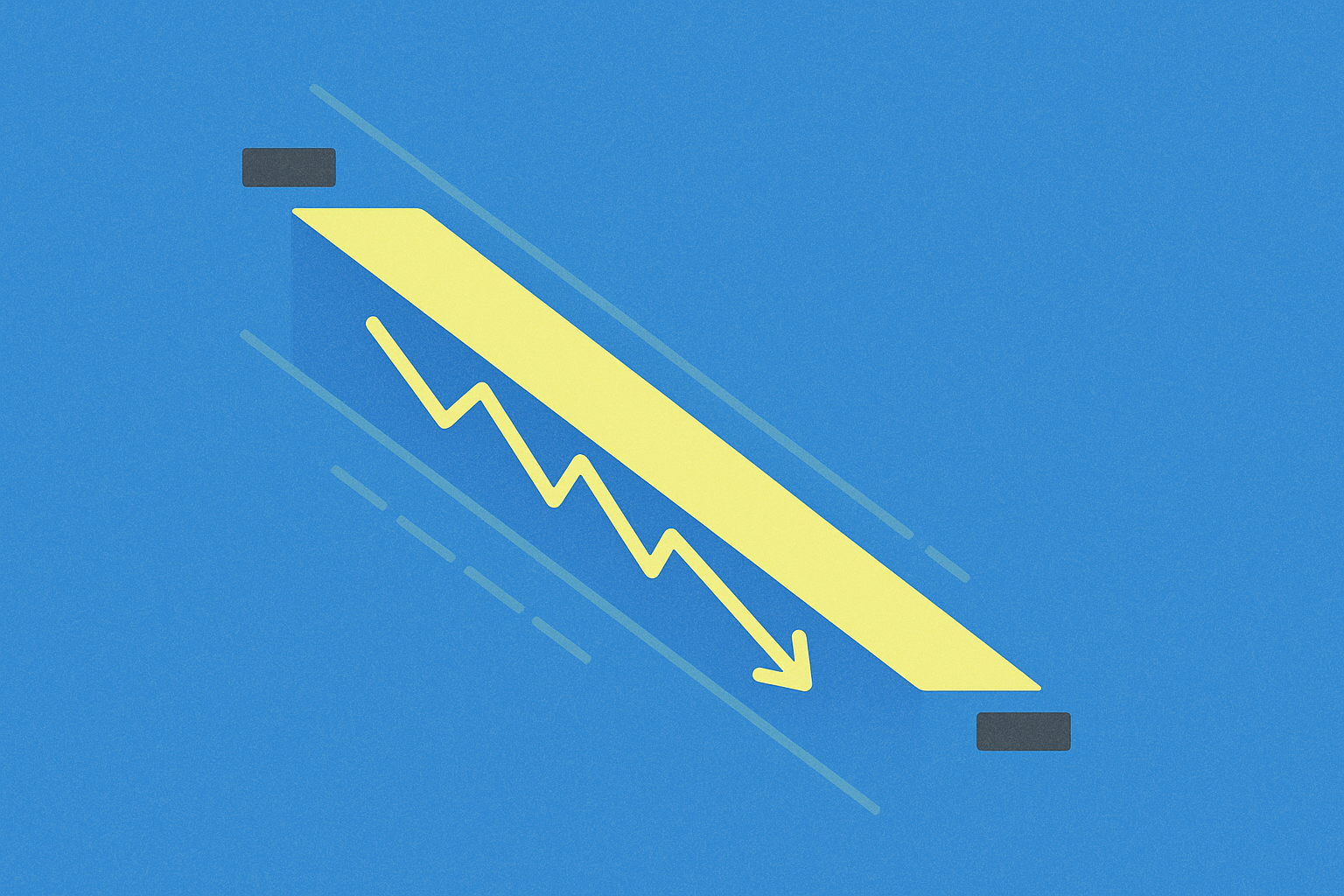
This comprehensive guide explores effective trading strategies for the descending channel pattern, a fundamental technical analysis tool for identifying downward price trends. The article explains how descending channels form through successive lower highs and lows, providing clear support and resistance levels for traders. It covers multiple trading methodologies including channel surfing, Donchian channels, CAP strategies, and linear regression analysis, each designed to maximize profit potential while managing risk. The guide analyzes both advantages—such as high return potential and robust risk management frameworks—and disadvantages including false signals and vulnerability to volatility. Additionally, it addresses practical considerations for traders using Gate and other platforms, emphasizing the importance of combining channel analysis with volume confirmation and broader market context for successful execution.
What Is a Trading Channel?
Trading channels represent one of the most fundamental tools in technical analysis, created by charting asset or security prices over selected periods of time. These channels are typically constructed by drawing two parallel lines, known as trend lines, across a price analysis chart. These lines serve a critical function by marking the boundaries of price movement, with the upper trend line representing the highest recorded price points and the lower line corresponding to the lowest price points during a given trading period.
The construction of trading channels provides traders with a visual framework for understanding price behavior. When prices move within these parallel lines, traders can identify optimal entry and exit points. The general trading strategy involves buying when prices approach the lower trend line (support level) and selling when prices near the upper trend line (resistance level). This systematic approach helps traders make more informed decisions based on historical price patterns rather than emotional reactions to market movements.
One of the most significant opportunities in channel trading occurs during what professionals call a "channel breakout." This phenomenon happens when an asset's price dramatically moves beyond the established channel boundaries, either breaking above the upper trend line or falling below the lower trend line. These breakouts often signal major shifts in market sentiment and can present substantial profit opportunities for traders who can identify and act on them quickly. The key to successful breakout trading lies in distinguishing genuine breakouts from false signals, which requires careful analysis of volume patterns and market context.
Trading channels also play a crucial role in identifying support and resistance levels, which are fundamental concepts in technical analysis. Support levels represent price points where downward trends tend to pause or reverse, as buying pressure increases at these levels. Conversely, resistance levels mark areas where upward trends typically encounter selling pressure, causing prices to stall or reverse. These levels act as psychological barriers in the market, and when they are broken, they often generate significant trading interest and can lead to substantial price movements in the direction of the breakout.
The effectiveness of trading channels stems from their ability to organize complex price data into easily interpretable patterns. By providing clear visual boundaries for price movement, channels help traders identify trends, anticipate potential reversals, and manage risk more effectively. This makes them an indispensable tool for both novice and experienced traders across various financial markets.
Which Channels Are Best for Trading?
Ascending and Descending Channels
Among the various types of trading channels available, ascending and descending channels have emerged as the most widely adopted patterns in technical analysis. These channel patterns offer traders clear visual representations of market trends and provide actionable insights for developing trading strategies. While the question of which channels are "best" remains subjective and depends on individual trading styles and market conditions, these fundamental patterns serve as the foundation for most channel-based trading approaches.
Ascending Channels (also referred to as rising channels or bullish channels) are formed when an asset's price consistently makes higher highs and higher lows over time. To construct an ascending channel, traders first draw a trend line connecting the successive low points (the support line), then draw a parallel line along the successive high points (the resistance line). The space between these parallel lines creates the ascending channel, which visually represents an upward trend in price movement.
The significance of ascending channels lies in their indication of sustained buying pressure and positive market sentiment. When prices move within an ascending channel, it suggests that buyers are willing to pay increasingly higher prices over time, while sellers are also demanding higher prices for their assets. Traders typically look for buying opportunities when prices approach the lower support line of an ascending channel, as these points historically represent good entry positions. The expectation is that the upward trend will continue, allowing traders to profit as prices move toward the upper resistance line.
Descending Channels (also known as bearish channels or falling channels) represent the mirror image of ascending channels. These patterns form when an asset's price consistently makes lower highs and lower lows over time. To create a descending channel, traders draw a trend line connecting the successive high points (the resistance line), then draw a parallel line along the successive low points (the support line). The resulting channel illustrates a downward trend in price movement.
Descending channels indicate sustained selling pressure and negative market sentiment. Within these channels, sellers are willing to accept progressively lower prices, while buyers are only willing to purchase at decreasing price levels. Traders often look for selling opportunities (or short-selling positions) when prices approach the upper resistance line of a descending channel, anticipating that the downward trend will continue and prices will move toward the lower support line.
Flat Channels (also called horizontal channels or sideways channels) occur when trend lines remain relatively horizontal, showing neither significant upward nor downward slope. These channels indicate a period of market consolidation where buying and selling pressures are relatively balanced. In flat channels, prices oscillate between well-defined support and resistance levels without establishing a clear directional trend. This pattern suggests market indecision and can often precede significant breakouts in either direction.
The trading strategy for each channel type depends on the trader's risk tolerance, market outlook, and overall investment approach. Traditional technical analysis suggests that traders should align their positions with the prevailing trend: buying (going long) in ascending channels and selling (going short) in descending channels. However, successful channel trading requires more than simply following these basic principles. Traders must also consider factors such as the strength of the trend, the reliability of the channel boundaries, volume patterns, and broader market conditions. The ability to accurately identify and interpret these channels forms the foundation of successful channel-based trading strategies.
What Other Types of Trading Channels and Strategies Are There?
Beyond the fundamental ascending and descending channels, the field of technical analysis has developed numerous sophisticated channel-based trading strategies and methodologies. These advanced approaches offer traders additional tools for analyzing market behavior and identifying profitable trading opportunities across different market conditions and timeframes.
Channel Surfing Trading represents a more dynamic and geometrically-oriented approach to channel analysis. Despite its casual-sounding name, this strategy involves sophisticated techniques for identifying and capitalizing on short-term price movements within channels. The core philosophy of channel surfing emphasizes entering trends early, capturing quick profits, and exiting positions before potential reversals occur. This approach prioritizes capital preservation and risk management over maximizing returns from any single trade.
The channel surfing methodology employs geometric principles to chart market movements, providing traders with a systematic framework for stop-loss placement and risk control. Rather than waiting for trends to fully develop or attempting to ride them to their ultimate conclusion, channel surfers aim to capture the most predictable portions of price movements. This strategy has been extensively documented in Michael Parsons' influential work, "Channel Surfing: Riding the Waves of Channels to Profitable Trading," which provides detailed analysis of the techniques and principles underlying this approach.
Donchian Channel Turtle Trading combines the technical analysis tool known as Donchian channels with the legendary turtle trading strategy. Donchian channels, developed by futures trader Richard Donchian, help traders visualize price trends by plotting the highest high and lowest low over a specified period. These channels provide a clear framework for identifying breakouts and trend changes across various timeframes.
The turtle trading strategy, originally developed by commodity trader Richard Dennis in the 1980s, demonstrated that successful trading could be taught through systematic rules and disciplined execution. The strategy incorporates sophisticated position sizing rules, such as increasing position sizes during periods of lower market volatility and reducing exposure during more volatile conditions. This approach to risk management helps traders optimize their capital allocation based on market conditions. Michael Covel's book "The Complete TurtleTrader: The Legend, The Lessons, The Results" provides comprehensive coverage of this methodology and its historical success.
CAP Channel Trading Strategy focuses on identifying and exploiting overbought and oversold market conditions through volatility-based analysis. This strategy typically employs technical indicators such as TRIX (Triple Exponential Average) or MACD (Moving Average Convergence Divergence) to assess supply and demand dynamics for specific assets or securities. By analyzing these indicators in conjunction with channel patterns, traders can better gauge when prices have moved too far in one direction and are likely to reverse.
The CAP channel approach emphasizes data-driven decision making and systematic risk management. It treats price volatility as a measurable factor that can inform position sizing and entry/exit timing. Perry J. Kaufman's comprehensive work "Trading Systems and Methods" explores this concept in detail, providing traders with frameworks for implementing volatility-based trading strategies across different markets and timeframes.
Linear Regression Channel Trading Strategy employs statistical analysis to identify and predict price trends. Unlike simple parallel channels that connect price highs and lows, linear regression channels use mathematical calculations to determine the most statistically probable path for price movement. This approach adds a middle line (the regression line) that represents the mean or expected value of price over the analyzed period, with upper and lower channels drawn at standard deviations from this central line.
Developed by Gilbert Raff and often called the Raff Regression Channel, this methodology provides traders with a more mathematically rigorous framework for channel analysis. The regression channel helps identify when prices deviate significantly from their statistical norm, potentially signaling overbought or oversold conditions. Raff's book "Trading the Regression Channel: Defining and Predicting Stock Price Trends" offers detailed insights into the construction and application of regression channels in various trading scenarios.
Each of these advanced strategies builds upon the fundamental principles of channel trading while adding layers of sophistication and specialization. Successful implementation of these approaches requires thorough understanding of their underlying principles, careful backtesting, and disciplined execution in live trading environments.
Does Channel Trading Work?
Channel trading has established itself as a cornerstone methodology in technical analysis, widely adopted across various financial markets and asset classes. The enduring popularity of channel trading stems from its ability to transform complex price data into actionable trading signals through relatively straightforward visual representations. This approach provides traders with a systematic framework for making investment decisions based on historical price patterns and statistical probabilities rather than emotional reactions or speculation.
The fundamental appeal of channel trading lies in its accessibility. Unlike some technical analysis methods that require advanced mathematical knowledge or complex computational tools, basic channel trading concepts can be understood and applied by traders at various experience levels. By drawing simple trend lines on price charts, traders can quickly identify potential support and resistance levels, recognize trend directions, and spot potential reversal points. This democratization of technical analysis has contributed significantly to the widespread adoption of channel trading strategies.
However, the effectiveness of channel trading depends heavily on proper implementation and realistic expectations. While channels provide valuable frameworks for understanding price behavior, they are not infallible predictive tools. Successful channel trading requires traders to develop skills in pattern recognition, understand market context, and combine channel analysis with other technical and fundamental indicators. The nuances of channel trading—such as distinguishing between genuine breakouts and false signals, adjusting channel parameters for different timeframes, and recognizing when channel patterns are losing validity—require experience and continuous learning.
Pros and Cons of Channel Trading
Understanding both the advantages and limitations of channel trading is essential for developing realistic expectations and effective trading strategies.
Advantages of Channel Trading:
High Return Potential: When applied correctly, channel trading strategies have historically generated competitive returns across various asset classes. Long-term investment strategies that incorporate channel analysis for timing entries and exits have shown the ability to capture significant portions of trending price movements while avoiding some of the pitfalls of poorly-timed trades. The systematic nature of channel trading helps traders maintain discipline and avoid emotional decision-making, which often leads to improved overall performance.
Risk Management Capabilities: One of the most significant benefits of channel trading is its inherent risk management framework. Channel boundaries provide natural reference points for setting stop-loss orders and defining risk-reward ratios before entering trades. By establishing clear support and resistance levels, channels help traders determine appropriate position sizes and exit strategies. This structured approach to risk management enables traders to protect capital while pursuing profit opportunities, a critical factor in long-term trading success.
Versatility and Diversification: Channel trading techniques can be applied across virtually any tradable asset that can be charted, including stocks, commodities, currencies, cryptocurrencies, and derivatives. This versatility allows traders to diversify their portfolios across different markets, geographic regions, and asset classes while maintaining a consistent analytical framework. The ability to apply the same fundamental principles across various markets provides traders with numerous opportunities for identifying profitable trades and spreading risk.
Objective Decision Framework: Channels provide traders with objective criteria for making trading decisions, reducing the influence of emotional biases and subjective interpretations. The visual nature of channels makes it easier to maintain discipline and stick to predetermined trading plans, even during periods of market stress or uncertainty.
Disadvantages of Channel Trading:
Vulnerability to Volatility: Channel trading strategies can face challenges during periods of high market volatility or rapid price fluctuations. Sudden price movements may break through channel boundaries without establishing new trends, leading to false signals and potential losses. Short-term channels are particularly susceptible to volatility-induced whipsaws, where prices quickly move outside channel boundaries before reversing direction. Traders must adjust their strategies and risk management approaches during volatile market conditions to avoid excessive losses.
Human Error and Subjectivity: Despite the systematic nature of channel trading, human judgment plays a significant role in drawing trend lines, identifying channel patterns, and interpreting signals. Different traders may draw channels differently on the same price chart, leading to varying interpretations and trading decisions. The placement of trend lines, selection of timeframes, and identification of significant price points all involve subjective elements that can introduce errors into the analysis. Even experienced traders must remain vigilant against biases and continually refine their pattern recognition skills.
False Signal Risk: Like all technical analysis tools, channel indicators can generate false signals that mislead traders into making unprofitable trades. Prices may appear to break out of channels only to reverse quickly, or channels that seemed reliable may suddenly lose their predictive power as market dynamics change. False breakouts are particularly problematic, as they can trigger stop-loss orders or prompt traders to enter positions in the wrong direction. To mitigate this risk, experienced traders typically use channels in conjunction with other technical indicators, volume analysis, and fundamental factors to confirm signals before taking action.
Lagging Nature: Channels are inherently backward-looking tools, based on historical price data. By the time a channel pattern becomes clearly visible, a significant portion of the trend may have already occurred. This lagging characteristic means that traders using channels may miss the early stages of major price movements or enter trends that are nearing exhaustion.
Market Condition Dependency: Channel trading strategies perform differently under various market conditions. Trending markets generally provide the best environment for channel trading, while choppy or transitional markets can produce inconsistent results. Traders must develop the ability to recognize when market conditions favor channel-based strategies and when alternative approaches might be more appropriate.
Conclusion
Trading channels represent an indispensable component of modern technical analysis, providing traders with essential frameworks for understanding and responding to price movements in financial markets. The enduring value of channel analysis lies in its ability to transform raw price data into structured, interpretable patterns that inform trading decisions and risk management strategies. Without such analytical tools, traders would be forced to navigate markets with limited insight into historical patterns and potential future price behavior, significantly increasing the uncertainty and risk associated with trading activities.
The study of trading channels encompasses both art and science. While the basic principles of drawing trend lines and identifying channel patterns are relatively straightforward, mastering the nuances of channel trading requires dedicated study, practice, and experience. Successful channel traders develop an intuitive understanding of how different channel patterns behave under various market conditions, learn to distinguish between reliable signals and false indicators, and cultivate the discipline to execute their strategies consistently.
The true power of channel trading emerges when traders combine channel analysis with broader market understanding. By studying historical price fluctuations and identifying the fundamental economic factors that drive supply and demand dynamics, traders can develop more robust and reliable trading strategies. Channel indicators serve as valuable tools within this larger analytical framework, helping traders identify optimal entry and exit points, manage risk effectively, and maintain disciplined approaches to market participation.
In an increasingly competitive trading environment, the systematic approach offered by channel analysis provides traders with significant advantages. Rather than relying on intuition or reacting emotionally to market movements, channel traders base their decisions on observable patterns and statistical probabilities. This data-driven methodology helps traders maintain objectivity during periods of market stress and capitalize on opportunities that less disciplined market participants might miss.
The competitive edge gained through proficient channel trading extends beyond individual trade selection. By providing frameworks for understanding market trends, identifying potential reversals, and managing risk, channel analysis enables traders to develop comprehensive trading strategies that can be consistently applied across different markets and timeframes. This consistency and adaptability are crucial for long-term trading success and portfolio growth.
Ultimately, the investment of time and effort required to master channel trading techniques represents a worthwhile commitment for serious traders. The ability to effectively analyze and interpret trading channels provides a foundation for making informed decisions, managing capital prudently, and achieving consistent profitability in financial markets. As markets continue to evolve and new trading technologies emerge, the fundamental principles of channel analysis remain relevant, offering traders timeless frameworks for understanding price behavior and market dynamics. The rewards of developing expertise in channel trading—improved decision-making, enhanced risk management, and increased profit potential—far outweigh the costs of acquiring this essential skill set in technical analysis.
FAQ
What is a Trading Channel? What is the difference between ascending and descending trading channels?
A trading channel is the price movement trajectory within a specific range. An ascending channel consists of rising support and resistance lines with upward price movement. A descending channel consists of falling support and resistance lines with downward price movement.
How to correctly identify and draw ascending and descending trading channels on candlestick charts?
Ascending channels consist of two parallel lines touching recent lows and highs, sloping upward. Descending channels mirror this with lines sloping downward. Draw the first line through two pivot points, then create a parallel line at the opposite extreme. These channels help traders identify trend direction and potential breakout levels.
A channel breakout occurs when price breaks above resistance or below support of an ascending/descending channel, signaling potential trend continuation or reversal. Traders can enter positions when price decisively breaks channel boundaries, using the breakout direction to confirm entry signals and set stop-losses at previous support/resistance levels for risk management.
How should stop-loss and take-profit levels be set in ascending and descending trading channels?
In ascending channels, set stop-loss at recent swing lows and take-profit using fixed risk-reward ratios like 1:2. In descending channels, place stop-loss at recent swing highs and take-profit at predetermined reward levels maintaining consistent risk-reward ratios.
What is the difference between trading channels and trend lines? How can they be used together?
Trend lines show price direction, while trading channels display price movement within a specific range. Combined, they provide more precise price movement predictions and help identify support and resistance levels more effectively.
Which has lower risk, trading within channels or trading channel breakouts?
Trading within channels typically carries lower risk as it relies on price fluctuations within established boundaries. Channel breakout trading has higher risk due to potential false breakout signals that can trigger unnecessary losses.
How do fake breakouts affect trading channel-based strategies?
Fake breakouts can undermine channel strategies by causing premature entries that reverse quickly. Traders should confirm breakouts with volume and price action to avoid false signals. Large orders often trigger fake breakouts before price reverts to the channel.
* The information is not intended to be and does not constitute financial advice or any other recommendation of any sort offered or endorsed by Gate.