This article delivers a comprehensive comparison of WEMIX and STX, two distinct blockchain platforms competing in different cryptocurrency sectors. WEMIX operates as an EVM-compatible gaming-focused platform using SPoA consensus with distributed governance across 40 Node Council Partners, while STX serves as Bitcoin ecosystem infrastructure using Proof of Transfer hybrid consensus and Clarity smart contracts. The analysis examines current market data showing both assets trading around $0.33-0.37 with STX demonstrating higher trading volume ($542,354 vs $261,190 daily), historical price trends reflecting substantial corrections from peaks, tokenomics mechanisms, institutional adoption patterns, regulatory challenges particularly for WEMIX in South Korea, and technical ecosystem differences. Investment recommendations vary by investor profile, from conservative STX-weighted allocations to aggressive WEMIX-tilted strategies, alongside detailed risk assessment covering market volatility, technical architecture vu
Introduction: WEMIX vs STX Investment Comparison
In the cryptocurrency market, the comparison between WEMIX vs STX has become a topic of ongoing interest for investors. The two projects exhibit notable differences in market capitalization rankings, application scenarios, and price performance, representing distinct positioning within the crypto asset landscape.
WEMIX: Launched as the native token of the WEMIX3.0 Mainnet, it serves as a medium of exchange and gas fee payment method within an experience-based, platform-driven mega-ecosystem. The mainnet operates as an EVM-compatible open-source protocol powered by the SPoA (Stake-based Proof of Authority) consensus mechanism, with governance distributed across 40 Node Council Partners.
STX (Stacks): Since its launch in October 2019, Stacks has positioned itself as infrastructure for decentralized applications, aiming to enable a new type of decentralized internet where users maintain control over their data. The project utilizes a hybrid consensus mechanism called Proof of Transfer (PoX) and supports smart contracts through its Clarity programming language.
This article will provide a comprehensive analysis of WEMIX vs STX investment value comparison, focusing on historical price trends, supply mechanisms, institutional adoption, technical ecosystems, and future predictions, attempting to address the question most relevant to investors:
"Which is the better buy right now?"
I. Historical Price Comparison and Current Market Status
Historical Price Trends of WEMIX (Coin A) and STX (Coin B)
- 2021: WEMIX experienced significant price movement, reaching a historical high of $24.71 on November 22, 2021. This period represented a peak phase for the asset.
- 2021: STX also saw notable price action during the same year, with its all-time high recorded at $3.86 on April 1, 2024, though it established its historical low of $0.04559639 on March 13, 2020.
- Comparative analysis: During the recent market cycle, WEMIX has declined from its peak of $24.71 to the current trading range, while STX has shown price fluctuations from its high of $3.86, with both assets experiencing substantial corrections from their respective peaks.
Current Market Situation (January 16, 2026)
- WEMIX current price: $0.3348
- STX current price: $0.3673
- 24-hour trading volume: WEMIX $261,190.55 vs STX $542,354.04
- Market sentiment index (Fear & Greed Index): 49 (Neutral)
View real-time prices:
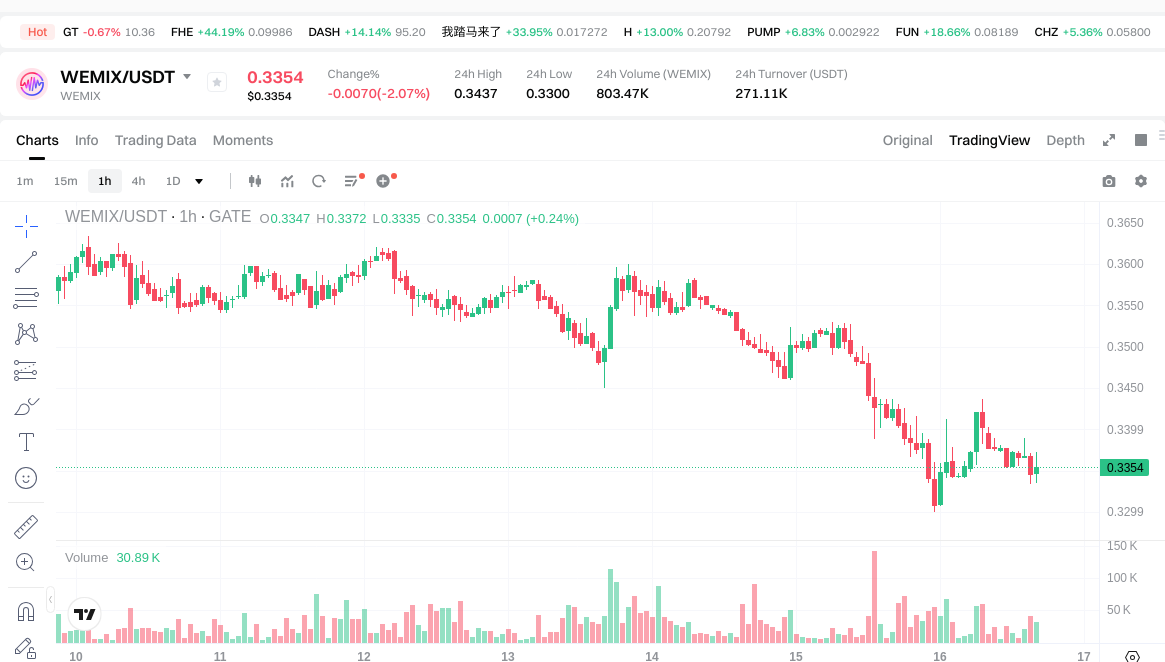
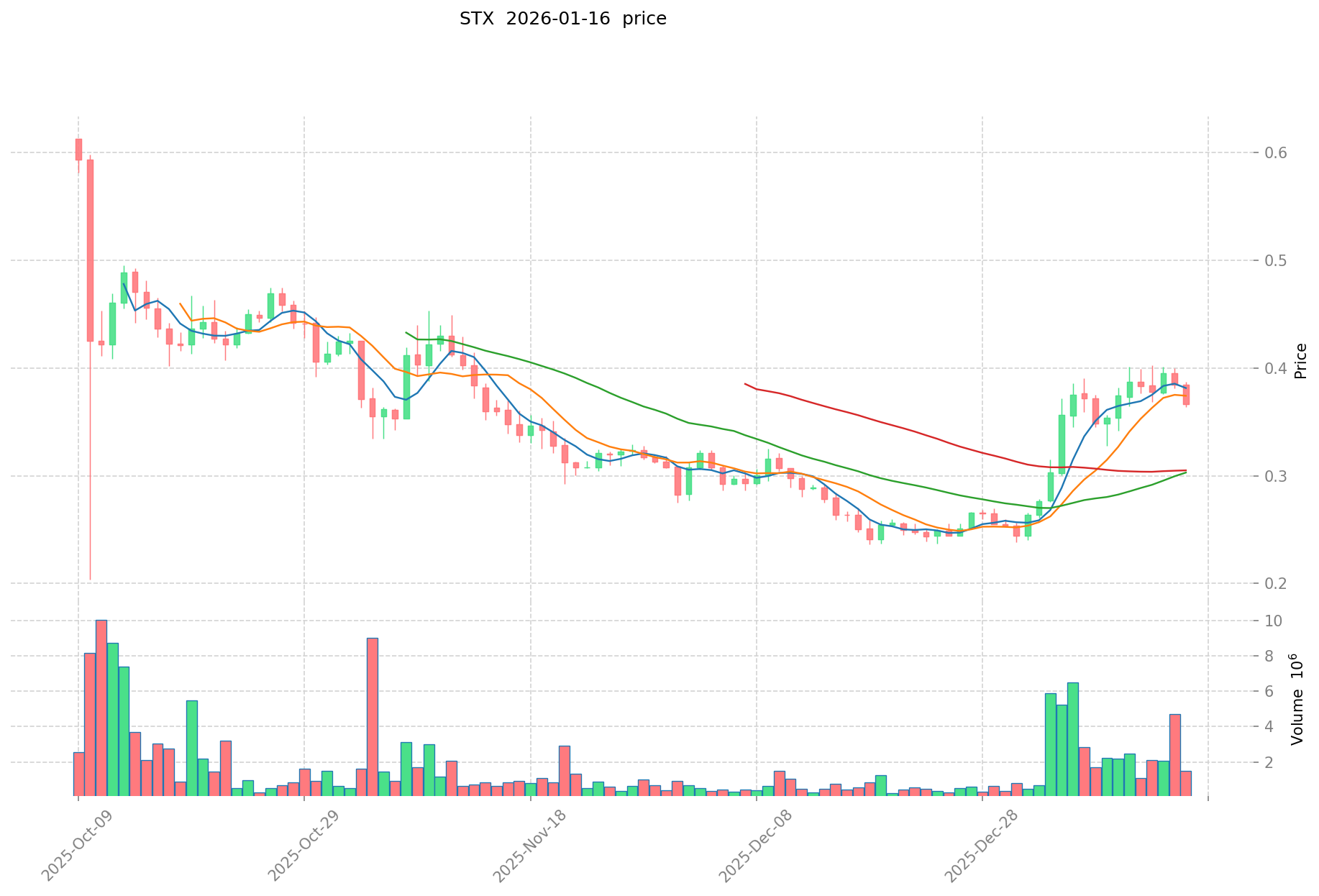
II. Core Factors Influencing WEMIX vs STX Investment Value
Supply Mechanism Comparison (Tokenomics)
- WEMIX: The reference materials do not provide specific information regarding WEMIX's supply mechanism or tokenomics model.
- STX: The reference materials do not provide specific information regarding STX's supply mechanism or tokenomics model.
- 📌 Historical Pattern: Supply mechanisms may influence price cycles through factors such as token distribution, emission schedules, and monetary policy designs, though specific historical data for these two projects is not detailed in the available materials.
Institutional Adoption and Market Application
- Institutional Holdings: The reference materials do not provide comparative data on institutional preference between WEMIX and STX.
- Enterprise Adoption: According to available information, both WEMIX and STX are positioned within the blockchain gaming and smart contract ecosystems respectively. WEMIX appears in references related to the gaming sector, while STX is associated with Bitcoin ecosystem development and decentralized applications. However, specific enterprise adoption cases in cross-border payments, settlements, or investment portfolios are not detailed in the materials.
- National Policy: The reference materials mention that WEMIX faced regulatory challenges in South Korea, including delisting events at Korean exchanges related to security incidents. Specific regulatory stances toward STX across different jurisdictions are not provided in the materials.
Technology Development and Ecosystem Building
- WEMIX Technology Upgrade: The reference materials do not provide detailed information about WEMIX's technology upgrades or their potential impact.
- STX Technology Development: STX is mentioned in the context of Bitcoin ecosystem projects, suggesting involvement in expanding Bitcoin's functionality beyond simple value transfer. However, specific technology upgrades and their implications are not detailed in the available materials.
- Ecosystem Comparison: The materials reference WEMIX within the gaming (Play-to-Earn) sector alongside other blockchain gaming projects. STX appears in discussions of Bitcoin ecosystem development. Specific implementations in DeFi, NFT, payment systems, and smart contract deployment are not comparatively detailed in the provided materials.
Macroeconomic and Market Cycles
- Performance in Inflationary Environments: The reference materials do not provide specific data comparing WEMIX and STX performance during inflationary periods or their anti-inflation properties.
- Macroeconomic Monetary Policy: The materials discuss general cryptocurrency market sensitivity to factors such as interest rates and US dollar index movements, but do not provide specific comparative analysis of how these factors affect WEMIX versus STX.
- Geopolitical Factors: The reference materials do not provide specific information regarding how geopolitical factors, cross-border transaction demand, or international situations differentially impact WEMIX and STX investment value.
III. 2026-2031 Price Forecast: WEMIX vs STX
Short-term Forecast (2026)
- WEMIX: Conservative $0.25-$0.33 | Optimistic $0.34-$0.38
- STX: Conservative $0.28-$0.37 | Optimistic $0.37-$0.38
Mid-term Forecast (2028-2029)
- WEMIX may enter a consolidation phase with estimated price range of $0.25-$0.63
- STX may enter a growth phase with estimated price range of $0.30-$0.60
- Key drivers: institutional capital inflows, ETF developments, ecosystem expansion
Long-term Forecast (2030-2031)
- WEMIX: Baseline scenario $0.31-$0.55 | Optimistic scenario $0.60-$0.76
- STX: Baseline scenario $0.37-$0.56 | Optimistic scenario $0.62-$0.63
View detailed price predictions for WEMIX and STX
Disclaimer: Price predictions are based on historical data analysis and market trends. Cryptocurrency markets are highly volatile and subject to various risk factors. These forecasts should not be considered as investment advice.
WEMIX:
| Year |
Predicted High Price |
Predicted Average Price |
Predicted Low Price |
Price Change |
| 2026 |
0.377646 |
0.3342 |
0.25065 |
0 |
| 2027 |
0.49473297 |
0.355923 |
0.29897532 |
6 |
| 2028 |
0.51464686185 |
0.425327985 |
0.25094351115 |
27 |
| 2029 |
0.6297831473895 |
0.469987423425 |
0.30549182522625 |
40 |
| 2030 |
0.604873813947975 |
0.54988528540725 |
0.30793575982806 |
64 |
| 2031 |
0.756367210077672 |
0.577379549677612 |
0.369522911793672 |
72 |
STX:
| Year |
Predicted High Price |
Predicted Average Price |
Predicted Low Price |
Price Change |
| 2026 |
0.378525 |
0.3675 |
0.2793 |
0 |
| 2027 |
0.518487375 |
0.3730125 |
0.29094975 |
1 |
| 2028 |
0.57947491875 |
0.4457499375 |
0.316482455625 |
21 |
| 2029 |
0.6048826651875 |
0.512612428125 |
0.30244133259375 |
39 |
| 2030 |
0.625797252255 |
0.55874754665625 |
0.53639764479 |
52 |
| 2031 |
0.621886019428406 |
0.592272399455625 |
0.367208887662487 |
61 |
IV. Investment Strategy Comparison: WEMIX vs STX
Long-term vs Short-term Investment Strategies
- WEMIX: May appeal to investors interested in blockchain gaming ecosystems and platform-driven infrastructure developments. The project's positioning within the gaming sector and its EVM-compatible architecture could attract those seeking exposure to Web3 gaming applications.
- STX: May suit investors focused on Bitcoin ecosystem expansion and decentralized application infrastructure. The project's approach to extending Bitcoin functionality through its Proof of Transfer mechanism could interest those seeking exposure to Bitcoin-adjacent innovations.
Risk Management and Asset Allocation
- Conservative investors: WEMIX 30-40% vs STX 60-70% - Given STX's established presence since 2019 and positioning within the Bitcoin ecosystem, conservative allocators might favor higher STX weighting.
- Aggressive investors: WEMIX 50-60% vs STX 40-50% - Investors with higher risk tolerance seeking gaming sector exposure might allocate more toward WEMIX while maintaining STX for Bitcoin ecosystem diversification.
- Hedging instruments: Stablecoin allocations for volatility management, options strategies where available, and cross-asset portfolio diversification across different blockchain sectors.
V. Potential Risk Comparison
Market Risks
- WEMIX: The asset has experienced notable price decline from its November 2021 peak of $24.71 to current levels around $0.33, representing substantial correction. Market sentiment and trading volume patterns suggest exposure to gaming sector volatility and broader market cycles.
- STX: Price movements from the April 2024 high of $3.86 to current levels around $0.37 indicate sensitivity to Bitcoin ecosystem developments and broader cryptocurrency market trends. Trading volume of $542,354.04 reflects ongoing market participation.
Technical Risks
- WEMIX: Operating on an EVM-compatible architecture with SPoA consensus mechanism distributed across 40 Node Council Partners. Network stability and scalability considerations depend on governance structure and node operation reliability.
- STX: Utilizes Proof of Transfer (PoX) hybrid consensus and Clarity smart contract language. Technical considerations include the ongoing development of Bitcoin-anchored security models and smart contract execution environments.
Regulatory Risks
- WEMIX faced regulatory challenges in South Korea, including delisting events at Korean exchanges related to security incidents, suggesting exposure to regional regulatory developments.
- STX's positioning within the Bitcoin ecosystem may subject it to evolving regulatory frameworks around cryptocurrency classifications, smart contract platforms, and decentralized application infrastructure across different jurisdictions.
- Global regulatory developments regarding cryptocurrency classifications, securities laws, and blockchain gaming platforms could impact both assets differently based on their specific use cases and geographic exposure.
VI. Conclusion: Which Is the Better Buy?
📌 Investment Value Summary:
- WEMIX strengths: EVM compatibility supporting developer familiarity, positioning within the blockchain gaming sector, and governance structure through Node Council Partners. The platform-driven ecosystem approach targets experience-based applications.
- STX strengths: Established operational history since October 2019, focus on Bitcoin ecosystem expansion, hybrid PoX consensus mechanism, and positioning as infrastructure for decentralized applications with emphasis on user data control.
✅ Investment Recommendations:
- Beginner investors: Consider starting with smaller position sizes in either asset, focusing on understanding the fundamental differences between gaming-focused platforms (WEMIX) and Bitcoin ecosystem infrastructure (STX). Diversification across both could provide exposure to different blockchain sectors while managing concentration risk.
- Experienced investors: May evaluate allocation strategies based on conviction in gaming sector growth versus Bitcoin ecosystem expansion. Technical analysis of price trends, volume patterns, and ecosystem development metrics could inform position sizing and entry timing decisions.
- Institutional investors: Could assess both assets within broader portfolio contexts, considering correlations with Bitcoin, Ethereum, and sector-specific indices. Due diligence on governance structures, regulatory exposure, and technical roadmaps would be relevant for larger allocation decisions.
⚠️ Risk Warning: Cryptocurrency markets exhibit high volatility. This content does not constitute investment advice. Investors should conduct independent research and consider their risk tolerance before making investment decisions.
VII. FAQ
Q1: What are the main differences between WEMIX and STX's underlying technology?
WEMIX operates on an EVM-compatible architecture using the SPoA (Stake-based Proof of Authority) consensus mechanism, while STX utilizes a hybrid Proof of Transfer (PoX) consensus with the Clarity programming language for smart contracts. WEMIX is designed as a platform-driven mega-ecosystem primarily targeting blockchain gaming and experience-based applications, with governance distributed across 40 Node Council Partners. In contrast, STX focuses on extending Bitcoin's functionality by anchoring to the Bitcoin blockchain, enabling decentralized applications while maintaining Bitcoin's security model. The EVM compatibility of WEMIX allows developers familiar with Ethereum to build applications more easily, whereas STX's Clarity language is specifically designed for predictability and security in smart contract execution within the Bitcoin ecosystem.
Q2: Which project has better historical price performance?
From a peak-to-present perspective, both assets have experienced substantial corrections from their all-time highs. WEMIX reached $24.71 in November 2021 and currently trades around $0.3348, representing approximately a 98.6% decline. STX peaked at $3.86 in April 2024 and now trades near $0.3673, reflecting approximately a 90.5% decline. While both have undergone significant price corrections, STX's more recent all-time high (2024 versus 2021) and relatively smaller percentage decline suggest different market cycle positioning. However, past performance does not guarantee future results, and both assets remain subject to high volatility typical of cryptocurrency markets.
Q3: What regulatory challenges should investors be aware of?
WEMIX has faced specific regulatory scrutiny in South Korea, including delisting events at Korean exchanges related to security incidents, making it particularly sensitive to regional regulatory developments in Asian markets. STX's positioning within the Bitcoin ecosystem subjects it to evolving regulatory frameworks surrounding cryptocurrency classifications, smart contract platforms, and decentralized application infrastructure across multiple jurisdictions. Global regulatory developments regarding securities laws, blockchain gaming platforms, and the classification of utility versus security tokens could impact both assets differently based on their distinct use cases and geographic exposure. Investors should monitor regulatory announcements from major jurisdictions including the United States, European Union, and Asian markets where these projects operate.
Q4: How do the current trading volumes compare between WEMIX and STX?
As of the current market data, STX demonstrates higher liquidity with a 24-hour trading volume of $542,354.04 compared to WEMIX's $261,190.55. This approximate 2:1 volume ratio suggests STX maintains stronger market participation and potentially better price discovery mechanisms. Higher trading volume typically correlates with tighter bid-ask spreads, reduced slippage for larger transactions, and generally improved market efficiency. For investors, particularly those planning larger position entries or exits, STX's superior liquidity profile may offer advantages in execution quality and reduced trading costs.
Q5: What are the key ecosystem strengths of each project?
WEMIX's primary ecosystem strength lies in its positioning within the blockchain gaming and Play-to-Earn sector, supported by its EVM-compatible architecture that facilitates developer adoption and application migration from Ethereum-based environments. The platform targets experience-based applications with a governance model distributed across 40 Node Council Partners. STX's core strength resides in its unique approach to Bitcoin ecosystem expansion, enabling smart contract functionality while leveraging Bitcoin's security and network effects. The project's focus on decentralized applications where users maintain data control, combined with its established operational history since October 2019, positions it as infrastructure for a decentralized internet built on Bitcoin's foundation. Investors should evaluate which ecosystem narrative aligns better with their investment thesis regarding blockchain sector growth.
Q6: Are these assets suitable for portfolio diversification?
WEMIX and STX can serve complementary diversification roles within a cryptocurrency portfolio due to their exposure to different blockchain sectors. WEMIX provides exposure to the gaming and Web3 entertainment vertical, while STX offers positioning in Bitcoin ecosystem expansion and decentralized application infrastructure. For conservative investors, allocating 30-40% to WEMIX and 60-70% to STX (between these two assets specifically) could balance gaming sector upside with Bitcoin ecosystem stability. Aggressive investors with higher risk tolerance might consider 50-60% WEMIX and 40-50% STX to emphasize gaming sector potential. However, both assets have shown high correlation to broader cryptocurrency market movements, limiting their effectiveness as diversifiers against systemic crypto market risk. Proper portfolio construction should include consideration of stablecoin allocations and non-crypto assets for comprehensive risk management.
Q7: What factors could drive future price appreciation for each asset?
For WEMIX, potential price catalysts include broader adoption of blockchain gaming, successful integration of additional gaming titles into its ecosystem, expansion of Node Council Partners, and positive regulatory clarity for gaming tokens. Recovery in the gaming sector following previous market downturns could benefit WEMIX's positioning. For STX, key drivers may include continued Bitcoin ecosystem development, increased adoption of Bitcoin-anchored smart contracts, growing interest in decentralized internet infrastructure, and successful implementation of technical upgrades that enhance scalability and functionality. Both assets could benefit from broader cryptocurrency market bull cycles, institutional capital inflows, increased retail participation, and macroeconomic conditions favoring risk assets. However, these potential catalysts remain speculative and subject to execution risk, market conditions, and competitive dynamics within their respective sectors.
Q8: What is the recommended investment horizon for these assets?
Given the substantial price corrections both assets have experienced from their peaks and the nascent stages of their respective ecosystems, a medium to long-term investment horizon of 3-5 years may be more appropriate than short-term trading approaches. Short-term price movements remain highly volatile and difficult to predict, influenced by broader cryptocurrency market sentiment, Bitcoin price action, and sector-specific developments. Investors should consider these assets as higher-risk allocations within a diversified portfolio, suitable for capital that can withstand significant interim volatility. The 2026-2031 price forecasts suggest gradual recovery trajectories, but these projections carry substantial uncertainty. Regular portfolio rebalancing, adherence to predetermined risk limits, and continuous monitoring of fundamental developments in gaming (for WEMIX) and Bitcoin ecosystem expansion (for STX) would be prudent approaches for longer-term holders.
* The information is not intended to be and does not constitute financial advice or any other recommendation of any sort offered or endorsed by Gate.