OKZOO represents the convergence of Artificial Intelligence and IoT technologies, functioning as the world's first urban-scale decentralized environmental data network launched in 2025. This comprehensive article examines OKZOO's technical architecture built on blockchain and AIoT infrastructure, analyzing its market performance with 638,303 holders and current trading dynamics on Gate. The article explores how OKZOO eliminates centralized control through distributed device networks, ensuring transparent and secure environmental data collection. It addresses core applications in decentralized environmental monitoring, ecosystem partnerships, and real-world deployment challenges. Additionally, the article provides practical guidance on participation methods, community engagement on social platforms, and OKZOO's long-term vision for establishing foundational infrastructure in smart cities, making it essential reading for stakeholders interested in blockchain-based environmental solutions.
OKZOO's Positioning and Significance
In 2025, the OKZOO team launched OKZOO (AIOT), aiming to address the lack of reliable, decentralized environmental data collection at urban scale.
As the world's first urban-scale decentralized environmental data network, OKZOO plays a key role in environmental monitoring and AIoT infrastructure.
As of 2026, OKZOO has established itself with over 638,000 holders and an active development community.
This article will provide an in-depth analysis of its technical architecture, market performance, and future potential.
Origin and Development History
Birth Background
OKZOO was created in 2025, aiming to solve the challenges of centralized environmental data collection and the need for transparent, community-driven monitoring systems.
It emerged during the growing awareness of environmental issues and the expansion of AIoT technology, with the goal of providing decentralized, reliable environmental data through advanced AIoT devices.
The launch of OKZOO brought new possibilities for environmental researchers, urban planners, and data-driven sustainability initiatives.
Important Milestones
- 2025: Mainnet launch on BSC (Binance Smart Chain), establishing the foundation for decentralized environmental data collection.
- 2025: Token listing on Gate.com and other exchanges, expanding accessibility for global users.
- 2026: Continued ecosystem growth with holder base reaching over 638,000 participants.
With support from its community and development team, OKZOO continues to optimize its technology, security, and real-world applications.
How OKZOO Works?
No Central Control
OKZOO operates on a decentralized network of AIoT devices distributed globally, eliminating dependence on centralized authorities.
These devices collaborate to collect and verify environmental data, ensuring the system remains transparent and resistant to manipulation, granting users greater autonomy and enhancing network resilience.
Blockchain Core
OKZOO's blockchain is a public, immutable digital ledger that records environmental data transactions.
Transactions are grouped into blocks and linked through cryptographic hashes to form a secure chain.
Anyone can view the records, establishing trust without intermediaries.
The integration with AIoT devices enables real-time data collection and verification at urban scale.
Ensuring Fairness
OKZOO utilizes a consensus mechanism to validate data transactions and prevent fraudulent activities.
Network participants maintain system security through operating AIoT devices and validating environmental data, earning AIOT token rewards.
Its innovation includes leveraging AIoT technology for decentralized data collection.
Secure Transactions
OKZOO uses public-private key cryptography to protect transactions:
- Private keys (similar to secret passwords) are used to sign transactions
- Public keys (similar to account numbers) are used to verify ownership
This mechanism ensures fund security while transactions maintain transparency on the blockchain.
The token is deployed on BSC, providing efficient and cost-effective transaction processing.
Circulation Overview
As of January 27, 2026, OKZOO has a circulating supply of 111,200,000 tokens, with a total supply of 1,000,000,000 tokens. The circulating supply represents approximately 11.12% of the total supply, indicating a significant portion remains unissued. The current circulation ratio suggests a controlled token release mechanism that may influence supply-demand dynamics over time.
Price Volatility
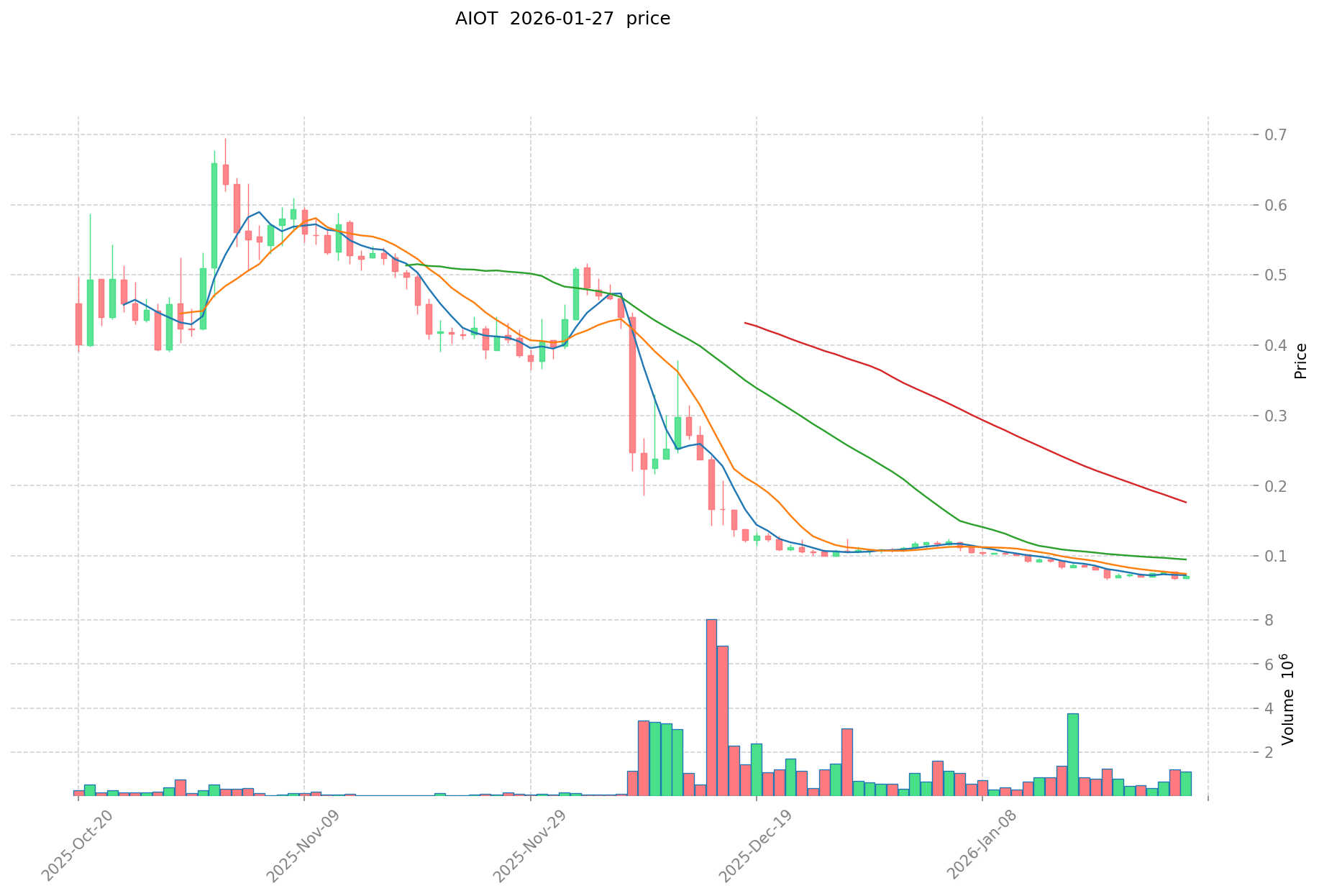
OKZOO reached its peak price of $1.85 on September 6, 2025, during a period of heightened market activity. The token experienced its lowest price of $0.01 on August 30, 2025, reflecting early-stage price discovery and market volatility. As of the latest update, OKZOO is trading at $0.07035, showing a decline of 1.16% over the past 24 hours. Over different timeframes, the token has experienced varied performance: a slight increase of 0.51% in the past hour, a decrease of 2.79% over 7 days, and more significant declines of 33.48% over 30 days. These fluctuations reflect evolving market sentiment, adoption patterns, and external factors affecting the broader cryptocurrency market.
Click to view the current AIOT market price
On-Chain Metrics
- Holders: 638,303 addresses currently hold OKZOO tokens, indicating a broad distribution across the user base.
- Market Capitalization: The current market cap stands at approximately $7.82 million, representing 0.0022% of the total cryptocurrency market.
- Fully Diluted Valuation: At current prices, the fully diluted market cap would be approximately $70.35 million if all tokens were in circulation.
OKZOO Ecosystem Applications and Partners
Core Use Cases
OKZOO's ecosystem supports environmental data collection and monitoring applications:
- Decentralized Environmental Networks: OKZOO creates urban-scale decentralized environmental data networks, providing real-time environmental monitoring and data collection.
- AIoT Infrastructure: Advanced AIoT machines deployed across urban areas, driving distributed sensor networks and environmental intelligence.
Strategic Partnerships
While specific partnership details are not extensively documented in available materials, OKZOO's infrastructure positions it for collaboration with environmental monitoring organizations and smart city initiatives.
These potential partnerships could provide a foundation for OKZOO's ecosystem expansion in urban environmental data collection.
Challenges and Considerations
OKZOO faces several challenges in its development:
- Market Performance: Price volatility with recent 30-day decline of approximately 33.48%
- Market Competition: Competition from other blockchain-based environmental and IoT data projects
- Adoption Scale: Expanding from current holder base of 638,303 to achieve broader urban deployment
These factors continue to shape community discussions and drive ongoing innovation within the OKZOO ecosystem.
OKZOO's community shows growing activity, with a holder base reaching 638,303 wallet addresses.
On X platform, discussions around OKZOO focus on environmental data applications and AIoT technology integration.
Community interest centers around the project's urban-scale deployment potential and environmental monitoring capabilities.
X platform discussions present varied perspectives:
- Supporters highlight OKZOO's innovative approach to decentralized environmental data collection and its potential as infrastructure for smart cities.
- Observers note concerns about price movements and market volatility, particularly the recent monthly decline.
Recent trends reflect cautious optimism about the project's technological foundation while acknowledging market challenges.
Discussion Topics
X users actively discuss OKZOO's environmental data network expansion, AIoT device deployment, and market performance,
showcasing both its technological innovation potential and the path toward mainstream adoption.
- Official Website: Visit OKZOO Official Site for features, use cases, and latest updates.
- Documentation: OKZOO Documentation details its technical architecture, goals, and vision for decentralized environmental data networks.
- X Updates: On X platform, OKZOO maintains active presence at @okzoo_app,
sharing updates on technical developments, AIoT deployments, and environmental data network expansion.
OKZOO Future Roadmap
While specific timeline details are limited in available materials, OKZOO's development focus includes:
- Network Expansion: Scaling urban-scale environmental data collection infrastructure
- Ecosystem Goals: Expanding AIoT device deployment and environmental monitoring coverage
- Long-term Vision: Establishing decentralized environmental data networks as foundational infrastructure for smart cities
How to Participate in OKZOO?
- Purchase Options: OKZOO (AIOT) is available on Gate.com and 9 exchanges
- Storage Solutions: Use compatible BSC wallets to securely store AIOT tokens (Contract: 0x55ad16bd573b3365f43a9daeb0cc66a73821b4a5)
- Network Participation: Engage with the environmental data network through AIoT infrastructure
- Ecosystem Building: Visit OKZOO documentation to explore development opportunities
Summary
OKZOO leverages blockchain and AIoT technology to create decentralized environmental data networks, offering transparency, distributed monitoring, and urban-scale data collection.
Its growing community, environmental focus, and innovative infrastructure approach position it within the decentralized technology landscape.
Despite facing market volatility and adoption challenges, OKZOO's environmental data mission and technological foundation make it a project worth following in the intersection of blockchain, IoT, and environmental monitoring.
Whether you're interested in environmental technology or decentralized infrastructure, OKZOO presents an innovative approach to urban data collection.
FAQ
What is Crypto AIOT? How does it combine blockchain, AI, and IoT technologies?
Crypto AIOT integrates blockchain, AI, and IoT technologies to create intelligent networks. It uses AI algorithms to optimize device connectivity and data processing, while blockchain ensures transparent and secure data management across distributed networks.
What are the practical application scenarios of Crypto AIOT?
Crypto AIOT powers autonomous driving image recognition, medical imaging diagnosis, and AI data annotation. These applications enhance efficiency in high-precision scenarios while enabling contributors to earn through decentralized data labeling and validation.
What are the advantages of Crypto AIOT compared to traditional AIOT and cryptocurrency?
Crypto AIOT combines blockchain security with AI automation, offering enhanced data protection, lower technical barriers, greater scalability, and decentralized autonomous operations that traditional AIOT and standalone crypto cannot achieve individually.
What are the security risks and challenges faced by Crypto AIOT projects?
Crypto AIOT projects face device heterogeneity, communication protocol complexity, and data privacy risks. Multiple device types increase security vulnerabilities. Data transmission and storage security are major challenges requiring robust encryption and authentication mechanisms.
Notable Crypto AIOT projects include Trusta and Gitcoin, which leverage AI and blockchain technology. Trusta combines expertise from tech giants like Ant Group and Alibaba with blockchain specialists, offering AI-driven security solutions for the crypto ecosystem.
What are the future development prospects of Crypto AIoT?
Crypto AIoT market is projected to reach USD 896.8 billion by 2030, with a compound annual growth rate of 31.68%. Manufacturing and Asia-Pacific regions will be key growth drivers, demonstrating strong market potential.
* The information is not intended to be and does not constitute financial advice or any other recommendation of any sort offered or endorsed by Gate.