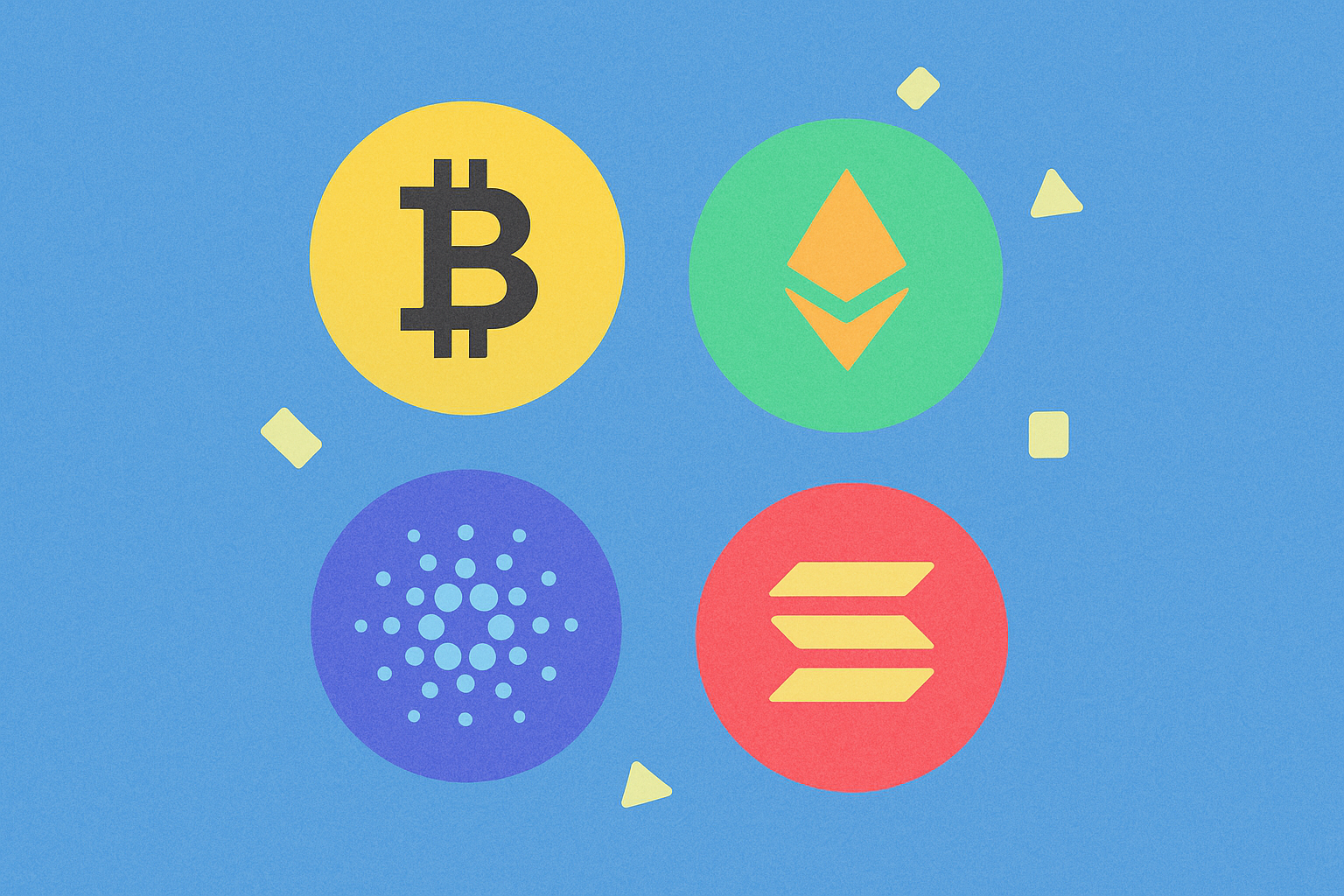
This comprehensive guide introduces cryptocurrency as decentralized digital assets operating on blockchain technology without central bank control. The article covers cryptocurrency fundamentals including definitions, historical development from Bitcoin through Ethereum to modern ecosystems with over 20,000 digital currencies. It explores major types including Layer 1 cryptocurrencies like Bitcoin and Ethereum, altcoins such as Cardano and Solana, speculative memecoins, and stablecoins pegged to fiat currencies. The guide explains how blockchain networks operate through consensus mechanisms—Proof of Work and Proof of Stake—and details acquisition methods via mining and staking. Security remains paramount, addressing private key protection, investment risks including volatility and hacking, and secure storage solutions from hardware wallets to mobile applications. Practical sections cover cryptocurrency exchanges, wallet management, and Poland-specific guidance on payments and 19% taxation. The content weighs
Cryptocurrencies – Introduction to Digital Assets
Cryptocurrencies are digital assets that function as a form of money or store of value within blockchain networks. Unlike traditional currencies, cryptocurrencies are not issued or controlled by governments or central banks. Their value is determined by market forces, which offers the potential for high returns but also comes with significant volatility.
The emergence of cryptocurrencies has revolutionized the financial landscape by introducing a decentralized alternative to conventional monetary systems. These digital assets leverage cryptographic techniques to ensure security, transparency, and immutability of transactions. As the adoption of cryptocurrencies continues to grow globally, understanding their fundamental nature becomes increasingly important for investors, businesses, and individuals seeking to participate in the digital economy.
Definition of Cryptocurrency
A cryptocurrency is a digital asset that utilizes cryptography to secure transactions, control the supply, and verify the transfer of assets. It can serve as a medium of exchange, function as an investment vehicle, or be utilized within applications built on blockchain technology.
The cryptographic foundation of cryptocurrencies ensures that transactions are secure, transparent, and resistant to fraud. Each cryptocurrency operates on a distributed ledger system, which means that transaction records are maintained across multiple nodes in the network rather than being stored in a centralized database. This decentralized architecture eliminates the need for intermediaries such as banks or payment processors, enabling peer-to-peer transactions that are faster, cheaper, and more accessible.
History and Development of the Cryptocurrency Market
- The first cryptocurrency was Bitcoin, created in 2009 by an anonymous person or group using the pseudonym Satoshi Nakamoto. Bitcoin introduced the concept of a decentralized digital currency that could operate without the need for a central authority.
- In 2011, Litecoin was launched by Charlie Lee, offering faster transaction times and a different hashing algorithm compared to Bitcoin.
- A major breakthrough came with the launch of Ethereum in 2015 by Vitalik Buterin and collaborators, which introduced the concept of smart contracts. This innovation enabled developers to build decentralized applications (dApps) on the blockchain.
- In recent years, the cryptocurrency ecosystem has expanded dramatically, with over 20,000 different cryptocurrencies in existence, and their combined market capitalization reaching trillions of dollars.
The evolution of the cryptocurrency market has been marked by periods of rapid innovation, regulatory challenges, and market volatility. From the early days of Bitcoin as a niche technology experiment to the current landscape featuring diverse use cases including decentralized finance (DeFi), non-fungible tokens (NFTs), and enterprise blockchain solutions, cryptocurrencies have demonstrated their potential to transform various aspects of the global economy.
Cryptocurrency – What is it? Examples
Bitcoin allows for the global transfer of value in an almost instantaneous manner and is used both as a medium of payment and a store of value. Often referred to as "digital gold," Bitcoin has become a popular hedge against inflation and economic uncertainty.
Ether, the native cryptocurrency of the Ethereum network, serves not only as a payment method but also as fuel for smart contracts on the Ethereum platform. Smart contracts are self-executing agreements with the terms of the contract directly written into code, enabling automated and trustless transactions without intermediaries. This functionality has given rise to a wide range of decentralized applications, from financial services to supply chain management and digital identity verification.
Types of Cryptocurrencies
Native Cryptocurrencies, Layer 1 (Bitcoin, Ethereum)
Bitcoin is primarily a store of value and medium of exchange, often compared to digital gold. Its limited supply of 21 million coins and decentralized nature make it an attractive asset for those seeking to preserve wealth outside of traditional financial systems. Bitcoin's blockchain is specifically designed to facilitate secure peer-to-peer transactions without the need for intermediaries.
Ethereum, on the other hand, enables the use of smart contracts, which allows for the creation of decentralized applications and the development of the DeFi sector. Ethereum's blockchain is more versatile than Bitcoin's, supporting a wide range of use cases beyond simple value transfer. The Ethereum network has become the foundation for numerous innovative projects, including decentralized exchanges, lending platforms, and tokenization of real-world assets.
Layer 1 cryptocurrencies represent the base layer of blockchain networks, providing the fundamental infrastructure for transaction processing and consensus mechanisms. These networks are characterized by their independence and self-sufficiency, as they do not rely on other blockchains for security or functionality.
Altcoins – What They Are and Examples
Altcoins are alternative cryptocurrencies to Bitcoin that often introduce technological innovations and new use cases. These digital assets have emerged to address specific limitations of Bitcoin or to explore new applications of blockchain technology.
Examples of prominent altcoins include:
- Cardano: A blockchain platform that emphasizes scientific research and peer-reviewed development, offering a more sustainable and scalable approach to decentralized applications.
- Solana: Known for its high transaction throughput and low fees, Solana has become a popular platform for DeFi and NFT projects.
- Ripple (XRP): Designed specifically for cross-border payments and remittances, Ripple aims to facilitate faster and cheaper international money transfers.
- Polkadot: A multi-chain protocol that enables different blockchains to interoperate and share information securely.
Altcoins have played a crucial role in advancing blockchain technology by experimenting with different consensus mechanisms, governance models, and use cases. While some altcoins have achieved significant success and adoption, others have failed to gain traction or have been abandoned by their development teams.
Memecoins: Trending Cryptocurrencies
Memecoins are cryptocurrencies created primarily for social or entertainment purposes. The most well-known memecoin is Dogecoin, which started as a joke based on the popular "Doge" internet meme but has since gained a substantial following and market capitalization.
Although memecoins often lack sophisticated infrastructure or clear use cases, they can achieve enormous popularity through viral marketing and community engagement. The success of memecoins demonstrates the power of social media and internet culture in driving cryptocurrency adoption. However, investors should be aware that memecoins are typically highly speculative and volatile, with their value largely dependent on community sentiment rather than fundamental utility or technological innovation.
Other examples of memecoins include Shiba Inu, which positioned itself as a "Dogecoin killer," and various other tokens that leverage internet memes and pop culture references to attract attention and investment.
Stablecoins – What They Are and How They Work
Stablecoins are cryptocurrencies with a fixed value, typically pegged to traditional money such as the US dollar. Examples include Tether (USDT) and USD Coin (USDC).
The primary purpose of stablecoins is to provide the benefits of cryptocurrency transactions (speed, low cost, global accessibility) while minimizing the price volatility that characterizes most digital assets. Stablecoins achieve price stability through various mechanisms:
- Fiat-collateralized stablecoins: Backed by reserves of traditional currency held in bank accounts or other secure locations.
- Crypto-collateralized stablecoins: Backed by other cryptocurrencies, often over-collateralized to account for price volatility.
- Algorithmic stablecoins: Use smart contracts and algorithms to automatically adjust supply based on demand, maintaining price stability without traditional collateral.
Stablecoins have become essential infrastructure in the cryptocurrency ecosystem, serving as a bridge between traditional finance and digital assets. They are widely used for trading, remittances, and as a safe haven during periods of market volatility.
How Cryptocurrencies Work
Fundamentals of Blockchain Network Operation
Blockchain is a decentralized ledger of transactions, functioning like a digital accounting book. Each transaction is grouped into blocks, which are cryptographically linked together. The transaction history is nearly immutable and extremely difficult to falsify.
The blockchain operates through a network of nodes (computers) that maintain copies of the entire transaction history. When a new transaction is initiated, it is broadcast to the network and validated by multiple nodes according to the network's consensus rules. Once validated, the transaction is added to a new block, which is then appended to the existing chain of blocks.
This distributed architecture provides several key advantages:
- Transparency: All transactions are visible to network participants, promoting accountability and trust.
- Security: The cryptographic linking of blocks and distribution across multiple nodes makes it extremely difficult to alter historical records.
- Resilience: The network has no single point of failure, as it continues to operate even if some nodes go offline.
- Censorship resistance: No single entity can prevent or reverse transactions that comply with the network's rules.
Proof of Work and Proof of Stake – Consensus Mechanisms
-
Proof of Work (PoW): Requires miners to solve complex mathematical problems to validate transactions. This process, known as mining, involves significant computational power and energy consumption. Bitcoin and several other major cryptocurrencies use PoW to secure their networks. The difficulty of the mathematical problems adjusts automatically to maintain a consistent block creation rate, ensuring network stability and security.
-
Proof of Stake (PoS): Requires network participants to lock up a certain number of coins as collateral. Validators are selected to create new blocks based on the amount of cryptocurrency they have staked and other factors such as the duration of their stake. PoS is generally more energy-efficient than PoW and has been adopted by Ethereum and many newer blockchain projects. This consensus mechanism aligns the interests of validators with the health of the network, as malicious behavior could result in the loss of their staked assets.
Both consensus mechanisms aim to prevent double-spending and ensure that all network participants agree on the current state of the blockchain. The choice between PoW and PoS involves trade-offs between security, decentralization, energy efficiency, and scalability.
Mining and Staking – How to Acquire Cryptocurrencies
-
Mining: The process of creating new coins in PoW systems, requiring specialized hardware such as ASIC miners or high-performance GPUs. Miners compete to solve cryptographic puzzles, and the first to find a valid solution receives newly minted cryptocurrency as a reward, along with transaction fees from the block. Mining has become increasingly competitive and resource-intensive, with large mining operations dominating the industry in regions with low electricity costs.
-
Staking: Enables earning rewards in PoS systems by "locking" cryptocurrencies in a wallet. Stakers participate in network validation and receive rewards proportional to their stake. Staking is generally more accessible to individual participants than mining, as it does not require expensive specialized hardware or consume large amounts of electricity. Many cryptocurrency holders view staking as a way to earn passive income while supporting network security and decentralization.
Both mining and staking serve the dual purpose of securing blockchain networks and distributing new cryptocurrency to participants who contribute to network operation and security.
Cryptocurrencies and Security
Cryptocurrencies rely on advanced cryptographic technology, and the risk of double-spending is minimized through consensus mechanisms and distributed validation. However, the greatest threat to users remains improper storage of private keys.
Private keys are cryptographic codes that grant access to cryptocurrency holdings. If a private key is lost, stolen, or compromised, the associated funds may be irretrievably lost or stolen. Unlike traditional banking systems, there is no central authority that can reverse transactions or recover lost credentials in most cryptocurrency networks.
Investment Risks
-
Price Volatility: Cryptocurrencies can dramatically gain or lose value in short periods. Price swings of 10% or more in a single day are not uncommon, making cryptocurrency investments highly speculative. This volatility can be attributed to factors such as market sentiment, regulatory news, technological developments, and macroeconomic conditions.
-
Hacker Attacks: Exchanges and online wallets are targets for cybercriminals. Despite advances in security technology, high-profile hacks and thefts continue to occur, resulting in the loss of millions or even billions of dollars worth of cryptocurrency. Users who store their assets on exchanges or in online wallets face the risk of losing their funds if the platform is compromised.
-
Regulatory Risk: Legal regulations concerning cryptocurrencies are still evolving. Governments around the world are developing frameworks to regulate cryptocurrency trading, taxation, and use. Changes in regulatory policy can significantly impact cryptocurrency prices and accessibility. Some jurisdictions have implemented strict regulations or outright bans on certain cryptocurrency activities, creating uncertainty for investors and businesses.
Additional risks include:
- Technology risk: Bugs or vulnerabilities in blockchain protocols or smart contracts can lead to loss of funds.
- Market manipulation: The relatively small size and unregulated nature of many cryptocurrency markets make them susceptible to manipulation.
- Liquidity risk: Some cryptocurrencies may be difficult to sell quickly without significantly impacting their price.
Secure Storage of Cryptocurrencies
-
Hardware Wallets (Cold Wallets): The most secure form of cryptocurrency storage, operating offline. These physical devices store private keys in a secure environment isolated from internet-connected computers, protecting against remote hacking attempts. Popular hardware wallet brands include Ledger and Trezor. While hardware wallets offer superior security, users must still protect their recovery phrases and ensure physical security of the device.
-
Mobile and Desktop Wallets (Hot Wallets): Convenient for everyday use but more vulnerable to attacks. These software wallets store private keys on internet-connected devices, making them accessible for quick transactions but also exposed to potential malware, phishing attacks, and other security threats. Hot wallets are suitable for holding small amounts of cryptocurrency needed for regular transactions, while larger holdings should be stored in cold wallets.
Best practices for cryptocurrency security include:
- Using strong, unique passwords for all cryptocurrency accounts
- Enabling two-factor authentication whenever possible
- Keeping software and firmware updated
- Being cautious of phishing attempts and suspicious links
- Storing backup phrases securely and offline
- Diversifying storage methods to reduce risk
How to Buy and Use Cryptocurrencies in Poland
Cryptocurrency Exchanges and Wallets
Popular exchanges include Kraken and major exchanges. Centralized exchanges are convenient and intuitive, but funds are held in exchange wallets, meaning users do not have direct control over their private keys. This introduces counterparty risk, as users must trust the exchange to secure their funds and honor withdrawal requests.
Alternatives are decentralized exchanges, such as Uniswap or PancakeSwap. These platforms allow users to trade cryptocurrencies directly from their personal wallets without surrendering custody of their assets. Decentralized exchanges operate through smart contracts, eliminating the need for a central authority to facilitate trades. While decentralized exchanges offer greater privacy and control, they may have lower liquidity and can be more complex for beginners to use.
Wallets are divided into hot wallets (mobile/desktop applications) and cold wallets (offline devices). The choice between different wallet types depends on the user's needs for security, convenience, and frequency of transactions. Many cryptocurrency users employ a combination of wallet types, keeping small amounts in hot wallets for daily use and larger holdings in cold storage for long-term security.
Cryptocurrency Payments – Examples
Cryptocurrencies in Poland are increasingly serving as a means of payment. Thanks to cryptocurrency cards, purchases can be made in traditional stores – cryptocurrencies are converted to Polish złoty in real-time.
Several Polish businesses now accept cryptocurrency payments directly, particularly in the technology, e-commerce, and service sectors. Cryptocurrency payment processors have made it easier for merchants to accept digital assets without worrying about price volatility or technical complexity. These services instantly convert cryptocurrency payments to fiat currency, allowing businesses to receive stable value while offering customers the option to pay with their preferred digital assets.
Additionally, cryptocurrency ATMs have been deployed in various Polish cities, enabling users to buy and sell cryptocurrencies using cash. These machines provide an accessible entry point for individuals who may not be comfortable using online exchanges.
Cryptocurrency Tax in Poland
Income from cryptocurrencies is subject to a 19% personal income tax (PIT). The following activities are taxable: sale of cryptocurrencies, exchange of one cryptocurrency for another, profits from staking, and gains from DeFi projects.
Polish tax regulations require cryptocurrency users to maintain detailed records of all transactions, including dates, amounts, and the value in Polish złoty at the time of each transaction. Taxpayers are responsible for calculating their gains or losses and reporting them in their annual tax returns.
Some specific considerations for cryptocurrency taxation in Poland include:
- Each cryptocurrency-to-cryptocurrency exchange is treated as a taxable event
- Mining and staking rewards are taxable as income when received
- Losses can potentially be offset against gains within the same tax year
- Holding cryptocurrency without selling or exchanging it does not trigger a tax obligation
As cryptocurrency tax regulations continue to evolve, users should consult with tax professionals familiar with digital asset taxation to ensure compliance with current laws.
What is Cryptocurrency: Advantages and Disadvantages of Cryptocurrencies
Advantages:
-
Fast International Transactions: Cryptocurrency transfers can be completed in minutes or even seconds, regardless of geographical distance, compared to traditional international wire transfers that may take several days. This speed is particularly valuable for businesses engaged in global commerce and individuals sending remittances to family members abroad.
-
Potential Protection Against Inflation: Many cryptocurrencies have fixed or predictable supply schedules, potentially making them a hedge against fiat currency inflation. Bitcoin's maximum supply of 21 million coins, for example, creates scarcity that may preserve purchasing power over time, similar to precious metals.
-
Transparency and No Intermediaries: Blockchain technology enables direct peer-to-peer transactions without banks or payment processors, reducing costs and increasing transparency. All transactions are recorded on a public ledger, allowing anyone to verify the movement of funds and ensuring accountability.
-
Accessibility for the Financially Excluded: Cryptocurrencies provide financial services to individuals who lack access to traditional banking systems. Anyone with an internet connection can create a cryptocurrency wallet and participate in the global economy, regardless of their location, credit history, or immigration status.
Additional advantages include:
- Programmability: Smart contracts enable automated, trustless agreements and complex financial instruments
- Divisibility: Cryptocurrencies can be divided into very small units, facilitating micropayments
- Portability: Digital assets can be easily transported across borders without physical limitations
- Pseudonymity: Users can transact with a degree of privacy not available in traditional financial systems
Disadvantages:
-
High Price Volatility: The value of cryptocurrencies can fluctuate dramatically, making them risky investments and less suitable as stable stores of value or media of exchange. This volatility can result in significant gains but also substantial losses for investors.
-
Lack of Complete Legal Regulation: The regulatory landscape for cryptocurrencies remains uncertain in many jurisdictions, creating legal and compliance challenges for users and businesses. The absence of clear regulations can also leave investors with limited recourse in cases of fraud or theft.
-
Possibility of Losing Funds with Improper Storage: Unlike traditional bank accounts, cryptocurrency holdings are not insured or protected by government guarantees. Users who lose their private keys or fall victim to scams have little to no recourse for recovering their funds.
-
Energy Intensity of Certain Mechanisms: Proof of Work mining, particularly for Bitcoin, consumes enormous amounts of electricity, raising environmental concerns. The carbon footprint of cryptocurrency mining has become a subject of debate and criticism, though some projects are exploring more sustainable alternatives.
Additional disadvantages include:
- Scalability limitations: Many blockchain networks face challenges in processing large numbers of transactions quickly and cheaply
- Irreversibility of transactions: Mistaken or fraudulent transactions cannot be reversed, unlike credit card chargebacks
- Technical complexity: Understanding and safely using cryptocurrencies requires a certain level of technical knowledge
- Use in illegal activities: The pseudonymous nature of cryptocurrencies has made them attractive for money laundering and other criminal activities
Summary
Cryptocurrency is a digital form of money based on blockchain technology, enabling the transfer of value without intermediaries while maintaining a high level of security. Although still a novelty to many, cryptocurrencies have become an integral element of global finance.
The cryptocurrency ecosystem has evolved significantly since Bitcoin's introduction, expanding to include thousands of different digital assets serving various purposes. From simple peer-to-peer payments to complex decentralized financial applications, cryptocurrencies have demonstrated their potential to transform how value is stored, transferred, and utilized.
The future of the market indicates continued development, with growing roles for DeFi (Decentralized Finance), NFTs (Non-Fungible Tokens), and stablecoins. DeFi platforms are recreating traditional financial services such as lending, borrowing, and trading without centralized intermediaries. NFTs have opened new possibilities for digital ownership and creator monetization. Stablecoins are bridging the gap between traditional finance and cryptocurrency markets.
Looking ahead, potential developments include:
- Implementation of central bank digital currencies (CBDCs) by governments worldwide
- Increased integration of blockchain technology in traditional financial institutions
- Improved scalability solutions enabling faster and cheaper transactions
- Enhanced regulatory frameworks providing clarity and consumer protection
- Greater mainstream adoption as user interfaces become more intuitive and accessible
While challenges remain, including regulatory uncertainty, scalability limitations, and environmental concerns, the fundamental innovations introduced by cryptocurrencies – decentralization, transparency, and programmable money – are likely to have lasting impacts on the global financial system. Whether as investment vehicles, payment methods, or platforms for innovation, cryptocurrencies represent a significant technological and economic development that continues to evolve and mature.
FAQ
What is cryptocurrency? How does it differ from traditional currency?
Cryptocurrency is a digital currency operating on decentralized blockchain networks, requiring no central authority. Traditional currency is issued and regulated by governments. Cryptocurrencies use cryptography for security and transactions, offering transparency and independence from institutional control.
How does cryptocurrency work? What are the principles of blockchain and decentralization?
Cryptocurrency operates through blockchain technology, a distributed ledger maintained by a network of participants. Decentralization eliminates single points of control, enabling peer-to-peer transactions without intermediaries. Each transaction is cryptographically secured and recorded immutably across the network.
What are the main types of cryptocurrencies? What are the differences between Bitcoin, Ethereum, and other tokens?
Bitcoin is the first cryptocurrency with its own blockchain. Ethereum is the second-largest, featuring ETH and supporting ERC-20 tokens built on its network. Cryptocurrencies have native blockchains, while tokens are created on existing blockchains. Over 6,000 digital currencies exist today, each serving different purposes.
What are the practical uses of cryptocurrency? Why do people use it?
Cryptocurrencies enable fast cross-border payments, bypass traditional financial intermediaries and fees, and power decentralized finance applications. People use them for financial freedom, investment opportunities, and access to financial services without geographical restrictions.
Is cryptocurrency safe? What risks should I understand?
Cryptocurrency security depends on proper safeguards. Main risks include hacking, phishing attacks, and private key theft. Use hardware wallets, enable two-factor authentication, and practice vigilant security habits to protect your assets effectively.
How to Obtain and Store Cryptocurrency? How Should Beginners Get Started?
Beginners should first research cryptocurrencies and blockchain technology. Open a digital wallet to store assets securely, preferably a hardware wallet for better security. Purchase crypto through peer-to-peer transactions or mining. Always keep private keys safe and enable two-factor authentication for account protection.
* The information is not intended to be and does not constitute financial advice or any other recommendation of any sort offered or endorsed by Gate.