This comprehensive guide explores Streamr (DATA), a pioneering decentralized peer-to-peer network launched in 2017 to address data monopolization and enable real-time data trading. The article examines Streamr's technical architecture built on blockchain integration, no central control mechanisms, and secure cryptographic transactions. With over 5,000 token holders, Streamr demonstrates market viability through its current circulation metrics and ecosystem applications spanning IoT, autonomous vehicles, and smart cities. The guide covers market performance, strategic partnerships, and community sentiment on X platform. Additionally, it provides practical guidance on purchasing DATA through Gate, storage solutions, and ecosystem participation. Despite facing scalability and regulatory challenges, Streamr positions itself as the foundational infrastructure for decentralized data streaming and tokenized data economy, making it essential for both newcomers and experienced participants in the cryptocurrency space.
Streamr's Positioning and Significance
In 2017, the Streamr team launched Streamr (DATA), aiming to address data monopolization by large corporations and inefficiencies in real-time data trading.
As a decentralized peer-to-peer network for streaming data, Streamr plays a key role in real-time data applications, IoT, and decentralized data marketplaces.
As of 2026, Streamr has established itself as a pioneering infrastructure for tokenized data streams, with over 5,000 token holders and an active developer community.
This article will provide an in-depth analysis of its technical architecture, market performance, and future potential.
Origin and Development History
Birth Background
Streamr was created by the Streamr team in 2017, aiming to solve the problem of centralized data control and enable individuals and machines to trade data autonomously.
It emerged during the blockchain technology boom, with the goal of providing a decentralized infrastructure for real-time data delivery and monetization to change the current landscape.
Streamr's launch brought new possibilities for data producers, IoT applications, and real-time analytics users.
Important Milestones
- 2017: Project launch and token generation event, establishing the vision for decentralized data streaming.
- Subsequent years: Development of the Streamr Network with horizontal scalability through sharding mechanisms.
- Integration with Ethereum: Leveraged smart contracts for key operations including access control and monetization models.
- Ecosystem expansion: Built a data marketplace facilitating data stream trading, alongside a visual programming environment and real-time analytics engine.
With support from the Streamr Foundation and community, Streamr continues to optimize its technology, security, and real-world applications.
How Streamr Works
No Central Control
Streamr operates on a decentralized peer-to-peer network of nodes distributed globally, eliminating control by banks or governments.
These nodes collaborate to validate and relay data streams, ensuring system transparency and attack resistance, granting users greater autonomy and enhancing network resilience.
Blockchain Core
Streamr integrates with the Ethereum blockchain, utilizing smart contracts as a public, immutable digital ledger for critical operations.
Smart contracts manage key functions such as access control and revenue models, enabling trustless interactions.
Anyone can verify permissions and transactions without intermediaries.
The network employs sharding to achieve horizontal scalability, enabling efficient handling of multiple data streams simultaneously.
Ensuring Fairness
Streamr utilizes Ethereum's consensus mechanism to validate operations and prevent fraudulent activities.
Network participants maintain security by running nodes that relay data streams, contributing to network stability and data delivery.
The innovation includes a decentralized architecture that removes single points of failure and enables permissionless participation.
Secure Transactions
Streamr uses cryptographic techniques to protect data streams:
- Private keys (like secret passwords) control access and publishing rights
- Public keys (like account numbers) verify data sources and subscriber identities
This mechanism ensures data integrity, with transactions maintaining transparency through on-chain smart contract verification.
The network supports access control mechanisms, allowing data publishers to define who can subscribe to their streams and under what terms.
Circulation Overview
As of January 31, 2026, Streamr (DATA) has a circulating supply of 767,121,867 tokens, with a total supply of 1,000,541,714 tokens and a maximum supply of 2,000,000,000 tokens. The circulating supply represents approximately 38.36% of the total supply.
New tokens enter the market through the network's distribution mechanism, affecting supply and demand dynamics.
Price Fluctuations
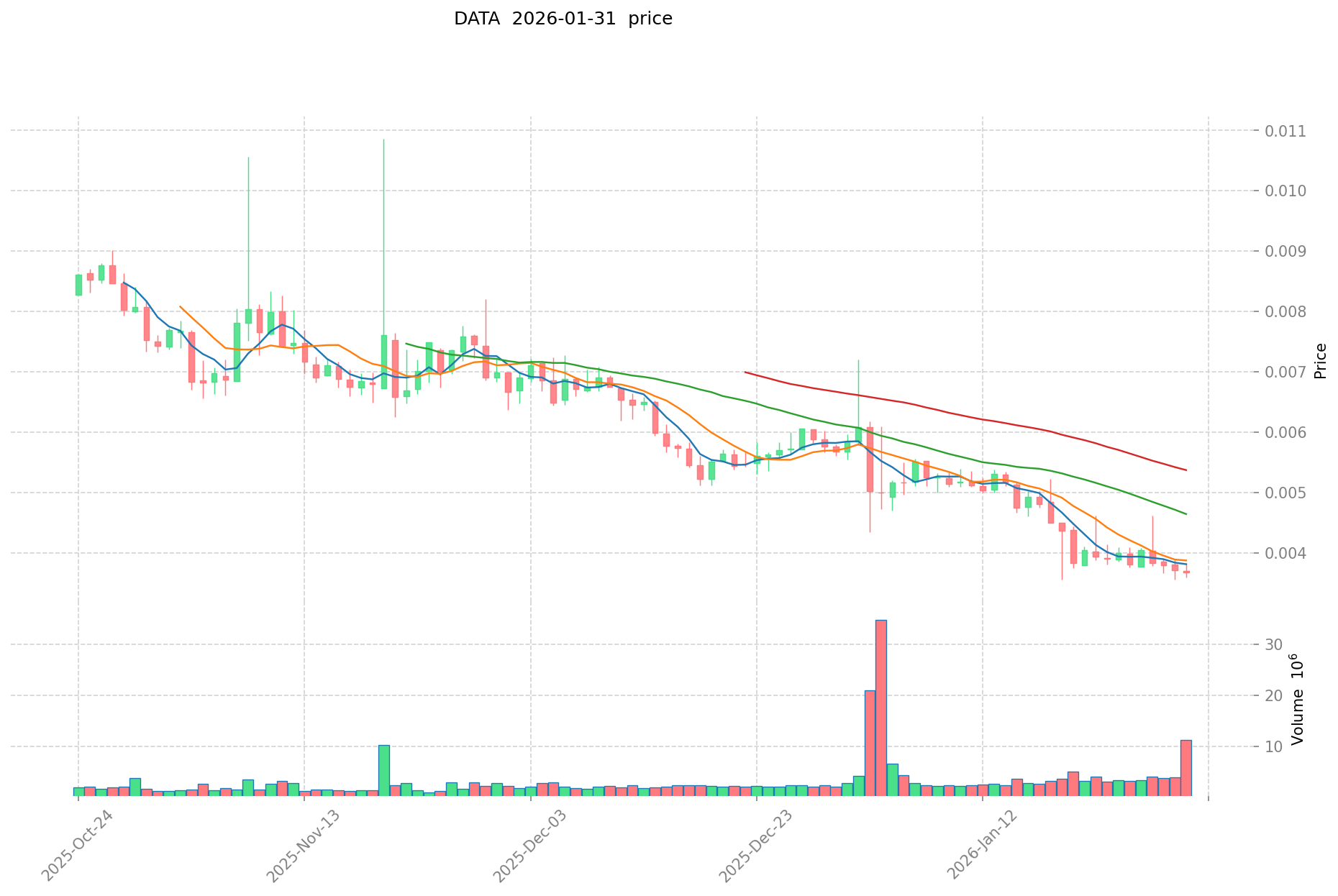
Streamr (DATA) reached a notable price level of $0.209972 on December 3, 2021, driven by favorable market conditions during that period.
The token experienced a lower price point of $0.00359195 on January 30, 2026, reflecting challenging market dynamics.
These fluctuations demonstrate the influence of market sentiment, adoption trends, and external factors on the token's valuation.
Click to view the current DATA market price
On-chain Metrics
- Holder Count: 5,142 addresses (indicating community participation)
- 24-Hour Trading Volume: $42,541.97 (reflecting current market activity)
- Market Capitalization: $2,840,652.27 (representing the token's current market valuation)
Streamr Ecosystem Applications and Partners
Core Use Cases
Streamr's ecosystem supports multiple applications:
- Data Streaming: Streamr Network, providing decentralized real-time data delivery and trading.
- IoT and Machine Economy: Applications for autonomous vehicles and smart cities, driving data monetization and peer-to-peer data exchange.
Strategic Partnerships
Streamr has established collaborations to enhance its technical capabilities and market influence.
These partnerships provide a solid foundation for Streamr's ecosystem expansion.
Controversies and Challenges
Streamr faces the following challenges:
- Technical Issues: Scalability and network adoption remain ongoing development areas
- Market Competition: Competition from other data streaming and blockchain platforms
- Regulatory Risks: Evolving regulatory frameworks for data trading and cryptocurrency operations
These issues have sparked discussions within the community and market, while also driving Streamr's continuous innovation.
Streamr's community demonstrates activity with its decentralized network infrastructure.
On X platform, related posts and hashtags (such as #Streamr and #DATA) generate community discussions.
Network upgrades and partnership announcements have energized community participation.
Sentiment on X shows varied perspectives:
- Supporters praise Streamr's decentralized data infrastructure and P2P network architecture, viewing it as "the foundation for data economy".
- Critics focus on price volatility and market adoption challenges.
Recent trends indicate mixed sentiment influenced by broader market conditions.
Popular Topics
X users discuss Streamr's data marketplace model, tokenomics, and real-world applications in IoT,
showcasing both its transformative potential and the obstacles toward mainstream adoption.
- Official Website: Visit Streamr Official Website for features, use cases, and latest updates.
- X Updates: On X platform, Streamr uses @streamr as its active handle,
with posts covering technical updates, community events, and partnership news, generating community engagement.
Streamr Future Roadmap
- Network Development: Continuing enhancement of decentralized P2P data network, improving scalability and throughput
- Ecosystem Goals: Expanding data marketplace and real-time analytics capabilities
- Long-term Vision: Becoming the standard infrastructure for decentralized data streaming and trading
How to Participate in Streamr?
- Purchase Channels: Buy DATA on Gate.com and other supported exchanges
- Storage Solutions: Securely store using compatible wallets that support ERC-20 tokens
- Participate in Governance: Engage with community through official channels
- Build Ecosystem: Visit developer documentation to develop data streaming applications or contribute to the network
Summary
Streamr redefines data streaming through blockchain technology, providing decentralized infrastructure, real-time data delivery, and tokenized data economy.
Its active community, comprehensive resources, and innovative approach distinguish it in the cryptocurrency field.
Despite facing market competition and adoption challenges, Streamr's innovation spirit and clear development direction position it importantly in the future of decentralized technology.
Whether you are a newcomer or an experienced participant, Streamr deserves attention and engagement.
FAQ
What is Crypto Data, and how does it differ from ordinary data?
Crypto Data is information encrypted using cryptographic algorithms and keys, readable only by authorized key holders. Unlike ordinary data, encrypted data remains unreadable without proper decryption keys, providing enhanced security and privacy protection.
What is the role of encrypted data in blockchain? Why is data encryption necessary?
Encrypted data in blockchain ensures transaction security and immutability, preventing data tampering and forgery while protecting user privacy. Encryption is blockchain's core, guaranteeing transaction authenticity and security.
How to ensure encryption data security? What are common encryption algorithms?
Encrypt data using AES for symmetric encryption and RSA for asymmetric encryption. Implement strong key management practices, regular key rotation, and access controls. Emerging quantum-resistant algorithms like lattice-based cryptography protect against future threats. Combine encryption with comprehensive security strategies for optimal protection.
What are the practical use cases of crypto data in real-world applications?
Crypto data secures sensitive information in financial transactions, healthcare records, and supply chain management. It enables secure data transmission, prevents unauthorized access, and ensures transaction transparency and immutability across decentralized systems.
How can individuals protect their crypto data and private keys?
Use strong passwords and hardware wallets for storage, enable multi-factor authentication, regularly backup encrypted keys offline, avoid phishing attacks, and never share private keys with anyone. Consider using cold storage solutions for long-term security.
What is the relationship between encrypted data and privacy protection?
Encrypted data is a key tool for privacy protection,preventing unauthorized access. Encryption converts information into ciphertext that only authorized users can decrypt,ensuring sensitive information security in crypto systems.
* The information is not intended to be and does not constitute financial advice or any other recommendation of any sort offered or endorsed by Gate.