This comprehensive guide explores Forta (FORT), a decentralized real-time detection network launched in 2022 to address critical security gaps in Web3 ecosystems. The article examines Forta's technical architecture, market performance, and ecosystem applications across DeFi protection, NFT monitoring, and cross-chain bridge security. With over 5,000 token holders and a circulating supply of 629.3 million tokens, FORT trades at $0.02055 on Gate and other exchanges. The guide covers network mechanics, tokenomics, current market metrics, strategic partnerships, and community sentiment while addressing adoption challenges. Whether you're a developer, investor, or security enthusiast, this resource provides essential insights into Forta's role as key infrastructure in blockchain security evolution.
Forta's Positioning and Significance
In 2022, the Forta team launched Forta (FORT), aiming to address the lack of real-time security monitoring and threat detection in blockchain ecosystems.
As a decentralized real-time detection network, Forta plays a critical role in Web3 security, DeFi protection, and operational monitoring.
As of 2026, Forta has become a key infrastructure project in the blockchain security sector, with over 5,000 token holders and an active developer community.
This article will provide an in-depth analysis of its technical architecture, market performance, and future potential.
Origin and Development History
Genesis Background
Forta was created by its founding team in 2022, aiming to solve the critical gap in real-time threat detection and security monitoring across decentralized systems.
It emerged during the rapid expansion of DeFi and Web3 applications, with the goal of providing immediate alerts for security threats, anomalies, and operational issues across blockchain networks.
Forta's launch brought new possibilities for developers, protocols, and investors seeking to protect their Web3 assets and infrastructure.
Key Milestones
- 2022: Mainnet launch on Ethereum, establishing a decentralized network for real-time monitoring of DeFi, NFT, governance, and bridge protocols.
- 2022: FORT token launched with an initial price of $0.25, enabling network participation and governance.
- 2024-2025: Ecosystem expansion with detection coverage extending across multiple blockchain networks and Web3 systems.
- 2025: Network demonstrated resilience during market volatility, maintaining operational continuity for security monitoring services.
With support from the Forta Foundation and its global community, Forta continues to enhance its detection capabilities, network security, and real-world applications.
How Forta Works
Decentralized Architecture
Forta operates on a decentralized network of nodes distributed globally, eliminating reliance on centralized security providers.
These nodes collaborate to scan blockchain activity in real-time, ensuring transparent threat detection and resilient monitoring that gives users greater autonomy and improves network reliability.
Detection Network Foundation
Forta's detection network functions as a transparent, continuous monitoring system that tracks blockchain activity across multiple chains.
Detection bots analyze transaction patterns, smart contract interactions, and protocol behaviors, identifying threats and anomalies as they occur.
The system creates verifiable alerts that anyone can access, establishing trust without intermediaries.
The network's architecture supports scalable, real-time monitoring across diverse Web3 systems including DeFi protocols, NFT platforms, governance mechanisms, and cross-chain bridges.
Network Security and Validation
Forta utilizes a node-based validation system to ensure accurate threat detection and prevent false alerts.
Node operators run detection bots and scanning infrastructure, maintaining network security while earning FORT token rewards for their contributions.
The system's innovation includes real-time alert generation with minimal latency and high accuracy in threat identification.
Secure Operations
Forta employs cryptographic techniques to ensure the integrity of detection data and alerts:
- Node operators maintain scanning infrastructure and validate detection accuracy
- Detection bots analyze blockchain activity using predefined security parameters
This mechanism ensures reliable threat detection while maintaining transparency in alert generation and distribution.
The network provides additional security features including customizable alert thresholds and multi-layered detection logic.
Circulation Overview
As of January 25, 2026, Forta's circulating supply stands at 629,287,639.63 FORT tokens, with a total supply of 1,000,000,000 FORT under a fixed supply model.
The maximum supply is capped at 1,000,000,000 tokens, representing a circulating ratio of approximately 62.93%.
FORT tokens are ERC-20 tokens deployed on the Ethereum mainnet, with additional presence on the Polygon network.
Price Fluctuations
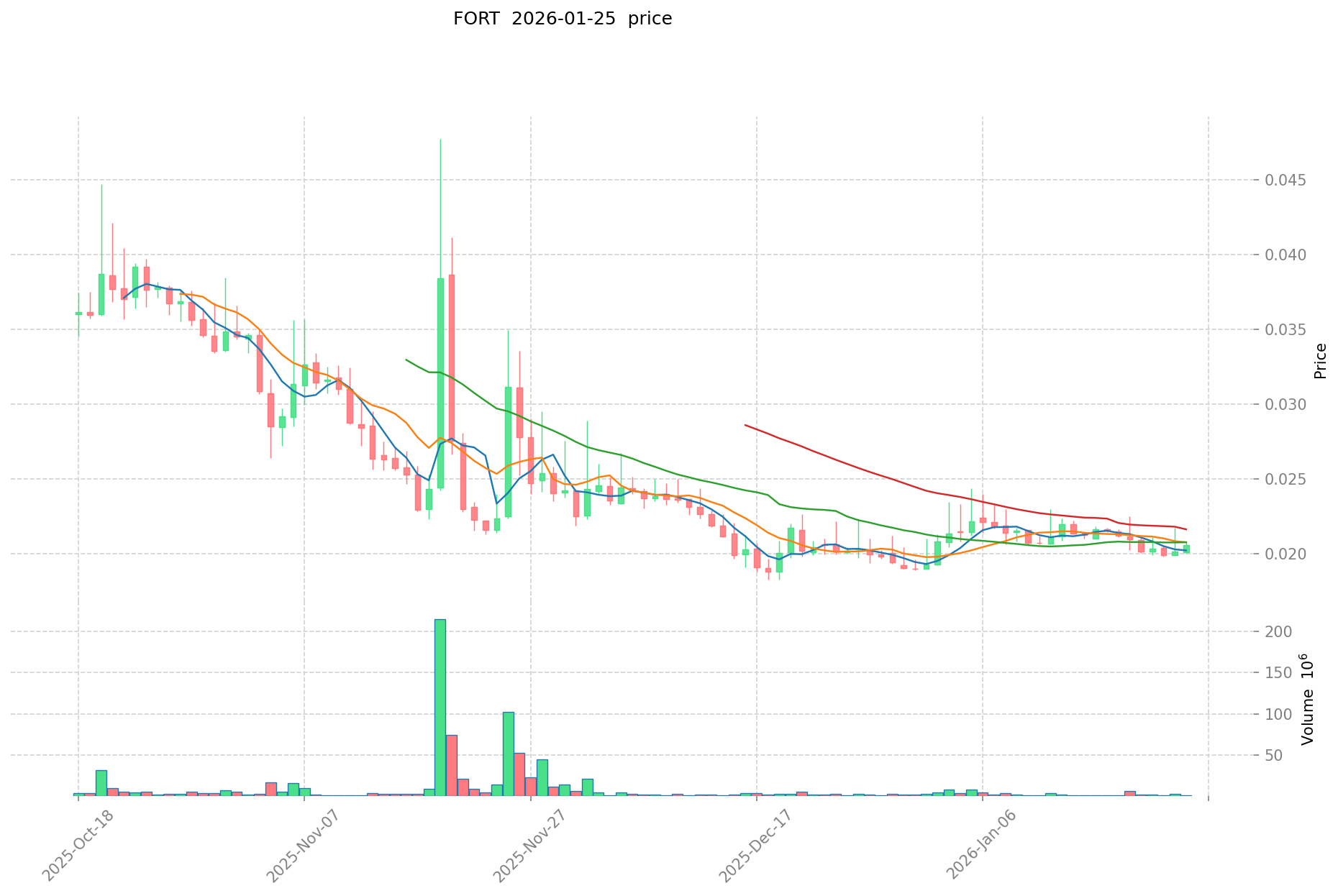
Forta reached its historical high price of $0.964645 on June 16, 2022, during a period of heightened interest in Web3 security solutions and broader market activity.
The token experienced its lowest price of $0.01832485 on December 19, 2025, reflecting market-wide adjustments and evolving sector dynamics.
As of the latest update, FORT is trading at $0.02055, showing a 24-hour increase of 2.13% and a 30-day gain of 2.23%, though the annual performance indicates a decline of 79.77%.
These fluctuations demonstrate the impact of market sentiment, adoption patterns, and external factors on the token's valuation.
Click to view current FORT market price
On-chain Metrics
- 24-Hour Trading Volume: $23,944.17 (indicating current market activity levels)
- Holders: 5,289 addresses (reflecting user distribution across the network)
- Market Capitalization: $12,931,860.99 (representing 62.93% of fully diluted valuation)
- Market Dominance: 0.00065% (showing Forta's position within the broader cryptocurrency market)
Forta Ecosystem Applications and Partners
Core Use Cases
Forta's ecosystem supports multiple applications focused on blockchain security and monitoring:
- DeFi Security: Real-time threat detection for decentralized finance protocols, providing continuous monitoring of smart contracts and transactions.
- NFT Protection: Monitoring services for NFT marketplaces and collections, helping to identify fraudulent activities and anomalies.
- Bridge Monitoring: Detection systems for cross-chain bridges, offering early warning of potential security vulnerabilities.
Strategic Collaborations
Forta operates as a decentralized monitoring network that serves various Web3 systems including governance protocols and bridges.
These partnerships within the Web3 security ecosystem provide a foundation for Forta's continued expansion.
Challenges and Controversies
Forta faces several challenges in the competitive blockchain security space:
- Market Competition: Competition from other blockchain monitoring and security solutions in the rapidly evolving Web3 landscape
- Token Performance: The token has experienced notable price fluctuations, with a significant decline from its peak levels
- Adoption Hurdles: The challenge of achieving widespread adoption among blockchain projects and protocols
These issues have sparked discussions within the community and continue to drive innovation in the project's development.
Forta's community demonstrates growing interest in blockchain security, with the project maintaining an active presence across various channels.
On X platform, discussions related to Forta and blockchain security monitoring frequently appear in Web3 security conversations.
Community enthusiasm is often sparked by new detection capabilities and partnerships with major blockchain protocols.
Sentiment on X shows diverse perspectives:
- Supporters highlight Forta's decentralized monitoring approach and real-time detection capabilities, viewing it as an essential infrastructure for Web3 security.
- Critics focus on token price volatility and questions about long-term adoption rates.
Recent trends indicate ongoing interest in blockchain security solutions within the broader crypto community.
Popular Topics
X users actively discuss Forta's role in preventing security incidents, integration with various blockchain networks, and the importance of decentralized monitoring,
showcasing both its potential to enhance Web3 security and the challenges in achieving widespread protocol adoption.
Additional Resources for Forta
- Official Website: Visit Forta's official website to learn about features, use cases, and latest developments.
- Application Portal: Access the Forta Network App for hands-on interaction with the platform.
- X Updates: Forta maintains an active presence on X at @FortaNetwork,
sharing updates on detection capabilities, network statistics, community initiatives, and partnership announcements.
- Technical Resources: Visit Forta's GitHub for technical documentation and open-source contributions.
Forta Future Roadmap
Forta continues to develop its decentralized monitoring network with focus on:
- Expanding detection capabilities across multiple blockchain networks
- Growing the ecosystem of detection bots and node operators
- Enhancing real-time threat detection algorithms and monitoring precision
How to Participate in Forta?
- Purchase Options: FORT tokens are available on Gate.com and other cryptocurrency exchanges
- Storage Solutions: Use compatible wallets such as MetaMask or hardware wallets to securely store FORT tokens
- Network Participation: Explore opportunities to contribute as a node operator or detection bot developer
- Developer Resources: Visit Forta's technical documentation to build detection bots or contribute to the network
Summary
Forta leverages blockchain technology to provide decentralized security monitoring, offering real-time threat detection, operational monitoring, and anomaly identification for Web3 systems.
Its focus on decentralized infrastructure and community-driven security makes it a noteworthy project in the blockchain security sector.
Despite facing market volatility and adoption challenges, Forta's innovative approach to blockchain monitoring positions it as a valuable infrastructure component in the evolving Web3 ecosystem.
Whether you're a developer focused on security or an investor interested in Web3 infrastructure, Forta represents an interesting project to follow.
FAQ
What is FORT and what problem does it solve?
FORT is a decentralized protocol designed to provide secure, efficient cross-chain asset transfers and liquidity solutions. It solves fragmentation issues in Web3 by enabling seamless interoperability between blockchain networks, reducing transaction costs and settlement times while maintaining security and transparency.
How can I buy or acquire FORT tokens?
You can acquire FORT tokens through decentralized exchanges, DEX platforms, or by participating in liquidity pools. Check major DeFi protocols and swap FORT against other cryptocurrencies directly from your wallet.
What is the total supply and tokenomics of FORT?
FORT has a total supply of 1 billion tokens with a deflationary mechanism. Tokenomics include staking rewards, governance rights, and periodic token burns to maintain scarcity and long-term value appreciation.
Is FORT safe to invest in? What are the main risks?
FORT demonstrates strong security fundamentals with audited smart contracts and transparent governance. Main risks include market volatility, regulatory changes, and liquidity fluctuations. Investors should conduct thorough research and only invest capital they can afford to lose in cryptocurrency markets.
What blockchain network does FORT operate on?
FORT operates on multiple blockchain networks including Ethereum, Binance Smart Chain, and Polygon, enabling users to access the protocol across different ecosystems with varying transaction costs and speeds.
Who is the team behind the FORT project?
The FORT project is led by a team of experienced blockchain developers and financial experts dedicated to building secure, scalable cryptocurrency solutions. The team combines deep Web3 expertise with institutional-grade security practices to deliver innovative decentralized finance products.
How does FORT compare to other similar crypto projects?
FORT stands out through superior security features, innovative tokenomics, and higher transaction efficiency. Our protocol delivers faster settlement speeds and lower fees than comparable projects, while maintaining stronger decentralization and community governance mechanisms.
What are the use cases and utility of FORT tokens?
FORT tokens serve as governance assets enabling community voting on protocol decisions, provide staking rewards for network validators, facilitate transaction fees within the ecosystem, and grant access to premium platform features and services.
* The information is not intended to be and does not constitute financial advice or any other recommendation of any sort offered or endorsed by Gate.