Helium (HNT) is a decentralized wireless network cryptocurrency launched in 2013 to solve IoT device connectivity challenges. This comprehensive guide explores HNT's technical architecture powered by Proof of Coverage consensus, blockchain foundation, and real-world applications in IoT connectivity. The article examines Helium's market performance, including circulating supply of 186.3 million HNT tokens and 536,704 active holders, alongside historical price movements from all-time highs to current market dynamics. Discover how Hotspot operators earn HNT rewards while contributing to decentralized infrastructure, the ecosystem's strategic partnerships, and community sentiment across social platforms. Learn participation methods including purchasing HNT on Gate, deploying Hotspots for passive income, and building IoT applications. Despite facing market volatility and scaling challenges, Helium's innovative approach positions it as a significant player in decentralized wireless infrastructure development.
Helium's Positioning and Significance
In 2013, Shawn Fanning, Amir Haleem, and Sean Carey launched Helium (HNT), aiming to address the challenges of connecting low-power Internet of Things (IoT) devices to the internet efficiently and affordably.
As a decentralized wireless network infrastructure provider, Helium plays a key role in IoT connectivity, decentralized wireless networks, and device-to-internet communication.
As of 2026, Helium has established itself within the cryptocurrency ecosystem, with 536,704 holders and an active community of network contributors.
This article will provide an in-depth analysis of its technical architecture, market performance, and future potential.
Origin and Development Journey
Birth Background
Helium was created by Shawn Fanning, Amir Haleem, and Sean Carey in 2013, aiming to solve the difficulty of building networked devices and providing affordable, accessible wireless coverage for IoT devices.
It emerged during the expansion of IoT technology and the need for decentralized connectivity solutions, with the goal of enabling anyone to earn cryptocurrency by establishing wireless networks in their communities and creating more connected environments.
Helium's launch brought new possibilities for IoT device manufacturers, developers, and individuals seeking decentralized network participation.
Important Milestones
- 2019: Network launch, establishing the foundation for decentralized wireless coverage through Hotspots.
- 2021: Significant market attention, with price movements reflecting growing ecosystem adoption.
- 2023: Migration to Solana blockchain, enhancing network scalability and transaction efficiency.
- Ongoing: Continuous ecosystem expansion with increasing Hotspot deployments and IoT device integrations.
With support from the Helium Foundation and community contributors, Helium continues to refine its technology, security, and real-world applications.
How Helium Works
No Central Control
Helium operates on a decentralized network of Hotspots distributed globally, independent of traditional telecommunications companies or centralized authorities.
These Hotspots collaboratively provide wireless coverage and validate network activity, ensuring system transparency and resistance to centralized control, granting users greater autonomy and enhancing network resilience.
Blockchain Core
Helium's blockchain is a public, immutable digital ledger recording network activity and token transactions.
Transactions are grouped into blocks and linked through cryptographic hashing to form a secure chain.
Anyone can view the records, establishing trust without intermediaries.
The migration to Solana's infrastructure has enhanced transaction processing capabilities and network efficiency.
Ensuring Fairness
Helium utilizes Proof of Coverage (PoC), a unique consensus mechanism that validates wireless coverage provision by Hotspots.
Hotspot operators maintain network security and coverage by deploying and operating wireless access points that serve IoT devices, earning HNT rewards for their contributions.
This innovative approach incentivizes physical infrastructure deployment rather than pure computational work, promoting real-world utility.
Secure Transactions
Helium employs public-private key cryptography to protect transactions:
- Private keys (like secret passwords) are used to sign transactions
- Public keys (like account numbers) are used to verify ownership
This mechanism ensures fund security while maintaining pseudonymous transaction characteristics.
HNT tokens can generate Data Credits, which are used to pay for data transmission and network usage fees, creating a burn mechanism that supports token economics.
Circulation Overview
As of January 15, 2026, Helium's circulating supply is 186,321,438.09 HNT, with a total supply of 223,000,000 HNT, representing a fixed supply model with a maximum cap.
New tokens enter the market through Proof of Coverage (PoC) mining rewards, where network participants earn HNT by operating Hotspots and validating wireless coverage, influencing the supply-demand dynamics.
Price Fluctuation
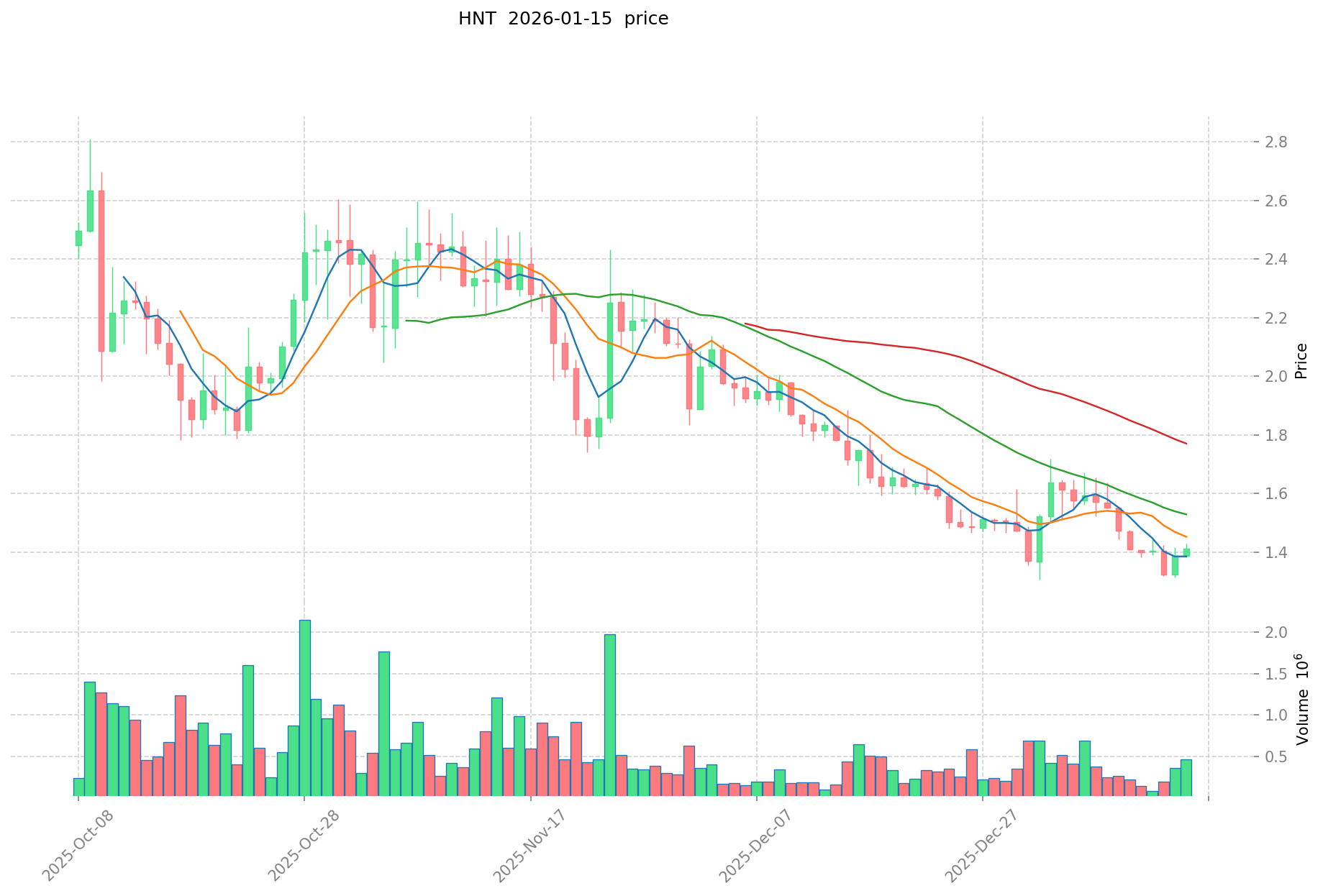
Helium reached an all-time high of $54.88 on November 13, 2021, driven by growing adoption of decentralized wireless infrastructure and increased interest in IoT connectivity solutions.
Its lowest price was $0.113248, recorded on April 18, 2020, during a period of early-stage development and limited market awareness.
These fluctuations reflect market sentiment, adoption trends, and external factors in the cryptocurrency ecosystem.
Click to view the current HNT market price
On-Chain Metrics
- Holder Addresses: 536,704 addresses (indicating broad distribution and user participation)
- 24-Hour Trading Volume: $748,024.11 (showing current market activity levels)
- Circulating Supply Ratio: 83.55% of total supply is currently in circulation
Helium Ecosystem Applications and Partners
Core Use Cases
Helium's ecosystem supports multiple applications:
- IoT Connectivity: Helium Network provides decentralized wireless infrastructure for low-power Internet of Things devices, enabling seamless internet connectivity.
- Decentralized Network Infrastructure: Hotspot operators contribute to network coverage and earn HNT token rewards through Proof of Coverage validation.
Strategic Partnerships
Helium continues to expand its ecosystem through technical innovation and network growth.
These developments provide a foundation for Helium's ecosystem expansion.
Controversies and Challenges
Helium faces the following challenges:
- Technical Issues: Network coverage optimization and scaling challenges as the ecosystem grows
- Market Competition: Competition from other decentralized wireless network projects and traditional IoT infrastructure providers
- Token Economics: Managing the balance between HNT rewards and Data Credits usage
These issues have sparked discussions within the community and market, while also driving Helium's continuous innovation.
Helium's community demonstrates significant activity, with over 536,704 holders participating in the network.
On X platform, related posts and hashtags frequently gain attention.
New network deployments and technology upgrades have energized community participation.
Sentiment on X shows diverse perspectives:
- Supporters praise Helium's decentralized wireless network infrastructure and innovative Proof of Coverage mechanism, viewing it as a foundation for future IoT connectivity.
- Critics focus on price volatility and network coverage challenges in certain regions.
Recent trends reflect mixed sentiment as the market adjusts to price movements.
Hot Topics
X users actively discuss Helium's network expansion, tokenomics, and real-world IoT applications,
showcasing both its transformative potential and obstacles toward mainstream adoption.
- Official Website: Visit Helium Official Website for features, use cases, and latest updates.
- White Paper: Helium White Paper details its technical architecture, goals, and vision.
- X Updates: On X platform, Helium maintains an active presence at @helium,
with posts covering topics such as network updates, community activities, and ecosystem developments.
Helium Future Roadmap
- Network Development: Continue expanding wireless network coverage and improving network performance
- Ecosystem Goals: Attract more IoT device manufacturers and developers to build on Helium Network
- Long-term Vision: Become a leading decentralized wireless infrastructure for global IoT connectivity
How to Participate in Helium?
- Purchase Options: Buy HNT on Gate.com and other supported exchanges
- Storage Solutions: Use compatible wallets to securely store HNT tokens
- Network Participation: Deploy Hotspots to contribute to network coverage and earn rewards
- Ecosystem Building: Visit developer documentation to build IoT applications on Helium Network
Summary
Helium has redefined wireless connectivity through blockchain technology, providing decentralized infrastructure, transparent incentive mechanisms, and efficient IoT connectivity.
Its active community, innovative consensus mechanism, and growing network presence distinguish it in the cryptocurrency space.
Despite facing challenges such as market volatility and network scaling, Helium's innovative approach and clear development path position it as a significant player in the future of decentralized wireless infrastructure.
Whether you are new to crypto or an experienced participant, Helium deserves attention and engagement.
FAQ
What is HNT (Helium) and how does it work?
Helium (HNT) is a decentralized wireless network powered by blockchain. It enables individuals to build and own connectivity infrastructure by operating hotspots that provide network coverage. HNT holders are rewarded for participating in the network and validating coverage.
What are the main use cases and benefits of Helium (HNT)?
Helium (HNT) powers a decentralized wireless network for IoT devices using LoRaWAN and 5G. Key benefits include passive income rewards for network participants, low-power connectivity, and scalable infrastructure. HNT tokens incentivize hotspot operators, creating a sustainable ecosystem for IoT communication.
How can I buy, store, and secure HNT tokens?
Purchase HNT on cryptocurrency exchanges using fiat or crypto. Transfer tokens to a secure wallet with private key control. Enable two-factor authentication and use hardware wallets for maximum security.
What is a Helium hotspot and how do you earn HNT rewards?
A Helium hotspot is a device providing wireless coverage for IoT devices. Owners earn HNT rewards by validating network coverage through Proof of Coverage algorithm, contributing to the Helium blockchain network infrastructure.
What are the risks and potential challenges associated with investing in HNT?
HNT investment risks include variable earnings, high equipment costs, maintenance expenses, and competition from nearby miners. Market volatility and network changes also present challenges.
How does Helium compare to other IoT and blockchain projects?
Helium distinguishes itself through its decentralized Hotspot network providing real-world wireless coverage, recent SEC regulatory victory, and strong institutional adoption. Unlike traditional IoT projects, it uniquely combines blockchain infrastructure with physical network assets, positioning it as a leading DePIN solution for secure IoT communication.
What is the current market cap and price of HNT?
As of January 15, 2026, Helium (HNT) has a market cap of $290.93 million and a live price of $1.56. HNT powers the Helium network, a decentralized wireless infrastructure platform.
* The information is not intended to be and does not constitute financial advice or any other recommendation of any sort offered or endorsed by Gate.