This comprehensive guide explores Internet Computer (ICP), a groundbreaking blockchain platform designed to decentralize the entire internet stack by enabling applications to run directly on-chain. The article covers ICP's innovative technical architecture, including its subnet-based scalability model and Chain-Key Cryptography technology enabling 1-2 second transaction finality. It details the ICP token's dual utility: governance through the Network Nervous System and computational resource payments via cycles. The guide examines tokenomics dynamics with built-in inflation and deflationary mechanisms, compares ICP with NEAR Protocol, and analyzes investment considerations highlighting ambitious vision against market volatility risks. Recent developments include AI integration, native Bitcoin and Ethereum interoperability, and performance improvements. Finally, it provides practical guidance on acquiring ICP tokens through exchanges and outlines real-world applications from DeFi to enterprise solutions, makin
Overview of Internet Computer
Internet Computer represents a groundbreaking public blockchain and cryptographic protocol designed to build a new decentralized internet infrastructure. Developed by the DFINITY Foundation, this innovative platform aims to extend the functionality of the public internet beyond traditional centralized corporate cloud services.
 The primary objective is to enable software and data to be hosted directly on-chain, creating a truly decentralized computing environment.
The core mission of Internet Computer addresses the centralization problem inherent in today's internet. Most websites, applications, and enterprise systems currently run on servers owned by a handful of major technology corporations. Internet Computer fundamentally redesigns blockchain architecture to provide a scalable alternative that can host everything from simple websites to complex DeFi platforms and enterprise systems in a fully decentralized manner. This approach offers a complete technology stack where frontend, application logic, and data all exist on the blockchain, representing a significant advancement in Web3 technology.
The significance of ICP extends across the entire Web3 ecosystem, providing developers and users with unprecedented capabilities for building and deploying truly decentralized applications. By eliminating reliance on traditional cloud infrastructure, Internet Computer opens new possibilities for innovation in areas ranging from social media and gaming to financial services and artificial intelligence.
Technical Architecture and Key Features
Consensus Mechanism and Subnet Structure
Internet Computer operates on a modified Proof-of-Stake (PoS) consensus mechanism, powered by independent data center nodes distributed globally. The network is composed of multiple independent yet interconnected blockchains called subnets. Each subnet functions as a replicated state machine consisting of multiple nodes that process identical inputs in the same order, ensuring fault tolerance even when some nodes behave maliciously.
This subnet architecture provides exceptional scalability advantages. As network demand grows, new subnets can be added to increase overall capacity without compromising performance. Each subnet operates independently while maintaining interoperability with other subnets, creating a highly efficient and scalable decentralized computing infrastructure. The subnet model also enhances security by isolating different applications and services, preventing issues in one subnet from affecting others.
Chain-Key Cryptography Innovation
The core engine of Internet Computer is Chain-Key Cryptography, an advanced cryptographic technology suite that provides unique capabilities distinguishing ICP from other blockchain platforms. The key component is threshold signature technology, where each subnet has a single public key, but the private key is distributed in small fragments across multiple nodes.
This innovative technology enables several breakthrough capabilities:
-
Speed: Transactions are finalized within 1-2 seconds, dramatically faster than most other blockchain platforms. This web-speed performance makes Internet Computer suitable for real-time applications that require instant responsiveness.
-
Efficiency: External users and other subnets can verify transactions using a single public key without needing to validate the entire blockchain history. This significantly reduces computational overhead and improves overall system efficiency.
-
Chain Evolution: Essential maintenance operations such as garbage collection, supporting new or recovered nodes, and protocol upgrades can be performed without network interruption. This ensures continuous operation and seamless evolution of the platform.
Chain-Key Cryptography also enables direct integration with other blockchains like Bitcoin and Ethereum without requiring centralized bridges, opening new possibilities for cross-chain interoperability and decentralized finance applications.
Canisters: Evolution of Smart Contracts
Internet Computer introduces a revolutionary concept called canisters, which represent an evolution of traditional smart contracts. A canister is a comprehensive unit that packages WebAssembly (Wasm) bytecode together with its execution memory. Unlike conventional smart contracts that primarily handle transaction logic, canisters can perform general-purpose computation, store data, and directly serve web content to end-user browsers.
Canisters provide developers with unprecedented flexibility and power. They can host complete web applications, including frontend interfaces, backend logic, and databases, entirely on-chain. This eliminates the need for traditional web hosting services and creates truly decentralized applications where all components run on the blockchain. Canisters can also interact with each other, enabling the creation of complex, composable decentralized systems.
The canister model also introduces a "reverse gas model" where developers pay for computational resources upfront, allowing end users to interact with applications without paying transaction fees. This user-friendly approach removes a significant barrier to mainstream adoption of blockchain technology.
ICP Token Utility and Use Cases
The ICP token serves as the native utility token that powers the network and enables core operational functions across the Internet Computer ecosystem.
Network Governance Through the Network Nervous System
The most prominent purpose of ICP is governance. Token holders can lock their ICP in the Network Nervous System (NNS) to create "neurons" that grant voting rights on proposals determining the platform's future direction. The governance scope includes:
- Protocol software upgrades and improvements
- Onboarding new data centers and node providers
- Modifying network economic parameters
- Creating new subnets to enhance scalability
- Adjusting tokenomics and reward structures
This decentralized governance model ensures that the network evolves according to community consensus rather than centralized control. Neuron holders are incentivized to participate actively in governance through voting rewards, creating a self-sustaining ecosystem where stakeholders have direct influence over the platform's development.
Computational Resource Payment Through Cycles
Internet Computer implements an innovative "reverse gas model" where developers pay for the computational resources their applications consume. ICP tokens are converted into cycles, which are used to pay for CPU usage, storage, and network bandwidth consumed by canisters.
This model offers several advantages over traditional gas fee systems. End users can interact with applications without needing to hold tokens or pay transaction fees, significantly lowering the barrier to entry for mainstream adoption. Developers can predict and control operational costs more effectively, as cycle prices are designed to remain relatively stable in fiat terms even as ICP token prices fluctuate. The cycle burning mechanism also creates deflationary pressure on ICP supply, potentially benefiting long-term token holders.
Node Provider Compensation
ICP serves as the compensation mechanism for independent data centers (node providers) that host the network infrastructure. The NNS regularly distributes newly minted ICP to node operators who provide reliable hardware and network resources, ensuring the continued operation and security of the Internet Computer network.
This compensation system incentivizes geographic and organizational diversity among node providers, enhancing network decentralization and resilience. Node providers must meet strict requirements for hardware specifications, network connectivity, and operational reliability to receive rewards, ensuring high quality of service across the entire network.
ICP Tokenomics and Supply Dynamics
Internet Computer's tokenomics operates through a balanced system of inflationary and deflationary pressures, creating dynamic supply mechanics that respond to network usage and governance participation.
-
Circulating and Total Supply: In recent years, the ICP circulating supply has been approximately 539 million tokens, which represents the current total supply.
-
Inflationary Mechanisms: Internet Computer has built-in inflation through new ICP issuance serving two primary purposes:
- Voting rewards for neuron holders who lock ICP and participate in NNS governance
- Node provider compensation for data center operators running network nodes
The inflation rate is algorithmically determined by the NNS and can be adjusted through governance proposals to maintain optimal network economics. This flexible approach allows the community to respond to changing market conditions and network requirements.
- Deflationary Mechanisms: Developers must convert ICP into cycles to operate their applications, and this conversion process burns ICP, permanently removing it from circulation. As network usage increases and more applications are deployed, the rate of ICP burning accelerates, creating deflationary pressure that can potentially offset or exceed inflationary issuance.
This dual-mechanism approach creates a self-balancing economic system where token supply responds organically to network adoption and usage patterns. During periods of high network activity, deflationary forces may dominate, while periods of lower usage may see net inflation. This dynamic equilibrium is designed to support long-term sustainability and value accrual for ICP token holders.
Internet Computer vs. NEAR Protocol Comparison
| Feature |
Internet Computer |
NEAR Protocol |
| Core Vision |
Aims to replace the entire traditional IT stack with a fully decentralized "world computer," hosting applications entirely on-chain from start to finish |
Focuses on being a super-fast, highly secure, massively scalable "blockchain operating system" for the open web |
| Architecture |
Subnets: Network of independent blockchains (subnets), scaling by adding new subnets |
Nightshade Sharding: Splits the chain into parallel shards to increase transaction throughput |
| Consensus |
Proprietary PoS variant controlled by the Network Nervous System (NNS) |
Doomslug/Nightshade: PoS consensus structure optimized for sharded environments |
| Transaction Speed |
Supports web-speed with 1-2 second transaction finality, optimal for real-time services |
Very fast with average 1-3 second transaction finality |
| Cost Structure |
Reverse gas model: Developers prepay computational costs (cycles), enabling free interactions for dApp users |
Traditional gas model: Users pay transaction fees in NEAR, though developers can subsidize costs |
| Smart Contracts |
Canisters: Combine logic and data, can directly serve web services |
Standard smart contracts (Wasm compiled), supporting development in Rust and JavaScript/TypeScript |
| Governance |
On-chain DAO: Token-based algorithmic DAO controls all aspects of the network |
Hybrid on-chain and off-chain structure with community-focused guilds and evolving governance design |
This comparison highlights how Internet Computer takes a more radical approach to decentralization by attempting to replace traditional cloud infrastructure entirely, while NEAR Protocol focuses on providing a developer-friendly platform with excellent performance characteristics. Both projects represent significant innovations in blockchain technology, but they address different aspects of the decentralization challenge with distinct technical and philosophical approaches.
Development Team and Project Origins
The Internet Computer project was founded in 2016 by entrepreneur and technology theorist Dominic Williams, with the DFINITY Foundation serving as the primary development organization. Based in Zurich, Switzerland, this non-profit scientific research institute brings together world-class cryptographers, distributed systems engineers, and programming language experts.
The project has attracted significant investment from major venture capital firms including a16z (Andreessen Horowitz) and Polychain Capital, among others. After years of intensive research and development, the mainnet was launched in May 2021 under the codename "Mercury." The DFINITY Foundation continues to drive innovation and development, regularly publishing research papers and releasing protocol upgrades that enhance the capabilities and performance of Internet Computer.
The team's deep expertise in cryptography, distributed systems, and programming language design has been instrumental in creating the innovative technologies that power Internet Computer, including Chain-Key Cryptography and the canister smart contract model. This strong technical foundation positions the project well for continued evolution and adoption in the competitive blockchain landscape.
Recent Developments and Key News
-
ICP-Based AI Integration: The DFINITY Foundation is actively working to integrate artificial intelligence capabilities directly on the blockchain. Implementation of decentralized AI models running within canisters is becoming increasingly practical, opening new possibilities for privacy-preserving machine learning and AI applications that operate without centralized control.
-
Native Bitcoin and Ethereum Integration: ICP canisters can now securely store and transfer Bitcoin and Ethereum assets without relying on centralized bridges. This breakthrough enables powerful cross-chain DeFi possibilities and enhances interoperability with the broader cryptocurrency ecosystem. Developers can build applications that interact directly with Bitcoin and Ethereum networks while maintaining full decentralization.
-
Subnet and Canister Performance Improvements: Under NNS governance, continuous network upgrades are being implemented. Recent enhancements include expanded canister memory limits, improved subnet performance, and enhanced developer tools. These improvements create a more developer-friendly environment and expand the range of applications that can be built on Internet Computer.
These developments demonstrate the active evolution of the Internet Computer ecosystem and the commitment of the DFINITY Foundation to pushing the boundaries of what's possible with decentralized computing technology.
Investment Considerations for Internet Computer
Positive Factors (Bullish Case)
-
Innovative and Ambitious Vision: ICP is not merely another Layer 1 blockchain but aims to decentralize the entire internet stack. If the project captures even a small portion of the cloud computing market, the growth potential is substantial. The addressable market includes not just cryptocurrency applications but potentially any software or service currently running on centralized cloud infrastructure.
-
Superior Technical Capabilities: Chain-Key Cryptography and the canister-based architecture provide significant differentiation in terms of speed, scalability, and developer experience. The reverse gas model contributes greatly to potential mainstream adoption by eliminating user-facing transaction fees, removing a major barrier to entry for non-crypto-native users.
-
Strong Development Support: The DFINITY Foundation's technical expertise and financial resources are world-class, providing a solid foundation for long-term development. The team has demonstrated consistent execution on their ambitious roadmap and continues to attract top talent from academia and industry.
-
Rapidly Growing Ecosystem: dApps, DeFi protocols, and enterprise solutions are being built with increasing frequency, and real-world adoption cases are growing. The ecosystem includes social media platforms, gaming applications, decentralized finance protocols, and enterprise solutions, demonstrating the versatility of the platform.
Risks and Challenges
-
Market Volatility: Like all cryptocurrencies, ICP price is subject to extreme volatility and market sentiment swings. The token has experienced significant price fluctuations since launch, and investors should be prepared for continued volatility.
-
Competitive Environment: Internet Computer faces competition not only from Web2 cloud giants like Amazon AWS and Microsoft Azure but also from other Web3 platforms targeting scalability and usability challenges. The blockchain space is rapidly evolving, and maintaining competitive advantages requires continuous innovation.
-
Development Complexity: ICP's innovative technology comes with considerable entry barriers and learning curves, which may create challenges for developer adoption or explaining value propositions to mainstream audiences. The platform's unique architecture requires developers to learn new concepts and tools, which may slow adoption compared to more familiar platforms.
-
Centralization Concerns: Some critics raise concerns about centralization in the DFINITY Foundation and NNS governance structure, though the project is pursuing gradual decentralization. The concentration of neurons and voting power among early participants remains a topic of community discussion.
Investors should carefully weigh these factors and conduct thorough research before making investment decisions. Internet Computer represents a high-risk, high-reward opportunity in the blockchain space, suitable for those who believe in the long-term vision of decentralized computing and are prepared for significant volatility.
Trading Internet Computer on Major Exchanges
For those interested in acquiring ICP tokens, major cryptocurrency exchanges offer trading pairs with various fiat currencies and stablecoins. The process typically involves:
-
Account Creation: Register on a reputable exchange platform by providing necessary identification and completing verification procedures.
-
Funding Your Account: Deposit cryptocurrency directly or use supported fiat currency payment methods to fund your trading account.
-
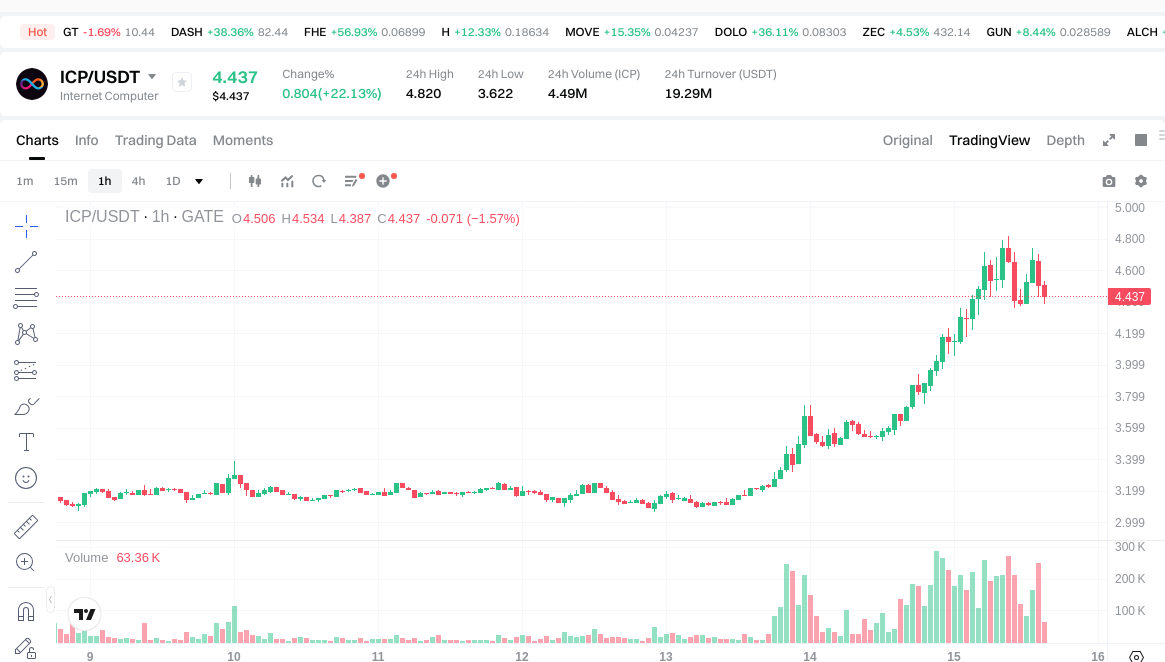
Navigating to Spot Trading: Access the spot trading interface and search for ICP trading pairs (such as ICP/USDT), where you can analyze current price charts and market data.
-
Placing Orders: Select your preferred order type (market order for immediate execution or limit order for specific price targets), enter the desired ICP quantity, and confirm the transaction.
As with all cryptocurrency investments, it's important to use secure storage solutions such as hardware wallets for long-term holdings and to implement appropriate security measures to protect your assets. Consider the risks carefully and only invest amounts you can afford to lose.
FAQ
What is Internet Computer (ICP) and how does it work?
Internet Computer (ICP) is a blockchain enabling decentralized Web3 services without traditional cloud infrastructure. Developers build smart contracts on its distributed nodes forming a public World Computer. ICP holders stake tokens to create voting neurons in the Network Nervous System DAO governing the protocol.
What are the main features and advantages of Internet Computer compared to other blockchain platforms?
Internet Computer offers ultra-fast transaction speeds processing 5,382 update calls per second, superior scalability, high throughput, and provides a robust decentralized computing environment for Web3 applications.
How can I buy and store Internet Computer (ICP) tokens?
Purchase ICP tokens on cryptocurrency exchanges using fiat or crypto. Store them in compatible wallets for security. ICP can be staked in neurons for governance participation and converted to cycles for network computation.
What are the risks and challenges associated with investing in Internet Computer?
Internet Computer faces high volatility and price fluctuations. Key challenges include regulatory uncertainties, technology adoption risks, and competition from other blockchain platforms. Market conditions and network security also impact investment outcomes.
What is the current market outlook and price prediction for ICP?
As of 2026, ICP's market outlook remains positive. Price predictions suggest ICP could trade between $27.81 and $33.36 by 2031, with an average expected price around $28.81. Analysts expect continued growth driven by Internet Computer's expanding ecosystem and adoption.
What are the real-world applications and use cases of Internet Computer?
Internet Computer enables enterprise solutions including supply chain management, secure data storage, and decentralized applications. It supports dApps, smart contracts, and web services with improved efficiency, security, and scalability for businesses and developers.
How does Internet Computer achieve decentralization in web hosting and computing?
Internet Computer achieves decentralization through a global network of independent data centers that collectively host and run applications, providing a decentralized alternative to centralized cloud services. This network operates on its own protocols, enabling truly decentralized web hosting and computing infrastructure.
What is the difference between Internet Computer and traditional cloud computing services?
Internet Computer is decentralized and blockchain-based, offering enhanced security and privacy without relying on centralized servers. Traditional cloud computing depends on centralized infrastructure and the internet, giving providers control over your data.
* The information is not intended to be and does not constitute financial advice or any other recommendation of any sort offered or endorsed by Gate.