Momentum (MMT) is a decentralized financial operating system built on the Sui blockchain, launched in 2025 to address DeFi accessibility challenges and inefficient tokenized trading. This comprehensive guide explores Momentum's technical architecture leveraging Sui's delegated proof-of-stake consensus, market performance including 2.1 million users and $500 million liquidity, and diverse ecosystem applications from DeFi trading to integrated financial services. The article examines key milestones, on-chain metrics with $1.1 billion daily trading volume, strategic positioning, community dynamics, and practical participation methods through Gate and partner exchanges. Ideal for traders, DeFi participants, and blockchain enthusiasts seeking to understand Momentum's role as the Robinhood of tokenized assets, despite facing market volatility and competitive pressures in the evolving cryptocurrency landscape.
Momentum's Positioning and Significance
In 2025, the Momentum team launched Momentum (MMT), aiming to address inefficiencies in decentralized finance and barriers to accessible tokenized trading.
As a financial operating system for the tokenized world, Momentum plays a critical role in DeFi and digital asset trading.
As of 2026, Momentum has emerged as a rapidly growing platform in the Sui ecosystem, boasting over 2.1 million users and $500 million in liquidity, along with an active development community.
This article will provide an in-depth analysis of its technical architecture, market performance, and future potential.
Origin and Development Timeline
Background
Momentum was created by its founding team in 2025, aiming to solve accessibility challenges in decentralized finance and inefficient tokenized asset trading.
It emerged during the expansion of blockchain ecosystems and rising demand for integrated financial platforms, with the goal of providing seamless, user-friendly financial services in the tokenized era.
Momentum's launch brought new possibilities for retail traders and DeFi participants.
Key Milestones
- March 31, 2025: Mainnet launch on Sui, achieving rapid user onboarding and liquidity growth.
- 2025: Platform expansion resulted in liquidity growing from zero to $500 million.
- 2025: User base surpassed 2.1 million, with daily trading volume reaching $1.1 billion.
- 2026: Continued ecosystem development with integration of multiple core financial products.
With community and development team support, Momentum continues to enhance its technology, security, and real-world applications.
How Momentum Works
Decentralized Infrastructure
Momentum operates on the Sui blockchain, a decentralized network of nodes distributed globally, removing reliance on traditional financial intermediaries.
These nodes collaborate to validate transactions, ensuring system transparency and attack resistance, granting users greater autonomy and enhancing network resilience.
Blockchain Foundation
Momentum's blockchain is a public, immutable digital ledger that records every transaction.
Transactions are grouped into blocks and linked through cryptographic hashing to form a secure chain.
Anyone can view the records, establishing trust without intermediaries.
Built on Sui's architecture, Momentum benefits from high throughput and parallel transaction processing to improve performance.
Consensus Mechanism
Momentum leverages Sui's delegated proof-of-stake (DPoS) consensus mechanism to validate transactions and prevent fraudulent activities such as double-spending.
Validators maintain network security through stake delegation and node operation, earning rewards in the process.
Innovative features include efficient transaction finality and scalable infrastructure.
Secure Transactions
Momentum utilizes public-private key cryptography to protect transactions:
- Private keys (similar to secret passwords) are used to sign transactions
- Public keys (similar to account numbers) verify ownership
This mechanism ensures fund security while maintaining pseudonymous transaction privacy.
Additional security features include smart contract auditing and secure wallet integration.
Circulation Overview
As of 20 January 2026, Momentum's circulating supply stands at 204,095,424 MMT tokens, with a total supply of 1,000,000,000 MMT. The project features an uncapped maximum supply model, allowing for potential future token issuance based on protocol requirements.
The current circulating supply represents approximately 20.41% of the total supply, with tokens entering the market through the protocol's distribution mechanisms since its launch on 31 March 2025.
Price Dynamics
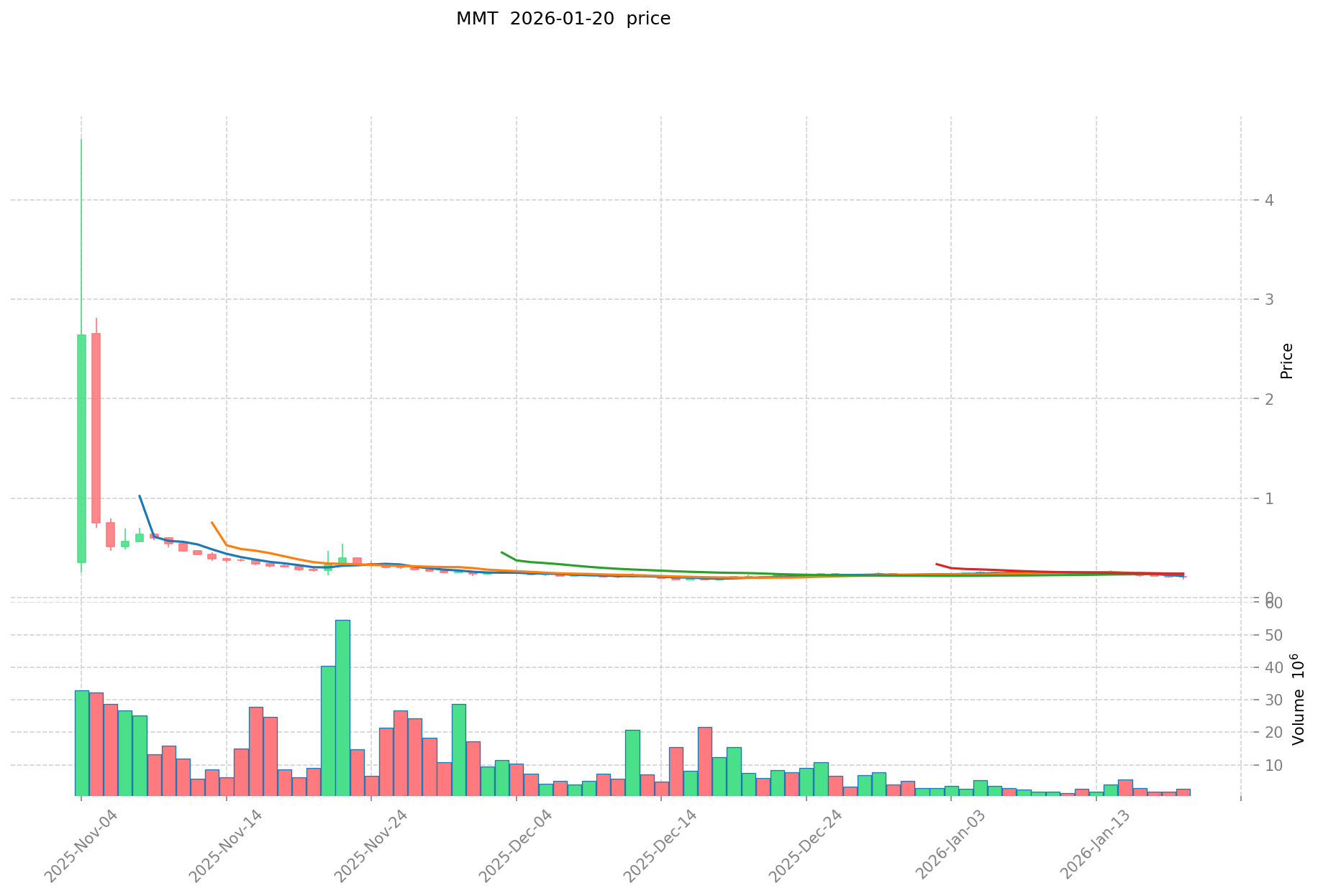
Momentum achieved a notable price level of $4.6188 on 4 November 2025, driven by the project's rapid growth trajectory that saw liquidity expand from zero to $500 million and attracted over 2.1 million users within its initial months of operation.
The token experienced a lower price point of $0.1774 on 15 December 2025, reflecting broader market adjustments and cyclical volatility patterns common in the cryptocurrency sector.
Recent price movements show varied performance across different timeframes: a 1.55% increase over 24 hours, contrasted with an 18.08% decline over the past week. The token's price movements reflect evolving market sentiment, adoption patterns, and the dynamic nature of the tokenized financial ecosystem Momentum is building on the Sui blockchain.
Click to view current MMT market price
On-Chain Metrics
- 24-Hour Trading Volume: The token recorded a trading volume of $336,196 over the past 24 hours, demonstrating active market participation
- Market Capitalization: Momentum maintains a circulating market cap of approximately $41.25 million, with a fully diluted valuation of $202.1 million
- Exchange Listings: The token is currently available on 32 cryptocurrency exchanges, providing diverse access points for traders and investors
Momentum Ecosystem Applications and Partners
Core Use Cases
Momentum's ecosystem supports multiple applications:
- DeFi: As a financial operating system built on Sui, Momentum provides decentralized trading and liquidity solutions, having achieved $500M in liquidity and $1.1B in daily trading volume.
- Integrated Financial Services: The platform combines several core products to create an integrated financial ecosystem, serving as the Robinhood of the tokenized era.
Strategic Partnerships
Momentum has established its presence on the Sui blockchain, leveraging its technical infrastructure to build the financial operating system of the tokenized world.
These partnerships provide a solid foundation for Momentum's ecosystem expansion.
Controversies and Challenges
Momentum faces the following challenges:
- Market Volatility: The token has experienced notable price fluctuations, with a decline from higher levels
- Competitive Pressure: Operating in a highly competitive DeFi landscape with established players
- Rapid Growth Management: Scaling from zero to over 2.1 million users since March 31, 2025, presents operational challenges
These issues have sparked discussions within the community and market, while also driving Momentum's continuous innovation.
Fan Enthusiasm
Momentum's community shows strong vitality, having onboarded over 2.1 million users and achieved $1.1B in daily trading volume.
On X platform, related posts and hashtags (such as #MMT and #Momentum) frequently trend.
Factors such as rapid liquidity growth from zero to $500M and the platform's innovative approach have ignited community enthusiasm.
Sentiment on X shows polarization:
- Supporters praise Momentum's rapid growth, user-friendly approach, and position as the Robinhood of tokenized assets, considering it a promising player in decentralized finance.
- Critics focus on price volatility and the challenges of maintaining momentum in a competitive market.
Recent trends reflect mixed sentiment as the market evaluates the platform's long-term sustainability.
Hot Topics
X users actively discuss Momentum's rapid user acquisition, liquidity growth, and integration of multiple financial products,
showcasing both its transformative potential and the hurdles it faces in achieving mainstream adoption.
- Official Website: Visit Momentum Official Website for features, use cases, and latest updates.
- Whitepaper: Momentum Documentation provides detailed information on its technical architecture, goals, and vision.
- X Updates: On X platform, Momentum is active with @MMTFinance, where it shares updates covering platform developments, trading volume milestones, and ecosystem growth, generating engagement from the community.
Momentum Future Roadmap
- Ecosystem Goals: Continue expanding the integrated financial ecosystem and enhancing user experience
- Long-term Vision: Establish itself as the leading financial operating system for the tokenized world
How to Participate in Momentum?
- Purchase Channels: Buy MMT on Gate.com and other supporting exchanges
- Storage Solutions: Use compatible wallets that support SUI network tokens for secure storage
- Participate in Governance: Engage with the community through official channels including Discord
- Build Ecosystem: Visit Momentum Documentation to explore development opportunities and contribute to the platform
Summary
Momentum is redefining decentralized finance through blockchain technology, providing an integrated financial operating system, rapid liquidity growth, and user-friendly access to tokenized assets.
Its active community, comprehensive resources, and notable market performance distinguish it in the cryptocurrency space.
Despite facing market volatility and competitive pressure, Momentum's innovative approach and clear positioning make it a noteworthy player in the future of decentralized technology.
Whether you are a newcomer or an experienced participant, Momentum is worth following and engaging with.
FAQ
What is Crypto MMT and how does it differ from traditional Modern Monetary Theory?
Crypto MMT applies Modern Monetary Theory principles to blockchain networks. Unlike traditional MMT focused on fiat currencies, Crypto MMT leverages decentralized protocols, smart contracts, and tokenomics to manage monetary supply and fiscal policy autonomously through cryptographic consensus mechanisms.
What are the practical applications of Crypto MMT in the cryptocurrency ecosystem?
Crypto MMT serves as a utility token enabling decentralized governance, liquidity provision, and yield farming within DeFi protocols. It facilitates cross-chain transactions, staking mechanisms, and community-driven platform development, enhancing ecosystem interoperability and user participation rewards.
What risks should be noted when adopting the Crypto MMT model?
MMT projects face liquidity concentration risks, smart contract vulnerabilities, regulatory uncertainty, and token volatility. Market manipulation and validator centralization can also impact stability. Ensure thorough due diligence on project fundamentals and audit reports.
What is the relationship between Crypto MMT, DeFi, and tokenomics?
Crypto MMT integrates with DeFi protocols to enable decentralized transactions and liquidity provision. Its tokenomics structure incentivizes network participation through token rewards, governance rights, and value distribution mechanisms essential to sustainable DeFi ecosystems.
How to evaluate whether a crypto project truly adopts MMT principles?
Assess MMT adoption by examining: transparent monetary policy documentation, algorithmic stability mechanisms, transaction volume growth consistency, community governance participation rates, and whether the protocol maintains predictable supply dynamics without centralized intervention.
* The information is not intended to be and does not constitute financial advice or any other recommendation of any sort offered or endorsed by Gate.