This comprehensive guide explores Onyxcoin (XCN), a foundational web3 blockchain infrastructure token serving the decentralized finance ecosystem. With approximately 59,652 holders and a circulating supply of 42.5 billion tokens, XCN operates across Ethereum and Binance Smart Chain, enabling developers to build and deploy decentralized applications. The token achieves market capitalization of $384.4 million with active 24-hour trading volume of $2.1 million on Gate. XCN utilizes decentralized consensus mechanisms and public-private key cryptography to ensure secure transactions and network resilience. Whether you're a developer seeking web3 infrastructure solutions or an investor exploring blockchain protocols, this guide covers XCN's technical architecture, market performance, ecosystem applications, and participation methods across multiple exchanges including Gate.
Onyxcoin's Positioning and Significance
In the evolving landscape of blockchain infrastructure, Onyxcoin (XCN) emerged as a foundational element designed to address the growing need for robust web3 blockchain infrastructure and decentralized financial services.
As the backbone of web3 blockchain infrastructure powered by the Onyx Protocol, Onyxcoin plays a critical role in decentralized finance (DeFi) and blockchain infrastructure development.
As of 2026, Onyxcoin has established itself as a significant player in the DeFi infrastructure space, with approximately 59,652 holders and an active development community.
This article will provide an in-depth analysis of its technical architecture, market performance, and future potential.
Origin and Development Journey
Birth Background
Onyxcoin was created to solve the challenges of building scalable and efficient web3 blockchain infrastructure.
It emerged in the context of rapid blockchain technology expansion and the growing demand for DeFi solutions, with the goal of providing a reliable foundation for decentralized applications and financial services.
Onyxcoin's launch brought new possibilities for developers and users seeking robust blockchain infrastructure.
Important Milestones
- The project has been listed on 19 exchanges, expanding its accessibility and liquidity.
- XCN tokens are deployed across multiple chains, with contract addresses on Ethereum (0xA2cd3D43c775978A96BdBf12d733D5A1ED94fb18) and Binance Smart Chain (0x7324c7C0d95CEBC73eEa7E85CbAac0dBdf88a05b).
- The project maintains active development, as evidenced by its presence on GitHub and comprehensive documentation through its whitepaper.
- As of January 2026, the circulating supply stands at approximately 42.5 billion XCN, representing 61.71% of the maximum supply of 68.9 billion tokens.
With support from its community and ongoing technical development, Onyxcoin continues to refine its infrastructure capabilities and expand its real-world applications.
How Onyxcoin Works
Decentralized Control
Onyxcoin operates on a decentralized network of computers (nodes) distributed globally, independent of centralized banking or governmental control.
These nodes collaborate to validate transactions, ensuring system transparency and attack resistance, granting users greater autonomy and enhancing network resilience.
Blockchain Foundation
Onyxcoin's blockchain serves as a public, immutable digital ledger recording every transaction.
Transactions are grouped into blocks and linked through cryptographic hashing to form a secure chain.
Anyone can view the records, establishing trust without intermediaries.
The protocol's infrastructure design aims to enhance performance and scalability for web3 applications.
Ensuring Fairness
The Onyx Protocol employs consensus mechanisms to validate transactions and prevent fraudulent activities such as double-spending.
Network participants maintain security through their contributions and may receive XCN rewards for their participation.
The protocol focuses on providing efficient and reliable infrastructure for decentralized applications.
Secure Transactions
Onyxcoin utilizes public-private key cryptography to protect transactions:
- Private keys (similar to secret passwords) are used to sign transactions
- Public keys (similar to account numbers) are used to verify ownership
This mechanism ensures fund security while maintaining transaction integrity across the network.
The multi-chain deployment on Ethereum and Binance Smart Chain provides flexibility and broader accessibility for users.
Circulation Overview
As of January 15, 2026, Onyxcoin (XCN) has a circulating supply of 42,516,524,556.69 tokens, with a total supply of 48,402,437,326 tokens and a maximum supply of 68,892,071,756 tokens. The circulating supply represents approximately 61.71% of the maximum supply, indicating a gradual release model. The token distribution mechanism influences market supply and demand dynamics as new tokens enter circulation over time.
Price Volatility
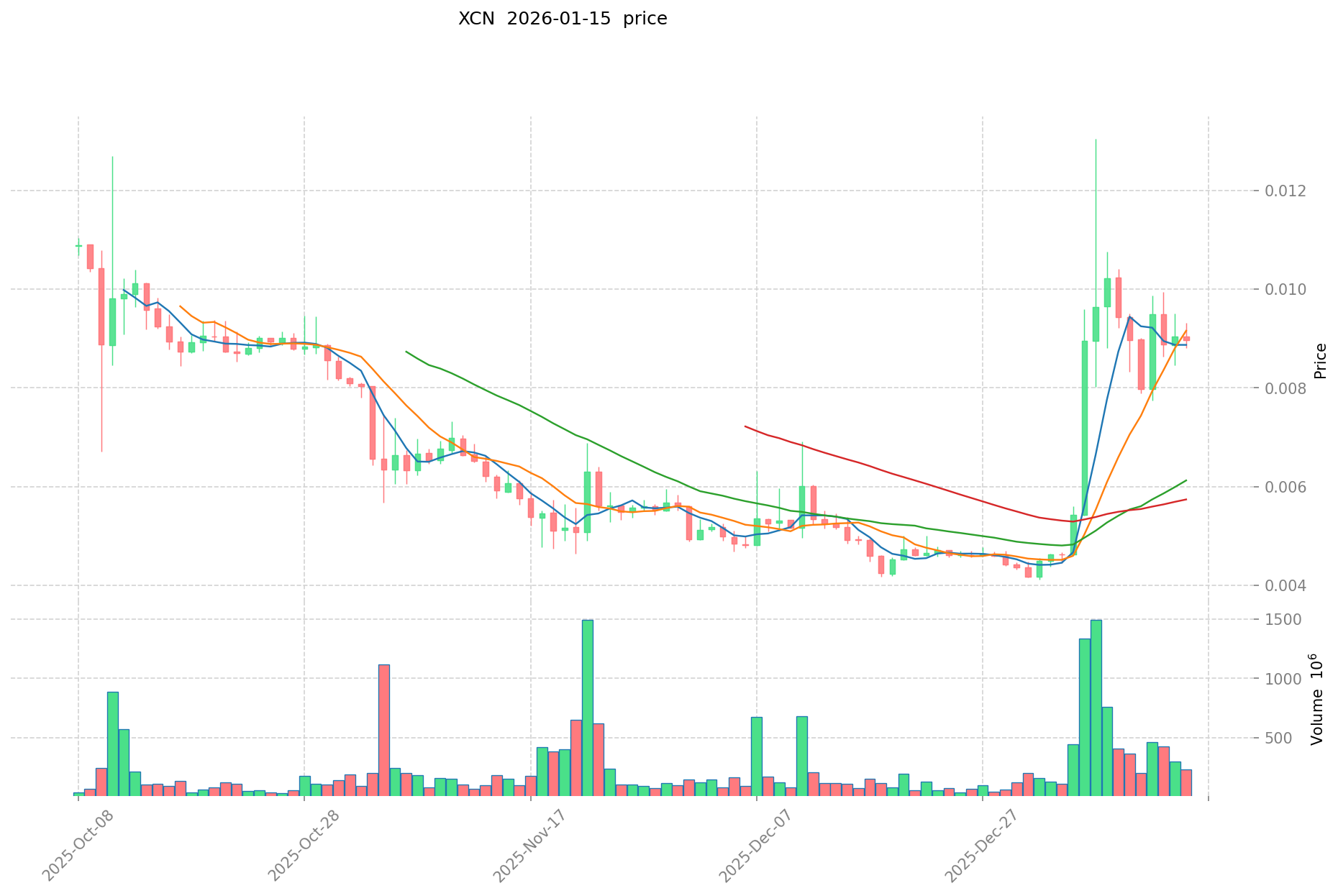
Onyxcoin (XCN) reached a notable price level of $0.184139 on May 27, 2022, driven by favorable market conditions during that period. Its lowest recorded price was $0.0007055 on October 12, 2023, reflecting broader market challenges and sentiment shifts. These price movements illustrate the impact of market sentiment, adoption trends, and external factors on the token's valuation.
Click to view the current XCN market price
On-chain Metrics
- Holders: Approximately 59,652 addresses hold XCN tokens, reflecting the breadth of community participation and distribution across the network.
- 24-hour Trading Volume: $2,107,506.82, indicating active market participation and liquidity.
- Market Capitalization: $384,391,898.52, representing the current market valuation based on circulating supply.
Onyxcoin (XCN) Ecosystem Applications and Partners
Core Use Cases
Onyxcoin's ecosystem serves as the backbone of web3 blockchain infrastructure, supporting various applications across decentralized finance and blockchain development. The protocol enables developers to build and deploy decentralized applications while providing essential infrastructure services for the broader web3 ecosystem.
Strategic Partnerships
As the foundational layer for web3 blockchain infrastructure, Onyxcoin positions itself to support emerging partnerships that enhance its technical capabilities and expand its ecosystem reach. These collaborative efforts aim to strengthen the protocol's role in powering decentralized applications and services.
Challenges and Considerations
Onyxcoin faces several industry-wide challenges:
- Market Competition: The web3 infrastructure space features numerous competing protocols vying for developer adoption and network effects
- Technical Evolution: Maintaining technological relevance requires continuous innovation in blockchain infrastructure capabilities
- Regulatory Landscape: The evolving regulatory framework for blockchain protocols presents ongoing compliance considerations
These factors influence the protocol's development trajectory and community engagement strategies.
Onyxcoin maintains an active community with approximately 59,652 token holders as of January 2026. The protocol's social presence centers on communicating technical developments and ecosystem updates to its stakeholder base.
Discussions around XCN reflect diverse perspectives:
- Supporters highlight the protocol's focus on web3 infrastructure and its positioning within the blockchain technology stack
- Observers monitor the project's development progress and competitive positioning in the infrastructure layer
Community discourse often centers on technical milestones and ecosystem expansion initiatives.
Discussion Topics
Community members actively discuss Onyxcoin's role in web3 infrastructure development, technical roadmap execution, and its positioning within the broader blockchain ecosystem, reflecting both opportunities and challenges in building foundational blockchain infrastructure.
- Official Website: Visit Onyxcoin official website for comprehensive information about the protocol's features, infrastructure capabilities, and latest developments
- White Paper: The Onyxcoin White Paper provides detailed technical documentation outlining the protocol's architecture, objectives, and long-term vision for web3 infrastructure
- Social Media: Follow Onyxcoin on X platform at @OnyxProtocol for updates on technical developments, community activities, and ecosystem announcements
- GitHub: Access the Onyxcoin GitHub repository to review code contributions and technical documentation
How to Participate in Onyxcoin (XCN)?
- Purchase Options: XCN is available for trading on Gate.com and other cryptocurrency exchanges
- Storage Solutions: Securely store XCN using compatible wallets that support ERC-20 tokens (Ethereum network) or BEP-20 tokens (BSC network)
- Contract Addresses:
- Ethereum: 0xA2cd3D43c775978A96BdBf12d733D5A1ED94fb18
- BSC: 0x7324c7C0d95CEBC73eEa7E85CbAac0dBdf88a05b
- Ecosystem Engagement: Explore the protocol's documentation and resources to understand its infrastructure capabilities
Summary
Onyxcoin (XCN) positions itself as foundational infrastructure for the web3 ecosystem, providing blockchain backbone services for decentralized applications. With a circulating supply of approximately 42.5 billion tokens and a market presence across multiple blockchain networks, the protocol aims to support the growing web3 development landscape. Despite facing competitive pressures and market volatility, Onyxcoin's focus on infrastructure development and its active community of nearly 60,000 holders demonstrate ongoing engagement in the blockchain technology space. Whether you're a developer exploring web3 infrastructure solutions or an investor interested in blockchain protocols, Onyxcoin represents an infrastructure-focused approach to decentralized technology development.
FAQ
What is XCN cryptocurrency? What are its main functions and uses?
XCN is the native gas token of the Onyx network, used to pay transaction fees and facilitate smart contract execution. It follows the ERC-20 standard and is compatible with Ethereum, ensuring seamless integration with wallets, DeFi protocols, and blockchain applications.
How to buy and store XCN tokens? Which wallets are supported?
Purchase XCN by converting USDT on major cryptocurrency platforms. Store XCN securely in compatible wallets like MetaMask, Trust Wallet, or hardware wallets. Ensure you use official wallet addresses and enable two-factor authentication for enhanced security.
What are the technical features of XCN? What is its consensus mechanism and total supply?
XCN utilizes a decentralized consensus mechanism where network nodes jointly validate transactions and write them to the blockchain. This distributed verification ensures network integrity, prevents fraud, and guarantees immutability. The total supply of XCN is capped at 1 billion tokens.
What are the risks of investing in XCN? How to safely trade and protect assets?
XCN investment carries market volatility and leverage risks. Secure trading requires setting stop-loss orders and maintaining account security with strong passwords and two-factor authentication. Manage position sizes and use risk management tools to protect your assets effectively.
What is the difference between XCN and mainstream cryptocurrencies like Bitcoin and Ethereum?
XCN is primarily designed for payments and transactions, while Bitcoin focuses on value storage and Ethereum provides smart contract capabilities. XCN offers more specialized functionality compared to Bitcoin's monetary purpose and Ethereum's computational platform.
* The information is not intended to be and does not constitute financial advice or any other recommendation of any sort offered or endorsed by Gate.