This comprehensive guide compares XLM (Stellar) and NEAR Protocol, two leading Layer-1 blockchain platforms targeting different market segments. XLM focuses on cross-border payments and financial inclusion since 2014, featuring 2-5 second transaction finality and institutional partnerships with IBM and Mercado Libre. NEAR Protocol, launched in 2020, emphasizes scalable smart contract infrastructure for decentralized applications with state sharding technology and mobile compatibility. The article examines critical investment factors including historical price trends (XLM: $0.22235, NEAR: $1.7477), tokenomics, institutional adoption, technological ecosystems, and market sentiment. Through detailed analysis of risk profiles, supply mechanisms, and 2026-2031 price predictions, investors gain insights into which asset aligns with their investment strategy—whether prioritizing established payment infrastructure or emerging smart contract platforms on Gate exchange.
Introduction: XLM vs NEAR Investment Comparison
In the cryptocurrency market, the comparison between XLM and NEAR has consistently been a topic of interest for investors. Both assets demonstrate notable differences in market cap rankings, application scenarios, and price performance, while representing distinct crypto asset positioning.
XLM (Stellar): Since its launch in 2014, Stellar has gained market recognition through its focus on facilitating rapid, stable, and low-cost transfers of digital assets among banks, payment institutions, and individuals. Its decentralized gateway between digital currencies and fiat currencies has positioned it as a network with strong throughput capacity and cost efficiency.
NEAR (NEAR Protocol): Since its inception in 2020, NEAR Protocol has been recognized as a highly scalable foundational protocol, designed to support decentralized application operations with sufficient speed on mobile devices. Through state sharding technology, it enables linear scalability with the number of nodes in the network.
This article will provide a comprehensive analysis of the investment value comparison between XLM and NEAR, examining historical price trends, supply mechanisms, institutional adoption, technological ecosystems, and future predictions. We aim to address the question that concerns investors most:
"Which is the better buy right now?"
I. Historical Price Comparison and Current Market Status
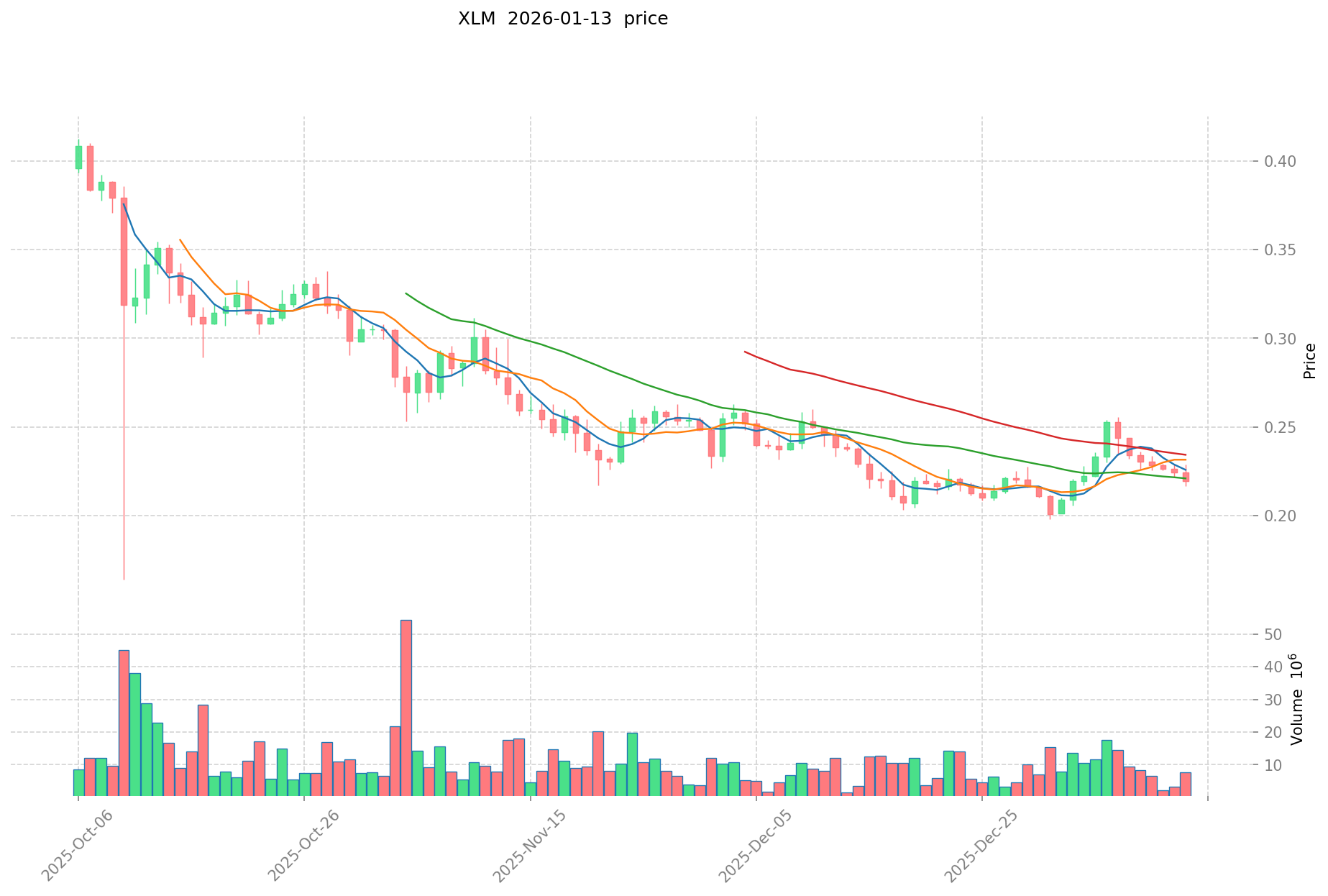
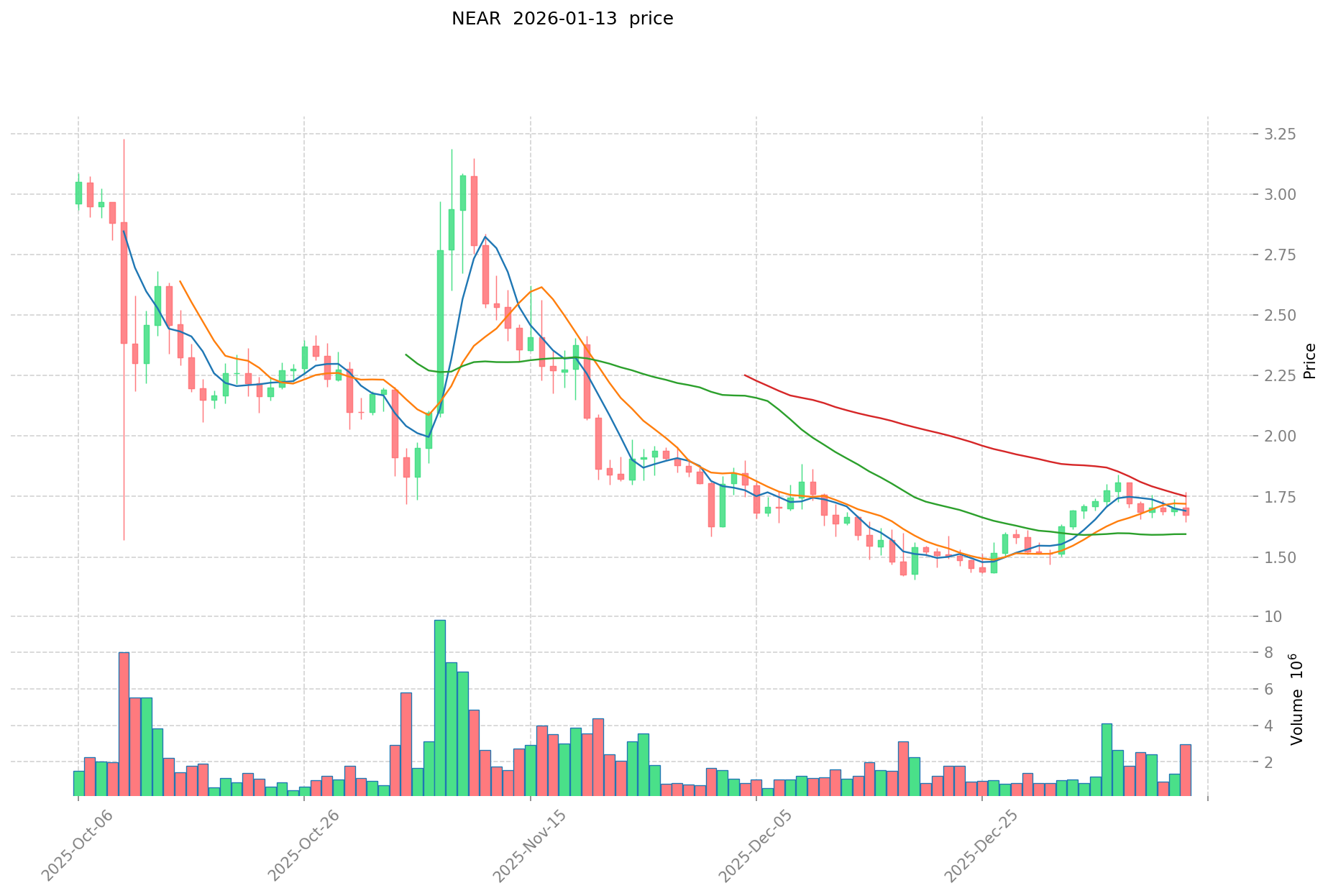
XLM and NEAR Historical Price Trends
- 2018: XLM experienced significant price movement, reaching an all-time high of $0.875563 on January 3rd during the broader cryptocurrency market rally.
- 2022: NEAR achieved its peak price of $20.44 on January 17th, reflecting strong market interest during the period.
- Comparative Analysis: During market cycles, XLM has declined from its historical high of $0.875563 to current levels around $0.22235, while NEAR has similarly decreased from its peak of $20.44 to approximately $1.7477.
Current Market Status (2026-01-13)
- XLM Current Price: $0.22235
- NEAR Current Price: $1.7477
- 24-Hour Trading Volume: XLM $1,560,863.41 vs NEAR $5,291,826.32
- Market Sentiment Index (Fear & Greed Index): 26 (Fear)
View real-time prices:
II. Core Factors Influencing XLM vs NEAR Investment Value
Supply Mechanism Comparison (Tokenomics)
-
XLM: XLM features a fixed supply model with no inflationary issuance mechanism, which may help maintain long-term scarcity. According to available information, the platform was designed with a predetermined token distribution strategy managed by the Stellar Development Foundation (SDF).
-
NEAR: Information regarding NEAR's supply mechanism was not available in the reference materials.
-
📌 Historical Pattern: Supply mechanisms can influence price cycles through scarcity dynamics and distribution strategies, though specific historical patterns vary across different market conditions.
Institutional Adoption and Market Applications
-
Institutional Holdings: XLM has established partnerships with notable entities including IBM (through the World Wire project) and Mercado Libre, which may enhance its credibility among institutional participants. The extent of institutional preference between the two assets requires further market data.
-
Enterprise Adoption: XLM has been applied in cross-border payment scenarios, particularly in regions where traditional banking services are limited or costly. The Stellar network positions itself as a payment settlement infrastructure supporting fast, low-cost international remittances. Specific comparative data on NEAR's enterprise adoption was not available in the materials.
-
National Policies: The global regulatory environment remains a significant factor for both assets. For XLM, favorable regulatory developments regarding blockchain-based financial services could strengthen investor confidence, while restrictive policies in key markets might negatively impact adoption. Specific regulatory attitudes toward NEAR were not detailed in the reference materials.
Technology Development and Ecosystem Building
-
XLM Technology Upgrades: The Stellar network utilizes the Stellar Consensus Protocol (SCP), which enables fast finality and scalability. Transaction speeds average 2-5 seconds with fees of only 0.00001 XLM per transaction. While Stellar's smart contract capabilities are relatively streamlined, they support various financial applications. The network also enables the issuance of stablecoins and tokenized assets (RWA).
-
NEAR Technology Development: Specific information about NEAR's technical architecture and recent upgrades was not provided in the reference materials.
-
Ecosystem Comparison: XLM's ecosystem focuses primarily on cross-border payments, remittances, and asset tokenization, with financial institutions able to issue various digital assets on the network. The platform emphasizes financial inclusion and payment infrastructure rather than extensive DeFi or NFT ecosystems. Comparative data on NEAR's ecosystem development across DeFi, NFT, and smart contract implementations was not available.
Macroeconomic Environment and Market Cycles
-
Performance Under Inflationary Conditions: XLM's price correlation with broader cryptocurrency market trends (particularly BTC and ETH) suggests its performance is influenced by overall crypto market sentiment. The asset's characteristics as an inflation hedge require assessment within the context of its specific use cases in payment systems. Information comparing inflation-resistant properties between XLM and NEAR was not available.
-
Macroeconomic Monetary Policy: XLM's price movements show correlation with major cryptocurrency assets, indicating sensitivity to factors such as interest rates and dollar index fluctuations that affect the broader crypto market. Specific comparative analysis of how monetary policy differentially impacts XLM versus NEAR was not detailed in the materials.
-
Geopolitical Factors: XLM's focus on cross-border payment solutions positions it to potentially benefit from increased demand for international transaction infrastructure, particularly in regions with developing financial systems. The impact of international political situations and cross-border transaction demand on both assets depends on various evolving geopolitical dynamics.
III. 2026-2031 Price Prediction: XLM vs NEAR
Short-term Forecast (2026)
- XLM: Conservative $0.21 - $0.22 | Optimistic $0.22 - $0.25
- NEAR: Conservative $1.38 - $1.75 | Optimistic $1.75 - $2.18
Medium-term Forecast (2028-2029)
- XLM may enter a gradual growth phase, with estimated prices ranging from $0.19 to $0.37 in 2028, potentially reaching $0.31 to $0.43 by 2029
- NEAR may enter a development expansion phase, with estimated prices ranging from $1.28 to $2.84 in 2028, potentially reaching $2.17 to $2.81 by 2029
- Key drivers: institutional capital inflows, ETF developments, ecosystem expansion
Long-term Forecast (2030-2031)
- XLM: Baseline scenario $0.20 - $0.37 (2030), $0.33 - $0.45 (2031) | Optimistic scenario $0.37 - $0.52 (2030), $0.45 - $0.55 (2031)
- NEAR: Baseline scenario $1.69 - $2.64 (2030), $1.78 - $3.11 (2031) | Optimistic scenario $2.64 - $3.59 (2030), $3.11 - $4.39 (2031)
View detailed price predictions for XLM and NEAR
Disclaimer: Price predictions are based on historical data analysis and market trends, and do not constitute investment advice. Cryptocurrency markets are highly volatile and actual prices may differ significantly from predictions.
XLM:
| Year |
Predicted High Price |
Predicted Average Price |
Predicted Low Price |
Price Change |
| 2026 |
0.2472747 |
0.22277 |
0.2071761 |
0 |
| 2027 |
0.291427714 |
0.23502235 |
0.1245618455 |
5 |
| 2028 |
0.36588279448 |
0.263225032 |
0.19478652368 |
18 |
| 2029 |
0.4309388611388 |
0.31455391324 |
0.3051172958428 |
41 |
| 2030 |
0.52184494206516 |
0.3727463871894 |
0.201283049082276 |
67 |
| 2031 |
0.550173667491554 |
0.44729566462728 |
0.330998791824187 |
101 |
NEAR:
| Year |
Predicted High Price |
Predicted Average Price |
Predicted Low Price |
Price Change |
| 2026 |
2.18125 |
1.745 |
1.37855 |
0 |
| 2027 |
2.21833125 |
1.963125 |
1.62939375 |
12 |
| 2028 |
2.84339025 |
2.090728125 |
1.27534415625 |
19 |
| 2029 |
2.81244747375 |
2.4670591875 |
2.171012085 |
41 |
| 2030 |
3.59006452965 |
2.639753330625 |
1.6894421316 |
51 |
| 2031 |
4.392021591493875 |
3.1149089301375 |
1.775498090178375 |
78 |
IV. Investment Strategy Comparison: XLM vs NEAR
Long-term vs Short-term Investment Strategies
-
XLM: May be suitable for investors focused on cross-border payment infrastructure and financial inclusion applications. The asset's positioning in payment settlement systems and partnerships with established entities like IBM suggest potential relevance for those interested in practical utility within the financial services sector.
-
NEAR: May appeal to investors seeking exposure to scalable blockchain infrastructure designed for decentralized applications. The protocol's emphasis on mobile device compatibility and state sharding technology positions it within the smart contract platform category.
Risk Management and Asset Allocation
-
Conservative Investors: A balanced approach might consider XLM: 40-50% vs NEAR: 50-60%, given NEAR's broader technological scope and XLM's established payment use cases.
-
Aggressive Investors: A more exploratory allocation could involve XLM: 30-40% vs NEAR: 60-70%, emphasizing NEAR's potential for ecosystem expansion while maintaining exposure to XLM's institutional adoption trajectory.
-
Hedging Tools: Investors may consider incorporating stablecoin allocations (20-30% of crypto portfolio), utilizing options contracts where available, and constructing cross-asset combinations to manage volatility exposure.
V. Potential Risk Comparison
Market Risks
-
XLM: Price movements demonstrate correlation with broader cryptocurrency market sentiment, particularly major assets like BTC and ETH. The asset's trading volume of $1,560,863.41 (24-hour) indicates liquidity considerations. Market adoption depends significantly on continued partnerships and expansion of cross-border payment use cases.
-
NEAR: With a 24-hour trading volume of $5,291,826.32, NEAR shows different liquidity characteristics. The protocol's market performance relates to competitive dynamics within the smart contract platform sector and the success of decentralized application development on the network.
Technical Risks
-
XLM: The Stellar network's transaction capacity (2-5 second finality) and minimal fees (0.00001 XLM per transaction) provide operational efficiency. Network stability considerations include the governance structure of the Stellar Development Foundation and the continued development of the Stellar Consensus Protocol.
-
NEAR: Specific technical implementation details regarding scalability performance and network security were not available in the reference materials. Potential considerations for blockchain platforms generally include smart contract security, node distribution, and upgrade implementation processes.
Regulatory Risks
- Global Regulatory Environment: XLM's focus on payment infrastructure positions it within evolving regulatory frameworks for blockchain-based financial services. Developments in cross-border payment regulations, digital asset classification policies, and banking sector blockchain adoption could influence both assets differently. NEAR's regulatory exposure relates to smart contract platform regulations and decentralized application governance frameworks, though specific jurisdictional approaches continue to develop.
VI. Conclusion: Which Is the Better Buy?
📌 Investment Value Summary:
-
XLM Characteristics: Established presence in cross-border payment solutions since 2014, partnerships with recognized institutions including IBM and Mercado Libre, transaction efficiency with 2-5 second finality and minimal fees, focus on financial inclusion and payment infrastructure applications.
-
NEAR Characteristics: Scalable blockchain protocol launched in 2020 emphasizing mobile device compatibility, state sharding technology for linear scalability, platform designed for decentralized application development, higher 24-hour trading volume ($5,291,826.32 vs XLM's $1,560,863.41).
✅ Investment Considerations:
-
New Investors: May consider starting with smaller allocations to understand each asset's specific market dynamics and use cases. Focus on understanding the fundamental differences between payment-focused networks (XLM) and smart contract platforms (NEAR) before establishing positions.
-
Experienced Investors: Could evaluate portfolio allocation based on existing exposure to payment infrastructure versus smart contract platforms. Consider the correlation of each asset with broader market movements and specific sector developments when constructing diversified cryptocurrency portfolios.
-
Institutional Participants: May assess XLM's established payment use cases and institutional partnerships alongside NEAR's technological infrastructure for application development. Evaluation should include liquidity requirements, regulatory compliance considerations, and alignment with institutional investment mandates.
⚠️ Risk Warning: The cryptocurrency market exhibits extreme volatility. This article does not constitute investment advice.
VII. FAQ
Q1: What are the main differences between XLM and NEAR in terms of use cases?
XLM focuses on cross-border payments and financial inclusion, while NEAR is designed as a smart contract platform for decentralized applications. XLM, launched in 2014, specializes in facilitating rapid, low-cost transfers between banks, payment institutions, and individuals through a decentralized gateway between digital and fiat currencies. Its transaction finality averages 2-5 seconds with fees of only 0.00001 XLM. In contrast, NEAR Protocol, introduced in 2020, emphasizes scalable infrastructure for decentralized application development with mobile device compatibility, utilizing state sharding technology for linear scalability as network nodes increase.
Q2: Which asset shows better institutional adoption?
XLM demonstrates more established institutional adoption with concrete partnerships. The Stellar network has secured collaborations with notable entities including IBM (through the World Wire project) and Mercado Libre, positioning itself within traditional financial services infrastructure. XLM's application in cross-border payment scenarios, particularly in regions with limited or costly banking services, has provided practical institutional use cases. However, the reference materials did not provide specific information regarding NEAR's institutional partnerships or enterprise adoption levels, making direct comparison limited to XLM's documented institutional engagement.
Q3: How do the price predictions compare for 2030?
XLM and NEAR show different growth trajectories through 2030, with NEAR projecting higher percentage gains. For XLM, baseline scenario predictions range from $0.20 to $0.37 in 2030, with optimistic scenarios reaching $0.37 to $0.52. NEAR's baseline forecast ranges from $1.69 to $2.64, with optimistic projections of $2.64 to $3.59. By 2031, XLM baseline estimates are $0.33 to $0.45 (optimistic: $0.45 to $0.55), while NEAR baseline projects $1.78 to $3.11 (optimistic: $3.11 to $4.39). These predictions suggest NEAR may offer higher absolute price levels, though both remain subject to significant market volatility.
Q4: What are the key technical advantages of each network?
XLM's technical strengths lie in its transaction efficiency and payment optimization. The Stellar Consensus Protocol (SCP) enables 2-5 second transaction finality with minimal fees (0.00001 XLM per transaction), supporting stablecoin issuance and tokenized asset capabilities. While its smart contract functionality is streamlined compared to general-purpose platforms, it efficiently serves financial applications. NEAR's documented advantage is its state sharding technology designed for linear scalability with network node growth and mobile device compatibility. However, specific technical performance metrics and smart contract implementation details for NEAR were not available in the reference materials.
Q5: How does current market sentiment affect both assets?
Both XLM and NEAR are influenced by the current fearful market environment, as indicated by the Fear & Greed Index reading of 26 (Fear) as of January 13, 2026. XLM's price movements show correlation with broader cryptocurrency market trends, particularly major assets like BTC and ETH, suggesting sensitivity to overall market sentiment. Current 24-hour trading volumes show NEAR at $5,291,826.32 compared to XLM's $1,560,863.41, indicating different liquidity profiles during market uncertainty. Both assets have declined significantly from historical peaks—XLM from $0.875563 (January 2018) to current $0.22235, and NEAR from $20.44 (January 2022) to $1.7477—reflecting the impact of broader market cycles.
Q6: What should investors consider regarding regulatory risks?
Regulatory considerations differ based on each asset's primary function. XLM's focus on payment infrastructure positions it within evolving frameworks for blockchain-based financial services, particularly cross-border payment regulations and digital asset classification policies affecting banking sector blockchain adoption. Its partnerships with established financial entities may provide both opportunities and regulatory scrutiny. NEAR's regulatory exposure relates to smart contract platform regulations and decentralized application governance frameworks, though specific jurisdictional approaches continue to develop. Investors should monitor developments in their respective jurisdictions regarding payment token classification (XLM) and smart contract platform regulations (NEAR), as regulatory clarity or restrictions could significantly impact adoption and market performance.
Q7: Which asset better suits conservative versus aggressive investment strategies?
Conservative investors seeking established use cases and institutional partnerships may find XLM's payment infrastructure focus and documented collaborations with entities like IBM more aligned with risk-averse profiles. A balanced allocation might consider XLM: 40-50% versus NEAR: 50-60% within a cryptocurrency portfolio. Aggressive investors targeting higher growth potential through emerging smart contract ecosystems and broader technological scope may favor NEAR's positioning, with potential allocations of XLM: 30-40% versus NEAR: 60-70%. Both strategies should incorporate hedging tools including stablecoin allocations (20-30% of crypto portfolio) and consider cross-asset combinations to manage volatility, given the extreme volatility characteristics of cryptocurrency markets.
Q8: What are the supply mechanism differences and their investment implications?
XLM features a fixed supply model without inflationary issuance mechanisms, potentially supporting long-term scarcity dynamics. The predetermined token distribution strategy is managed by the Stellar Development Foundation (SDF), providing transparency regarding supply schedules. This fixed-supply characteristic may appeal to investors concerned about dilution effects common in inflationary token models. Unfortunately, specific information regarding NEAR's supply mechanism, including whether it employs fixed or inflationary issuance, maximum supply limits, or distribution schedules, was not available in the reference materials. Understanding supply mechanisms is crucial for evaluating long-term value retention, as scarcity dynamics and distribution strategies significantly influence price cycles across different market conditions.
* The information is not intended to be and does not constitute financial advice or any other recommendation of any sort offered or endorsed by Gate.