


ASTER Tokenomics: Buybacks, Burns, and Staking as the Value Foundation of ASTER in 2026
As the Decentralized Perpetual Exchange (Perp DEX) sector enters a stage of zero-sum competition, ASTER’s tokenomic model has become the key to building the protocol’s competitive moat. With the official launch of the Aster Chain mainnet, market demand for a high-performance, low-cost trading environment translates into functional locking demand for ASTER. Particularly in the rivalry with strong competitors like Hyperliquid, this “Buyback-Burn-Staking” cycle effectively hedges against volatility risks and strengthens community stickiness.
The economic design of ASTER represents a paradigm shift in Web3 finance from “points expectations” to “Real Yield distribution.” It is more than just a medium of exchange; it is a certificate of governance and revenue rights for the underlying network, reflecting the unique advantage of application-specific chains (App-chains) in capturing ecosystem premiums.
ASTER Token Overview
The total supply of ASTER tokens is 8 billion, with the specific allocation structure detailed as follows:
- Airdrops: 4.28 billion tokens, representing 53.5% of total supply. At the token generation event, 704 million tokens were released, with the remainder unlocking linearly over 80 months.
- Ecosystem and community: 2.4 billion tokens, or 30%, allocated to APX holder migration, ecosystem grants, and marketing initiatives.
- Team: 400 million tokens, or 5%, locked for one year and then released linearly over 40 months.
- Liquidity and exchange listings: 360 million tokens, or 4.5%, fully released at token generation event.
- Treasury: 560 million tokens, or 7%, reserved for future strategic initiatives.
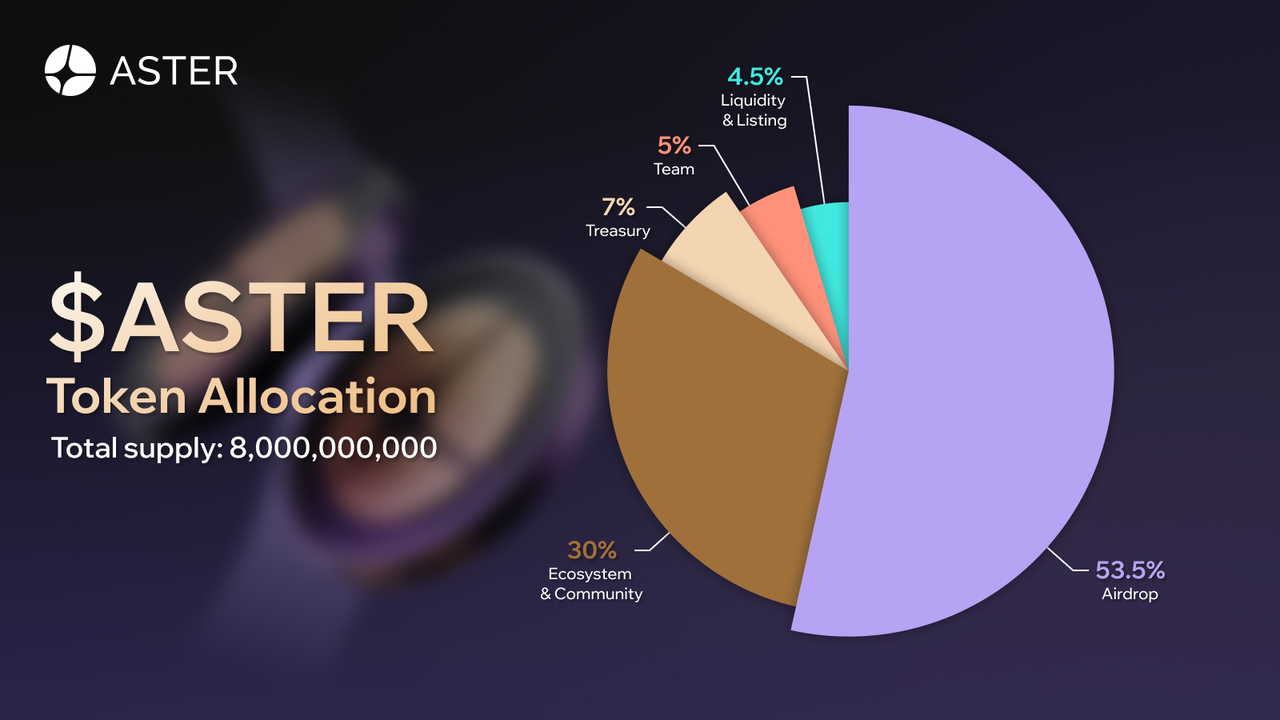
This allocation design ensures that the majority of tokens are distributed to the community, while lockup mechanisms are used to manage selling pressure from the team and early participants.
On February 5, with the Aster Chain testnet opening to all users and the mainnet planned for Q1, ASTER is expected to transition from a protocol level token toward a native gas and staking asset for a Layer 1 blockchain.
ASTER Token Use Cases
The value of ASTER is supported by multiple demand sources, including governance, fee discounts, gas usage, and staking rewards, forming an internal circulation loop within the ecosystem.
- Governance functions: Token holders can participate in platform governance, including decisions related to fee structures and asset listings.
- Fee discounts: Users who pay trading fees with ASTER can receive discounts, with discount levels determined by holding tiers.
- Staking rewards: Users can stake ASTER to receive a share of platform revenue. Under the latest buyback plan, up to 80% of platform fees are allocated to token buybacks, indirectly supporting stakers through reduced supply.
- Ecosystem infrastructure: As the base asset of Aster Chain, ASTER can be used to pay for on-chain transactions and smart contract execution.
ASTER Token Burns and Buybacks
Aster has implemented one of the more aggressive buyback programs in the sector.
According to on-chain data from the BSC explorer, as of February 7, 2026, more than 177 million ASTER tokens have already been burned. This direct reduction in circulating supply is intended to support token value through sustained deflation.
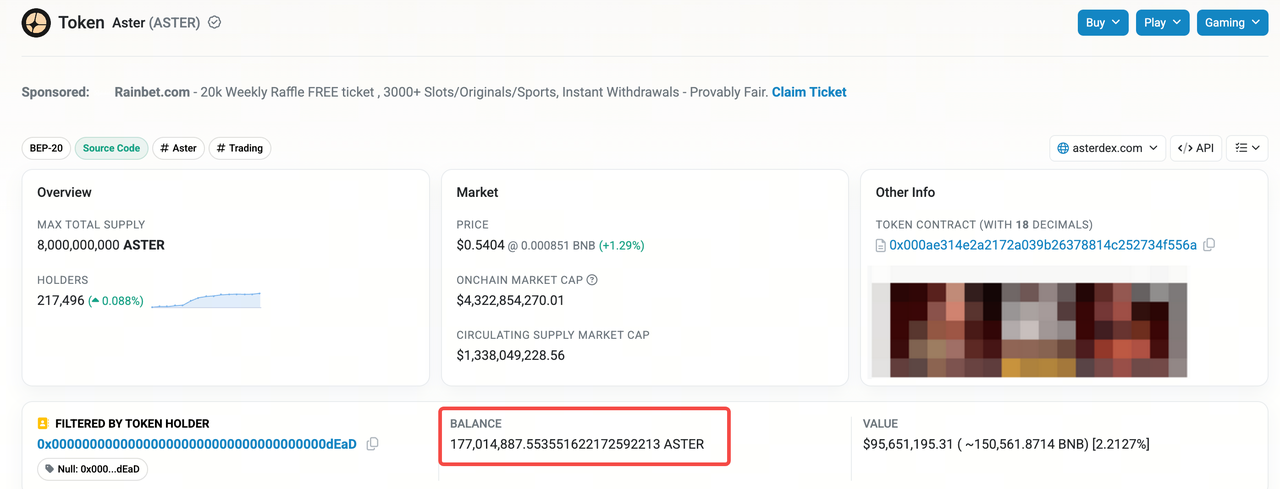
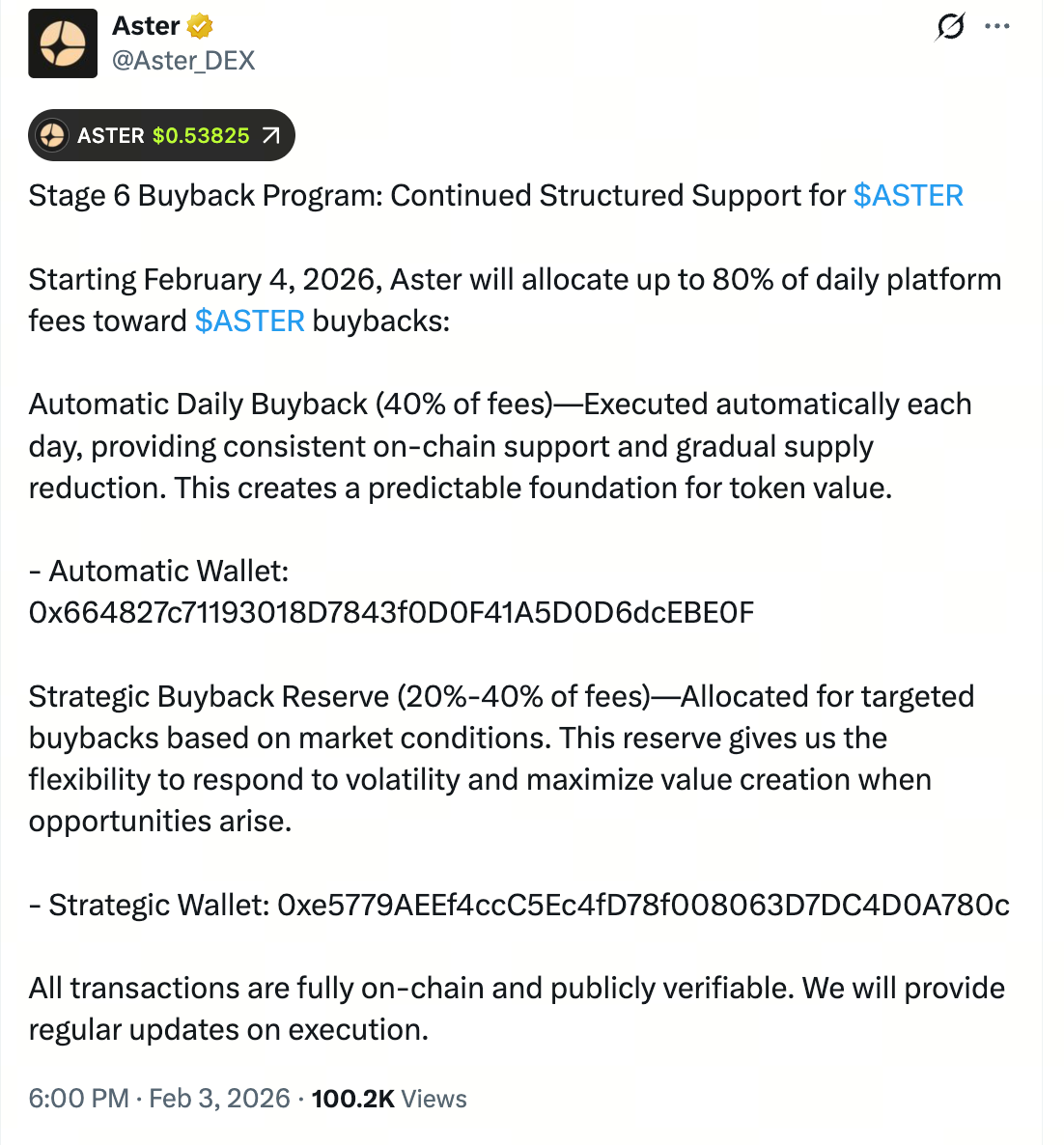
According to official disclosures, Aster launched its Stage 6 buyback program on February 4, 2026:
- Automatic daily buybacks: 40% of platform fees are used for automated daily buybacks, providing continuous on-chain support.
- Strategic buyback reserve: 20 to 40% of fees are reserved for discretionary buybacks based on market conditions.
- Transparent execution: All buyback transactions are verifiable on-chain, with wallet addresses publicly disclosed.
How to Buy ASTER Tokens
ASTER is listed on multiple mid-sized and large centralized exchanges, as well as several major decentralized exchanges. Users can gain exposure through spot trading or related derivatives, or by using Aster’s aggregated trading interface for swaps and cross chain capital routing.
Gate serves as an example of the steps users follow to purchase and trade ASTER:
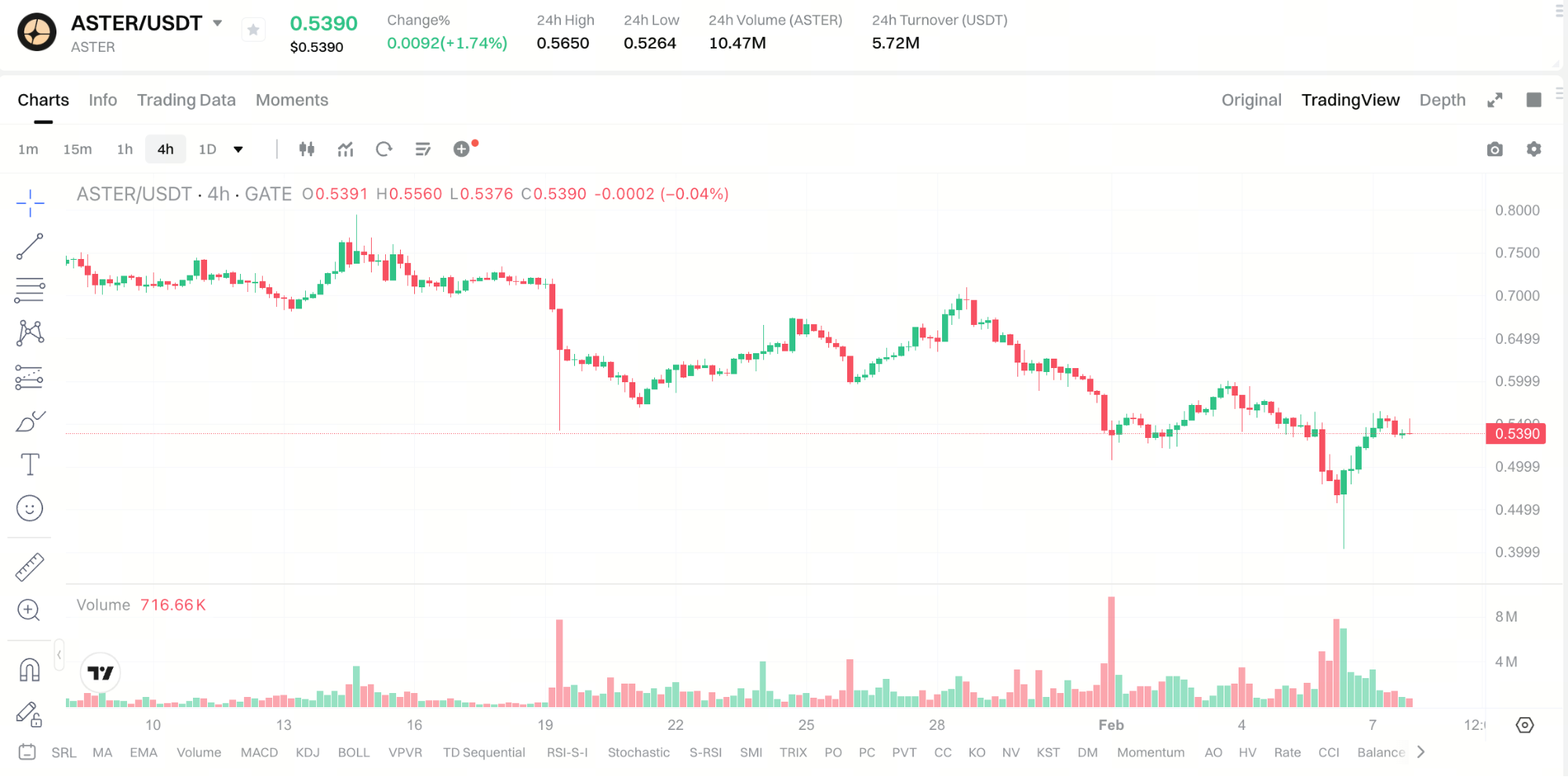
- Register a Gate account and complete KYC verification
- Deposit USDT or other major cryptocurrencies
- Search for ASTER on the trading page
- Select the ASTER USDT trading pair
- Enter the desired purchase amount and price, then place an order
- Withdraw tokens to a personal wallet for staking participation
Aster Roadmap and Latest Progress
According to official documentation, Aster’s key milestones for 2026 focus on the following areas.
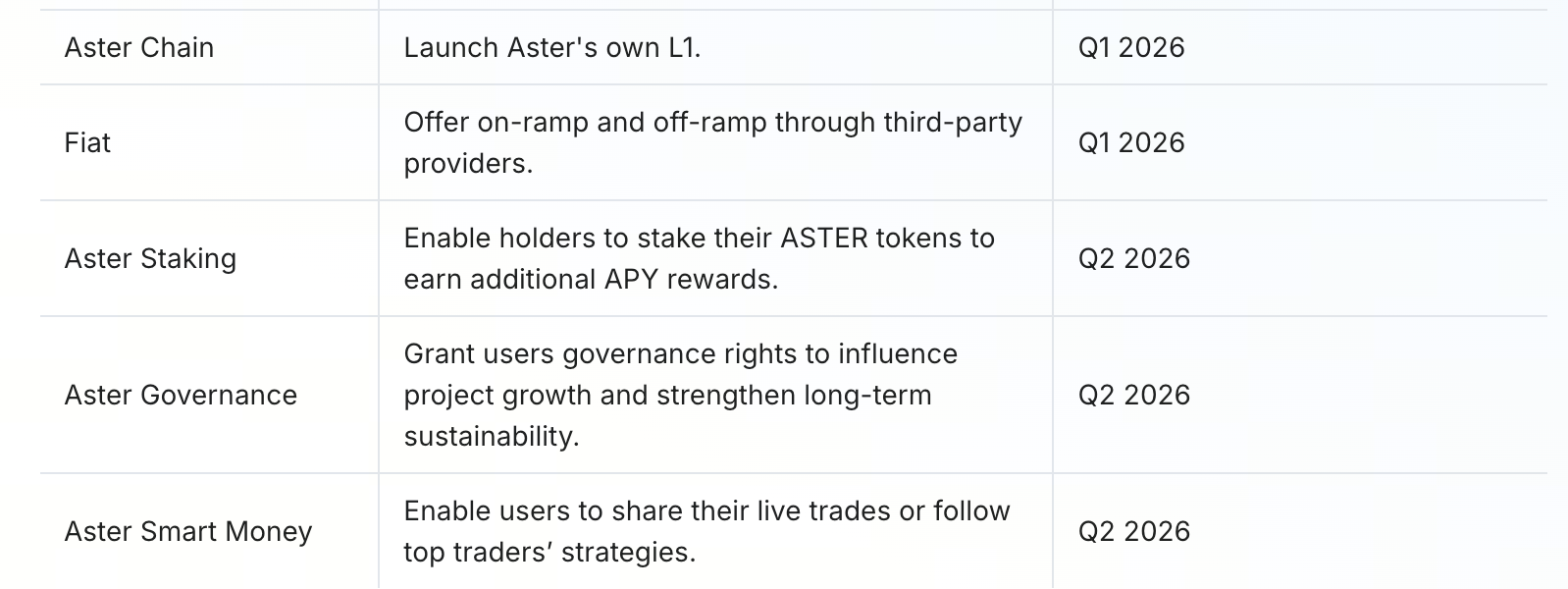
Screenshot source: Aster official website.
- Launch of the Layer 1 mainnet, completing the transition from a multi chain contract plus aggregation model to an application specific chain with multi chain assets.
- Introduction of fiat on ramp services to lower barriers for new users entering perpetual trading.
- Open sourcing of core code to support developers building secondary applications such as trading strategies, social trading, and liquidation services.
- Deployment of ASTER and related asset staking to complete the token value capture cycle.
One of the most significant recent technical developments is Aster Chain itself.
On February 5, 2026, after one month of intensive testing and the successful completion of the Human vs AI Season 2 program, the Aster Chain testnet was opened to all users. The team plans to launch the Aster Chain mainnet in Q1 2026. Performance improvements and privacy focused trading capabilities following the mainnet launch are expected to be closely monitored.
Summary
ASTER tokenomics are structured around three core mechanisms that support long term value.
- Deflationary model: Aggressive buybacks and token burns directly reduce circulating supply.
- Utility driven demand: Governance rights, fee discounts, and staking rewards create multiple use cases.
- Ecosystem growth: The Aster Chain mainnet launch and developer ecosystem expansion provide long term value drivers.
As 2026 progresses with the launch of the mainnet, the introduction of fiat on ramps, and continued ecosystem development, ASTER utility and demand are expected to expand further. Given the team’s stated commitment to buybacks and the upcoming technical milestones, both the project’s growth trajectory and the ASTER token’s value dynamics remain areas of close attention.
FAQs
What is the total supply of ASTER and its circulating status in 2026?
ASTER has a maximum supply of 8 billion tokens. According to CoinGecko data as of February 7, 2026, the circulating supply is approximately 2.45 billion tokens, with a circulating market capitalization of about 1.3 billion USD.
What is Aster’s Stage 6 buyback program?
Stage 6 is an aggressive buyback policy launched on February 4, 2026. Under this program, up to 80% of daily platform fees are allocated to ASTER buybacks. 40% is used for automatic daily buybacks, while 20 to 40% is reserved for strategic buybacks based on market conditions. All buyback activity is publicly verifiable on-chain.
How many ASTER tokens have been burned so far?
As of February 7, 2026, more than 177 million ASTER tokens have been permanently burned on-chain. This ongoing burn mechanism reduces effective circulating supply and reinforces ASTER’s deflationary characteristics.
What new use cases may ASTER gain after the Aster Chain mainnet launch?
With the planned Q1 2026 launch of the Aster Chain mainnet, ASTER may transition from an application token into a Layer 1 native asset. Potential new uses include paying gas fees, participating in Layer 1 staking, earning protocol revenue sharing, and serving as a governance voting asset.
Share
Content


Related Articles

In-depth Explanation of Yala: Building a Modular DeFi Yield Aggregator with $YU Stablecoin as a Medium

Exploring 8 Major DEX Aggregators: Engines Driving Efficiency and Liquidity in the Crypto Market

Sui: How are users leveraging its speed, security, & scalability?

What Is Copy Trading And How To Use It?

What Is Technical Analysis?
