Today, Dogecoin has leaped from a standalone meme asset into a complex financial entity with triple attributes: “political, social, and payment.” With the official listing of the 21Shares Dogecoin ETF (TDOG) on NASDAQ in early 2026 and the ongoing administrative narrative surrounding the “Department of Government Efficiency (D.O.G.E.)” led by Elon Musk, the brand consensus of this asset has expanded into the global mainstream spotlight.
From a macro perspective of blockchain evolution, the value of Dogecoin lies in its ultimate practice of “Tokenizing Social Consensus.” It demonstrates that community-driven soft power can be transformed into tangible economic productivity through hardware integration, such as with Seeker smartphones and official payment support from Tesla.
Introduction to Dogecoin
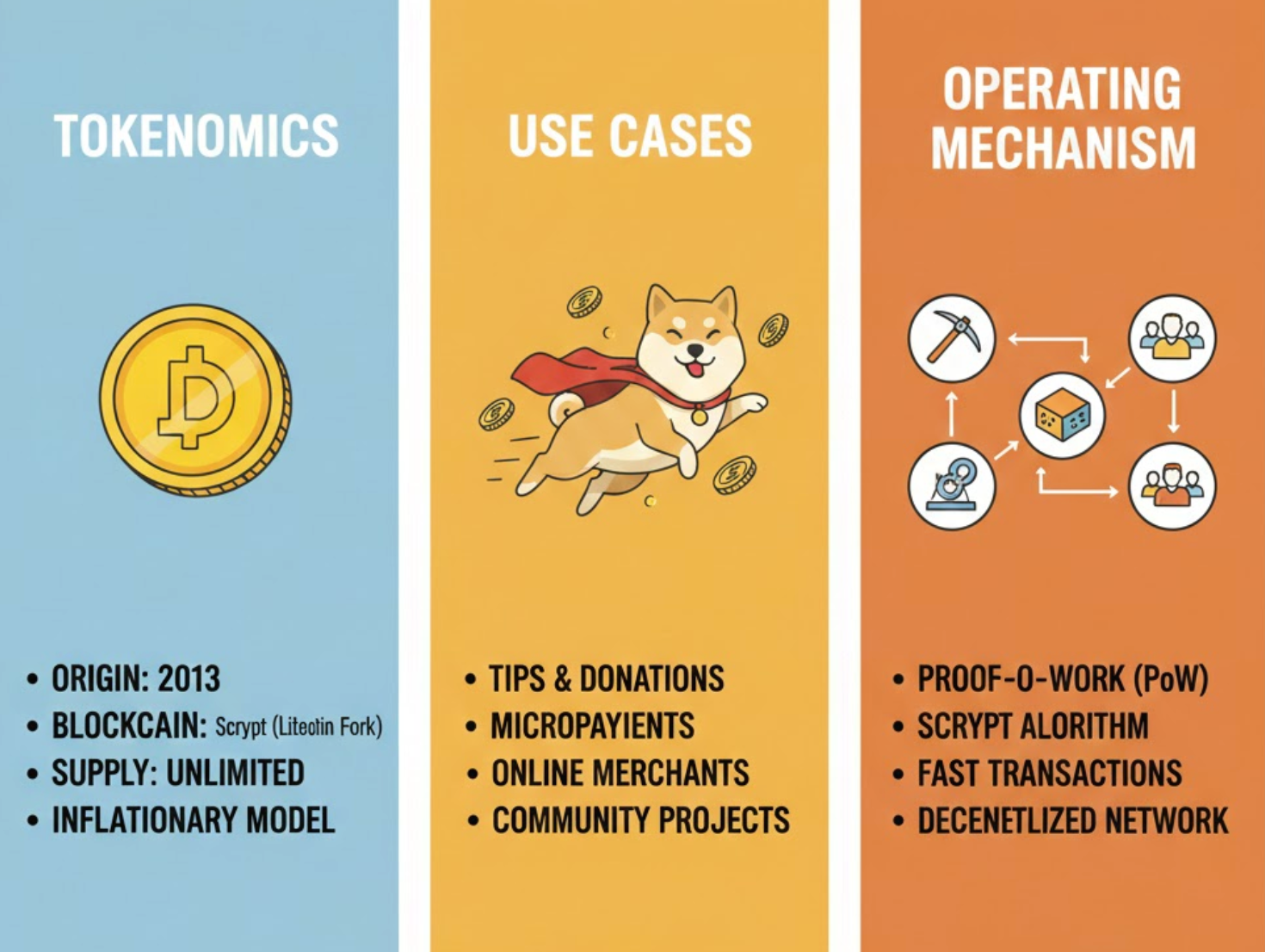
Dogecoin (DOGE) is a blockchain-based cryptocurrency that was first launched in 2013. It was inspired by the widely circulated Shiba Inu meme image and was created by software engineers Billy Markus and Jackson Palmer. Initially conceived as a lighthearted and fun digital currency experiment, Dogecoin aimed to make the blockchain space less serious and more accessible.
Despite its humorous origins, Dogecoin later established a unique position within the cryptocurrency ecosystem. Its community culture, ease of use, and accessibility have supported its long term presence.
Technically, Dogecoin is based on a fork of Litecoin’s codebase and uses the Scrypt Proof of Work (PoW) algorithm, enabling relatively efficient mining and transaction confirmation. Dogecoin has a block time of approximately one minute and low transaction fees, making it particularly suitable for small transfers and tipping scenarios.
DOGE Tokenomics: Distribution and Circulation Mechanisms
Dogecoin’s token economic system differs from many deflationary cryptocurrencies. It has no maximum supply limit, meaning new tokens continue to be issued. The design philosophy focuses on maintaining price stability and ensuring sufficient liquidity to support widespread use.
Reward and Issuance Mechanism
In its early stages, Dogecoin used random block rewards to enhance its playful nature. Starting from block height 600,000, the reward was fixed at 10,000 DOGE per block. With new blocks produced approximately every minute, the network adds around 5.2 billion DOGE annually.
Inflation and Stability
This uncapped inflationary structure helps prevent excessive hoarding and encourages users to spend, tip, or circulate DOGE rather than holding it purely as a speculative asset. From an economic perspective, Dogecoin more closely resembles a currency than a scarce digital asset.
Distribution Characteristics
- Initial issuance: No pre-mining was conducted. All DOGE are generated through mining.
- Circulation mechanism: Uses Scrypt mining and supports merged mining with Litecoin.
- Incentive structure: Continuous block rewards incentivize miners to maintain network security.
This economic model preserves Dogecoin’s decentralized nature while keeping the network active over the long term.
DOGE Use Cases and Application Scenarios
The Dogecoin community is one of its most distinctive features. Community members are highly active and willing to voluntarily promote Dogecoin’s ideas and culture. The community emphasizes friendliness, inclusiveness, and entertainment, giving Dogecoin a unique identity within the complex blockchain landscape.
After years of development, DOGE use cases now span online tipping, small payments, charitable initiatives, commercial payments, and e commerce.
Online Tipping and Small Payments
One of Dogecoin’s most well known use cases is tipping. On social media and content platforms, users can send small amounts of DOGE to show appreciation for creators or other users. Due to extremely low transaction fees, these micro transactions are effectively costless and have become a cultural symbol of Dogecoin.
Charity and Public Welfare Activities
The Dogecoin community gained early recognition through organizing multiple charitable events. These included fundraising to sponsor the Jamaican bobsled team for the Winter Olympics, building water wells in Kenya, and supporting animal rescue initiatives. This practice of “doing good with cryptocurrency” reflects Dogecoin’s lighthearted yet positive spirit.
Commercial Payments and E Commerce
Some online merchants and payment service providers support Dogecoin payments. Although DOGE still represents a relatively small share of commercial payments, its transaction speed and low cost give it a unique advantage in small payment scenarios.
Dogecoin Roadmap
Compared with other crypto projects, Dogecoin’s development has relied more heavily on community consensus. Rather than following a rigid roadmap, it represents an open process continuously shaped by users and developers.
In its early technical evolution from 2013 to 2015, Dogecoin was developed based on Litecoin’s source code. During this period, random block rewards were replaced with fixed rewards, and block time and block size were adjusted to improve transaction efficiency.
Starting in 2014, Dogecoin introduced merged mining with Litecoin. This significantly increased network hash power and security while reducing the risk of potential attacks.
At present, Dogecoin developers and volunteer contributors continue to maintain node compatibility, apply security patches, and optimize performance.
How to Acquire and Trade DOGE Tokens
Currently, most major cryptocurrency trading platforms support DOGE trading. Users typically exchange other cryptocurrencies such as BTC or USDT, or fiat currencies such as USD or JPY, for DOGE. Due to Dogecoin’s high level of adoption, trading pairs are widely available.
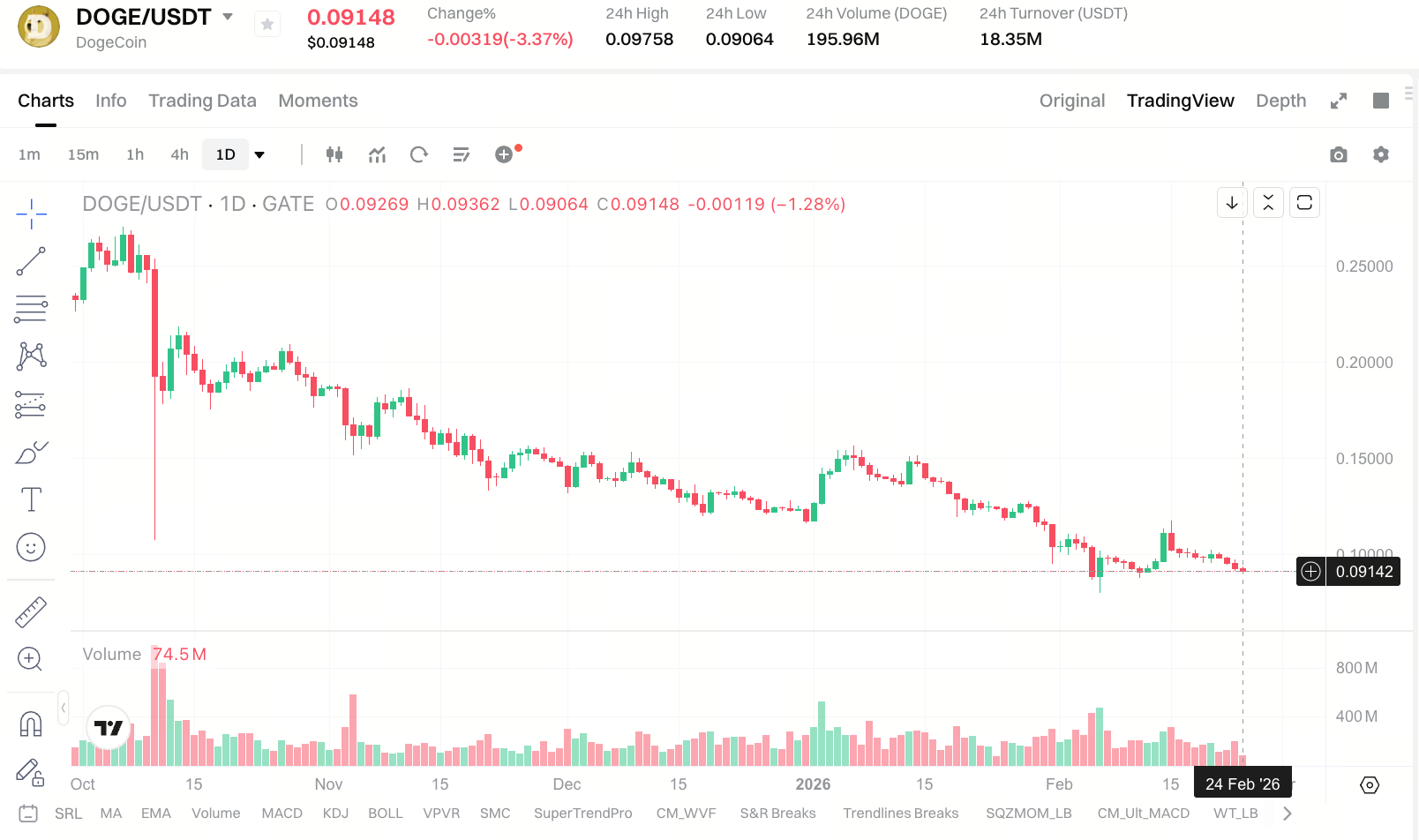
Using Gate as an example, users who wish to purchase or trade DOGE on the platform can follow these steps:
- Open the Gate platform and log in. If you do not have an account, complete registration and basic security setup first.
- On the Gate trading page, enter DOGE in the search bar and select the relevant result to access the project page. This page provides the Dogecoin project overview, official information, platform announcements, and relevant risk disclosures.
- Scroll down to view market data such as price trends, trading volume, and historical performance.
- Gate supports DOGE spot, futures, and margin trading. Available trading pairs, trading modes, and rules are displayed on the page.
- Enter the appropriate trading interface based on the page instructions, review the rules, and decide whether to participate. Actual features are subject to the Gate interface.
In addition to purchasing or trading on exchanges, users can also obtain DOGE through mining.
Dogecoin uses the Scrypt algorithm and is compatible with Litecoin mining. Individual miners or mining pools can earn block rewards by contributing hash power. In addition, many Dogecoin communities maintain a culture of token gifting. Users may earn small amounts of DOGE by participating in community activities, creating content, or contributing to projects. Although the amounts are limited, this mechanism strengthens ecosystem participation.
Risks and Challenges of the DOGE Token
Despite its positive community atmosphere and established use cases, Dogecoin still faces several challenges from both technical and economic perspectives.
- Inflationary Economic Model
Due to its uncapped issuance, Dogecoin lacks the scarcity characteristic of deflationary models. Over the long term, this may reduce its appeal as a store of value. However, inflation also sustains transaction activity and supports circulation and payment use cases.
- Limited Pace of Technical Upgrades
Compared with other major blockchains, Dogecoin evolves more slowly from a technical standpoint. Maintenance relies on volunteer developers rather than a corporate team, leading to less predictable update cycles and the need for continued attention to security and compatibility.
- Market Sentiment Volatility
DOGE is highly visible in online culture and public discourse. Its attention level and price movements are often influenced by social media and public events. While this article does not discuss price trends, understanding this sentiment driven nature is important for evaluating the Dogecoin ecosystem rationally.
- Limited Depth of Applications
Although Dogecoin has a strong community and cultural foundation, large scale commercial adoption remains limited. Without broader real world use cases, DOGE’s long term functional value may face constraints.
Summary
Dogecoin is a decentralized project that originated as an internet joke but gradually became a widely recognized presence in the crypto world. Supported by a simple and efficient PoW mechanism, an inflationary monetary model, and a strong community culture, it occupies a unique position in blockchain applications.
The value of DOGE lies not in scarcity, but in accessibility and cultural cohesion. With a lighthearted and open spirit, Dogecoin demonstrates that blockchain is not only a financial tool, but also a form of social experimentation and community collaboration. From payments and tipping to open source maintenance and charitable initiatives, Dogecoin’s development provides a vivid case study for understanding the social dimensions of cryptocurrency.