As DAO infrastructure evolves, tokenomics has shifted from high-emission reward systems toward models that emphasize governance participation and sustainable resource allocation. DEXE serves as the governance layer of the DeXe ecosystem, enabling participants to coordinate decisions, manage shared resources, and contribute to protocol development.
In this context, DEXE is not designed primarily as a yield-generating token but as a coordination asset that reflects influence over governance and treasury decisions. Its structure connects token ownership with participation, allowing decentralized systems to operate through rule-based and incentive-aligned processes.
This approach positions DEXE within a broader transition toward governance-driven economic models in decentralized systems.
DEXE supply model and initial distribution structure
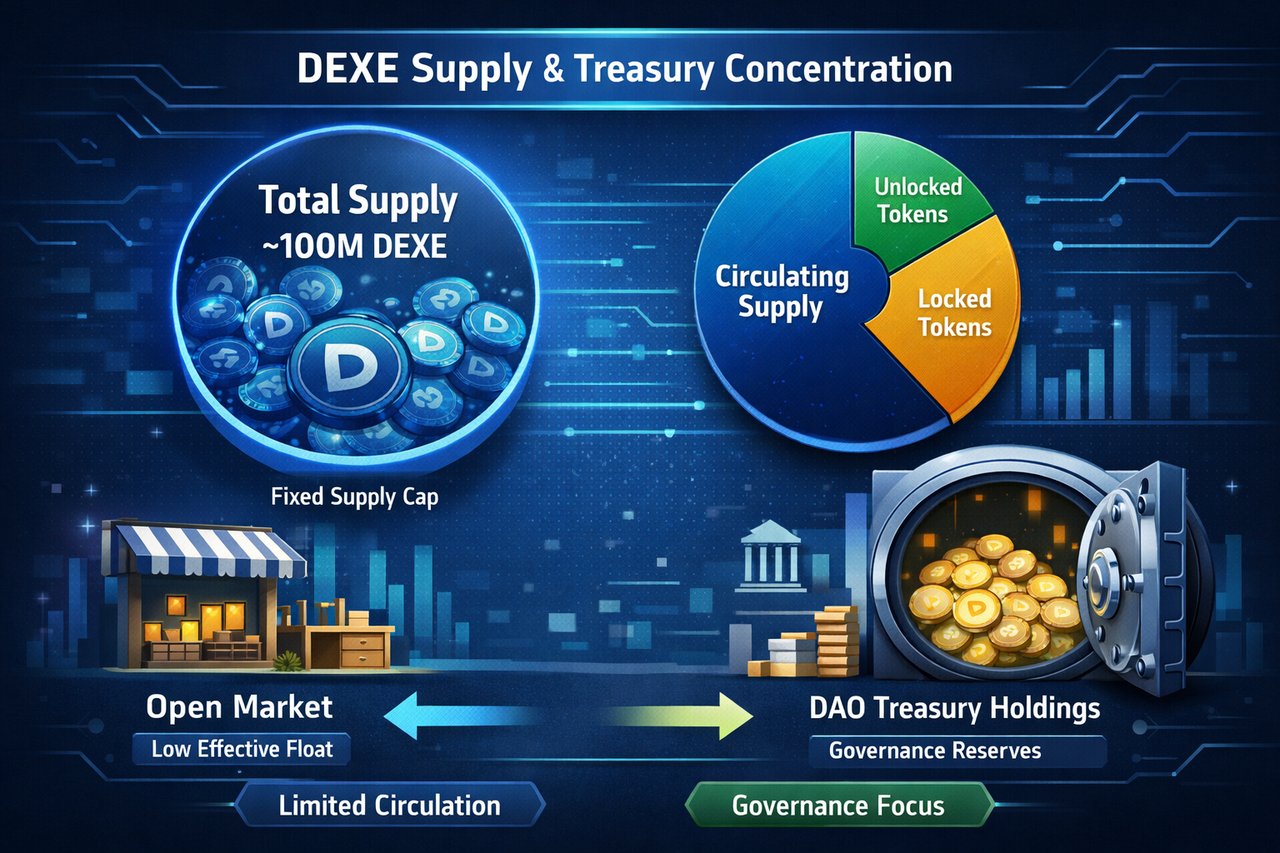
DEXE follows a near-fixed supply model, with total supply designed around approximately 100 million tokens. Most of this supply has already been issued, placing DEXE in a mature supply phase rather than an inflation-driven stage.
A defining characteristic of the current distribution structure is the concentration of tokens within governance systems and DAO treasuries rather than in freely circulating markets. This reduces effective liquidity and shifts the focus toward governance participation as a key driver of token dynamics.
| Supply Component |
Description |
Impact |
| Total Supply |
~100M DEXE |
Defines maximum token availability |
| Circulating Supply |
Majority emitted but partially locked |
Limits immediate selling pressure |
| Treasury Holdings |
Significant share held in DAO treasury |
Centralizes allocation via governance |
| Effective Float |
Lower than visible supply |
Amplifies demand-driven price movements |
This structure changes how supply is interpreted: instead of focusing on emissions, attention shifts toward treasury control and governance-driven distribution.
DEXE operates with a largely emitted supply where treasury-held tokens and governance participation reduce effective circulation and shape market behavior.
DEXE incentive mechanisms and emission logic
DEXE uses a governance-driven incentive model, where rewards are distributed through treasury decisions rather than continuous emissions. This design aligns incentives with meaningful participation and long-term ecosystem development.
Participants may receive incentives for governance-related actions that contribute to ecosystem growth and coordination:
-
Creating accepted proposals rewards valuable contributions and improves governance quality
-
Voting on decisions encourages active participation and strengthens collective input
-
Executing approved actions ensures decisions are implemented effectively
-
Supporting ecosystem growth incentivizes development, coordination, and strategic contributions
This structure aligns rewards with meaningful participation, linking incentives to governance effectiveness rather than passive activity.
| Incentive Type |
Mechanism |
Outcome |
| Proposal rewards |
Allocated for accepted proposals |
Encourages quality contributions |
| Voting rewards |
Distributed for successful participation |
Strengthens governance engagement |
| Execution rewards |
Given for completing actions |
Ensures operational follow-through |
| Delegation rewards |
Shared between users and experts |
Supports expertise-driven governance |
Unlike inflation-based systems, this model ties rewards to outcomes rather than activity alone. It encourages active participation while reducing unnecessary token emissions.
DEXE distributes incentives through governance-controlled treasury allocation, linking rewards to participation quality and ecosystem contribution.
DEXE lockup design and value capture
DEXE tokenomics incorporates lockups and governance participation as key mechanisms that influence supply dynamics and value capture. A significant portion of tokens remains held within treasury contracts or governance processes, limiting liquid supply and reinforcing long-term engagement.
Lockup mechanisms in DEXE are designed to reinforce long-term participation and reduce short-term speculative pressure within the system. These mechanisms include:
-
Governance participation requirements where tokens are committed to voting or proposal processes, limiting immediate liquidity
-
Delegation-based voting structures that often involve holding or assigning tokens within governance frameworks
-
Treasury-controlled reserves where a significant portion of supply is held and deployed through collective decisions
These mechanisms contribute to a reduced effective circulating supply while aligning participants with long-term governance outcomes.
Value capture in DEXE is primarily indirect and closely tied to governance influence rather than direct revenue distribution. Instead of distributing profits, the system derives value through control and coordination over shared resources:
-
Control over treasury allocation, allowing participants to influence how capital is deployed across the ecosystem
-
Participation in protocol decision-making, shaping upgrades, incentives, and strategic direction
-
Growth of the DeXe ecosystem, where increased adoption expands the importance of governance coordination
-
Governance-driven supply management mechanisms, including decisions that may affect token distribution or long-term supply dynamics
Together, these elements position DEXE as a governance-based asset, where value is derived from influence, participation, and the ability to coordinate resources within a decentralized system.
This model treats DEXE as a coordination asset, where value is derived from influence over shared resources rather than direct yield generation.
DEXE captures value through governance influence, treasury control, and reduced circulating supply via lockups and participation.
Advantages and risks of DEXE tokenomics
DEXE tokenomics adopts a governance-centric structure that emphasizes participation, treasury coordination, and reduced reliance on emissions. This design introduces clear strengths while also creating trade-offs related to system complexity and governance dynamics.
Advantages
-
Mature supply structure With most tokens already issued, DEXE operates with limited inflation pressure, shifting focus from emissions to governance-driven dynamics.
-
Treasury-driven allocation Resources are distributed through DAO governance, allowing flexible funding of ecosystem initiatives, incentives, and development activities.
-
Participation-based value Token utility is tied to governance engagement, encouraging active contribution rather than passive holding.
-
Reduced effective float Treasury reserves and governance-related lockups limit circulating supply, which can influence market behavior and increase sensitivity to demand.
Risks
-
Treasury concentration A significant portion of tokens is controlled within governance systems, making outcomes highly dependent on collective decision quality.
-
Governance imbalance Delegation structures and participation patterns may concentrate influence among a smaller group of active participants or experts.
-
Adoption dependency The value of DEXE is closely linked to the growth and usage of the DeXe ecosystem and its governance infrastructure.
-
Complex incentive design Governance-based reward mechanisms require careful calibration to maintain alignment, as poorly designed incentives can reduce efficiency or participation quality.
Overall, DEXE tokenomics reflects a shift toward governance-driven economic design, balancing reduced emissions with reliance on participation, treasury management, and system configuration.
Conclusion
DEXE tokenomics reflects a transition from emission-driven token models toward governance-centered economic systems, where supply dynamics and incentives are closely tied to participation and coordination. By concentrating on a significant portion of tokens within treasury structures and distributing rewards through governance processes, it creates a system where decision-making and resource allocation are directly interconnected.
This design positions DEXE as a coordination layer within decentralized ecosystems, where value is derived from governance influence, treasury control, and ecosystem growth rather than continuous token issuance.
As a result, DEXE functions as a governance-driven asset that aligns incentives, participation, and resource management within a structured DAO framework, supporting long-term coordination and scalability in decentralized systems.
FAQs
What is the total supply of DEXE?
DEXE has a total supply of approximately 100 million tokens, with most of the supply already issued and a significant portion held in governance and treasury systems.
Is DEXE inflationary?
DEXE does not rely on continuous emissions; instead, token distribution is primarily governed through treasury allocation and governance decisions.
What drives DEXE value?
DEXE derives value from governance participation, influence over treasury allocation, and the growth and adoption of the DeXe ecosystem.
Are DEXE tokens locked?
Yes, a substantial number of tokens are held within treasury contracts or governance processes, reducing effective circulating supply.
What is the main risk in DEXE tokenomics?
Key risks include treasury concentration, potential governance imbalance, and dependence on ecosystem growth and active participation.