As the DeFi ecosystem continues to evolve, competition among protocols is no longer limited to technical performance or liquidity scale. Governance structure has become a key factor in determining long-term value. Compared with centralized operational models, decentralized governance improves transparency and censorship resistance while allowing community members to participate directly in protocol development. This shifts users from passive participants to active stakeholders.
From the perspective of blockchain and digital asset development, governance mechanisms are evolving from simple voting tools into more complex economic systems. By integrating the BARD token with security, yield, and governance rights, Lombard not only strengthens protocol security but also embeds clear economic incentives into governance actions. This design reflects a broader transition in DeFi from functional systems to institutional frameworks, offering a more sustainable governance model for cross-chain infrastructure.
Lombard’s Decentralized Governance Architecture
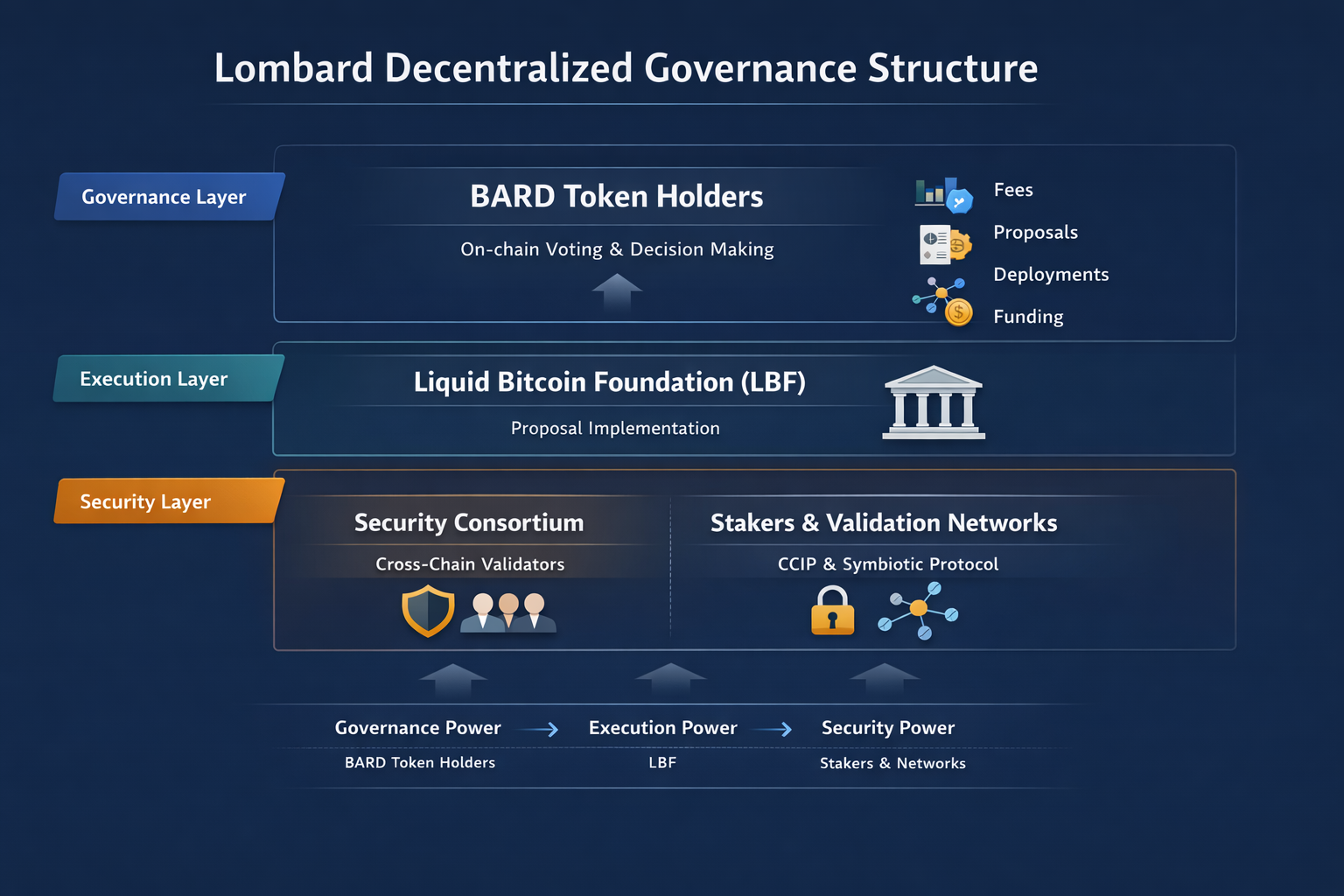
Lombard’s governance system is not a single DAO but a composite structure consisting of a governance layer, execution layer, and security layer, with the Liquid Bitcoin Foundation (LBF) acting as the central coordination hub.
At the governance layer, BARD holders participate in protocol decisions through on-chain voting. These decisions include fee structures, product roadmaps, chain deployments, and ecosystem fund allocation.
At the execution layer, LBF acts as the governance executor, responsible for translating approved proposals into concrete actions. This design addresses a common issue in DAOs where decisions are approved but difficult to implement, ensuring that governance outcomes can be executed effectively.
At the security layer, Lombard relies on a Security Consortium and an on-chain validation network to maintain system integrity. The consortium consists of multiple institutions and participates in the verification and approval of cross-chain transactions.
Overall, this architecture has three key characteristics:
-
Governance authority is held by BARD holders
-
Execution authority is handled by LBF
-
Security responsibility is maintained by stakers and the validation network
This layered structure creates a balance between decentralization and execution efficiency.
Core Role of the BARD Token in Governance Distribution
BARD is not a traditional governance-only token but a core coordination mechanism that operates across the entire protocol.
Its role can be understood across three dimensions:
-
At the governance level, BARD serves as the foundational medium for community participation in protocol decisions. Holders can vote on key matters such as protocol upgrades, parameter adjustments, fee models, revenue distribution, new integrations, and ecosystem fund allocation. This ensures that protocol direction is shaped collectively rather than controlled by a single entity.
-
At the security level, BARD is used to establish a cryptoeconomic security framework for cross-chain assets. By staking BARD, participants provide economic guarantees for LBTC cross-chain transfers, forming a dual-layer validation system together with Chainlink CCIP and the Symbiotic network. In the event of anomalies or malicious behavior, staked assets may be subject to slashing, creating strong economic incentives for correct behavior. This means governance participants also take on security responsibilities.
-
At the usage and yield level, BARD extends into an entitlement-enhancing mechanism. Users who hold or stake BARD may receive higher DeFi yields, priority access to new products or features, and fee discounts when using the protocol. This gives the token direct influence over user experience and returns within the ecosystem.
Taken together, this integration of governance rights, security responsibilities, and usage benefits tightly links BARD’s value to Lombard’s growth, reinforcing long-term system stability and participation incentives.
Protocol Upgrades and Optimization: From Proposal to Deployment
Lombard’s governance process is similar to traditional DAOs but places greater emphasis on execution and security validation.
A typical proposal lifecycle includes:
-
Proposal stage: community members or core contributors submit proposals covering technical upgrades, parameter changes, or ecosystem incentives
-
Community discussion: proposals are publicly discussed, revised, and assessed for risk
-
Voting decision: BARD holders vote to approve or reject proposals
-
Execution stage: LBF or multisig mechanisms implement approved proposals, including contract upgrades, parameter changes, and fund allocation
-
Security validation: for cross-chain or asset-related changes, additional checks are required, including CCIP verification, Security Consortium approval, and Symbiotic network monitoring
A key feature of this process is that governance decisions must pass security validation before taking effect. This makes Lombard’s governance not only a decision system but also a security-triggered execution system.
Lombard’s participation model extends beyond traditional DAO voting into a multi-role collaborative structure.
The main participation paths include:
-
Governance participants: holding or staking BARD to participate in proposals and voting
-
Security participants: staking BARD to provide cross-chain security guarantees, participating in validation networks, and earning staking rewards
-
Liquidity and DeFi users: using LBTC in cross-chain DeFi strategies, yield generation, and liquidity provision
-
Developers and ecosystem builders: creating applications or integrations based on Lombard to expand use cases
This multi-dimensional structure transforms users from protocol users into protocol maintainers.
Advantages and Challenges of Decentralized Governance
Lombard’s governance model offers several structural advantages:
Advantages:
-
Transparency, with all key decisions recorded on-chain
-
Alignment of incentives across security, yield, and governance
-
Scalability across multiple chains and assets
-
Resistance to censorship without a single point of control
At the same time, it faces practical challenges:
Challenges:
-
Concentration of governance power among large holders
-
High complexity of proposals, increasing barriers for participation
-
Dependence on institutions such as the security consortium for execution
-
Increased complexity of cross-chain system security
In cross-chain scenarios, governance is not only about who makes decisions but also how those decisions are executed securely.
Conclusion
Lombard’s decentralized governance is not a simple DAO voting mechanism but a system that integrates governance rights, security responsibilities, and economic incentives. Through the combination of the BARD token, the Liquid Bitcoin Foundation, and the CCIP and Symbiotic security framework, the protocol establishes a complete loop from community decision-making to on-chain execution.
As DeFi infrastructure continues to mature, governance structures are becoming a core competitive factor. Lombard’s approach shows that decentralized systems can achieve long-term stability when governance participants also bear security and economic responsibility. This model is not only applicable to Bitcoin cross-chain assets but may also serve as a replicable governance framework for broader Web3 infrastructure.







