What Is Polymarket? How Prediction Markets Work
Polymarket is a blockchain-based prediction market platform that lets users trade on the probability of real-world events—ranging from politics and economics to sports and war. By buying and selling “outcome shares,” users turn their subjective views into price signals, generating what’s known as “collective intelligence.”
Prediction markets operate on three core principles:
- Price as Probability: Market prices directly reflect the expected likelihood of an event.
- Information Aggregation: Participants trade based on their own information and insights.
- Permissionless Participation: Anyone can trade with just a crypto wallet.
However, this model depends fundamentally on fair access to information. When insider information enters the picture, price signals get distorted and the market shifts from a “prediction tool” to an “arbitrage tool.”
Rule Update Background: Escalating Insider Trading Concerns
Recently, concerns about insider trading in prediction markets have surged. Typical cases involve accounts placing highly accurate bets just before major events, generating substantial profits in very short periods. These trades often share several characteristics:
- Newly registered accounts with no previous track record
- Trading times that closely coincide with the event itself
- Multiple accounts coordinating their actions
Before certain geopolitical events, related bets were placed in advance and quickly paid out, fueling widespread suspicion of information leaks. At the same time, US regulators have started paying attention to this sector, even pushing for dedicated legislation to prevent participants with non-public information from entering prediction markets.
Against this backdrop, Polymarket’s latest rule update is a direct response to both external regulatory pressure and internal risk management needs.
Three Types of Insider Trading Explained
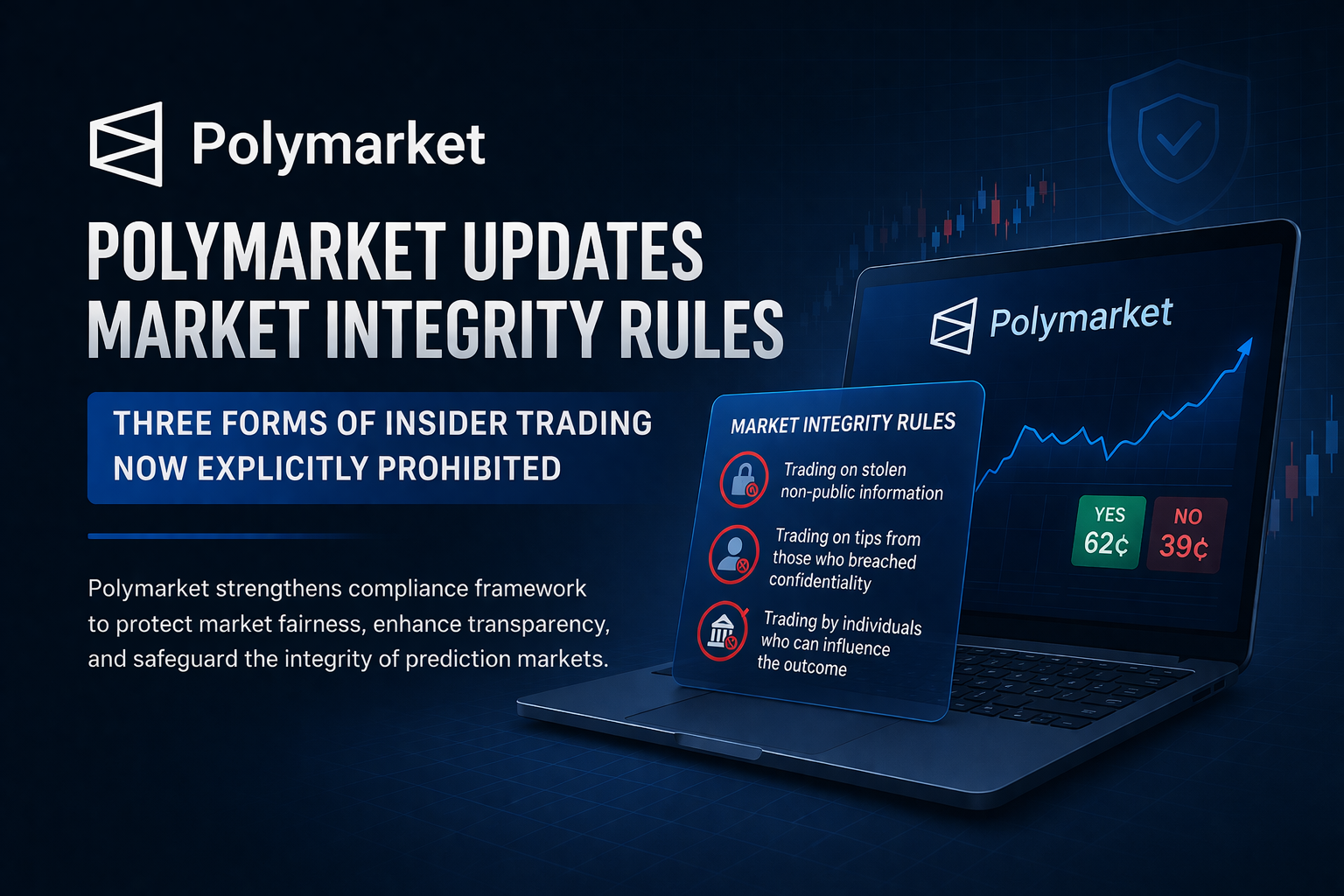
Under the new rules, Polymarket explicitly prohibits three types of insider trading:
-
If you possess information obtained by breaching trust or confidentiality—such as internal documents or undisclosed decisions—you may not use it for trading.
This aligns with traditional financial regulations on “illegally obtained insider information” and underscores the need for legitimate information sources.
-
Even if you didn’t steal the information yourself, if the source violated confidentiality and you “know or should know,” such trades are also banned.
This introduces the concept of “indirect insider trading,” broadening the scope of regulation.
-
Trading by Participants Who Can Influence Event Outcomes
If you have the power to influence an event’s outcome—such as a government official or corporate decision-maker—you are prohibited from participating in related markets. This addresses one of the most contentious scenarios in prediction markets: being both a participant and a bettor.
Together, these three categories create a robust framework for identifying insider trading, covering the spectrum from information sourcing and dissemination to direct influence over results.
Key Changes in Rule Upgrade and Technical Implications
This update goes beyond rule changes—it also improves market structure:
- Clearer Settlement Standards: Establishes precise criteria for determining event outcomes
- Transparent Data Sources: Reduces disputes over settlement
- Stronger Surveillance Mechanisms: Enhances detection of suspicious trading activity
The core goal is to make the market more “verifiable.” Technically, prediction markets have always faced a challenge: while on-chain transactions are transparent, the sources of information are not.
This rule upgrade aims to address those “information layer vulnerabilities” that technology alone cannot solve, by introducing stronger institutional controls.
Prediction markets are fundamentally about pricing information. However, their structure naturally amplifies information asymmetry:
- High Anonymity: Users can participate without identity verification, making insider trading easier.
- Strong Information Externality: Critical data often comes from off-chain sources—political, military, or corporate decisions.
- High-Leverage Returns: Accurate predictions can yield extremely high profits, incentivizing the use of insider information.
Research and case studies show that when a few participants hold privileged information, market prices can quickly become distorted, sometimes creating a “false consensus.”
In other words, prediction markets aren’t always “collective wisdom”—sometimes they function more like “information monopolies.”
Prediction markets currently operate in a regulatory gray area:
- Legally, some are treated as gambling.
- Functionally, they resemble financial derivatives.
- Technologically, they rely on cryptographic infrastructure.
This makes traditional regulatory frameworks difficult to apply directly.
However, the direction is clear:
- Legislators are getting involved (e.g., the Prediction Market Integrity Act).
- Platforms are strengthening self-regulation (as with this rule update).
- Monitoring is increasing (on-chain analytics, behavioral detection).
It’s clear that prediction markets will gradually be brought under regulatory regimes similar to those governing securities markets.
Where Are Prediction Markets Headed?
Polymarket’s rule update sends three clear signals:
-
Prediction Markets Are Becoming Financialized
They are evolving from free-form betting tools into regulated trading venues.
-
Compliance Is the New Competitive Edge
Future competition among platforms will center not just on liquidity, but on compliance capabilities.
-
Platforms that provide the most reliable data sources will command the greatest pricing power.
In the long run, prediction markets may split into two paths:
- Compliance-Driven: Moving closer to traditional finance and regulatory oversight
- Decentralized: Emphasizing anonymity and freedom, but accepting higher risks
Polymarket’s approach clearly favors the compliance-driven path.
Conclusion
This rule update represents a critical “institutional upgrade” in the evolution of prediction markets. As these markets grow in size, capital, and influence, previously overlooked issues—especially insider trading—inevitably come to the surface.
By clearly defining three types of prohibited activity, Polymarket has set a new industry baseline. But this is only the beginning.
For prediction markets to truly become a core “information infrastructure,” ongoing innovation in both technology and regulation will be essential.







