As the blockchain ecosystem transitions from single-chain development to a multi-chain landscape, the need for interoperability between assets and applications on different chains is accelerating rapidly. Bitcoin, Ethereum, and other public blockchains each maintain independent asset systems and user communities, but these assets typically cannot move freely across chains. This makes cross-chain infrastructure an essential bridge connecting the multi-chain ecosystem.
For both asset transfers and Cross-Chain Transactions, users rely on cross-chain protocols to facilitate value transfer between chains. Without efficient cross-chain infrastructure, liquidity within a multi-chain ecosystem becomes fragmented, reducing asset utilization efficiency. As a result, Bridges and cross-chain liquidity protocols are emerging as critical components of DeFi infrastructure. THORChain introduces a new cross-chain liquidity solution in this context.
THORChain’s Unique Role in Cross-Chain Liquidity
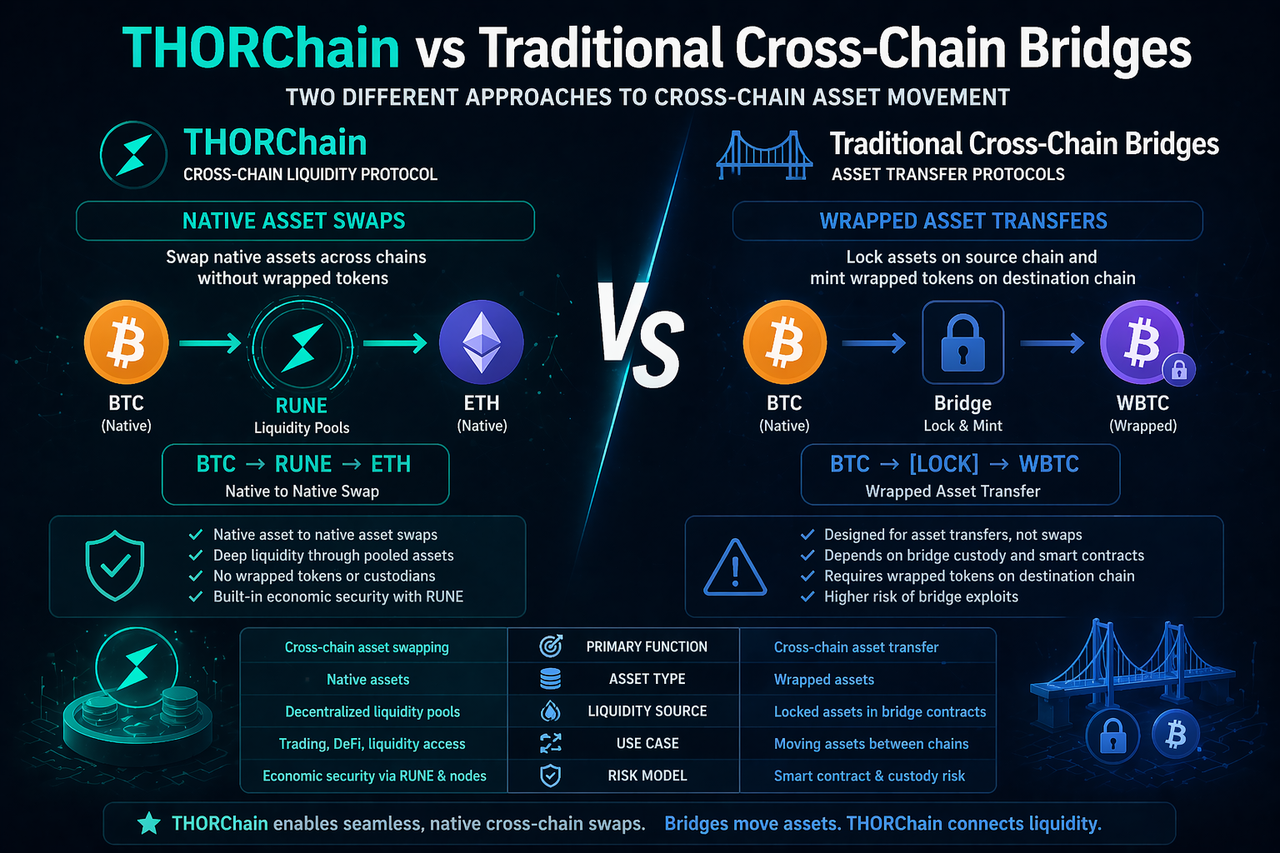
Within the cross-chain infrastructure sector, traditional Bridges primarily address “asset transfer,” while THORChain is focused on “native asset swaps.” Conventional bridging protocols are designed to map assets from one chain to another. In contrast, THORChain empowers users to swap native assets directly across blockchains.
This distinction gives THORChain a unique position in the cross-chain liquidity arena. It not only solves the problem of cross-chain asset transfers but also enables native asset swaps via liquidity pools, bridging decentralized trading and cross-chain infrastructure. This approach delivers more efficient asset flows for multi-chain DeFi and establishes THORChain as a leading cross-chain liquidity protocol.
How Do Traditional Bridges Operate?
Traditional Bridges typically function by “locking native assets and minting wrapped assets.” For example, when a user transfers BTC to the Ethereum network, the Bridge first locks BTC in a custodial address on the Bitcoin chain, then mints an equivalent amount of WBTC on Ethereum, which users can utilize within the Ethereum ecosystem.
While this model enables cross-chain asset transfers, users actually hold wrapped—not native—assets. This approach increases asset accessibility across chains but introduces custodial and bridge contract risks, since the value of wrapped assets depends on the security of the Bridge’s locked collateral.
How Does THORChain Enable Native Cross-Chain Swaps?
THORChain employs a different mechanism, utilizing liquidity pools and RUNE as a settlement asset to facilitate native cross-chain swaps. When a user wants to swap BTC for ETH, the protocol routes the transaction through BTC/RUNE and ETH/RUNE liquidity pools—executing the path BTC → RUNE → ETH.
This model allows users to swap BTC and ETH as native assets directly, without converting BTC into a wrapped token. THORChain settles assets through decentralized liquidity pools and a node network, making cross-chain asset movement more direct and reducing reliance on wrapped assets.
Key Differences: THORChain vs. Traditional Bridges
The fundamental distinction between THORChain and traditional Bridges lies in asset handling and protocol objectives. Traditional Bridges facilitate asset transfers between chains, while THORChain enables direct native asset swaps using liquidity pools.
| Comparison |
THORChain |
Traditional Bridge |
| Core Function |
Native asset cross-chain swap |
Cross-chain asset transfer |
| Asset Type |
Native asset |
Wrapped asset |
| Swap Method |
Liquidity pool swap |
Lock & mint wrapped asset |
| Wrapped Asset Requirement |
Not required |
Required |
| Liquidity Source |
Decentralized liquidity pool |
Bridge asset reserves |
| Main Use Case |
Cross-chain trading |
Cross-chain transfer |
| User Experience |
Direct asset swap |
Bridge before trading |
| Main Risks |
Liquidity & protocol risk |
Contract & custodial risk |
From an asset perspective, traditional Bridges depend on wrapped assets, meaning users hold mapped tokens on the target chain. THORChain supports native asset swaps, avoiding the complexity of wrapped tokens. In terms of liquidity, traditional Bridges rely on bridge reserves, while THORChain leverages decentralized liquidity pools for asset depth. These distinctions highlight the fundamental differences in their functional roles and liquidity mechanics.
What Are THORChain’s Advantages Over Traditional Bridges?
THORChain’s primary advantage is enabling direct native asset swaps, streamlining the user experience. Traditional bridging often requires multiple steps—bridging assets to the target chain before trading—while THORChain completes cross-chain swaps in a single transaction, increasing trading efficiency.
Additionally, THORChain aggregates cross-chain liquidity through liquidity pools, allowing assets on different chains to be swapped directly. This design enhances cross-chain asset utilization and reduces reliance on wrapped assets, making THORChain particularly advantageous in multi-chain DeFi environments.
Conclusion: THORChain or Traditional Bridges—Which Is Better for Cross-Chain Trading?
THORChain and traditional Bridges each address different cross-chain needs. Traditional Bridges are mainly used for asset migration, enabling assets to enter other ecosystems via locking and mapping. THORChain enables direct native asset swaps through liquidity pools, making it better suited for cross-chain trading.
As the multi-chain ecosystem expands and demand for cross-chain liquidity rises, THORChain’s native asset swap model is demonstrating superior liquidity efficiency. For users seeking cross-chain asset trading, THORChain offers a more efficient solution, while traditional Bridges remain essential for asset migration scenarios.
FAQs
What distinguishes THORChain from traditional Bridges?
THORChain supports direct native asset swaps, while traditional Bridges primarily rely on locking and minting wrapped assets for cross-chain transfers.
Why doesn’t THORChain require wrapped assets?
Because THORChain uses RUNE liquidity pools as a settlement asset, enabling direct swaps between native assets.
When are traditional Bridges most suitable?
Traditional Bridges are most suitable for transferring assets from one chain to another for use within the target chain’s ecosystem.
When is THORChain the better choice?
THORChain is optimal for cross-chain asset trading scenarios, such as swapping BTC directly for ETH without the need for wrapped assets.







