


94-year-old Zhang Zhongmou's "secret meeting" with Jensen Huang, what signals are TSMC and NVIDIA sending?
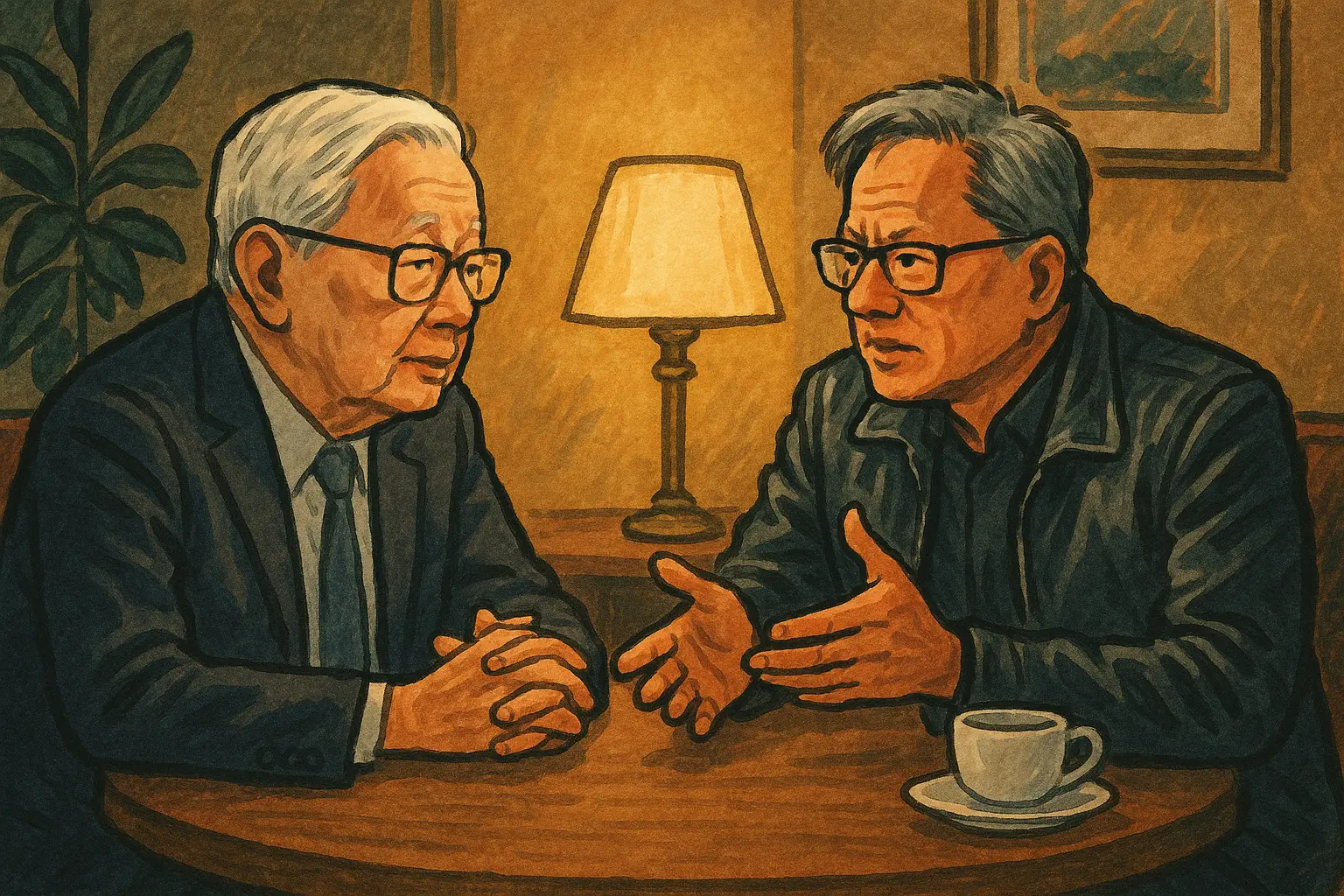
Jensen Huang makes a rare appearance in Taipei to meet with Morris Chang, sitting in a wheelchair for the first time in his 94 years. TSMC’s Q4 revenue hits $33.7 billion, totaling $122 billion for the year, with a market value of $1.8 trillion. The combined valuation of the two companies exceeds $6 trillion. Wei Zhejia announces a $56 billion global expansion plan for 2026.
30 Years of Friendship from Pizza Bookstore to Wheelchair Secret Meeting
Although Jensen Huang is a billionaire, in front of Morris Chang, he behaves like a student. Their relationship spans nearly 30 years as a “friendship across generations.” Rewind to 1997, when NVIDIA was just a young company struggling to find foundry support and repeatedly rejected. Huang had the courage to write a letter to Morris Chang, expecting it to go unanswered, but unexpectedly, Chang personally returned the call.
At that time, Huang was arguing with employees in his office when he heard it was Morris Chang calling. He immediately quieted the room. That call marked the beginning of their “honeymoon period.” Huang once emotionally said, “Without TSMC, there would be no NVIDIA.” This was not just politeness; in NVIDIA’s early days, without TSMC’s foundry support, it would have been impossible to compete with rivals like ATI. TSMC’s process technology and capacity were critical foundations for NVIDIA’s rise.
But friendship is one thing, business is another. In 2009, TSMC faced a disaster with its 40nm process, with extremely low yields, causing NVIDIA huge losses. Huang was so upset he publicly criticized TSMC. At that time, Morris Chang had just resumed his role as CEO. Seeing the situation, he knew that sending emails wouldn’t solve the problem.
Morris is also a tough character. He flew directly to Silicon Valley and invited Huang to his home. No formal business dinner—just in Huang’s study, eating pizza and salad, Morris offered a compensation plan worth over a billion dollars. “Take 48 hours to consider, or go to arbitration.” And Huang signed within two days. This crisis not only didn’t break their relationship but made it even stronger. Later, Morris even twice invited Huang to become TSMC’s CEO, though Huang politely declined, showing his trust in Morris.
Timeline of the 30-Year Friendship Between Morris Chang and Jensen Huang
1997: Morris Chang personally responds to NVIDIA’s foundry order, initiating cooperation
2009: 40nm yield crisis, Morris flies to Silicon Valley to negotiate billion-dollar compensation
Two Invitations: Morris invites Huang to be TSMC CEO, both declined
2026: 94-year-old Morris Chang in a wheelchair meets to discuss AI computing expansion needs
Today, one a giant in GPU, the other a dominant global foundry leader. This dinner is not just a reunion of friends but also a discussion on how AI computing demand is shaping chip manufacturing. NVIDIA’s GPU demand is exploding, and TSMC is the only manufacturer capable of mass-producing advanced process chips at scale. Their interests are deeply intertwined. Although Morris has retired, his appearance signals his concern for TSMC’s AI-era strategy.
TSMC’s Earnings Explode, AI Revenue Breaks 10%
TSMC just reported an “explosive” quarter. In Q4 2025, revenue hit $33.7 billion, up 25.5% year-over-year, with annual revenue reaching $122 billion and a market cap surpassing $1.8 trillion. NVIDIA and TSMC together are valued at over $6 trillion. This figure exceeds the GDP of most countries, illustrating their dominance in the AI era.
Specifically, in Q4 2025, 3nm process contributed 28% of TSMC’s wafer revenue, while 5nm and 7nm accounted for 35% and 14%, respectively. Advanced processes (7nm and below) made up 77% of total wafer revenue. This structure shows TSMC’s revenue increasingly concentrates on cutting-edge technology, with high-margin businesses driving an impressive net profit margin of 47.5% (16 billion net profit / 33.7 billion revenue).
Wei Zhejia’s remarks at the meeting injected strong confidence into the AI industry. He said, “Honestly, I’m also nervous. We plan to invest between $52 billion and $56 billion in capital expenditures. If we’re not careful, it could be a disaster for TSMC.” But he quickly added that he asked cloud service giants, and the conclusion was they made huge money from AI, and they have even more money than TSMC.
Wei Zhejia’s calculation is precise: the world is now competing fiercely for computing power. NVIDIA’s GPUs are in short supply, and TSMC can ride the AI wave by manufacturing these chips. Moreover, AI’s accelerated growth in 2025 has already contributed over 10% of total revenue. While 10% may seem modest, considering TSMC’s annual revenue of $122 billion, that’s $12.2 billion—more than many semiconductor companies’ entire yearly revenue.
Regarding concerns about AI causing power shortages, Wei Zhejia said that cloud service customers told him that power supply issues had been planned for five or six years. The real bottleneck now is TSMC’s chip capacity. They told Wei Zhejia not to worry about other issues but to first solve the chip supply problem. This reveals the current power structure in the AI industry chain: downstream customers (cloud providers) are wealthy and demand high, while upstream suppliers (TSMC) have become the bottleneck.
Wei Zhejia’s $56 Billion Gamble on Global Factory Expansion
TSMC’s capital expenditure in 2026 is expected to reach between $52 billion and $56 billion. About 70%-80% of this will be invested in advanced processes. That’s like burning nearly 400 billion RMB in a year. This scale of investment is extremely rare in manufacturing history, equivalent to building dozens of advanced wafer fabs.
Under Wei Zhejia’s strategic layout, TSMC is rapidly building factories worldwide. Sites in Arizona, Kumamoto in Japan, Dresden in Germany—everywhere are TSMC’s construction sites. His goal is to create a global “wafer empire.” This global deployment is not only a strategy to diversify against geopolitical risks but also a compromise to meet local government demands.
Now, Morris Chang has long stepped back from the spotlight, and TSMC has entered the “Wei Zhejia era.” Facing the insane demand from AI, the current leader Wei Zhejia is aggressively expanding manufacturing capacity worldwide. He openly admits that their cloud clients are wealthier than they are, and the AI demand is real. Although Morris has retired, the system and culture he built continue to drive this finely tuned machine at high speed.
The dinner between Morris Chang and Jensen Huang is not just about sentiment but also laying the foundation for their two companies’ powerful alliance in the AI era. The 94-year-old in a wheelchair attending underscores the importance of this meeting. These two semiconductor legends are endorsing the TSMC-NVIDIA alliance in the AI age in this special way.
Related Articles
US Spot Bitcoin ETFs See Renewed Inflows as Selling Pressure Eases
The value of Bitcoin ETF assets held by Harvard University exceeds the value of the Google stock assets it holds.
Victory Securities suspends virtual currency trading functions for users identified as Mainland China
No FTX-style collapse! Chainlink Founder: RWA on the blockchain is unaffected by coin prices
Ark Invest continued to increase its holdings of the $183 million Bullish stock on Monday, which then surged over 16% in a single day.
Stripe's valuation soars to $140 billion! Acquisition offers continue to surge, yet they still refuse to go public