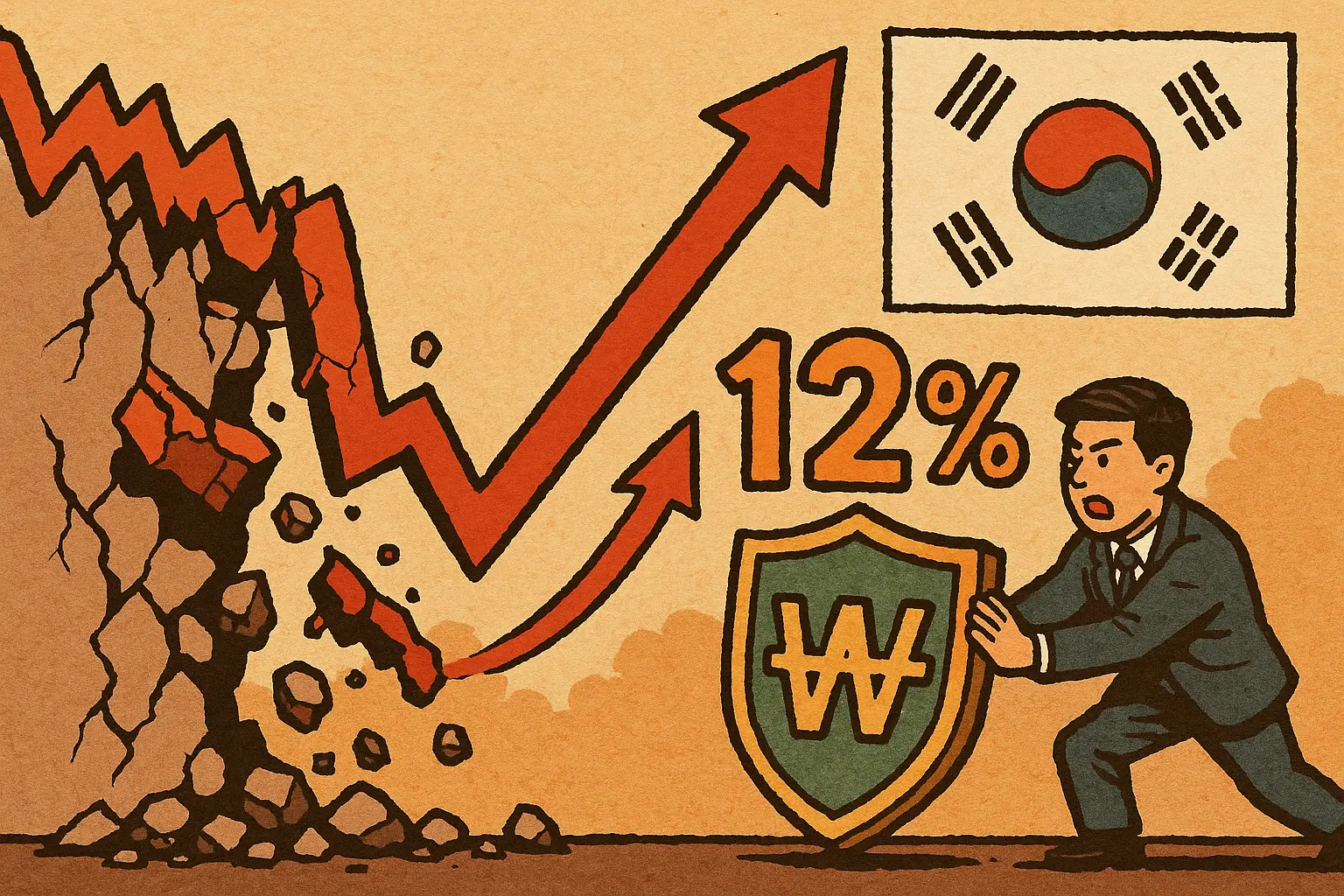
After the Korea Composite Stock Price Index (KOSPI) triggered the circuit breaker due to a sharp plunge, it experienced a strong rebound on March 5, rising nearly 12% intraday — the largest intraday gain since October 2008. Following an emergency coordination meeting on Wednesday, the Bank of Korea and the Ministry of Finance announced that if market volatility spirals out of control again, they will actively implement a market stabilization plan with a scale of up to 100 trillion won.
V-shaped recovery after the largest decline in history: chip stocks lead the rally
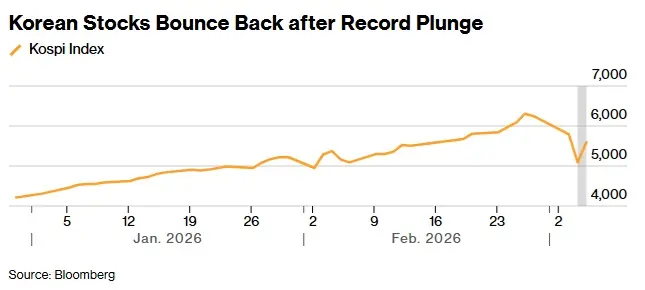
(Source: Bloomberg)
KOSPI’s rebound on Thursday nearly fully recovered the previous day’s losses, driven mainly by foreign and retail investors rushing to buy the dip. Samsung Electronics and SK Hynix, both semiconductor manufacturers, rose over 13%, leading the index’s strong rebound. Since the start of this year, these two companies have been the core drivers of South Korea’s stock market’s leading gains globally.
Notably, local institutional investors continued selling in the early hours of Thursday, showing a clear divergence from foreign and retail investors who were buying, indicating ongoing disagreement among institutions about the market’s future direction. Regulators also temporarily paused program trading on KOSPI and KOSDAQ after futures surged sharply to control volatility risks.
Earlier this week, the steep decline was mainly driven by soaring oil prices triggered by US-Iran tensions, with fears of rising inflation and economic slowdown sparking panic selling. South Korea’s market was hit hardest during this Asian sell-off, partly due to the risk of “crowded trades” accumulated after previous gains, with leveraged positions being liquidated, significantly amplifying the decline.
South Korea’s government stabilization mechanism: analysis of the 100 trillion won plan
Lee Eog-weon, Chairman of the Financial Services Commission, stated after the emergency meeting that the government will closely monitor market fluctuations and actively activate the stabilization plan if necessary.
The confirmed government response measures include:
100 trillion won Market Stabilization Fund: Ready for deployment when excessive volatility occurs, injecting liquidity through purchases of stocks, ETFs, and other market instruments.
Strict penalties for market disruption: Authorities will monitor violations during volatile periods and impose severe sanctions.
Joint coordination between the Bank of Korea and the Ministry of Finance: They held an emergency meeting on Wednesday to assess the current market situation and unify policy responses.
Participants generally believe that, given expectations of improving corporate earnings, active capital market policies, and ongoing capital inflows, the likelihood of a “trend decline” in the Korean stock market remains relatively low.
Institutional perspectives: technical rebound or genuine turning point?
Despite the strong rebound on Thursday, market institutions remain divided on the outlook.
Gerald Gan, Chief Investment Officer at Reed Capital Partners in Singapore, said the rally mainly reflects technical traders buying the dip after the market fell nearly 20% from its high. It’s still unclear whether this marks a genuine turning point for further gains or just a bear market rally, especially amid escalating Middle East geopolitical tensions.
Rob Li, Managing Partner at Amont Partners in New York, holds a more optimistic view, believing that the recent two-day sell-off was driven by position adjustments rather than deteriorating fundamentals. He noted that after the sharp correction, there are selective buying opportunities in Korean stocks, highlighting SK Hynix as a good buy due to its strong free cash flow and reasonable valuation.
Despite the volatility this week, the KOSPI has still gained over 30% year-to-date, indicating that the long-term market structure has not fundamentally changed due to this event.
Frequently Asked Questions
Q: What was the main reason for South Korea’s stock market’s largest single-day decline on Wednesday?
The plunge was mainly triggered by soaring oil prices caused by US-Iran tensions, with fears of rising inflation and economic slowdown fueling panic selling. The Korean market had previously experienced significant gains, accumulating crowded trades with high leverage, and the liquidation of these positions further amplified the decline, resulting in the largest single-day drop in KOSPI history.
Q: How does South Korea’s 100 trillion won market stabilization plan work?
This plan is a preemptive market intervention mechanism coordinated by the Financial Services Commission, with a scale of about 100 trillion won (roughly 530 billion RMB). When excessive market volatility occurs, liquidity can be injected by purchasing stocks, ETFs, and other market instruments to stabilize confidence and curb irrational selling.
Q: Has the overall performance of KOSPI since the beginning of the year been fundamentally affected by this week’s plunge?
Although this week saw the largest single-day decline and a strong rebound afterward, the KOSPI has still risen over 30% this year. The AI trading boom and corporate governance reforms remain core drivers supporting the Korean stock market, but ongoing developments in Middle East geopolitics continue to be major uncertainties for the future outlook.
Disclaimer: The information on this page may come from third parties and does not represent the views or opinions of Gate. The content displayed on this page is for reference only and does not constitute any financial, investment, or legal advice. Gate does not guarantee the accuracy or completeness of the information and shall not be liable for any losses arising from the use of this information. Virtual asset investments carry high risks and are subject to significant price volatility. You may lose all of your invested principal. Please fully understand the relevant risks and make prudent decisions based on your own financial situation and risk tolerance. For details, please refer to
Disclaimer.


