
According to a report by Cointelegraph on May 6, market data provider Kaiko released a report on Monday stating that before Robinhood announced multiple token listings, the open interest, funding rates, and on-chain trading patterns in the perpetual futures market showed unusual activity. In the report, Kaiko research analyst Laurens Fraussen asked whether the above phenomena reflect that some traders had pre-positioned their orders before the announcement was published.
The most典型 case: pre-positioning records from address 0xa1E
(Source: Kaiko)
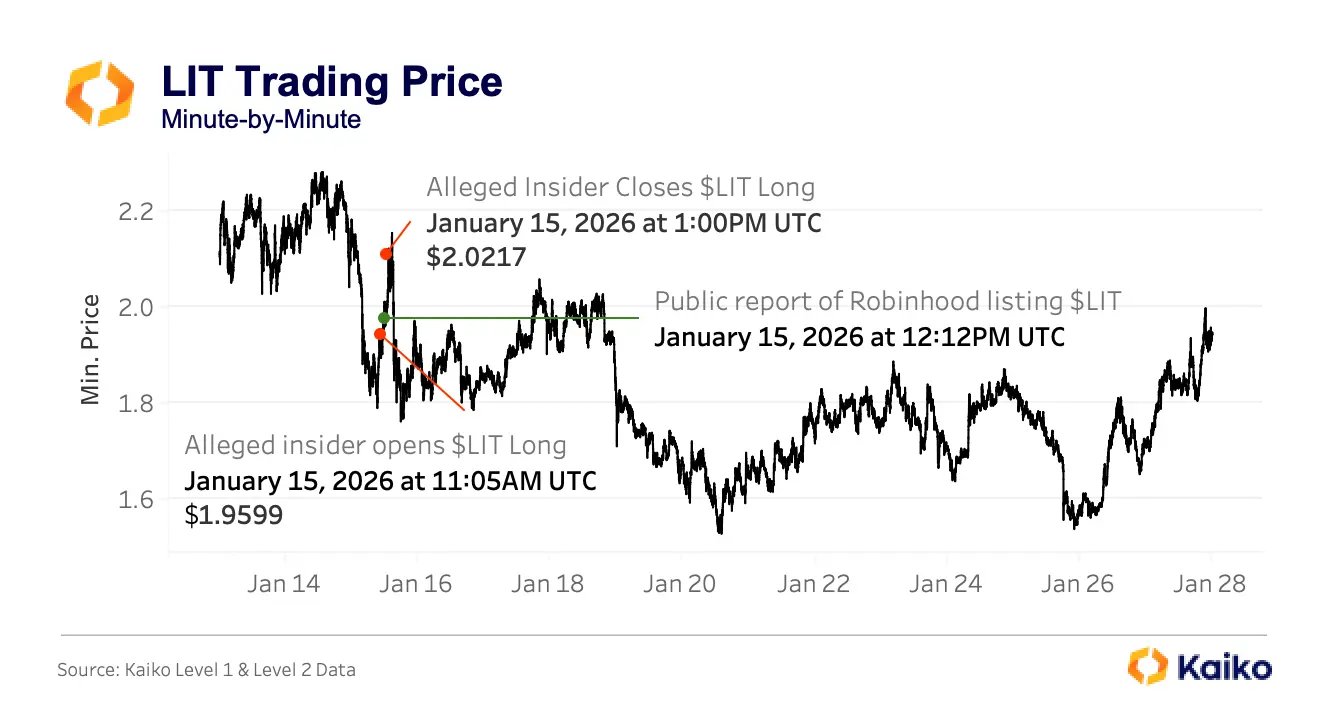
According to Kaiko’s report, the most representative case involves the wallet address “0xa1E”. Kaiko said that on January 15, 2026 at 11:05 UTC, the address opened a long position for the Lighter (LIT) token on the decentralized exchange Hyperliquid, about one hour before Robinhood announced the LIT listing at 12:12 UTC that afternoon; the address then closed the position at around 1:00 PM, approximately 50 minutes after the announcement was released.
According to Kaiko’s report, the same address later opened a short position in a perpetual contract tied to HOOD on April 28. A few hours later, Robinhood’s first-quarter revenue came in below analysts’ expectations; after the HOOD share price fell that day, the address completed the short position close.
Abnormal data before multiple token listings
(Source: Kaiko)
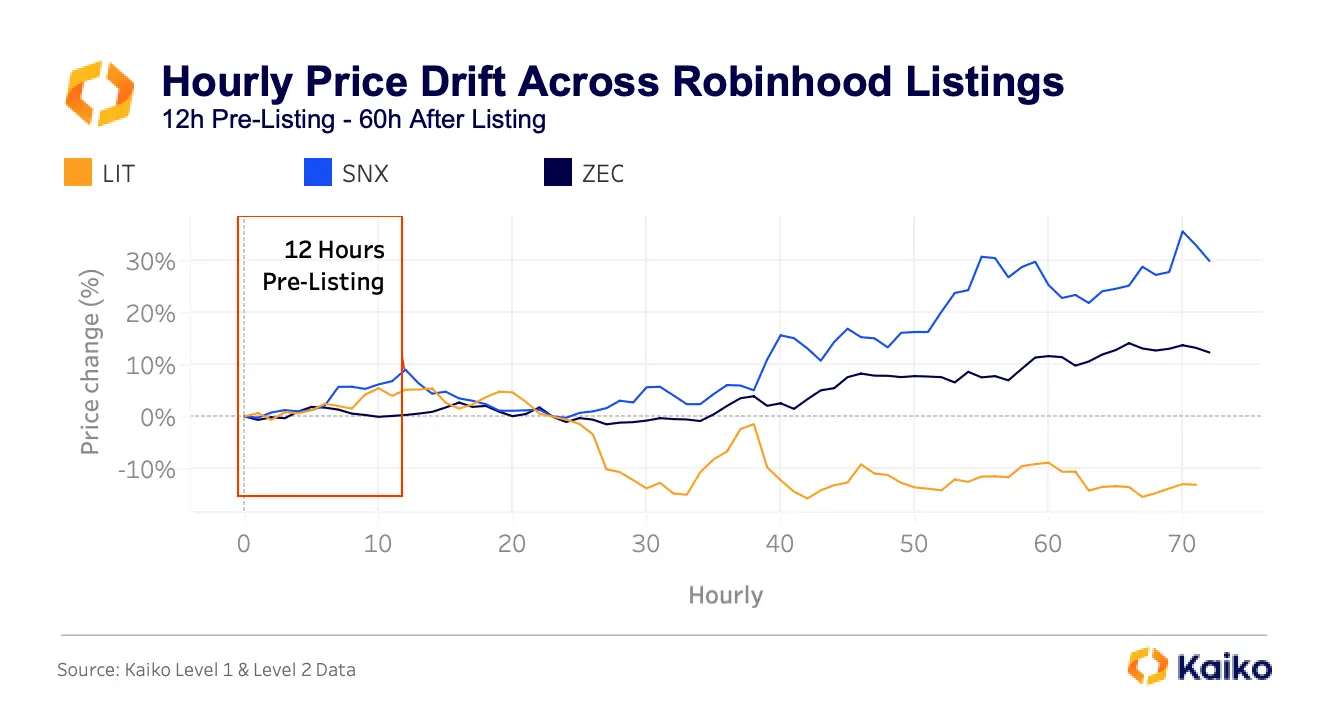
According to Kaiko’s report, before Robinhood announced the listings, multiple tokens showed spikes in open interest and funding rates, including Zcash (ZEC), Synthetix (SNX), and Near Protocol (NEAR). All three tokens experienced price drift before the announcement, and recorded average abnormal returns within a few hours before and after the listing announcement.
According to Kaiko’s report, Fraussen noted that multiple other wallets also carried out similar pre-positioning operations before the listings, and in the report asked: “Did multiple participants obtain the same information before the announcement was published?”
Kaiko analyst’s two interpretations
According to Cointelegraph’s report, Fraussen told Cointelegraph that derivatives indicators show this pre-positioning pattern is statistically consistent and has repeatedly appeared across multiple asset listing events. He said the above phenomena may reflect: “privileged access to Robinhood’s listing pipeline,” or “an extremely reliable front-running strategy built on public signals.”
Fraussen also added that some sophisticated traders may be pre-positioning based on publicly visible market signals—such as spikes in funding rates, increased trading volume, and surges in open interest—rather than relying on non-public information.
Common Questions
When was Kaiko’s report released? What types of trading data does it cover?
According to Cointelegraph’s May 6, 2026 report, Kaiko’s report was released on Monday of this week, and Fraussen provided Cointelegraph with related analysis. The report covers open interest, funding rates, and on-chain trading patterns in the perpetual futures market.
In which two events did address 0xa1E show abnormal pre-positioning?
According to Kaiko’s report, address 0xa1E appeared in two events: first, opening a long position on Hyperliquid about one hour before Robinhood announced the LIT listing; second, opening a short position in a HOOD-perpetual contract a few hours before Robinhood released its first-quarter earnings report that came in below expectations.
How did Kaiko interpret the abnormal pre-positioning?
According to Cointelegraph’s report, Fraussen said the related phenomena may represent “privileged access” to Robinhood’s listing pipeline, or a reliable front-running approach built on public signals. He also noted that sophisticated traders may pre-position based on publicly visible market signals such as funding rates.
Disclaimer: The information on this page may come from third parties and does not represent the views or opinions of Gate. The content displayed on this page is for reference only and does not constitute any financial, investment, or legal advice. Gate does not guarantee the accuracy or completeness of the information and shall not be liable for any losses arising from the use of this information. Virtual asset investments carry high risks and are subject to significant price volatility. You may lose all of your invested principal. Please fully understand the relevant risks and make prudent decisions based on your own financial situation and risk tolerance. For details, please refer to
Disclaimer.
Related Articles
Has the Bitcoin bear market ended? 10x Research: Early starters are already ahead with a 10% profit
10x Research said that early Bitcoin investors have already made about 10% profit; trading volume remains sluggish, and bullish and bearish sentiment are still strong. Open interest has stabilized, but the funding rate is -6.1%, suggesting a large amount of capital has tilted toward short positions, hinting at a possible market reversal. The research believes that new bull markets often quietly begin while most people are still on the sidelines, and it reminds traders to maintain strict risk control and use hedging.
ChainNewsAbmedia1h ago
Bitcoin spot ETF saw net inflows of $467 million, with positive inflows for 4 consecutive days
According to SoSoValue data, as of May 5, 2026, in Eastern Time, the total net inflow of Bitcoin spot ETFs reached $467 million, marking a positive capital inflow for the 4th consecutive day; the same day, the total net inflow of Ethereum spot ETFs reached $97.5728 million.
MarketWhisper1h ago
Trader Loracle Opens $3.2M TON Long Position With 5x Leverage on Hyperliquid as TON Surges 55% in Days
According to BlockBeats, on May 6, Hyperliquid trader Loracle opened a 5x leveraged long position in TON worth $3.2 million as the token broke above $2 this morning. The position, with an average entry price of $1.989, has already generated $180,000 in unrealized gains (27% return). TON surged 55% o
GateNews1h ago
BTC Falls Below $77,472, Major CEX Long Liquidations Hit $2.189B on May 6
According to Coinglass data, if BTC falls below $77,472, cumulative long liquidations on major centralized exchanges would reach $2.189 billion as of May 6. Conversely, if BTC breaks above $84,954, cumulative short liquidations would reach $1.948 billion.
GateNews1h ago
Ledger Integrates Hyperliquid Perps Trading in Hardware Wallets via Yield.xyz
According to The Block, Ledger has integrated Hyperliquid perps trading into its hardware wallet ecosystem via Yield.xyz, enabling users to access onchain derivatives markets with hardware-grade security. HyperLiquid is the largest onchain derivatives provider, with approximately $181 million in
GateNews2h ago


