This comprehensive guide provides expert analysis of Pyth Network (PYTH), a leading blockchain oracle delivering financial market data across 120+ networks. Starting from the current price of $0.06948 and market cap of $399.5M, the article examines PYTH's historical performance, including its peak of $1.1552 in March 2024 and recovery patterns. It synthesizes supply-demand dynamics, institutional adoption trends, and macroeconomic factors to forecast price movements through 2031, projecting potential appreciation to $0.13851 under optimistic scenarios. The guide equips investors with actionable strategies—from dollar-cost averaging for long-term holders to technical trading approaches—while highlighting critical risk management frameworks and security best practices on Gate. Ideal for crypto investors seeking oracle infrastructure exposure with balanced growth potential and professional guidance.
Introduction: PYTH's Market Position and Investment Value
Pyth Network (PYTH), as a blockchain oracle that publishes financial market data across multiple blockchains, has established itself as a critical infrastructure provider in the decentralized finance ecosystem since its launch in 2023. As of 2026, PYTH maintains a market capitalization of approximately $399.5 million, with a circulating supply of around 5.75 billion tokens and a current trading price hovering near $0.0695. This asset, recognized as a leading oracle solution, plays an increasingly vital role in bridging traditional financial data with blockchain applications.
This article will comprehensively analyze PYTH's price trajectory from 2026 to 2031, integrating historical patterns, market supply-demand dynamics, ecosystem developments, and macroeconomic conditions to provide investors with professional price forecasts and practical investment strategies.
I. PYTH Price History Review and Market Status
PYTH Historical Price Evolution Trajectory
- November 2023: Pyth Network token officially launched with a publish price baseline, marking the beginning of public trading activity
- March 2024: Token reached peak performance at $1.1552, representing a significant appreciation period during market expansion phase
- October 2025: Price touched historic low at $0.04747, reflecting broader market correction and adjustment period
PYTH Current Market Landscape
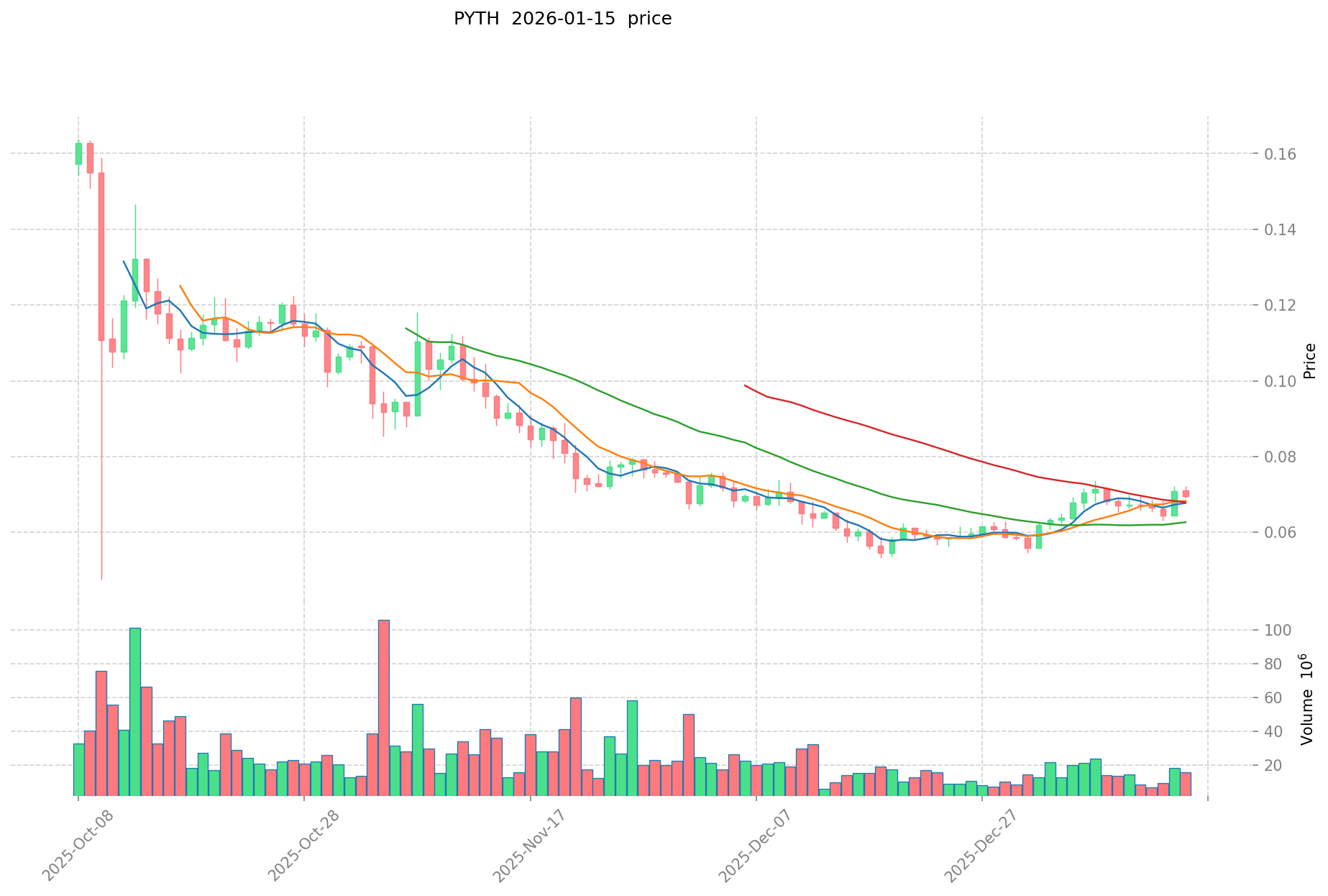
As of January 15, 2026, PYTH is trading at $0.06948, showing a modest hourly gain of 0.04% while experiencing a 24-hour decline of 2.43%. The token demonstrates notable recovery momentum with a 7-day increase of 2.01% and a substantial 30-day surge of 17.56%, though the annual performance reflects an adjustment of 78.53% from previous levels.
The current market capitalization stands at approximately $399.51 million, with a circulating supply of 5.75 billion tokens representing 57.5% of the maximum supply of 10 billion tokens. The fully diluted market cap is positioned at $694.8 million. Daily trading volume registers at $1.1 million across 54 exchanges, with Pyth Network holding a 0.020% share of the overall cryptocurrency market.
The token's 24-hour price range fluctuated between $0.06913 and $0.07217, indicating moderate volatility. With 309,265 token holders, Pyth Network maintains a growing community presence. The market sentiment indicator currently reflects a Greed level at 61, suggesting positive investor confidence in the current market environment.
Click to view current PYTH market price
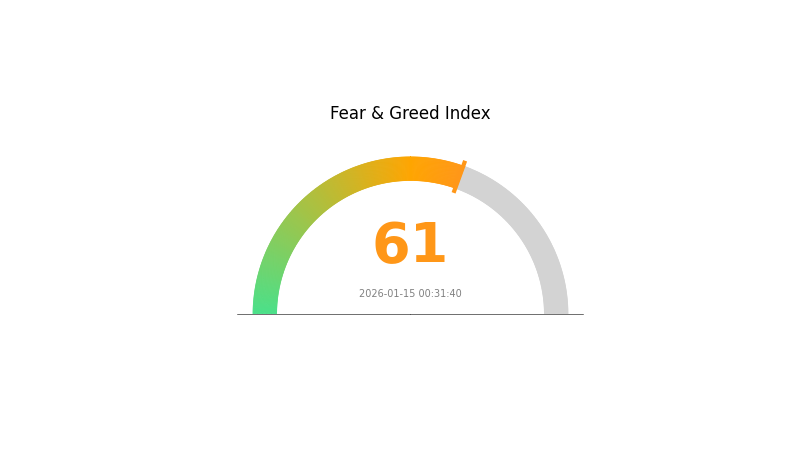
PYTH Market Sentiment Index
2026-01-15 Fear and Greed Index: 61 (Greed)
Click to view the current Fear & Greed Index
The cryptocurrency market is currently displaying strong bullish sentiment with a greed reading of 61. This indicates that investors are becoming increasingly optimistic and willing to take on more risk. During greed phases, market participants often show heightened buying enthusiasm and confidence in price appreciation. However, investors should remain cautious, as extreme greed can sometimes precede market corrections. It's advisable to maintain a balanced investment strategy and not let emotions drive trading decisions. Monitor market fundamentals alongside sentiment indicators for informed decision-making on Gate.com.
PYTH Holdings Distribution
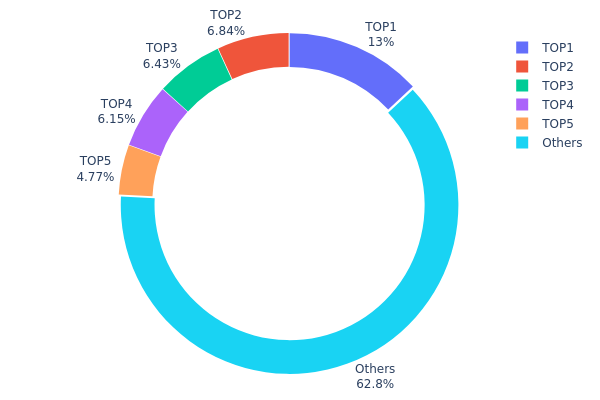
The holdings distribution chart reveals the concentration level of token ownership across different addresses on the blockchain. It serves as a critical indicator of decentralization and potential market control risks. For PYTH, the current distribution shows a moderate concentration pattern, with the top five addresses collectively holding approximately 37.18% of the total supply.
Specifically, the largest holder controls 1,301,712.57K tokens (13.01%), followed by addresses holding 6.84%, 6.42%, 6.15%, and 4.76% respectively. The remaining 62.82% is distributed among other addresses, suggesting a relatively diversified ownership structure compared to highly concentrated projects where top holders often exceed 50% of total supply. This distribution pattern indicates that while significant stakeholders exist, no single entity dominates the market.
From a market structure perspective, this concentration level presents both opportunities and risks. The substantial holdings of top addresses could lead to increased price volatility during large-scale transactions or coordinated selling pressure. However, the majority ownership residing in the "Others" category (62.82%) provides a buffer against manipulation by individual whales. The current distribution reflects a balanced ecosystem where PYTH maintains reasonable decentralization while accommodating institutional participants and early investors. This structure suggests moderate on-chain stability, though monitoring changes in top holder behavior remains essential for assessing future market dynamics.
Click to view current PYTH Holdings Distribution
| Top |
Address |
Holding Qty |
Holding (%) |
| 1 |
5WumPY...Q85qfY |
1301712.57K |
13.01% |
| 2 |
5cz3Jz...q5BxCw |
684291.67K |
6.84% |
| 3 |
Ffz4sG...Ycjc2Q |
642740.00K |
6.42% |
| 4 |
E294ht...X7WJGM |
615179.00K |
6.15% |
| 5 |
9HwAxu...EcR4QD |
476687.50K |
4.76% |
| - |
Others |
6279371.92K |
62.82% |
II. Core Factors Influencing PYTH's Future Price
Supply and Demand Dynamics
- Market Adoption and Network Growth: The expansion of Pythnet and the broader Solana ecosystem directly drives demand for PYTH tokens. As the network serves over 120 blockchain networks, ranking second in this metric, increased adoption of Pyth's oracle services creates organic demand pressure.
- Liquidity Considerations: Price movements may be significantly affected by liquidity conditions. In markets with lower liquidity, large buy orders could trigger substantial price changes, particularly impacting high-frequency trading and perpetual contract operations.
- Current Market Sentiment: Investor sentiment plays a crucial role in price formation, with market participants closely monitoring potential reversal signals and overall ecosystem developments.
Institutional and Market Participant Activity
- Network Service Coverage: Pyth Network currently serves 120 networks, positioning it as the second-largest oracle provider by network coverage. This extensive integration suggests growing institutional confidence in the protocol's reliability and utility.
- Ecosystem Integration: The protocol's role as a core oracle infrastructure within the Solana ecosystem provides strategic positioning, with its technical advantages enabling continuous integration with decentralized finance applications.
Macroeconomic Environment
- Broader Market Trends: PYTH token prices remain susceptible to macroeconomic factors, including overall cryptocurrency market conditions and investor risk appetite. News events and market developments can significantly impact valuation through their influence on investor sentiment.
- Asset Valuation Trends: Price movements typically reflect broader market trends affecting digital asset valuations, with correlation to general cryptocurrency market cycles.
Technical Development and Ecosystem Construction
- Pull Mechanism Architecture: Pyth's core Pull mechanism aligns with the rapid development needs of blockchain and DeFi sectors. Its high-speed data delivery, broad asset coverage, and high-fidelity characteristics position it as essential infrastructure for blockchain ecosystem growth.
- Oracle Security Enhancement: The protocol continues to advance security mechanisms through initiatives like Oracle Integrity Staking (OIS), which aims to strengthen price data security through cryptoeconomic guarantees. These evolving security measures address the growing sophistication requirements of DeFi applications.
- Low-Latency Performance: The protocol's permissionless and low-latency characteristics serve as key technical differentiators, supporting time-sensitive applications in decentralized finance.
- Cross-chain and Multi-scenario Support: Pyth V2 developments focus on enhanced cross-chain capabilities and support for diverse use cases, expanding the protocol's applicability across different blockchain environments.
Team and Project Development
- Development Progress: The project's ongoing evolution and technical improvements demonstrate continuous commitment to meeting market needs. The team's ability to execute on roadmap objectives influences market confidence and token valuation.
- Network Expansion Trajectory: Recent price trends suggest upward momentum, supported by the protocol's expanding service network and growing ecosystem presence.
III. 2026-2031 PYTH Price Forecast
2026 Outlook
- Conservative forecast: $0.03542 - $0.06946
- Neutral forecast: $0.06946
- Optimistic forecast: $0.10141 (requires favorable market conditions and increased adoption)
2027-2029 Outlook
- Market stage expectation: Gradual recovery and consolidation phase with moderate growth momentum
- Price range forecast:
- 2027: $0.07775 - $0.09398
- 2028: $0.05024 - $0.0933
- 2029: $0.0549 - $0.11895
- Key catalysts: Expanding ecosystem integration, enhanced oracle network adoption, and potential broader DeFi market recovery
2030-2031 Long-term Outlook
- Baseline scenario: $0.09576 - $0.10523 (assuming steady ecosystem development and sustained market interest)
- Optimistic scenario: $0.10523 - $0.13153 (assuming accelerated institutional adoption and expanded use cases)
- Transformative scenario: $0.13851 (requires breakthrough partnerships, significant protocol upgrades, and favorable regulatory environment)
The projections indicate a potential price change of up to 70% by 2031 compared to 2026 levels, reflecting gradual market maturation and ecosystem expansion. However, investors should note that cryptocurrency markets remain highly volatile, and actual performance may deviate significantly from these forecasts based on market conditions, technological developments, and regulatory changes.
| Year |
Predicted High Price |
Predicted Average Price |
Predicted Low Price |
Price Change |
| 2026 |
0.10141 |
0.06946 |
0.03542 |
0 |
| 2027 |
0.09398 |
0.08544 |
0.07775 |
22 |
| 2028 |
0.0933 |
0.08971 |
0.05024 |
29 |
| 2029 |
0.11895 |
0.0915 |
0.0549 |
31 |
| 2030 |
0.13153 |
0.10523 |
0.09576 |
51 |
| 2031 |
0.13851 |
0.11838 |
0.0876 |
70 |
IV. PYTH Professional Investment Strategy and Risk Management
PYTH Investment Methodology
(1) Long-term Holding Strategy
- Target Investors: Believers in oracle infrastructure and DeFi ecosystem development who seek long-term value appreciation
- Operational Recommendations:
- Establish positions during market corrections when PYTH trades below its 30-day moving average
- Implement dollar-cost averaging (DCA) to accumulate PYTH tokens over 6-12 month periods
- Utilize Gate Web3 Wallet for secure storage with multi-signature protection
(2) Active Trading Strategy
- Technical Analysis Tools:
- RSI (Relative Strength Index): Monitor overbought conditions above 70 and oversold conditions below 30 for potential entry/exit points
- Volume Analysis: Track 24-hour trading volume changes; current volume of $1.1M indicates moderate liquidity for position sizing
- Swing Trading Essentials:
- Set profit targets at 15-25% above entry price based on historical volatility patterns
- Implement stop-loss orders 8-12% below entry to manage downside risk
PYTH Risk Management Framework
(1) Asset Allocation Principles
- Conservative Investors: 1-3% of crypto portfolio allocation
- Aggressive Investors: 5-8% of crypto portfolio allocation
- Professional Investors: Up to 10-15% with hedging strategies
(2) Risk Hedging Solutions
- Portfolio Diversification: Balance PYTH holdings with stablecoins and major cryptocurrencies to reduce oracle sector concentration risk
- Position Sizing: Limit single trade exposure to 2-5% of total portfolio value
(3) Secure Storage Solutions
- Hot Wallet Recommendation: Gate Web3 Wallet for active trading with enhanced security features
- Cold Storage Option: Hardware wallet solutions for long-term holdings exceeding $10,000
- Security Precautions: Enable two-factor authentication, regularly update security protocols, and never share private keys or seed phrases
V. PYTH Potential Risks and Challenges
PYTH Market Risks
- Price Volatility: PYTH has declined 78.53% over the past year, demonstrating significant price fluctuation risk
- Liquidity Concerns: With 24-hour trading volume of approximately $1.1M, large position exits may face slippage
- Competition Risk: Other oracle solutions may capture market share, affecting PYTH's adoption and token value
PYTH Regulatory Risks
- Oracle Regulation: Potential regulatory frameworks targeting data providers in blockchain ecosystems may impact operations
- Securities Classification: Uncertainty regarding token classification could affect trading availability on certain platforms
- Cross-border Compliance: Multi-blockchain deployment across 54 exchanges requires navigation of diverse regulatory environments
PYTH Technical Risks
- Smart Contract Vulnerabilities: Potential bugs or exploits in oracle infrastructure could compromise data integrity
- Network Dependency: Reliance on Solana blockchain performance; network congestion or downtime may affect functionality
- Data Provider Risks: Quality and reliability of price feeds depend on data provider participation and accuracy
VI. Conclusion and Action Recommendations
PYTH Investment Value Assessment
Pyth Network represents a critical infrastructure component in the DeFi ecosystem, providing oracle services across multiple blockchains. With a current price of $0.06948 and market capitalization of approximately $399.5M, PYTH trades significantly below its all-time high of $1.1552. The circulating supply represents 57.5% of maximum supply, indicating moderate token inflation risk. While the oracle sector shows long-term growth potential driven by expanding blockchain adoption, investors must weigh this against substantial short-term volatility, as evidenced by the 78.53% decline over the past year. The project's integration across 54 exchanges and strong holder base of 309,265 addresses suggest established market presence, though competition and technical risks remain significant considerations.
PYTH Investment Recommendations
✅ Beginners: Start with small allocations (1-2% of crypto portfolio) using dollar-cost averaging on Gate.com, and prioritize learning about oracle functionality before increasing exposure
✅ Experienced Investors: Consider strategic accumulation during market corrections with 3-5% portfolio allocation, implementing technical analysis for optimal entry points
✅ Institutional Investors: Evaluate PYTH as part of broader DeFi infrastructure thesis with 5-10% allocation, utilizing advanced risk management tools and hedging strategies
PYTH Trading Participation Methods
- Spot Trading: Purchase PYTH directly on Gate.com with fiat or cryptocurrency pairs for straightforward exposure
- Grid Trading: Implement automated grid strategies on Gate.com to capitalize on PYTH's price volatility within defined ranges
- Staking Participation: Explore potential staking opportunities within the Pyth Network ecosystem to generate passive returns while holding tokens
Cryptocurrency investment carries extremely high risk, and this article does not constitute investment advice. Investors should make cautious decisions based on their own risk tolerance and are advised to consult professional financial advisors. Never invest more than you can afford to lose.
FAQ
What is PYTH? What is the purpose of Pyth Network?
PYTH is a decentralized protocol providing high-quality financial data on blockchain. Pyth Network enables reliable market data access for DeFi applications, derivatives trading, and cross-chain price feeds, ensuring transparent and tamper-proof information for smart contracts.
What is the current price of PYTH token? What are the all-time high and all-time low prices?
PYTH is currently trading between $0.06576 and $0.06989. Its all-time high reached $1.15, while the all-time low was $0.0533.
How to make price predictions for PYTH? What are the main factors affecting PYTH price?
PYTH price predictions rely on demand and supply dynamics. Key factors include market demand, network adoption rate, and technological developments. Analysis suggests PYTH may trade around 19.34 USD in coming years.
What is the difference between PYTH and Chainlink? Which one is more worth investing in?
PYTH focuses on high-frequency price data for derivatives, while Chainlink provides broader oracle services. PYTH offers lower latency and higher update frequency. Both have strong use cases; PYTH excels in trading efficiency, making it promising for active traders and protocols requiring real-time precision.
What is PYTH's future development outlook? What are the price predictions for 2024-2025?
PYTH demonstrates strong potential with 6.30% weekly gains, outperforming broader market trends. Price predictions for 2024-2025 are positive as oracle demand grows, with potential for significant appreciation driven by increased DeFi adoption and institutional interest.
What are the risks of investing in PYTH tokens and what should I pay attention to?
PYTH investments carry market volatility risk, regulatory risk, and technical risk. Investors should conduct thorough research, monitor market performance closely, and be prepared for cryptocurrency market uncertainties.
Where can I buy PYTH tokens? How to store them safely?
PYTH tokens are available on major cryptocurrency exchanges. For secure storage, use hardware wallets like Ledger or Trezor to keep your tokens offline and protected from unauthorized access.
* The information is not intended to be and does not constitute financial advice or any other recommendation of any sort offered or endorsed by Gate.