This article offers a comprehensive comparison of Aeternity (AE) and Bitcoin Cash (BCH) in the cryptocurrency market, focusing on their investment value, price history, market cap, technology, adoption, and strategies. It addresses investor concerns about which option might be the better buy. Suitable for investors analyzing crypto assets, the article explores price trends, supply mechanisms, and growth catalysts. Structured logically, it begins with an introduction, followed by detailed analyses of price history, technology, adoption, risk factors, and concludes with investment advice. Keywords are optimized for clarity and quick evaluation.
Introduction: Investment Comparison of AE vs BCH
In the cryptocurrency market, the comparison between Aeternity (AE) and Bitcoin Cash (BCH) has always been a topic that investors cannot ignore. The two not only have significant differences in market cap ranking, application scenarios, and price performance, but also represent different positioning in the crypto asset space.
Aeternity (AE): Since its launch in 2016, it has gained market recognition for its focus on smart contracts and decentralized oracles.
Bitcoin Cash (BCH): Launched in 2017, it has been hailed as a "peer-to-peer electronic cash system," and is one of the cryptocurrencies with high global trading volume and market capitalization.
This article will comprehensively analyze the investment value comparison between AE and BCH, focusing on historical price trends, supply mechanisms, institutional adoption, technological ecosystems, and future predictions, attempting to answer the question that investors are most concerned about:
"Which is the better buy right now?"
I. Price History Comparison and Current Market Status
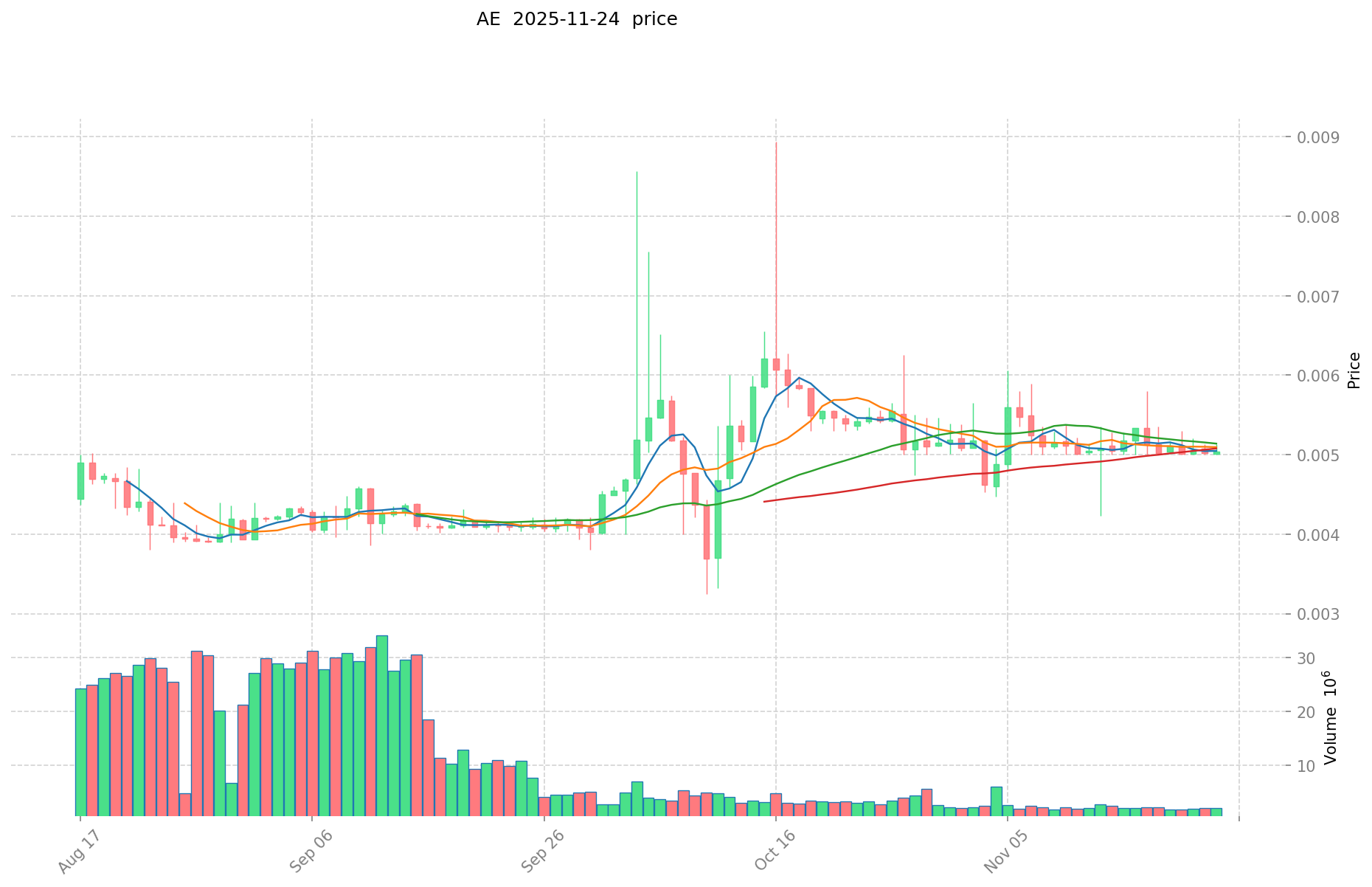
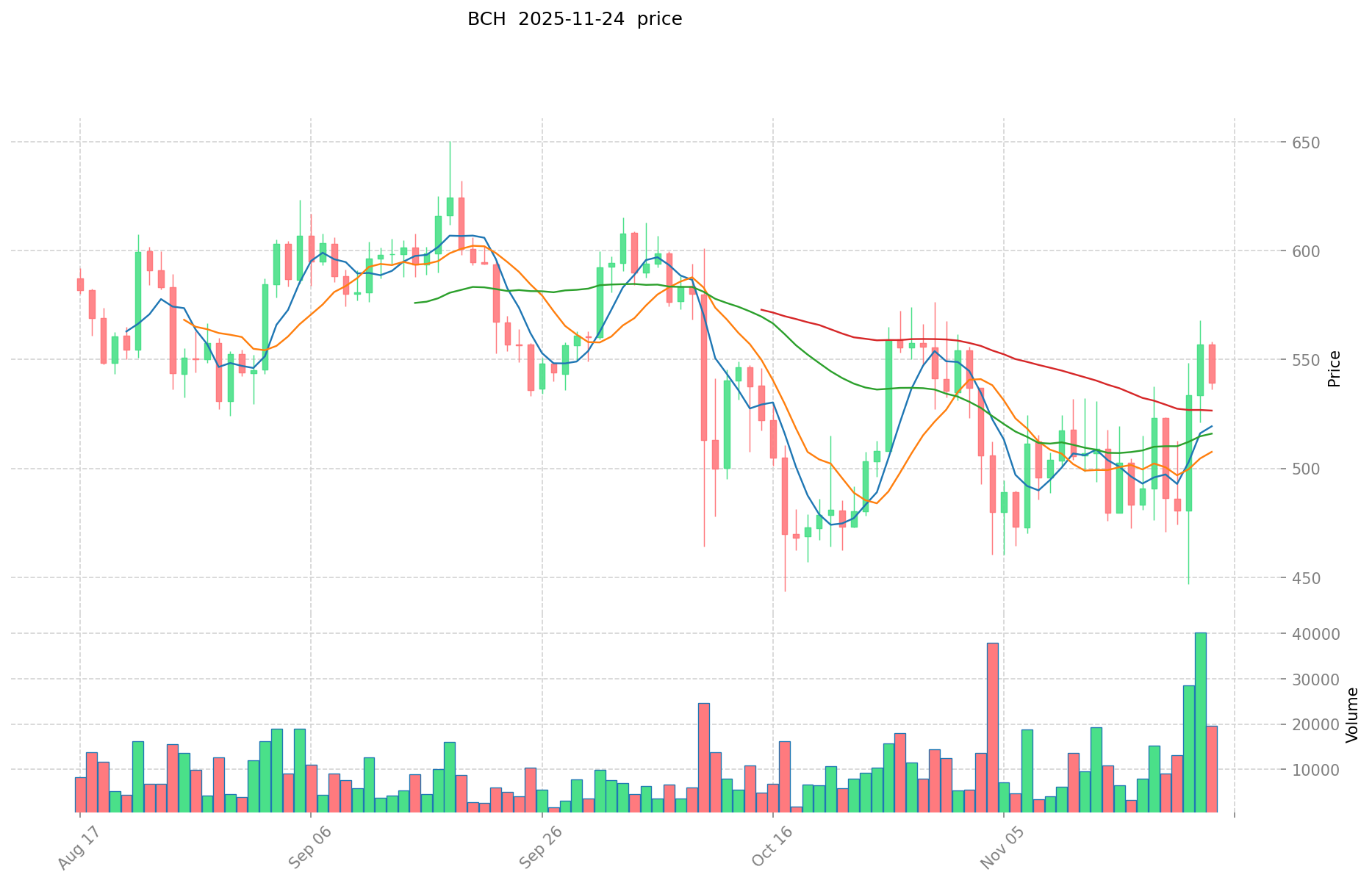
AE and BCH Historical Price Trends
- 2018: AE reached its all-time high of $5.69 on April 29, 2018.
- 2017: BCH hit its all-time high of $3,785.82 on December 20, 2017, shortly after its launch.
- Comparative analysis: AE has experienced a significant decline from its peak, currently trading at $0.005032. BCH, while also down from its all-time high, has shown more resilience, currently trading at $547.58.
Current Market Situation (2025-11-24)
- AE current price: $0.005032
- BCH current price: $547.58
- 24-hour trading volume: AE $10,424.76 vs BCH $11,329,490.17
- Market Sentiment Index (Fear & Greed Index): 19 (Extreme Fear)
Click to view real-time prices:
- Check AE current price Market Price
- Check BCH current price Market Price
II. Market Cap and Supply Analysis
Market Capitalization Comparison
- AE Market Cap: $2,201,511.85
- BCH Market Cap: $10,928,351,750.03
- Market dominance: AE 0.000085% vs BCH 0.34%
Circulating Supply and Total Supply
- AE: Circulating supply 437,502,355.49932 / Total supply 536,306,702
- BCH: Circulating supply 19,957,543.64665078 / Total supply 19,957,553.02165078
- Circulation ratio: AE 81.58% vs BCH 95.04%
Maximum Supply and Inflation Rate
- AE max supply: 536,306,702
- BCH max supply: 21,000,000
- Inflation rate analysis: BCH has a fixed supply cap similar to Bitcoin, while AE has a larger total supply.
III. Technology and Development
Core Features
- AE:
- Turing-complete state channels
- Decentralized oracles
- Modular blockchain network
- BCH:
- Larger block size (8MB)
- Enhanced transaction signatures
- New difficulty adjustment algorithm
Recent Technical Upgrades
- AE: No recent major upgrades mentioned in the provided information.
- BCH: No recent major upgrades mentioned in the provided information.
Development Activity
- AE: Active GitHub repositories for core protocol, smart contracts, and infrastructure.
- BCH: Multiple active implementations including BCHD, Bitcoin Verde, and Knuth.
IV. Ecosystem and Adoption
Use Cases and Applications
- AE: Focus on smart contracts interacting with real-world data through oracles.
- BCH: Emphasis on global adoption as a peer-to-peer electronic cash system.
Partnerships and Collaborations
- AE: No specific partnerships mentioned in the provided information.
- BCH: No specific partnerships mentioned in the provided information.
- AE: Active Twitter, Reddit, and Facebook communities.
- BCH: Active Reddit community, no official Twitter mentioned.
V. Investment Considerations
Risk Factors
- Market volatility: Both coins have experienced significant price fluctuations.
- Regulatory environment: Potential impact of changing cryptocurrency regulations.
- Competition: Both face competition from other blockchain platforms and cryptocurrencies.
Potential Growth Catalysts
- AE: Further development of oracle technology and smart contract applications.
- BCH: Increased adoption as a payment method and potential scalability improvements.
Expert Opinions
No specific expert opinions provided in the given information.
VI. Conclusion
AE and BCH represent different approaches in the cryptocurrency space. AE focuses on innovative features like state channels and oracles, while BCH aims to be a global, scalable payment system. BCH has a significantly larger market presence and trading volume, but both face challenges in a highly competitive and volatile market. Investors should conduct thorough research and consider their risk tolerance before making investment decisions.
II. Core Factors Affecting Investment Value of AE vs BCH
Supply Mechanisms Comparison (Tokenomics)
- AE: Fixed supply of approximately 280 million tokens
- BCH: Limited supply with halving mechanism, maximum of 21 million coins
- 📌 Historical Pattern: Limited supply assets like BCH tend to appreciate during bull cycles when demand increases against fixed supply, while AE's larger fixed supply provides less scarcity pressure.
Institutional Adoption and Market Applications
- Institutional Holdings: BCH has greater institutional presence through Grayscale's BCH Trust and integration with payment processors
- Enterprise Adoption: BCH has more established adoption in retail payments and remittances through partnerships with BitPay and other payment processors
- National Policies: BCH faces similar regulatory scrutiny as Bitcoin in most jurisdictions, while AE has less regulatory visibility due to smaller market presence
Technical Development and Ecosystem Building
- AE Technical Upgrades: Focus on state channels for scalability and Sophia smart contract language
- BCH Technical Development: Regular protocol upgrades focused on transaction capacity, with recent developments in smart contracts through SmartBCH
- Ecosystem Comparison: BCH has a more developed ecosystem spanning payments, with emerging DeFi applications through SmartBCH; AE ecosystem remains smaller with fewer commercial applications
Macroeconomic and Market Cycles
- Inflation Environment Performance: BCH positions as "electronic cash" with hard-cap supply provides some inflation hedge properties
- Macroeconomic Monetary Policy: Both cryptocurrencies generally move with broader crypto market in response to monetary policy shifts
- Geopolitical Factors: BCH's focus on payments provides potential utility in cross-border transactions during financial uncertainty
III. 2025-2030 Price Prediction: AE vs BCH
Short-term Prediction (2025)
- AE: Conservative $0.00452880 - $0.005032 | Optimistic $0.005032 - $0.00548488
- BCH: Conservative $371.416 - $546.2 | Optimistic $546.2 - $808.376
Mid-term Prediction (2027)
- AE may enter a growth phase, with expected prices ranging from $0.004708407176 to $0.00763525488
- BCH may enter a bullish market, with expected prices ranging from $760.7976104 to $1100.7284576
- Key drivers: Institutional capital inflow, ETF, ecosystem development
Long-term Prediction (2030)
- AE: Base scenario $0.00917391780613 - $0.011375658079601 | Optimistic scenario $0.011375658079601+
- BCH: Base scenario $1169.26013511384 - $1309.5713513275008 | Optimistic scenario $1309.5713513275008+
View detailed price predictions for AE and BCH
Disclaimer: The information provided is for informational purposes only and should not be considered as financial advice. Cryptocurrency markets are highly volatile and unpredictable. Always conduct your own research before making any investment decisions.
AE:
| 年份 |
预测最高价 |
预测平均价格 |
预测最低价 |
涨跌幅 |
| 2025 |
0.00548488 |
0.005032 |
0.0045288 |
0 |
| 2026 |
0.0074669848 |
0.00525844 |
0.0046800116 |
4 |
| 2027 |
0.00763525488 |
0.0063627124 |
0.004708407176 |
26 |
| 2028 |
0.0079788413496 |
0.00699898364 |
0.0051792478936 |
39 |
| 2029 |
0.01085892311746 |
0.0074889124948 |
0.004942682246568 |
48 |
| 2030 |
0.011375658079601 |
0.00917391780613 |
0.008256526025517 |
82 |
BCH:
| 年份 |
预测最高价 |
预测平均价格 |
预测最低价 |
涨跌幅 |
| 2025 |
808.376 |
546.2 |
371.416 |
0 |
| 2026 |
941.43032 |
677.288 |
406.3728 |
23 |
| 2027 |
1100.7284576 |
809.35916 |
760.7976104 |
47 |
| 2028 |
1069.649065856 |
955.0438088 |
897.741180272 |
74 |
| 2029 |
1326.17383289968 |
1012.346437328 |
597.28439802352 |
84 |
| 2030 |
1309.5713513275008 |
1169.26013511384 |
830.1746959308264 |
113 |
IV. Investment Strategy Comparison: AE vs BCH
Long-term vs Short-term Investment Strategies
- AE: Suitable for investors focused on smart contract and oracle technology potential
- BCH: Suitable for investors seeking payment system adoption and potential inflation hedge
Risk Management and Asset Allocation
- Conservative investors: AE: 10% vs BCH: 90%
- Aggressive investors: AE: 30% vs BCH: 70%
- Hedging tools: Stablecoin allocation, options, cross-currency portfolios
V. Potential Risk Comparison
Market Risk
- AE: Higher volatility due to smaller market cap and lower liquidity
- BCH: Susceptible to broader crypto market trends and Bitcoin price movements
Technical Risk
- AE: Scalability, network stability
- BCH: Mining centralization, potential security vulnerabilities
Regulatory Risk
- Global regulatory policies may have a more significant impact on BCH due to its larger market presence and focus on payments
VI. Conclusion: Which Is the Better Buy?
📌 Investment Value Summary:
- AE advantages: Innovative smart contract and oracle technology, potential for ecosystem growth
- BCH advantages: Established payment system, larger market cap, more widespread adoption
✅ Investment Advice:
- New investors: Consider a higher allocation to BCH for its established market presence
- Experienced investors: Balanced approach, with a tilt towards BCH but some exposure to AE for diversification
- Institutional investors: Focus on BCH for its liquidity and market cap, with potential small allocation to AE for technology exposure
⚠️ Risk Warning: Cryptocurrency markets are highly volatile. This article does not constitute investment advice.
None
VII. FAQ
Q1: What are the main differences between AE and BCH?
A: AE focuses on smart contracts and oracles, while BCH aims to be a global payment system. BCH has a larger market cap, higher trading volume, and more widespread adoption. AE offers innovative technology but has a smaller ecosystem.
Q2: Which coin has performed better historically?
A: BCH has shown more resilience in price performance. While both have declined from their all-time highs, BCH currently trades at $547.58, compared to AE at $0.005032. BCH also has a significantly larger market cap and trading volume.
Q3: How do the supply mechanisms of AE and BCH compare?
A: BCH has a limited supply of 21 million coins with a halving mechanism, similar to Bitcoin. AE has a larger fixed supply of approximately 536 million tokens. BCH's scarcity model may provide more upward price pressure during bull markets.
Q4: Which coin is more suitable for long-term investment?
A: BCH may be more suitable for long-term investment due to its larger market presence, established ecosystem, and potential as an inflation hedge. However, AE could offer growth potential if its oracle and smart contract technology gains traction.
Q5: What are the key risks associated with investing in AE and BCH?
A: Both face market volatility and regulatory risks. AE has higher volatility due to its smaller market cap and lower liquidity. BCH faces risks related to mining centralization and competition from other payment-focused cryptocurrencies.
Q6: How do experts recommend allocating investments between AE and BCH?
A: Conservative investors might consider allocating 10% to AE and 90% to BCH, while more aggressive investors could opt for 30% AE and 70% BCH. The exact allocation should depend on individual risk tolerance and investment goals.
Q7: What factors could drive future growth for AE and BCH?
A: For AE, further development of oracle technology and smart contract applications could drive growth. For BCH, increased adoption as a payment method and potential scalability improvements are key growth catalysts.
* The information is not intended to be and does not constitute financial advice or any other recommendation of any sort offered or endorsed by Gate.














