The article provides an in-depth analysis of VeChain (VET) as a potential investment opportunity, highlighting its technological foundation, market positioning, and investment prospects. It evaluates VET’s historical performance, market dynamics, and adoption strategy through its Renaissance roadmap, emphasizing real-world applications in supply chain transparency. The article addresses risks, investment strategies, and regulatory compliance, suited for investors exploring long-term blockchain investments. It closes with FAQs on token specifications, strategic partnerships, and competitive positioning. Readers gain actionable insights into VeChain's potential growth and investment considerations.
Introduction: VeChain (VET)'s Investment Position and Market Outlook
VET is an important asset in the cryptocurrency sector. Founded in 2015 by Sunny Lu, VeChain began as a blockchain solution for supply chain transparency and anti-counterfeiting. Early enterprise adoption, backing from Fenbushi Capital, and the 2017 ICO paved the way for the launch of the VeChainThor blockchain—an efficient, enterprise-grade Layer-1 network. As of December 16, 2025, VET's market capitalization stands at approximately $901.98 million, with a circulating supply of about 85.99 billion tokens and a current price hovering around $0.01049. Supported by major partnerships with organizations such as DNV, Walmart, and BCG, VeChain has established itself as a platform focused on real-world applications and network utility.
As part of its Renaissance roadmap, VeChain is rolling out Ethereum-compatible infrastructure, delegated Proof of Stake (dPoS) consensus, dynamic VTHO tokenomics, and StarGate NFT staking. Combined with MiCA-compliant tokens and enhanced interoperability, VeChain is positioning itself as a blockchain where real adoption, network utility, and sustainability converge to create long-term value. With this strategic positioning, VET has increasingly become a focal point for investors evaluating long-term blockchain investments. This article provides a comprehensive analysis of VET's investment value, historical performance, future price prospects, and associated risks to inform investment decisions.
VeChain (VET) Cryptocurrency Research Report
I. VET Price History Review and Current Investment Status
VET Historical Price Trends and Investment Returns
Based on available data:
- All-time high (ATH): $0.280991 (April 19, 2021) → Early investors achieved substantial returns during the 2021 bull market
- All-time low (ATL): $0.00191713 (March 13, 2020) → Marked the bottom during the 2020 market downturn
- One-year performance: -81.61% decline from the previous year → Significant bearish pressure in the broader market environment
Current VET Investment Market Status (December 16, 2025)
- Current VET price: $0.01049 USD
- Market sentiment: Neutral (score: 1)
- 24-hour trading volume: $312,048.46 (in VET units)
- Market capitalization: $901,983,081.95 USD
- Circulating supply: 85,985,041,177 VET (99.16% of max supply)
- Number of holders: 14,311,862
View real-time VET market price
Short-term Price Movement
| Timeframe |
Change Percentage |
Change Amount |
| 1 hour |
+0.38% |
+0.000039711 |
| 24 hours |
-6.92% |
-0.000779875 |
| 7 days |
-16.61% |
-0.002089446 |
| 30 days |
-33.18% |
-0.005208893 |
| 1 year |
-81.61% |
-0.046551871 |
24-hour trading range: $0.01035 (low) to $0.01149 (high)
III. Project Overview and Technical Foundation
Core Business Model
VeChain was founded in 2015 by Sunny Lu with an initial focus on blockchain solutions for supply chain transparency and anti-counterfeiting measures. The project evolved through enterprise adoption, strategic investments from Fenbushi Capital, and a 2017 ICO that culminated in the launch of VeChainThor—an efficient, enterprise-grade Layer-1 blockchain network.
Key Strategic Partnerships
VeChain has established major partnerships with:
- DNV (Det Norske Veritas)
- Walmart
- Boston Consulting Group (BCG)
These collaborations have validated VeChain's real-world use cases and supported its global ecosystem expansion.
Renaissance Roadmap Initiatives
As part of its strategic "Renaissance" upgrade, VeChain is implementing:
- Ethereum-compatible infrastructure: Enhanced compatibility for broader ecosystem integration
- Delegated Proof-of-Stake (dPoS) consensus mechanism: Improved network efficiency and validator participation
- Dynamic VTHO tokenomics: Flexible utility token economics tied to network demand
- StarGate NFT staking system: New mechanisms for user engagement and value distribution
Regulatory Compliance
VeChain's token architecture is designed to comply with the European Union's MiCA (Markets in Crypto-Assets) regulatory standard, positioning it as a compliant digital asset for regulated markets.
IV. Network Metrics and Market Position
- Global ranking: #89 (by market capitalization)
- Market dominance: 0.029%
- Market cap to FDV ratio: 99.16% (indicating mature token distribution)
- Listed on exchanges: 41 trading platforms
V. Technical Resources
Official channels:
Developer resources:
- GitHub repositories: VeChain Thor, web3-Gear, Thor-DevKit.js, Thorify
Community channels:
VI. Summary
VeChain represents an enterprise-focused blockchain platform with established real-world partnerships and a clear technical roadmap. The project's positioning around supply chain solutions, regulatory compliance, and enhanced interoperability reflects efforts to bridge blockchain technology with practical business applications. Current market conditions show significant volatility, with the token experiencing substantial pressure over the past year, though the underlying infrastructure and ecosystem partnerships continue to develop.
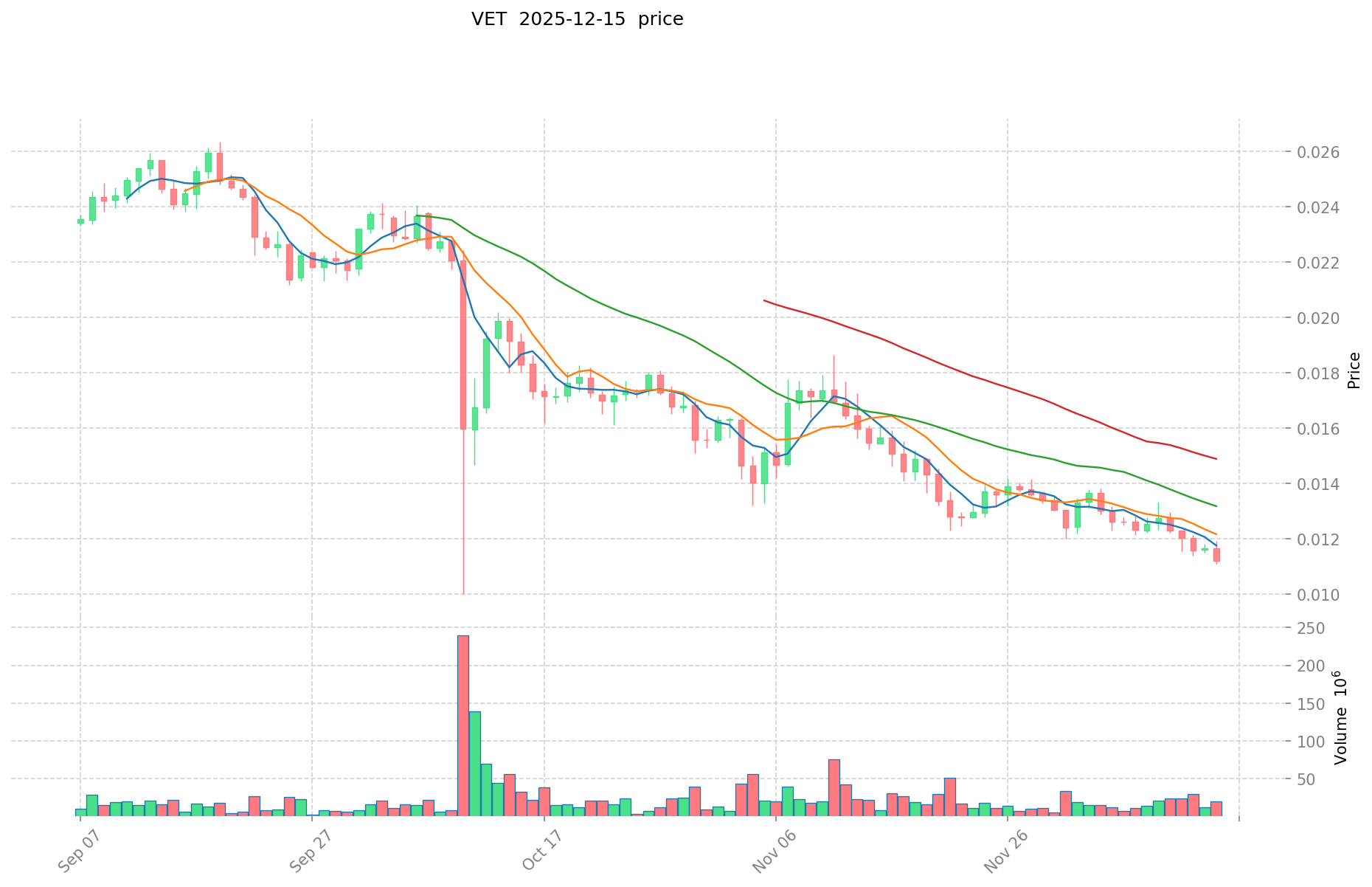
VeChain (VET) Investment Analysis Report
Report Date: December 16, 2025
I. Executive Summary
VeChain (VET) is an enterprise-grade Layer-1 blockchain platform founded in 2015 by Sunny Lu, initially designed to address supply chain transparency and anti-counterfeiting needs. As of December 16, 2025, VET trades at $0.01049 with a market capitalization of approximately $902 million, ranking 89th among cryptocurrencies. The token has experienced significant price volatility, declining 6.92% in the past 24 hours and 81.61% over the past year from its all-time high of $0.280991 recorded in April 2021.
II. Core Factors Influencing VeChain (VET) as an Investment
Supply Mechanism and Scarcity
VeChain operates with a clearly defined tokenomics structure:
- Circulating Supply: 85,985,041,177 VET (representing 99.16% of total supply)
- Maximum Supply: 86,712,634,466 VET
- Market Cap to FDV Ratio: 99.16%, indicating near-complete circulation
The high circulation ratio reflects a transparent supply model that constrains scarcity dynamics typically available in early-stage tokens. The defined maximum supply provides long-term supply certainty for investors.
Institutional Investment and Enterprise Adoption
VeChain demonstrates substantive real-world enterprise adoption:
- Strategic Partnerships: Established collaborations with DNV, Walmart, and Boston Consulting Group (BCG) validate practical applications in commercial sectors
- Use Cases: Active deployment in supply chain verification, compliance, and product authentication across major industries
- Network Infrastructure: The platform supports enterprise-level applications requiring stability and regulatory compliance
The partnership portfolio with internationally recognized organizations distinguishes VeChain from projects lacking tangible commercial implementations.
- Active Holders: 14,311,862 token holders indicate distributed participation
- Exchange Listings: Available across 41 cryptocurrency exchanges, providing liquidity accessibility
- Operational History: Nine years of network operation since 2015 foundation demonstrates technical stability
Technology and Ecosystem Development
VeChain's "Renaissance" strategic roadmap encompasses multiple infrastructure enhancements:
- Ethereum-Compatible Infrastructure: Enables interoperability and developer accessibility
- Delegated Proof-of-Stake (dPoS) Consensus: Improves energy efficiency compared to proof-of-work systems
- Dynamic VTHO Tokenomics: Introduces flexibility in transaction cost mechanisms through VeChainThor Energy (VTHO) token generation
- StarGate NFT Staking System: Expands ecosystem utility beyond traditional value transfer
Regulatory Alignment: The platform's token architecture complies with European Union Markets in Crypto-Assets (MiCA) regulatory standards, positioning VeChain favorably in regulated markets.
Cross-Chain Interoperability: Enhanced bridge protocols support multi-chain integration, expanding potential use case scenarios.
Current Market Position
| Metric |
Value |
| Current Price |
$0.01049 |
| 24-Hour Change |
-6.92% |
| 7-Day Change |
-16.61% |
| 30-Day Change |
-33.18% |
| 1-Year Change |
-81.61% |
| All-Time High |
$0.280991 (April 19, 2021) |
| All-Time Low |
$0.00191713 (March 13, 2020) |
Price Trend Analysis
VET exhibits pronounced downward pressure across multiple timeframes:
- Short-term: Marginal intraday gains (+0.38% in 1 hour) offset by deteriorating medium-term momentum
- Medium-term: Cumulative 24-hour and 7-day declines signal consistent selling pressure
- Extended Horizon: The 81.61% annual decline reflects significant value depreciation relative to 2024 levels
24-Hour Trading Range: $0.01035 to $0.01149, indicating constrained volatility on the current trading day.
IV. Assessment of Investment Considerations
Positive Factors
- Enterprise-Grade Technology: Genuine supply chain and compliance use cases differentiate VeChain from purely speculative projects
- Regulatory Clarity: MiCA compliance positions the platform favorably for European market access
- Established Partnerships: Collaborations with major corporations provide foundational enterprise demand
- Network Stability: Nine-year operational history and diverse holder base demonstrate technical reliability
- Dynamic Tokenomics: VTHO and StarGate mechanisms introduce network utility beyond basic value transfer
Negative Factors
- Significant Price Depreciation: 81.61% annual decline reflects sustained market underperformance
- Bear Market Conditions: Multiple timeframe indicators show downward momentum
- Market Sentiment: Technical analysis suggests bearish outlook among quantitative indicators
- Altcoin Sector Performance: VET ranks among worst-performing altcoins in 2025
- High Circulation Ratio: 99.16% circulating supply limits scarcity-driven appreciation mechanisms
Official Channels:
Technical Documentation:
VI. Conclusion
VeChain presents a technically sophisticated platform with demonstrated enterprise adoption and regulatory compliance. However, the significant price depreciation across all measured timeframes and negative short-to-medium-term market momentum warrant careful consideration. Investment decisions should be informed by individual risk tolerance, portfolio objectives, and ongoing assessment of ecosystem development progress.
III. VET Future Investment Predictions and Price Outlook (Is Vechain(VET) worth investing in 2025-2030)
Short-term Investment Prediction (2025, short-term VET investment outlook)
- Conservative forecast: $0.01007 - $0.01049
- Neutral forecast: $0.01049 - $0.01322
- Optimistic forecast: $0.01322 - $0.01850
Mid-term Investment Outlook (2026-2027, mid-term Vechain(VET) investment forecast)
- Market phase expectation: VET is transitioning through implementation of its Renaissance roadmap upgrades including Ethereum-compatible infrastructure and dPoS consensus, with increasing enterprise adoption validating real-world use cases.
- Investment return predictions:
- 2026: $0.00604 - $0.01375
- 2027: $0.01037 - $0.01818
- Key catalysts: Completion of Ethereum-compatible infrastructure rollout, enterprise adoption milestones with DNV and Walmart partnerships, regulatory compliance under EU MiCA standards, and StarGate NFT staking ecosystem maturation.
Long-term Investment Outlook (Is VeChain a good long-term investment?)
- Base case scenario: $0.01920 - $0.02293 (2028-2029, assuming steady enterprise adoption and network utility growth with stable tokenomics)
- Optimistic scenario: $0.02694 - $0.02926 (2030, assuming accelerated real-world application deployment and substantial market sentiment improvement)
- Risk scenario: $0.01460 - $0.01928 (2029-2030 downturn, assuming delayed adoption or adverse regulatory environment)
Click to view VET long-term investment and price predictions: Price Prediction
2025-12-31 Long-term Outlook
- Base case: $0.01928 - $0.02323 USD (corresponding to steady progress in enterprise adoption and network utility enhancement)
- Optimistic case: $0.02694 - $0.02926 USD (corresponding to large-scale adoption realization and favorable market environment)
- Transformative case: $0.03000+ USD (if the ecosystem achieves breakthrough innovations and mainstream adoption)
- 2030-12-31 forecast high: $0.02926 USD (based on optimistic development assumptions)
Disclaimer:
This analysis is based on available market data and historical trends and should not be construed as investment advice. Cryptocurrency markets are highly volatile and subject to regulatory, technological, and macroeconomic risks. Past performance does not guarantee future results. Investors should conduct their own due diligence and consult financial advisors before making investment decisions.
| 年份 |
预测最高价 |
预测平均价格 |
预测最低价 |
涨跌幅 |
| 2025 |
0.0132174 |
0.01049 |
0.0100704 |
0 |
| 2026 |
0.013750292 |
0.0118537 |
0.006045387 |
13 |
| 2027 |
0.01817883432 |
0.012801996 |
0.01036961676 |
22 |
| 2028 |
0.0229258144368 |
0.01549041516 |
0.0119276196732 |
47 |
| 2029 |
0.027275523013728 |
0.0192081147984 |
0.014598167246784 |
83 |
| 2030 |
0.026960509931034 |
0.023241818906064 |
0.019058291502972 |
121 |
VeChain (VET) Investment Strategy and Risk Analysis Report
IV. VeChain Investment Strategy and Risk Management
Investment Methodology
Long-term Holding (HODL VET)
Long-term holding is suited for conservative investors who believe in VeChain's enterprise adoption trajectory and technological roadmap. This strategy capitalizes on:
- Enterprise Ecosystem Growth: VeChain's partnerships with organizations such as DNV, Walmart, and Boston Consulting Group demonstrate real-world application potential in supply chain transparency and anti-counterfeiting use cases.
- Renaissance Roadmap Implementation: The ongoing rollout of Ethereum-compatible infrastructure, delegated proof-of-stake (dPoS) consensus, dynamic VTHO tokenomics, and StarGate NFT staking systems may drive long-term network utility and value creation.
- Regulatory Alignment: MiCA-compliant token architecture positions VeChain favorably within evolving European regulatory frameworks.
Active Trading
Active traders may employ technical analysis and swing trading strategies, though this approach carries elevated risk given VeChain's price volatility:
- 24-hour volatility: -6.92% (as of December 16, 2025)
- 7-day decline: -16.61%
- Historical context: VET has declined 81.61% over the past year from higher levels
Risk Management for VeChain Investment
Asset Allocation Framework
Conservative Portfolio (Risk-averse investors):
- VET allocation: 2-5% of total crypto holdings
- Rationale: Maintain exposure to enterprise blockchain without overconcentration
Moderate Portfolio (Balanced investors):
- VET allocation: 5-10% of total crypto holdings
- Diversification: Combine with established Layer-1 networks and stablecoins
Aggressive Portfolio (Experienced investors):
- VET allocation: 10-20% of total crypto holdings
- Structure: Pair with higher-conviction positions and tactical trading strategies
Risk Hedging Approaches
- Multi-Asset Composition: Combine VET holdings with uncorrelated assets (Bitcoin, Ethereum, stablecoins) to reduce concentration risk
- Volatility Management: Consider dollar-cost averaging (DCA) entry strategies to mitigate timing risk given the asset's price fluctuations
- Derivatives Hedging: Experienced traders may utilize spot-futures strategies or protective puts for downside protection
Secure Storage Recommendations
- Hot Wallet: VeChainThor-compatible web wallets for active trading and frequent transactions
- Cold Wallet: Hardware wallets (Ledger, Trezor) for long-term holdings
- Best Practice: Maintain majority holdings in cold storage; reserve only necessary amounts in hot wallets for operational needs
V. VeChain Investment Risks and Challenges
Market Risk
- High Volatility: VET exhibits significant price fluctuations (±16-33% swings observed over weekly and monthly periods)
- Liquidity Constraints: Despite 41 exchange listings, trading volume may be insufficient during market stress, amplifying slippage
- Valuation Pressure: Current market capitalization of approximately $902 million represents a modest position in the broader cryptocurrency ecosystem (0.029% dominance), limiting institutional capital inflow potential
Regulatory Risk
- Jurisdiction Uncertainty: While MiCA compliance is emphasized, regulatory treatment of enterprise blockchains and utility tokens remains evolving across global markets
- Policy Changes: Unfavorable regulatory developments in major markets could impact adoption rates and token valuation
- Compliance Burden: Regulatory requirements may increase operational costs or restrict certain use cases
Technology Risk
- Network Security: As an enterprise-grade platform, VeChain faces heightened security scrutiny; vulnerabilities could undermine trust in supply chain data integrity
- Consensus Migration: The transition to delegated proof-of-stake (dPoS) requires successful technical execution; implementation delays or bugs could erode confidence
- Interoperability Challenges: Enhanced cross-chain functionality introduces new attack surfaces and technical dependencies
- Adoption Execution: Realization of enterprise partnerships depends on successful product-market fit; execution failures could limit network utility growth
Competitive Risk
- Market Saturation: Competing enterprise blockchain solutions (Hyperledger Fabric, Corda, alternative Layer-1 networks) may fragment the supply chain transparency market
- Technology Obsolescence: Rapid blockchain innovation could render specific technical choices outdated
VI. Conclusion: Is VeChain a Good Investment?
Investment Value Summary
VeChain presents a differentiated enterprise blockchain thesis with legitimate real-world applications in supply chain transparency and anti-counterfeiting. The project's partnerships with established organizations, strategic roadmap clarity, and regulatory positioning offer long-term structural advantages.
However, substantial headwinds warrant caution:
- Severe Underperformance: The -81.61% annual decline reflects market skepticism regarding execution risk and growth prospects
- Limited Market Position: 0.029% dominance and modest market capitalization constrain capital availability and price stability
- Unproven Scaling: Enterprise adoption metrics require transparent disclosure; current evidence remains largely anecdotal
Investor Recommendations
✅ For Beginners:
- Employ dollar-cost averaging (DCA) strategies with modest position sizing (2-3% of crypto allocation)
- Prioritize secure cold wallet storage
- Avoid leverage or derivatives
✅ For Experienced Investors:
- Integrate VET as a 5-10% tactical allocation within diversified crypto portfolios
- Employ swing trading strategies during established support/resistance levels
- Monitor enterprise partnership announcements as catalysts
✅ For Institutional Investors:
- Conduct detailed due diligence on enterprise adoption metrics and VTHO tokenomics sustainability
- Structure multi-year strategic positions aligned with supply chain digitalization trends
- Engage with project governance on regulatory and scaling roadmap priorities
Risk Disclosure
⚠️ Important Notice: Cryptocurrency investments carry substantial risk, including potential total capital loss. VeChain exhibits high volatility and faces execution, regulatory, competitive, and technological challenges. This report is provided for informational purposes only and does not constitute investment advice, financial recommendations, or an offer to buy or sell securities. Conduct independent research and consult qualified financial advisors before making investment decisions.
Report Date: December 16, 2025
Data Source: Gate Market Data
Disclaimer: This analysis reflects publicly available information as of the publication date and should not be construed as a guarantee of future performance.
VeChain (VET) Frequently Asked Questions (FAQ)
I. FAQ
Q1: What is VeChain (VET) and what are its primary use cases?
A: VeChain is an enterprise-grade Layer-1 blockchain platform founded in 2015 by Sunny Lu, specifically designed for supply chain transparency and anti-counterfeiting solutions. The platform leverages blockchain technology to enable real-time product authentication, compliance verification, and supply chain traceability. VeChain has established strategic partnerships with major organizations including DNV, Walmart, and Boston Consulting Group (BCG), validating its applications across multiple industries. The VeChainThor blockchain serves as the underlying infrastructure, supporting enterprise-level applications requiring stability and regulatory compliance through its dual-token system (VET for value transfer and VTHO for transaction fees).
Q2: What is VET's current price and market position as of December 16, 2025?
A: As of December 16, 2025, VET trades at $0.01049 USD with a market capitalization of approximately $901.98 million, ranking 89th among all cryptocurrencies by market cap. The token has experienced significant short-term pressure, declining 6.92% over 24 hours and 16.61% over the past 7 days. Over the extended one-year period, VET has declined 81.61% from previous levels. The circulating supply stands at 85.99 billion VET tokens (99.16% of maximum supply), supported by 14.31 million active token holders across 41 cryptocurrency exchanges globally, indicating distributed participation and adequate liquidity accessibility.
Q3: What are the key components of VeChain's Renaissance roadmap?
A: VeChain's Renaissance strategic initiative comprises four primary infrastructure enhancements: (1) Ethereum-compatible infrastructure enabling broader ecosystem integration and interoperability with established decentralized finance protocols; (2) delegated Proof-of-Stake (dPoS) consensus mechanism improving network efficiency and validator participation compared to proof-of-work alternatives; (3) dynamic VTHO tokenomics introducing flexible transaction cost mechanisms aligned with network demand fluctuations; and (4) StarGate NFT staking system creating new value distribution mechanisms and user engagement pathways. Additionally, the platform maintains regulatory alignment through Markets in Crypto-Assets (MiCA) compliance, positioning VeChain favorably within European regulatory frameworks and international markets.
Q4: Is VeChain a good long-term investment, and what are the price forecasts?
A: VeChain presents a differentiated long-term investment thesis centered on enterprise blockchain adoption and real-world utility. However, investment suitability depends on individual risk tolerance and investment objectives. Conservative price forecasts for 2030 range from $0.01928 to $0.02323 USD, assuming steady enterprise adoption progress. Optimistic scenarios project $0.02694 to $0.02926 USD based on accelerated real-world application deployment. The most transformative case assumes $0.03000 USD or higher if breakthrough innovations and mainstream adoption materialize. Nevertheless, these projections carry substantial uncertainty; investors should recognize that cryptocurrency markets remain highly volatile and past performance does not guarantee future results. Conduct independent due diligence before making investment commitments.
Q5: What are the primary risks and challenges associated with VeChain investment?
A: VeChain faces multiple interconnected risk categories requiring careful consideration. Market risks include significant price volatility (7-33% weekly swings), potentially constrained liquidity during market stress despite 41 exchange listings, and limited market dominance (0.029%) restricting institutional capital influx. Regulatory risks encompass evolving jurisdictional treatment of enterprise blockchains, potential policy changes affecting adoption rates, and compliance burden implications. Technology risks include network security vulnerabilities, execution risks during the dPoS consensus transition, interoperability challenges from cross-chain functionality, and unproven enterprise adoption scaling. Competitive pressures from alternative enterprise blockchain solutions (Hyperledger Fabric, Corda) and rapid technology obsolescence further constrain long-term value creation potential.
Q6: What investment strategies are recommended for different investor profiles?
A: For beginners, employ dollar-cost averaging (DCA) strategies with conservative position sizing of 2-3% within total cryptocurrency allocations, utilizing secure cold wallet storage and avoiding leverage or derivatives. For experienced investors, integrate VET as a tactical 5-10% allocation within diversified crypto portfolios combining uncorrelated assets (Bitcoin, Ethereum, stablecoins), employ swing trading strategies around established support and resistance levels, and monitor enterprise partnership announcements as trading catalysts. For institutional investors, conduct detailed due diligence on quantifiable enterprise adoption metrics, structure multi-year strategic positions aligned with supply chain digitalization industry trends, and actively engage project governance on regulatory and technical roadmap priorities. Risk management fundamentals include multi-asset diversification, volatility mitigation through systematic entry strategies, and cold wallet storage for majority holdings.
Q7: How does VeChain compare to competing enterprise blockchain solutions?
A: VeChain differentiates through several key competitive factors: established partnerships with internationally recognized organizations (DNV, Walmart, BCG) providing validated real-world applications; nine years of operational history and technical stability since 2015 foundation; regulatory alignment through MiCA compliance positioning favorable access to European markets; enterprise-grade infrastructure supporting supply chain transparency and anti-counterfeiting use cases; and transparent tokenomics with defined maximum supply. However, VeChain faces competition from alternative enterprise blockchain platforms including Hyperledger Fabric (permissioned architecture), Corda (financial services focus), and emerging Layer-1 networks offering competing value propositions. Relative competitive positioning depends on successful execution of the Renaissance roadmap, demonstrated enterprise adoption acceleration, and market sentiment improvements following the extended 81.61% price decline.
Q8: What secure storage and custody recommendations apply to VET holdings?
A: For active trading and frequent transactions, utilize VeChainThor-compatible hot wallets (web-based or mobile applications) balancing accessibility with reasonable security protocols. For long-term holdings exceeding six months, employ hardware wallets such as Ledger or Trezor devices providing offline private key storage and substantially enhanced security against digital threats. Implement best practices by maintaining the majority of VET holdings in cold storage environments, reserving only necessary operational amounts in hot wallets for immediate transaction requirements. Avoid exchange custody for extended holding periods due to counterparty risk exposure; self-custody through hardware wallets remains the optimal security framework. Enable multi-signature authentication where available, maintain secure backup of recovery phrases in geographically distributed locations, and periodically verify wallet address integrity before transactions to mitigate phishing and social engineering risks.
* The information is not intended to be and does not constitute financial advice or any other recommendation of any sort offered or endorsed by Gate.