What Is FET?
FET is the native token of the Artificial Superintelligence Alliance ecosystem (formerly known as Fetch.ai). It is used for paying network transaction fees, incentivizing participants, and providing collateral to secure the network. In this context, an "agent" refers to a software entity that executes tasks on behalf of users. The "decentralized ledger" is an immutable record system jointly maintained by distributed nodes.
FET enables on-chain automated economic collaboration by connecting data, hardware, and services through multi-agent systems and AI capabilities. The token is also used as collateral for nodes and agents, reducing malicious activities and enhancing network reliability.
FET (FET): Current Price, Market Cap, and Circulating Supply
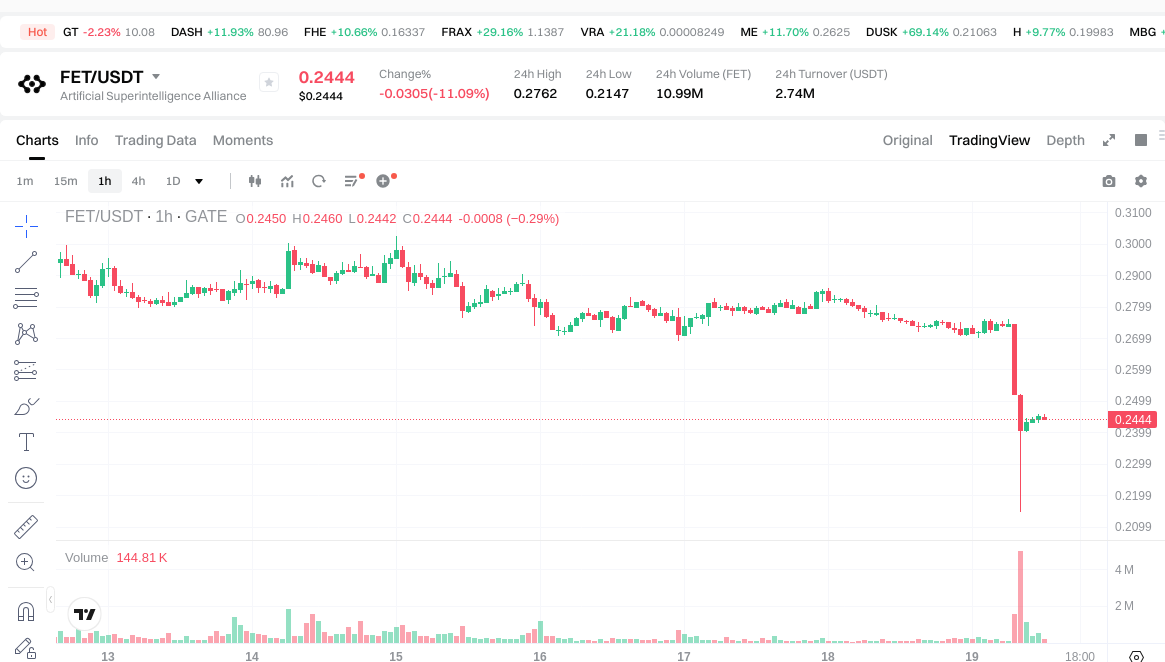
As of January 19, 2026 (source: user-provided data), FET is priced at $0.2450. The circulating market cap is approximately $665,024,213.93, with a 24-hour trading volume around $2,742,139.58.
Click to view FET USDT Price
The circulating supply is 2,302,526,919.95 FET, total supply is 2,714,384,546.67 FET, and the maximum supply is capped at 2,719,493,897 FET. Its market dominance stands at approximately 0.02%.

Click to view Top Crypto Market Cap Share
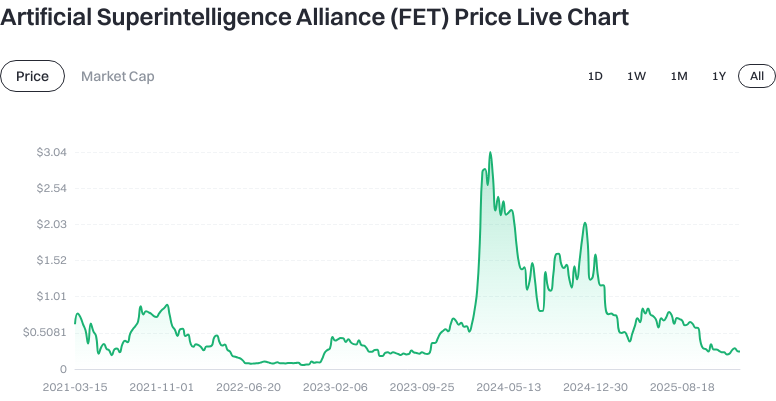
Short-term price changes: +0.16% in 1 hour, -11.26% in 24 hours, -21.14% in 7 days, and +17.11% over 30 days.
Click to view Latest FET Price Action
These figures reflect current popularity and volatility and do not constitute investment advice.
Who Created FET (FET), and When?
FET launched on February 24, 2019, initially developed by the Fetch.ai team to enable multi-agent systems for open network value exchange. Over time, the ecosystem’s scope broadened to become the Artificial Superintelligence Alliance, bringing together a wider range of AI capabilities and applications (per public announcements as of 2024).
This evolution means FET’s role may expand within the ecosystem—from payments and collateralization, to incentives and cross-component cooperation.
How Does FET (FET) Work?
FET operates through the coordination of multi-agent systems and a decentralized ledger. Agents are software entities that execute specific tasks—representing users in data marketplaces or service networks for discovery, matching, and transactions. The ledger records all transactions and state changes to ensure trustful collaboration without centralized intermediaries.
The token fulfills three core functions:
- Paying network transaction and service fees.
- Providing collateral (staking) to earn operational licenses for nodes or agents—a mechanism where tokens are locked to gain qualifications or rewards.
- Incentivizing contributors such as those providing computing power, data, or development services.
Nodes are software and servers running the network protocol; they validate and broadcast transactions. Through staking and consensus mechanisms, the network maintains security and efficiency in an open environment.
What Can FET (FET) Be Used For?
Key use cases supported by FET include:
- Smart mobility scheduling: Agents match travel demands with vehicles and routes, automating payments and incentives.
- Data marketplace collaboration: Data providers and consumers use agents for discovering and trading data assets, with token-based settlement and access control handled on-chain.
- Energy trading and device coordination: Distributed energy resources and IoT devices use agents for supply-demand matching, load optimization, and settlement.
- Web service automation: Businesses or individuals can deploy agents to connect APIs, services, and contracts automatically—reducing manual work and improving responsiveness.
Collectively, these scenarios drive the vision of an "automated economy," where repetitive rule-based transactions are handled by agents with tokens facilitating value exchange and permissioning.
What Wallets and Extensions Exist in the FET (FET) Ecosystem?
Wallets and tools help manage assets and access ecosystem services. A private key is a secret string controlling your assets—always store it securely offline. “Custodial wallets” are managed by platforms for convenience but come with platform risk; “non-custodial wallets” let users control private keys directly with security dependent on personal practices.
Common solutions include browser wallets and hardware wallets supporting FET send/receive functions, transaction history viewing, and agent/application interaction. Extension tools often feature block explorers for transaction queries plus cross-chain or migration utilities for different network environments. Always verify address formats and network types before transactions to avoid asset loss.
What Are the Main Risks and Regulatory Considerations for FET (FET)?
- Market volatility: Crypto asset prices can fluctuate sharply, affecting portfolio safety.
- Technical and agent security: Agents may be misconfigured or maliciously exploited; smart contracts or protocols may have vulnerabilities.
- Liquidity and migration: Ecosystem upgrades or network migrations can change token contracts, addresses, or cross-chain paths—exercise caution and follow official guidance.
- Regulation and compliance: Rules for token trading, data usage, and AI applications vary by region; these may impact availability and compliance costs.
- Exchange/custody risk: Long-term storage on platform wallets poses platform/account security risks—enable security settings and diversify storage.
Effective risk management should include careful fund allocation, tool selection, monitoring official updates, and adhering to local regulations.
How Do I Buy and Safely Store FET (FET) on Gate?
Step 1: Register and complete verification. Sign up on Gate’s website and follow instructions to finish identity verification (KYC), a compliance requirement to enhance account security and withdrawal limits.
Step 2: Deposit funds or purchase stablecoins. You can deposit fiat or buy stablecoins like USDT on the spot market. Stablecoins are tokens pegged to fiat value to reduce settlement volatility.
Step 3: Search for FET and place an order. On the spot trading page, search for “FET” and choose either a market order (executed immediately at current price) or a limit order (executed at your set price).
Step 4: Withdraw assets and confirm the network. To self-custody assets, go to the “withdrawal” page—enter your receiving address and select the correct withdrawal network. Make sure the address format matches the network; some networks require a Memo/Tag—double-check all details.
Step 5: Set up secure storage. Whether you keep assets in Gate’s wallet or transfer to self-custody, always enable two-factor authentication (SMS/App code), set a strong password, and back up your private key. Cold wallets are offline devices/methods for storing private keys—these help reduce hacking risk.
How Is FET (FET) Different from Ethereum (ETH)?
The two serve distinct purposes. FET focuses on AI-powered multi-agent systems for automated economic collaboration—emphasizing agent discovery, matchmaking, and value settlement. Ethereum is a general-purpose smart contract platform powering a wide range of decentralized applications.
Regarding token utility and economic models: FET emphasizes payment for agent services and collateral-based access; ETH is mainly used for transaction fees (gas) and staking in proof-of-stake consensus. Supply mechanics also differ—FET has a capped maximum supply; ETH now features dynamic issuance/burn since the Merge and EIP-1559.
Ecosystem maturity varies too: Ethereum boasts a large developer community with cross-industry applications; FET’s ecosystem is more specialized toward AI and automation niches. Choosing between them depends on your application requirements and risk appetite.
Summary of FET (FET)
FET serves the vision of AI-driven multi-agent systems for automated economic collaboration—playing key roles in payments, collateralization, and incentives. Current data highlights its market cap and supply metrics; technologically it leverages agents plus decentralized ledgers to realize practical use cases. To get started on Gate, follow steps for registration, purchase, order placement, and secure storage setup. Going forward, monitor real-world ecosystem adoption, upgrades in networks/tools, tokenomics changes, local regulatory trends—and align your portfolio/security strategy with your goals and risk tolerance.
FAQ
Is FET Suitable for Beginners?
As a leading project in AI agent technology, FET is innovative but carries market risks. Beginners should thoroughly understand its technical fundamentals and volatility before investing—start with small amounts and always set up risk management strategies when trading on regulated platforms like Gate; never go all-in on any single token.
What Is FET’s Total Token Supply?
FET’s total supply is 12 million tokens. A portion circulates in the market while some are locked for ecosystem incentives or team reserves. Knowing the supply distribution helps assess price trends—you can check live circulation data via Gate or block explorers.
How Does FET Differ from Other AI Tokens?
FET’s focus is autonomous agents and decentralized AI applications; other AI tokens may target different technologies. FET stands out with its autonomous agent economic system plus cross-chain interoperability—offering unique infrastructure positioning within AI.
Can You Earn Yield by Holding FET?
Yield opportunities for holding FET include ecosystem incentives, staking rewards (if supported), and price appreciation. Some projects offer liquidity mining mechanisms—check Gate or other platforms for latest staking/mining activities but be mindful of their risks and variable returns.
Is FET Listed on Major Exchanges?
FET is listed on several major exchanges including Gate with relatively strong liquidity. Trading on regulated exchanges ensures fund safety and transparency; beginners are advised to use licensed platforms like Gate rather than unverified small exchanges.
Fetch.ai (FET) Glossary
- Autonomous Agents: Intelligent programs capable of independently executing tasks such as negotiation, trading, and coordination.
- Machine Learning: Model training with data that enables systems to learn automatically and optimize decisions.
- Decentralized Marketplace: Blockchain-based platforms enabling peer-to-peer interaction/trading among agents/users.
- Smart Contracts: Self-executing code enforcing agreement terms—ensuring transparent and secure transactions without intermediaries.
- Staking: Users lock up FET tokens to validate network transactions in exchange for rewards.
- Internet of Things (IoT): Networks connecting devices/sensors; agents automate their coordination.
Fetch.ai (FET): References & Further Reading