Author: William Nuelle, Arjun Mohan Source: Galaxy Translated by: Shan Ouba, Golden Finance
As we lead the investment in Solana's top meta-aggregator exchange Titan, we wish to share our views on the evolving microstructure of the Solana market and Titan's positioning in this rapidly changing landscape.
1. The Evolution of Solana's Trading Infrastructure
Over the past two years, the market structure of Solana has undergone a dramatic change driven by the surge in retail trading activity and the unique demand for high-frequency on-chain trading. This evolution began with traditional order book exchanges like Serum and Phoenix, where market makers actively provide liquidity on these platforms, resulting in narrower spreads compared to the passive automated market makers (AMMs) that use standard xy=k bonding curves. Initially, these platforms dominated the price discovery process, especially during the meme coin frenzy in early 2024, when Phoenix handled a large volume of high-value trades. However, both in the past and now, the performance of these platforms has always lagged behind the order books of centralized exchanges.
On-chain trading infrastructure has faced severe challenges. During the congestion peak from March to May 2024, Solana was nearly in an “unusable” state for market makers: traders were sending thousands of transactions per second, but ultimately only 2-3 could be successfully on-chain; updating order book quotes required consuming hundreds of thousands of compute units (Solana's measure of computational workload), and the difficulty of transaction scheduling increased significantly. More critically, public quotes from exchanges like Phoenix made market makers easy targets for mature arbitrageurs, as harmful order flow could still erode market-making profits despite the large trading volume from retail investors.
2. The Rise of Proprietary AMM
In the autumn of 2024, this pressure gave rise to “proprietary AMM” or “dark pool AMM”. These types of protocols signify a fundamental shift in how professional market makers provide liquidity on Solana: unlike traditional AMMs, proprietary AMMs do not publicly disclose their source code or matching logic, but instead integrate directly with routing protocols like Jupiter, while keeping their pricing algorithms strictly confidential.
The proprietary AMM uses a preference curve mechanism, allowing for the update of liquidity across multiple markets by simply adjusting a few parameters, without the need to handle a complex order book structure. This efficiency enables it to offer narrower spreads while avoiding harmful order flow by “preventing arbitrageurs from directly interacting with the contracts.” This creates a cat-and-mouse game: seasoned traders attempt to “disguise themselves as harmless order flow” to capture these better quotes through aggregators.
The traditional order book model on Solana is fundamentally collapsing, and this is a feature of DeFi composability, not a flaw. The core issue lies in the economics of state management: maintaining a complete order book on-chain requires updating multiple price levels with every market fluctuation; coupled with Solana's priority fees and Jito tips, each update can consume hundreds of thousands of compute units, making it economically unfeasible for market makers to maintain competitive quotes across dozens of price levels.
Traditional order books integrate different orders into a unified structure, allowing takers to obtain optimal prices through an auction mechanism. However, in Solana, aggregators have become synthetic order books, while proprietary AMMs play the role of intelligent order submitters — simply modifying one parameter can update the entire pricing curve. The realization of this model entirely relies on the composability of DeFi: smart contracts enable atomic-level interactions within a single transaction, which is simply not achievable in the closed systems of traditional finance or the opaque CEX environments of matching engines.
Proprietary AMM does not require maintaining high-cost states across multiple independent price levels (each level needs to be updated individually), but instead uses an oracle-based pricing curve — a single transaction can update all quotes, equivalent to simultaneously submitting 100 orders on a traditional order book. This composable architecture deconstructs and reconstructs the order book, forming a distributed price discovery mechanism: aggregators act as matching engines, proprietary AMM provides liquidity, mathematical optimization ensures optimal execution, while maintaining atomic-level composability.
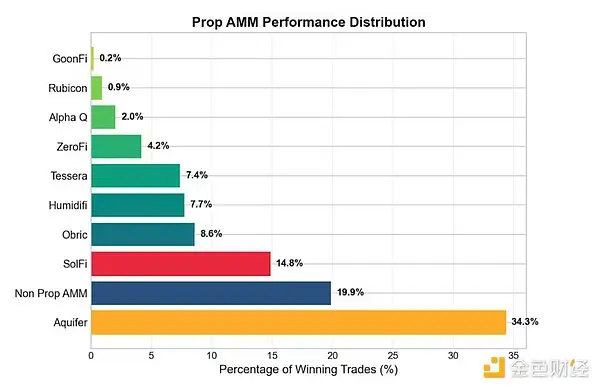
Data source: Galaxy | Data as of September 25, 2025
3. The Fragmented Market Urgently Needs High-Quality Aggregation Services
The current trading landscape of Solana exhibits a highly fragmented characteristic: over 10,000 liquidity pools, multiple proprietary AMMs each with their own unique pricing logic, and traditional DEX quotes that vary from one another. To achieve competitive trade execution, an efficient aggregation service has become crucial. In this fragmented environment, without a mature routing algorithm capable of navigating the complex liquidity network, price discovery cannot be conducted efficiently.
Whether they are elastic or inelastic users, ultimately, optimal prices on Solana must be obtained through aggregators – currently, aggregators handle 81% of the DEX trading volume on this network. This stands in stark contrast to Ethereum, where only 20% of transactions flow through aggregators. The dominant position of aggregated trading flow on Solana provides strong impetus for the continuous innovation of routing technology.
4. The Mathematical Advantages of Titan
This is precisely Titan's entry point. Most aggregators use classic pathfinding algorithms like Bellman-Ford, while Titan achieves better trade execution through pure mathematical optimization techniques.
The core difference between the two lies in precision: the pathfinding algorithm divides liquidity into “chunks” (such as 10%, 20%, etc., discrete ratios), resulting in efficiency losses when transactions are split across platforms; whereas Titan's convex optimization method can precisely allocate any proportion of trade volume to multiple liquidity pools, extracting maximum value from fragmented liquidity with machine-level accuracy.
This is not just a simple incremental improvement. The mathematical optimization methods enable Titan to incorporate more liquidity pools into the routing calculations, discovering optimal paths that classic algorithms cannot find. In practical terms, this means users can continuously receive better quotes: when exchanging asset Y for asset X, the actual amount received is significantly higher.
5. The Progressive Improvement Economics of Titan
It's worth looking at the compounding effect generated by the execution improvements validated by Titan. If a trader exchanges $1,000 each time and saves an average of 21 basis points (0.21%) on each trade through Titan, the long-term accumulated value is quite substantial:
- For active traders executing 10 trades daily, Titan's premium routing can save $7,665 annually just through linear accumulation;
- If these saved funds are reinvested and compounded, the annual return will increase to $10,384, which is 35% higher than simple linear returns.
For algorithmic trading strategies that dominate Solana's trading volume, Titan's execution advantages are more practically significant. Wallets like Phantom charge fees based on user trading profits, so Titan's continuous “outperformance” can be directly converted into user gains. For example, through Titan's optimized routing, each transaction can earn an additional 0.5 SOL (increasing from 99.5 SOL to 100 SOL), which, after thousands of transactions compounded, will lead to actual portfolio growth positively correlated with trading frequency and scale.
VI. Future Outlook: The Evolution Direction of Market Structure
Looking to the future, we believe that the following major trends will shape the market structure of Solana:
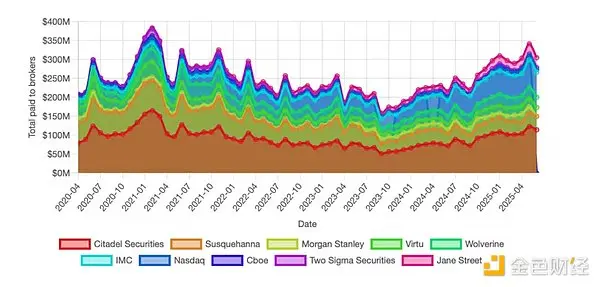
As aggregators compete for market share, zero-commission competition will become increasingly fierce. The order flow payment (PFOF) market in traditional finance provides a strong reference for sustainable monetization: in May 2024 alone, U.S. retail brokers generated $461 million in order flow revenue, with Robinhood's monthly revenue exceeding $100 million. This model is viable because market makers value harmless retail order flow.
Unlike the traditional market's standardized national best bid and offer (NBBO), Solana's PFOF model is more refined: DEX and market makers can stratify order flow based on wallet addresses or execution complexity.
- The development path of Titan is reminiscent of the evolution of Interactive Brokers: it started as a technology-first execution platform and gradually expanded into a full-service brokerage. Similar to Interactive Brokers, Titan can monetize in various ways: charging execution fees to mature traders, generating revenue through order flow partnerships, and providing premium services to institutional clients. The core difference lies in the fragmented market structure of Solana, which highlights the value of high-quality routing technology.
- As more mature trading institutions launch proprietary AMMs, the fragmentation of liquidity providers will continue. Teams like Wintermute and Wincent, along with emerging participants, are continuously upgrading algorithms, pushing execution quality into an arms race. While this can benefit users through narrower spreads, it also raises higher demands on the complexity of aggregation services.
- Through upgrades like Alpenglow, Solana's transaction finality time will be shortened, which not only reduces slippage but also allows for more accurate pricing. As block times decrease and finality efficiency improves, aggregators can reduce the “buffer space to cope with price reverse fluctuations” in their quotes, thereby providing narrower spreads.
- The RFQ system may introduce delays, but it ensures execution at the quoted price. The trade-off between speed and certainty can provide differentiated services for different user groups.
7. Strategic Positioning of Titan
We believe that in this evolving landscape, Titan possesses unique value capture capabilities. In addition to the technical advantages brought by mathematical optimization, the platform can generate revenue through multiple channels: integration partnerships with wallets, high-end products offered to mature traders, and order internalization opportunities that arise as trading volume increases.
What makes it more attractive is the incentive alignment mechanism: Titan only charges fees when performance exceeds that of competitors, directly linking protocol success to user value. With a proven win rate advantage and the growing adoption of mainstream wallets, Titan represents a fundamental advancement in on-chain price discovery mechanisms.
As the Solana infrastructure matures and institutional adoption accelerates, the market's demand for execution quality will continue to rise. Platforms that can continuously create value for users in an increasingly complex environment are expected to gain an advantage in the market.


