


The coin unlocks 1.2 billion this year, countdown to collapse! Trading volume remains at 6 million, not yet listed on mainstream exchanges.
The trading price of Pi remains at $0.2075, far below the $3 high point. Daily trading volume has plummeted to just $6 million, yet the market capitalization reaches $1.7 billion. A new round of CEX listings has not been initiated, and $1.2 billion worth of tokens will be unlocked this year. Technically, an ascending wedge bearish pattern has formed, testing the $0.1918 low point, and a break below could create a new low.
Liquidity Crisis as Trading Volume Crashes to $6 Million
The current consolidation is mainly due to weakened investor demand. Data compiled by CoinMarketCap shows that Pi’s trading volume over the past 24 hours is only $6 million, which is negligible for a cryptocurrency with a market cap of over $1.7 billion. Its trading volume is far lower than some smaller cryptocurrencies like Render, Cosmos, and Official Trump.
The ratio of trading volume to market cap (turnover rate) is a key indicator of liquidity health. Pi’s daily turnover rate is only 0.35% (6 million / 1.7 billion), whereas healthy cryptocurrencies typically maintain between 5% and 20%. Bitcoin’s daily turnover rate is about 2%, Ethereum around 3%, and mainstream altcoins usually above 10%. Pi’s extremely low turnover rate indicates a market with very little active buying and selling, and this liquidity drought makes prices highly susceptible to manipulation.
Even after developers launched new tools to accelerate the integration of payment functions into their applications, Pi’s trading volume continues to decline. These new tools include Pi SDK and backend APIs, designed to enable developers to complete payment integrations within minutes. The Pi team is also developing decentralized exchanges, automated markets, and token creation tools, which are expected to be launched later this year. They hope these tools will enhance Pi’s utility over time.
Three Critical Reasons for the Crash in Pi’s Trading Volume
Mainstream Exchange Absence: No new CEX listings, limiting liquidity and accessibility
Supply Unlock Panic: Over 1.2 billion tokens will be unlocked this year, representing a large proportion of current circulating supply
Centralization Controversy: Pi Foundation holds billions of tokens, leading to trust issues due to high centralization
PiThe decline in Pi’s trading volume over the past few months is due to several reasons. First, unlike most tokens, Pi has not been listed on new mainstream exchanges like CEXs. This absence greatly restricts Pi’s liquidity and accessibility, as most crypto investors use these platforms. Without support from major exchanges, Pi can only be traded on smaller exchanges and OTC markets, naturally limiting liquidity.
Second, the increasing daily token unlocks have raised concerns, as this will increase the supply. Over 1.2 billion tokens will be unlocked this year. This figure is enormous relative to the current circulating supply, implying a significant increase in supply. Without a corresponding increase in demand, this supply surge will inevitably push prices down. More critically, many of these unlocked tokens are held by early miners, whose acquisition costs are near zero; once unlocked, they may sell immediately for cash.
Additionally, Pi is a highly centralized network in the crypto industry, with the little-known Pi Foundation holding billions of tokens. This centralization has triggered a serious trust crisis. Investors worry that the Foundation might sell large amounts of tokens at any time to crash the market, and the community has no means to restrain this. In contrast, Bitcoin and Ethereum’s decentralized governance structures prevent any single entity from manipulating the market.
Ascending Wedge Breakdown and the 0.1918 USD Critical Level
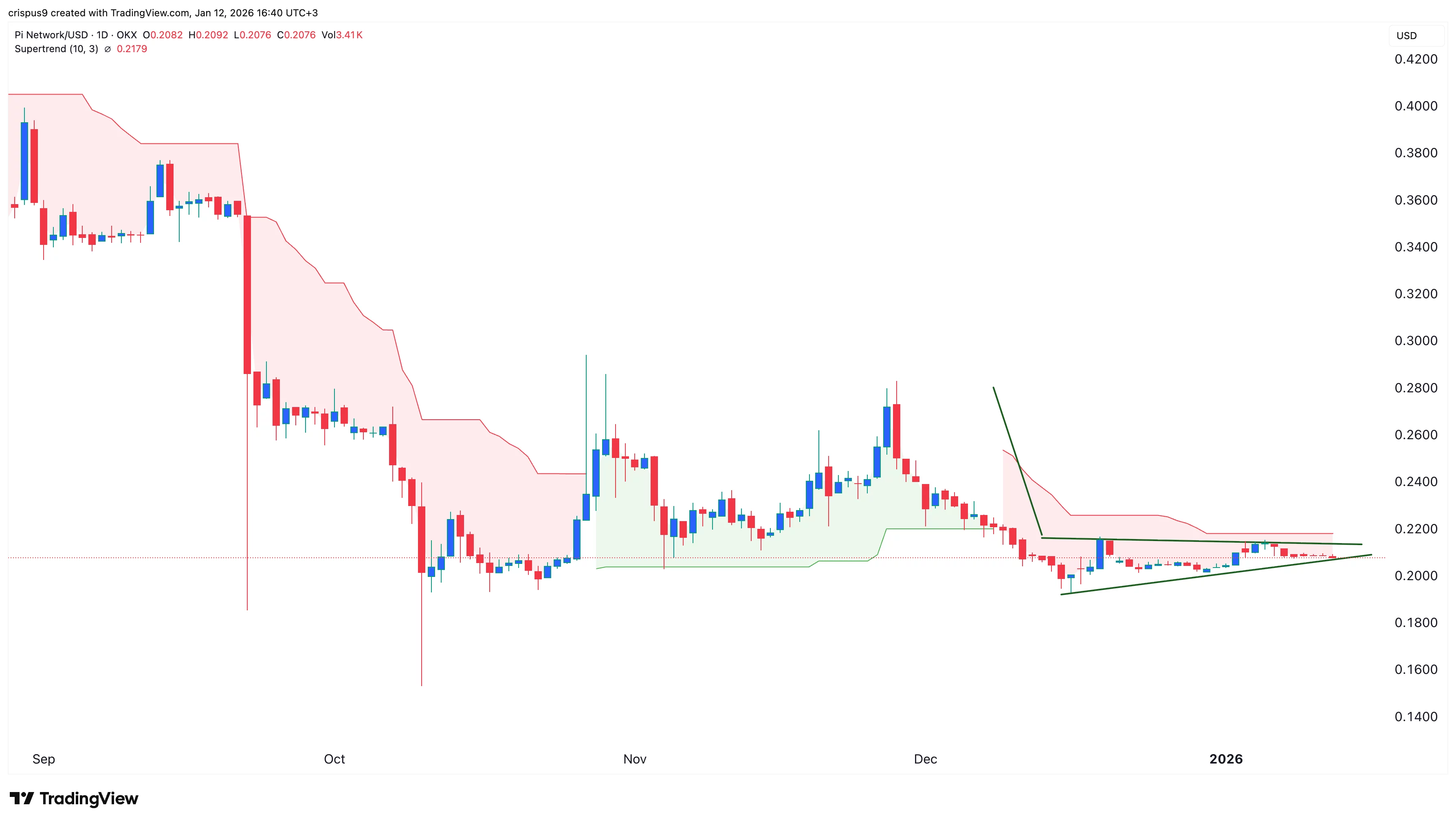
The daily chart shows that Pi has formed a highly bearish chart pattern, indicating further decline. It is forming an ascending wedge pattern, composed of two rising and converging trendlines. These trendlines are about to converge, which will likely lead to a downward breakout. The ascending wedge is one of the most reliable bearish patterns in technical analysis, with statistics showing over a 70% probability of a downward breakout.
Pi also forms a bearish pennant pattern, a common continuation signal. It remains below the 50-day exponential moving average (EMA) and the Super Trend indicator, both of which show a medium-term bearish trend. The 50-day EMA is often seen as a mid-term trend threshold; when the price stays below this line, it indicates dominant selling pressure.
Therefore, the most probable forecast for Pi is bearish, with the next key target at $0.1918, its lowest point in December. A break below this level could open a new downward space, possibly testing $0.15 or even lower. Falling below $0.1918 would increase the likelihood of hitting a new all-time low, as this is the lowest support since mainnet launch; losing this level would enter uncharted territory.
From a risk-reward perspective, Pi’s current investment value is extremely low. The technical outlook is clearly bearish, and the fundamentals (collapse in trading volume, supply unlocks, absence from major exchanges) are also negative, with no obvious bullish catalysts. For existing Pi holders, it is advisable to reduce positions on rebounds. Potential buyers should wait until the price breaks below $0.1918 and shows clear bottoming signals before considering entry.
Related Articles
Pi Network Celebrates One Year of Open Network: A Look at the 2026 Key Metrics
Pi Network Rolls Out Phase 2 Protocol Upgrades With Mandatory Node Deadline
Pi Network Urges Mainnet Node Operators to Upgrade Before Key Deadline
Best Crypto to Buy Now: Whales Earn $17K Per Month Staking Pepeto While $460 Million Gets Liquidated, Sui and Pi Network Bleed
Why Is Crypto Crashing: Whales Knew the War Was Coming and Sold Days Before You Did, Pepeto Presale Surges as Sui and Pi Network Collapse