


Wall Street Enters RWA! DTCC and JPMorgan Chase Bet on a $20 Billion Market to Surge into Trillion-Scale Assets

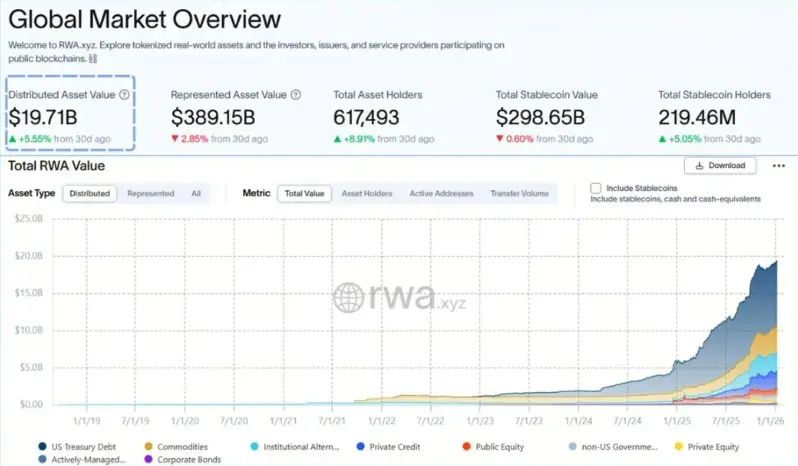
The RWA tokenization market is close to $20 billion, a 150% surge since early 2024. Government bonds account for 45%, with private credit growing the fastest. The top five protocols include Rayls Labs, Ondo Finance, and others. The key milestones for 2026 are Ondo launching on Solana, Canton releasing MVP, and Centrifuge deploying $1 billion.
Segmentation and Three Main Drivers of the $20 Billion Market
(Source: rwa.xyz)
Three years ago, tokenized RWA was almost considered a niche. Today, on-chain assets such as government bonds, private credit, and public equities are approaching $20 billion. According to a market snapshot from rwa.xyz in early January 2026: government bonds and money market funds make up about $8-9 billion, accounting for 45%-50% of the market; private credit ranges from $2-6 billion (smaller base but fastest growth, 20%-30%); public equities exceed $400 million (rapid growth, mainly driven by Ondo Finance).
The three main drivers accelerate RWA adoption. The first is the appeal of yield arbitrage: tokenized government bond products offer 4%-6% returns with 24/7 access, whereas traditional markets have T+2 settlement cycles. Private credit tools provide 8%-12% yields. For institutional finance managers managing billions in idle capital, this is an attractive proposition.
The second is the gradual improvement of regulatory frameworks. The EU’s MiCA regulation has been enforced in 27 countries. The US SEC’s Project Crypto is advancing on-chain securities frameworks, while No-Action Letters enable infrastructure providers like DTCC to tokenize assets. Third, the maturity of custody and oracle infrastructure, with Chronicle Labs handling over $20 billion in total locked value, and Halborn completing security audits for major RWA protocols.
Current Status of the Three Main Segments in the RWA Market
Government Bonds and Money Markets: $8-9 billion, led by Franklin Templeton’s $828 million fund
Private Credit: $2-6 billion, supported by Janus Henderson’s $373 billion AUM
Tokenized Stocks: $400 million, Ondo rapidly expanding with 98 asset types launched
Despite this progress, the industry faces significant challenges. Cross-chain transaction costs are estimated at up to $130 million annually. Due to high capital flow costs exceeding arbitrage gains, the price difference for the same asset across different blockchains reaches 1%-3%. Conflicts between privacy needs and regulatory transparency remain unresolved.
Market Segments and Competitive Barriers of the Five Major Protocols
Rayls Labs, Ondo Finance, Centrifuge, Canton Network, and Polymesh are not competing for the same clients but are targeting different institutional needs. This market segmentation is more important than many realize; institutions do not choose the “best blockchain,” but rather the infrastructure that best addresses their specific compliance, operational, and competitive requirements.
Rayls Labs positions itself as a compliance-first bridge connecting banks and DeFi, developed by Brazil-based fintech Parfin, supported by Framework Ventures and ParaFi Capital. Its Enygma privacy stack uses zero-knowledge proofs to ensure transaction confidentiality, homomorphic encryption for encrypted data computation, and selective data disclosure to auditors. Practical applications include the Brazilian Central Bank’s CBDC cross-border settlement pilot. It completed a security audit by Halborn on January 8, 2026, and the AmFi alliance plans to reach $1 billion in tokenized assets by June 2027.
Ondo Finance has achieved the fastest expansion from institutional to retail, with TVL reaching $1.93 billion. Tokenized stocks account for over $400 million, holding 53% of the market share. On January 8, 2026, Ondo launched 98 new tokenized assets covering AI, electric vehicles, and thematic investments. It plans to launch tokenized US stocks and ETFs on Solana in Q1, aiming for over 1,000 assets. Its multi-chain deployment strategy includes Ethereum, BNB Chain, and Solana.
Centrifuge has become the standard for institutional private credit tokenization, with TVL between $1.3 billion and $1.45 billion. Janus Henderson’s AAA-rated CLO fund, with $373 billion AUM, is fully on-chain. Grove committed $1 billion in allocations, and on January 8, 2026, partnered with Chronicle Labs for oracle services. AAA assets have an APY of 3.3%-4.6%.
Canton Network, supported by DTCC, BlackRock, Goldman Sachs, and Citadel Securities, targets the $3.7 quadrillion annual settlement flow processed by DTCC in 2024. It received SEC No-Action Letter approval in December 2025 and plans to launch MVP in the first half of 2026. On January 8, 2026, the Temple Digital platform went live, offering sub-second matching with a centralized limit order book.
Polymesh stands out for protocol-level compliance, designed specifically for regulated securities. Its embedded transfer rules cause non-compliant transactions to fail at consensus, with final confirmation within 6 seconds. In August 2025, it integrated Republic for private securities issuance, with plans to launch an Ethereum bridge in Q2 2026.
Four Key Milestones in 2026 and the Vision for 2030 Trillion-Scale
The catalysts to watch in 2026 include: Ondo’s launch on Solana (Q1) testing retail-scale issuance for sustainable liquidity, with success measured by over 100,000 holders; Canton’s DTCC MVP (H1) validating blockchain’s feasibility for US government bond settlement, potentially transferring trillions of dollars on-chain; the US CLARITY Act passing, providing clear regulatory guidance enabling cautious institutions to deploy capital; Centrifuge’s Grove completing $1 billion in allocations within the year, testing real capital operations with credit tokens.
Market forecasts target a tokenized asset scale of $2-4 trillion by 2030, a 50- to 100-fold increase from the current $19.7 billion. Industry growth projections include private credit expanding from $2-6 billion to $150-200 billion (highest growth rate), tokenized government bonds and money market funds migrating on-chain with potential exceeding $5 trillion, and real estate reaching $3-4 trillion.
The $100 billion milestone is expected around 2027-2028, with distribution estimates: institutional credit $30-400 billion, government bonds $30-400 billion, tokenized stocks $20-300 billion, real estate and commodities $10-20 billion. Achieving this requires a fivefold increase from current levels, but considering the institutional momentum in Q4 2025 and upcoming regulatory clarity, the goal is not out of reach.