


The turning point after ten years of debate: Will Ethereum end the debate over the "Impossible Triangle"?
Article by: imToken
The term “Impossible Triangle,” everyone must have heard it so many times that their ears are numb, right?
In Ethereum’s first decade since its birth, the “Impossible Triangle” has been like a physical law hanging over every developer’s head— you can choose any two among decentralization, security, and scalability, but never all three at once.
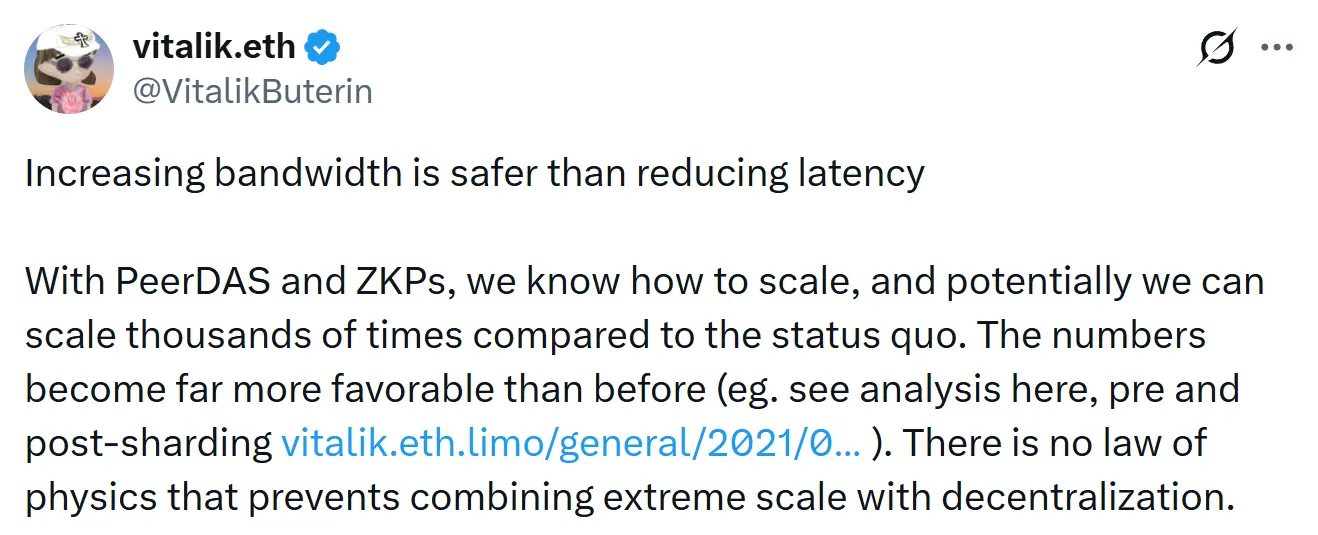
However, looking back from the beginning of 2026, we find that it seems to be gradually transforming into a “design threshold” that can be crossed through technological evolution, just as Vitalik Buterin pointed out in his disruptive view on January 8: "Compared to reducing latency, increasing bandwidth is safer and more reliable. With PeerDAS and ZKP, Ethereum scalability can be increased by thousands of times, and this does not conflict with decentralization."
So, can the once considered insurmountable “Impossible Triangle” really dissipate today in 2026 as PeerDAS, ZK technology, and account abstraction mature?
1. Why has the “Impossible Triangle” been difficult to conquer for so long?
First, let’s review the concept of the “Blockchain Impossible Triangle” proposed by Vitalik Buterin, which was specifically used to describe the dilemma that public chains face in balancing security, scalability, and decentralization:
- Decentralization means low node barriers, broad participation, and no trust in a single entity;
- Security means the system can maintain consistency against malicious acts, censorship, and attacks;
- Scalability means high throughput, low latency, and a good user experience;
The problem is that these three often hinder each other under traditional architectures. For example, increasing throughput usually means raising hardware requirements or introducing centralized coordination; reducing node burdens may weaken security assumptions; insisting on extreme decentralization often sacrifices performance and user experience.
It can be said that over the past 5-10 years, from early chains like EOS to later ones like Polkadot, Cosmos, and the ultra-performance chains like Solana, Sui, Aptos, different public chains have given different answers—some sacrifice decentralization for performance, some improve efficiency through permissioned nodes or committee mechanisms, and others accept performance limitations to prioritize resistance to censorship and verification freedom.
But the common point is that almost all scaling solutions can only satisfy two of the three, inevitably sacrificing the third.
Or in other words, almost all solutions are stuck in a tug-of-war under the “monolithic blockchain” logic— if you want to run fast, you need strong nodes; if you want many nodes, you have to run slower. This seems to be a dead-end.
If we temporarily set aside the debate over monolithic vs. modular blockchains and carefully review Ethereum’s development path from 2020, which shifted from a “monolithic chain” to a multi-layer architecture centered on Rollups, and recent maturity of supporting technologies like ZK (Zero-Knowledge Proofs), we will find:
The underlying logic of the “Impossible Triangle” has been gradually reconstructed over the past 5 years through Ethereum’s modularization process.
Objectively, Ethereum has decoupled the originally constrained factors through a series of engineering practices. At least in terms of engineering pathways, this problem is no longer just a philosophical discussion.
2. The engineering approach of “divide and conquer”
Next, we will dissect these engineering details. Specifically, in the five-year empirical period from 2020 to 2025, how Ethereum has advanced multiple technical lines in parallel to dissolve this triangle constraint.
First, by achieving “decoupling” of data availability through PeerDAS, freeing the inherent limit of scalability.
As is well known, in the impossible triangle, data availability is often the first bottleneck for scalability because traditional blockchains require each full node to download and verify all data, which guarantees security but limits scalability. This is why solutions like Celestia, which adopt a “heretical” DA approach, have seen explosive growth.
Ethereum’s direction is not to make nodes stronger but to change how nodes verify data, with PeerDAS (Peer Data Availability Sampling) as a core idea:
It no longer requires each node to download all block data but instead verifies data availability through probabilistic sampling—block data is split and encoded, and nodes randomly sample parts of the data. If data is hidden, the probability of sampling failure quickly increases. This significantly boosts data throughput, while allowing ordinary nodes to participate in verification. It means Ethereum is not sacrificing decentralization for performance but optimizing the cost structure of verification through mathematics and engineering design (see extended reading: “Is the DA War Coming to an End? Deconstructing PeerDAS and How It Helps Ethereum Reclaim ‘Data Sovereignty’”).
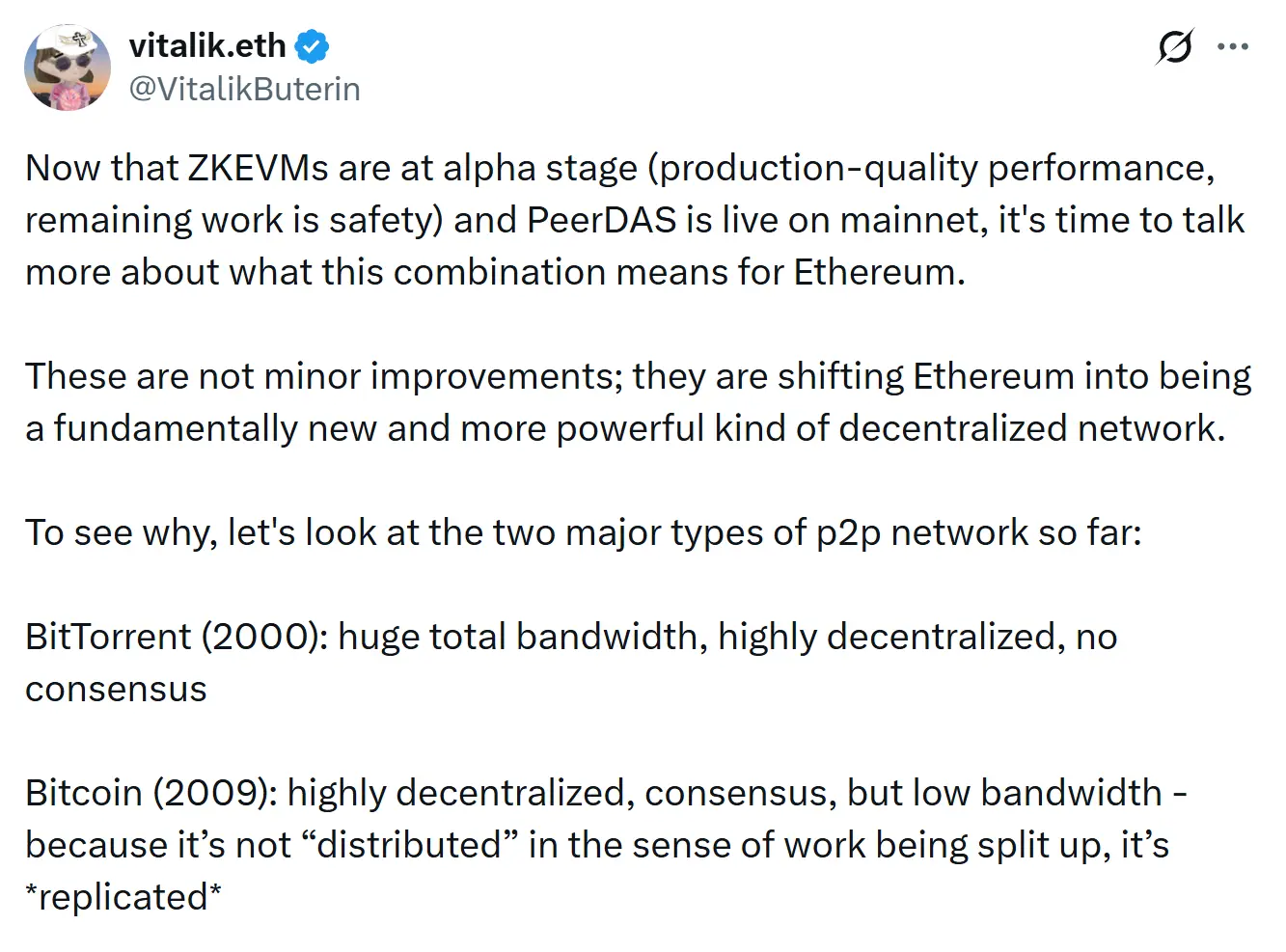
Moreover, Vitalik emphasizes that PeerDAS is no longer just a conceptual roadmap but a real deployed system component, marking a substantial step forward in Ethereum’s “scalability × decentralization.”
Second, zkEVM aims to solve the problem of “must every node repeat all computations” through zero-knowledge proof-driven verification layers.
The core idea is to enable the Ethereum mainnet to generate and verify ZK proofs. In other words, after executing each block, a verifiable mathematical proof is produced, allowing other nodes to confirm correctness without re-executing all transactions. Specifically, zkEVM’s advantages focus on three aspects:
- Faster verification: nodes do not need to re-execute transactions, only verify zkProofs;
- Lighter burden: significantly reduces full node computation and storage pressures, making light nodes and cross-chain verifiers easier to participate;
- Stronger security: compared to the OP approach, ZK state proofs are confirmed on-chain in real-time, with higher tamper resistance and clearer security boundaries;
Recently, the Ethereum Foundation (EF) officially released the L1 zkEVM real-time proof standard, marking the first time ZK has been formally included in the mainnet technical plan. Over the next year, Ethereum mainnet will gradually transition to an execution environment supporting zkEVM verification, achieving a structural shift from “heavy execution” to “verification proof.”
Vitalik believes zkEVM has initially reached a stage suitable for production in terms of performance and completeness. The real challenges lie in long-term security and implementation complexity. According to EF’s published technical roadmap, block proof latency is targeted within 10 seconds, individual zk proofs are less than 300 KB, and they adopt 128-bit security, avoid trusted setup, and plan to enable household devices to participate in proof generation, lowering decentralization barriers (see extended reading: “ZK Roadmap ‘Dawn’: Is Ethereum’s Finality Roadmap Accelerating?”).
Finally, besides these two, there are other multi-dimensional efforts based on the Ethereum roadmap before 2030 (such as The Surge, The Verge, etc.), focusing on increasing throughput, reconstructing state models, raising Gas limits, and improving execution layers.
These are all trial-and-error and accumulation paths to overcome traditional triangle limitations. They resemble a long-term mainline, aiming for higher blob throughput, clearer Rollup division of labor, and more stable execution and settlement rhythms, laying the foundation for future multi-chain collaboration and interoperability.
Importantly, these are not isolated upgrades but are explicitly designed to be layered and mutually reinforcing modules, which also reflects Ethereum’s “engineering attitude” toward the Impossible Triangle: not seeking a magic solution like monolithic chains, but readjusting costs and risks through multi-layer architecture modifications.
3. The 2030 vision: Ethereum’s ultimate form
Even so, we must remain cautious. Because elements like “decentralization” are not static technical indicators but long-term evolutionary results.
Ethereum is actually exploring the boundaries of the Impossible Triangle step by step through engineering practice—as verification methods (from recomputation to sampling), data structures (from state bloat to state expiration), and execution models (from monolithic to modular) change, the original trade-offs are shifting. We are approaching that “both want and need and still want” endpoint.
Recently, Vitalik also provided a relatively clear timeline:
- 2026: With some improvements in execution layers / construction mechanisms, such as ePBS, the Gas limit without zkEVM dependence can be raised first, creating conditions for “more widespread zkEVM node operation”;
- 2026–2028: Adjustments around Gas pricing, state structure, and execution load organization to maintain security under higher loads;
- 2027–2030: As zkEVM gradually becomes a key method for verifying blocks, Gas limits may further increase, with the long-term ideal aiming for a more distributed block construction;
Combining recent roadmap updates, we can glimpse three key features of Ethereum before 2030, which together constitute the final answer to the Impossible Triangle:
- Minimalist L1: L1 becomes a stable, neutral bottom layer responsible only for data availability and settlement proofs, no longer handling complex application logic, thus maintaining very high security;
- Prosperous L2 and interoperability: Through EIL (Interoperability Layer) and fast confirmation rules, fragmented L2s are stitched into a whole, users perceive no chain existence, only tens of thousands of TPS;
- Extremely low verification threshold: Due to mature state processing and light client technology, even mobile phones can participate in verification, ensuring the cornerstone of decentralization remains solid;
Interestingly, as I write this article, Vitalik again emphasizes an important testing standard—the “Walkaway Test”—reaffirming that Ethereum must have autonomous operation capability, even if all service providers disappear or are attacked, so that DApps can still run and user assets remain safe.
This statement essentially brings the evaluation metric of this “final form” back from speed/experience to what Ethereum cares most about—the system’s trustworthiness in the worst case, and whether it still does not rely on a single point.
In conclusion
People always need to look at problems with a developmental perspective, especially in the rapidly changing Web3/Crypto industry.
I also believe that many years later, when people look back at the fierce debates about the Impossible Triangle from 2020–2025, they might think it’s like discussing how to make a carriage that can simultaneously achieve speed, safety, and load capacity before the invention of the automobile.
Ethereum’s answer is not to find a magic solution at the three vertices but to build a digital infrastructure that belongs to everyone, is extremely secure, and can carry all human financial activities through PeerDAS, ZK proofs, and clever economic game design.
Objectively speaking, every step forward in this direction is stepping closer to the end of the “Impossible Triangle” story.
Related Articles
Data: If ETH breaks through $2,076, the total liquidation strength of long positions on mainstream CEXs will reach $683 million.
Vitalik Buterin Plans “Cypherpunk” Upgrade Path to Strengthen Ethereum Over the Next Five Years
Vitalik Buterin Plans Cypherpunk Upgrade for Ethereum
Data: In the past 24 hours, the total liquidation across the network was $87,420,900, with long positions liquidated at $34,809,600 and short positions at $52,611,300.