Author: Jae, PANews
On January 14th, the DFINITY Foundation officially released a new tokenomics white paper titled “Mission 70,” proposing an extremely aggressive deflationary plan: by the end of 2026, reduce ICP’s inflation rate by 70%.
Following the announcement, ICP’s price performed strongly, with intraday gains exceeding 30%, leading the market. This is not mere emotional hype but a re-pricing of the Internet Computer’s fundamentals.
For DFINITY, which harbors the ambition of “rebuilding the internet,” this is not just an adjustment of the economic model but could become a turning point for ecosystem development. It attempts to perform a high-difficulty “economic surgery,” making a daring leap from “money-burning infrastructure” to “self-sufficient value engine.”
From subsidy expansion to a deflationary era, aiming to cut inflation by over 70%
This new white paper is personally crafted by founder Dominic Williams. It reads less like a typical project update and more like a “fiscal austerity bill” directed at all token holders.
The core goal of this plan is to leverage “supply reduction” and “demand increase” simultaneously, reducing the new issuance of ICP tokens—i.e., the nominal inflation rate—by 70% or more within 2026, moving ICP toward a deflationary state.
Currently, ICP’s annualized inflation rate is about 9.72%, mainly stemming from two “bleeding points” on the supply side: governance voting rewards (5.88%) and node provider incentives (3.84%). It’s like a printing press constantly diluting the assets of early participants.
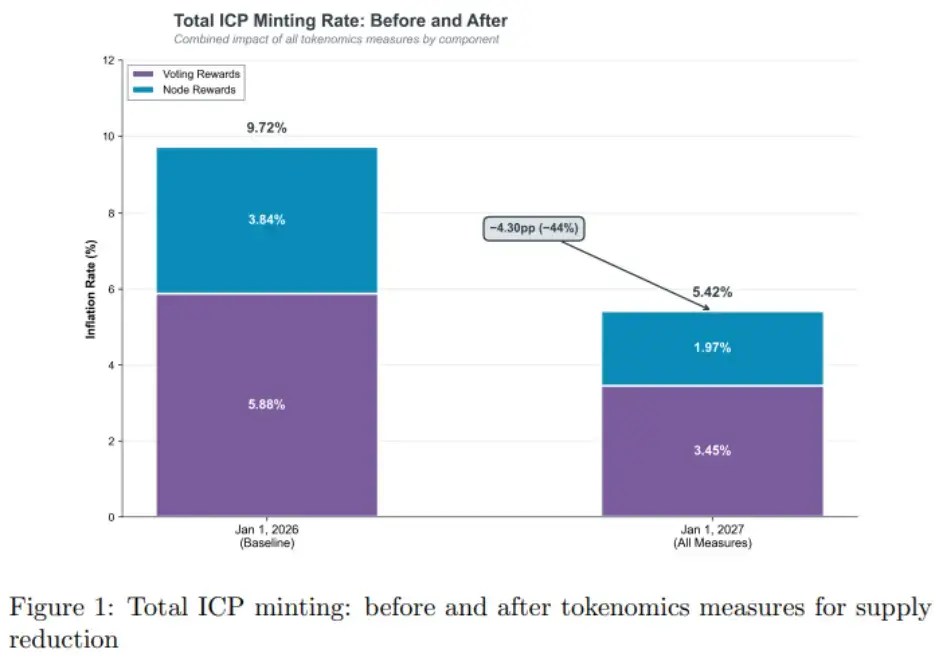
Mission 70 proposes to first “stop the bleeding” on the supply side by modifying the incentive parameters of the NNS (Network Nervous System), expecting to achieve a 44% “absolute token reduction.” The logic behind this mode is that, by sacrificing part of the nominal yield, it results in lower inflation and higher asset scarcity, thereby enhancing the long-term scarcity of tokens—essentially a deep value game.
The white paper states that reducing voting rewards may lower nominal yields for stakers in the short term, but by increasing token value and reducing circulating sell pressure, long-term holders’ risk-adjusted returns will be optimized due to decreased liquidity risk.
Additionally, cuts to node incentives are based on improved operational efficiency of providers and the multiplier effect of rising ICP prices: when ICP prices increase, the amount of ICP needed to pay the same fiat value for node fees will decrease.
Relying solely on supply-side “tightening” makes it difficult to achieve the 70% overall reduction target. To fill the remaining 26%, DFINITY is betting on the AI track, developing a demand expansion strategy centered around the “Caffeine AI” platform.
Caffeine is positioned as the world’s first commercial “self-programming internet” platform. Its technical principle involves using on-chain large language models (LLMs) to enable natural language programming (NLP), allowing non-technical users to develop, deploy, and run full-stack applications directly on ICP through textual descriptions, aiming to transform internet users from mere consumers into active builders.
In the economic model, all network activities driven by Caffeine—such as computation and storage—consume “Cycles.” Cycles are the units used in the ICP ecosystem to quantify and compute storage resources, representing the cost of executing a single instruction, created by destroying ICP tokens.
DFINITY plans to attract more AI models and enterprise cloud engines to run directly on ICP, burning large amounts of Cycles through these high-compute, high-storage-demand applications, thereby creating a sustainable deflationary effect on ICP.
This also means that ICP’s value capture will no longer rely on speculation but will be directly linked to the real demand for decentralized AI computing worldwide.
Related: DFINITY Foundation bets on AI, how does Caffeine drive ICP’s surge?
The underlying logic of this economic surgery is DFINITY’s precise judgment of its development stage: the subsidy expansion phase has ended, and it must now enter the value capture phase. It aims to solve the most criticized issue of value dilution since ICP’s inception, shifting market focus from inflation to actual on-chain resource consumption.
Active development second only globally, building three major competitive barriers
Markets are often easily misled by price fluctuations. DFINITY’s major economic reform is built on a solid technical foundation.
Codebase activity is usually the most objective visible indicator of a project’s long-term vitality.
CryptoMiso data shows that over the past 12 months, Internet Computer has had 4,185 commits on GitHub, ranking second among all blockchain projects worldwide, ahead of established chains like Bitcoin, Ethereum, and Solana.

This high-intensity development pace mainly stems from DFINITY Foundation’s large development team. This activity is not blind accumulation but focuses on:
- Subnet expansion: a series of upgrades in 2025 will increase subnet storage capacity to 2 TiB and introduce dynamic load balancing, significantly enhancing the network’s ability to handle massive data.
- Wasm execution efficiency optimization: continuously pushing the performance limits of WebAssembly, enabling ICP to execute complex smart contracts at speeds close to native.
- Threshold cryptography iteration: ongoing enhancement of Chain Fusion technology, allowing ICP smart contracts to directly manage native assets of external blockchains like Bitcoin, Ethereum, and Solana without relying on risky cross-chain bridges.
The high development activity and continuous technical delivery demonstrate that, despite volatile market cycles, ICP’s developer community has not diminished but is steadily progressing toward DFINITY’s goals.
These technological foundations also give DFINITY the confidence to launch its “economic surgery.”
With iterative technological architecture, Internet Computer has evolved from a simple Layer 1 to a cloud platform with sovereign computing capabilities. In fierce market competition, its competitive advantages mainly lie in three dimensions:
First, consolidating on-chain AI practical capabilities. Internet Computer is currently one of the few public chains capable of native AI inference model execution. Unlike other projects that run AI off-chain and use zero-knowledge proofs (ZKP) to return results, ICP can directly load neural network models. In the context of the AI + Web3 explosion, this advantage is hard to replace.
- End-to-end encryption and privacy: Internet Computer achieves encrypted storage of sensitive on-chain data, ensuring that even node providers cannot peek into user private data when processing AI models.
- Cost efficiency: Running AI inference on Internet Computer reduces costs by over 20% compared to traditional SaaS giants like Palantir, giving it a strong commercial edge in decentralized machine learning (DeML).
Second, building a seamless interoperability future. ICP smart contracts can operate as native addresses on other chains. Amid frequent cross-chain bridge security incidents, Internet Computer’s “Chain Fusion” technology may represent the future direction of interoperability.
- Native integration with BTC and SOL: Internet Computer has already enabled direct operations on native assets of Bitcoin (such as Ordinals, Runes) and Solana, without involving any wrapped tokens or centralized custodians, greatly enhancing multi-chain asset management security.
- Full-chain DeFi hub: This capability could make Internet Computer a “glue” connecting fragmented blockchain ecosystems, allowing developers to build seamless multi-chain DeFi applications.
Finally, eliminating barriers to mass adoption, ICP’s “reverse gas model” is a powerful weapon to attract mainstream developers. Under this model, users can access DApps without purchasing tokens or installing wallet plugins, greatly lowering Web3’s entry barrier and providing user experience comparable to Web2. Coupled with Internet Identity 2.0, users can log in seamlessly using fingerprint or facial recognition on their phones, far surpassing legacy public chains.
“Heaven’s demise” label discourages new funds, confronting ecosystem and liquidity challenges
Despite grand technological visions, DFINITY’s path to becoming the “world’s computer” remains fraught with difficulties, facing multiple challenges from market bias, ecosystem scale, and execution risks.
On one hand, since the mainnet launched in 2021, ICP’s token price has plummeted from over $400 to single digits, causing many investors to lose everything. Although DFINITY claims this was due to market manipulation, ongoing investor lawsuits and accusations of Foundation sell-offs still cast a shadow.
DFINITY has repeatedly requested courts to dismiss related cases, but legal scrutiny over market manipulation remains a Damocles sword hanging over the project.
This “Heaven’s fallen project” stereotype may, to some extent, limit new capital participation.
On the other hand, ICP faces a mismatch between technology and application.
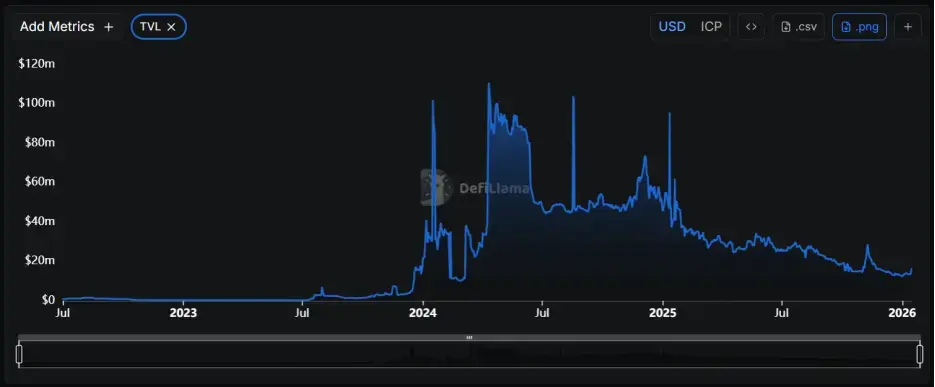
First, DeFi scale is lagging. Compared to Ethereum or Solana, ICP’s DeFi ecosystem remains significantly smaller. As of January 16, its on-chain TVL is only about $16 million.
Second, liquidity depth is insufficient. Although the protocol boasts strong cross-chain technology, native assets like ckBTC and ckETH lack liquidity depth, making large trades risky due to high slippage.
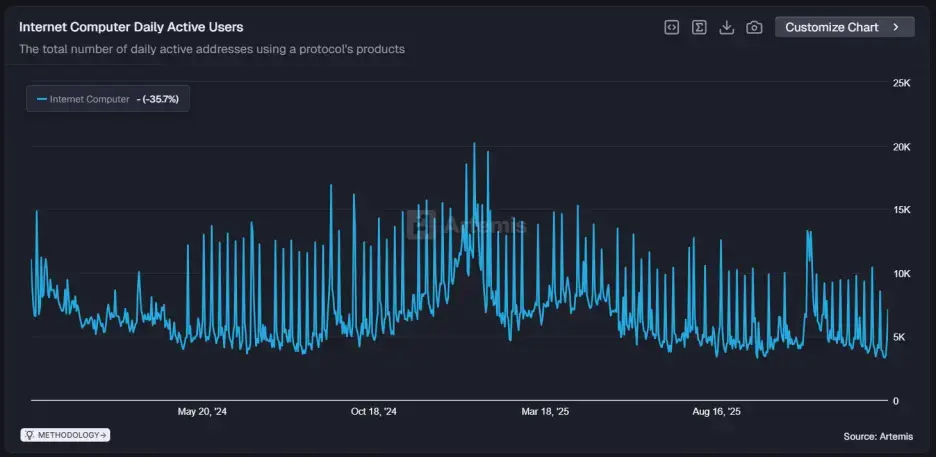
 Third, user base is weak. With only around 7,000 daily active addresses, ICP still lags significantly behind top ten market cap chains. Turning the “self-programming internet” vision into real user traffic is an urgent task.
The most uncertain aspect is the execution of the “inflation surgery.” Mission 70 is a delicate economic experiment, whose success depends on two synchronized premises: first, that reducing rewards will not cause a large exodus of node providers; second, that Caffeine AI can generate exponential growth in Cycles burning. If the AI platform’s deployment falls short of expectations, mere reward cuts could backfire, damaging ecosystem vitality or even triggering a “price decline—inflation acceleration” vicious cycle.
DFINITY is attempting a turnaround with a new tokenomics model. If in 2021 ICP was propelled by the “world’s computer” vision, by 2026 ICP aims to prove its value creation and capture capabilities through a precise deflationary model and real data.
For investors, the underlying logic of ICP’s price has shifted from vague ecosystem prosperity to two quantifiable, traceable hard metrics: the burning rate of Cycles and the frequency of on-chain AI inference calls.
Short-term price surges may merely reflect emotional release, but the actual execution of the new tokenomics Mission 70 and whether it can break the “strong tech, weak ecosystem” curse will be key to whether ICP can return to the top-tier public chain ranks.


