


Cardano price approaches $0.6 as leading validators emphasize decentralization advantages
Cardano (ADA) price is becoming a focal point as discussions about decentralization push the ADA trading price close to $0.40, while a leading validator emphasizes how broad stake distribution helps protect the network.
This not only increases value for delegators but also lays the groundwork for Cardano’s development, especially as the new Midnight rewards are set to be deployed on global markets in the near future.
Cardano’s Decentralization and the Big Picture
Cardano’s decentralization features are being tested directly through real-world data, providing strong confidence to the community.
According to Jaromir Tesar, the largest staking pool operator controls only about 10% of the total delegated ADA. In many other networks, such a level of concentration would be concerning, but with Cardano, it demonstrates effective decentralization.
Most ADA is staked in independent pools, not dominated by any large group. This ensures that no individual or organization can decide on critical issues like system upgrades, block production, or fee settings.
Even top operators hold only 10%, with the rest distributed among various parties, creating balance and stability for the network.
This structure directly influences how upgrades are implemented. All changes must go through a public proposal, testing, and community feedback process before widespread adoption.
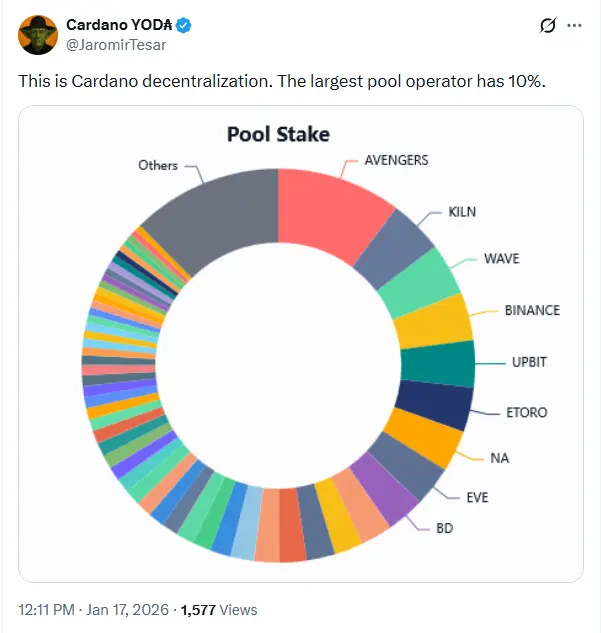 Introduction to Cardano’s Decentralization | Source: Cardano YODAD While this process may seem slow to investors, it minimizes potential risks and protects user rights.
Network reliability is also reinforced: if a large pool encounters issues, Cardano continues to operate smoothly thanks to hundreds of other pools producing blocks.
Small operators also have a fair chance to earn rewards, helping maintain diversity and competition within the validator system.
At the same time, decentralization underpins new development plans. Notably, the upcoming Midnight chain will use existing Cardano staking pools to validate transactions, directly inheriting the security of this distributed system.
For the community, this is clear evidence that Cardano’s decentralization is not just theoretical but has become a practical model delivering sustainable value.
Dual Rewards: ADA and NIGHT
Soon, Cardano delegators will enjoy enhanced financial benefits. When the Midnight Mainnet officially launches, Cardano staking pools will be able to validate Midnight blocks alongside Cardano, opening two sources of rewards for delegators.
The Cardanians project has confirmed it will operate the Midnight validator, meaning a single ADA delegation will earn both ADA from Cardano and NIGHT from Midnight.
This dual model makes staking more attractive, without requiring users to transfer funds or take on additional risks. The process is simple: users only need to delegate once, and their stake will support both chains simultaneously.
For small investors, this saves costs and effort, while expanding access to new ecosystems.
Many experts expect this linkage to strengthen engagement with Cardano. If Midnight develops strongly, demand for staking ADA will increase as it becomes a gateway to earning NIGHT rewards.
Decentralization remains crucial, as a diverse validator set builds strong trust in the system.
Pressure from Altcoins and ADA Price Outlook
The altcoin market still faces many challenges, with Cardano’s price under considerable pressure. Investor capital is shifting heavily into Bitcoin, causing assets like ADA to be undervalued despite their superior technology.
The launch of Bitcoin ETFs and macroeconomic instability have solidified BTC’s leading position. Global liquidity surged in March 2025, mainly flowing into the safest cryptocurrencies.
Meanwhile, many altcoins struggle with diluted funds, slow adoption, and lack compelling development stories.
Although many projects show potential and have good technology, these haven’t yet translated into rapid price growth. In this cycle, liquidity, confidence, and simplicity are valued more than long-term potential.
Most altcoins may not fall to zero, but many will perform worse than Bitcoin until capital flows return. The altcoin season isn’t over—it’s just delayed.
Currently, ADA trades around $0.384, with about 2% volatility in the past 24 hours. Experts believe Cardano’s recovery doesn’t require overly optimistic assumptions.
If ADA regains the $0.70–$0.75 range and stays above the 200-day moving average, reaching $1.00 in the next market cycle is entirely feasible.
Looking ahead to 2026, reaching $1.20–$1.50 aligns with past growth models, rather than relying on temporary hype effects.