


BitMine Shareholders' Meeting Turns into a Farce! New Executives Absent, Investors Dissatisfied with MrBeast Financing
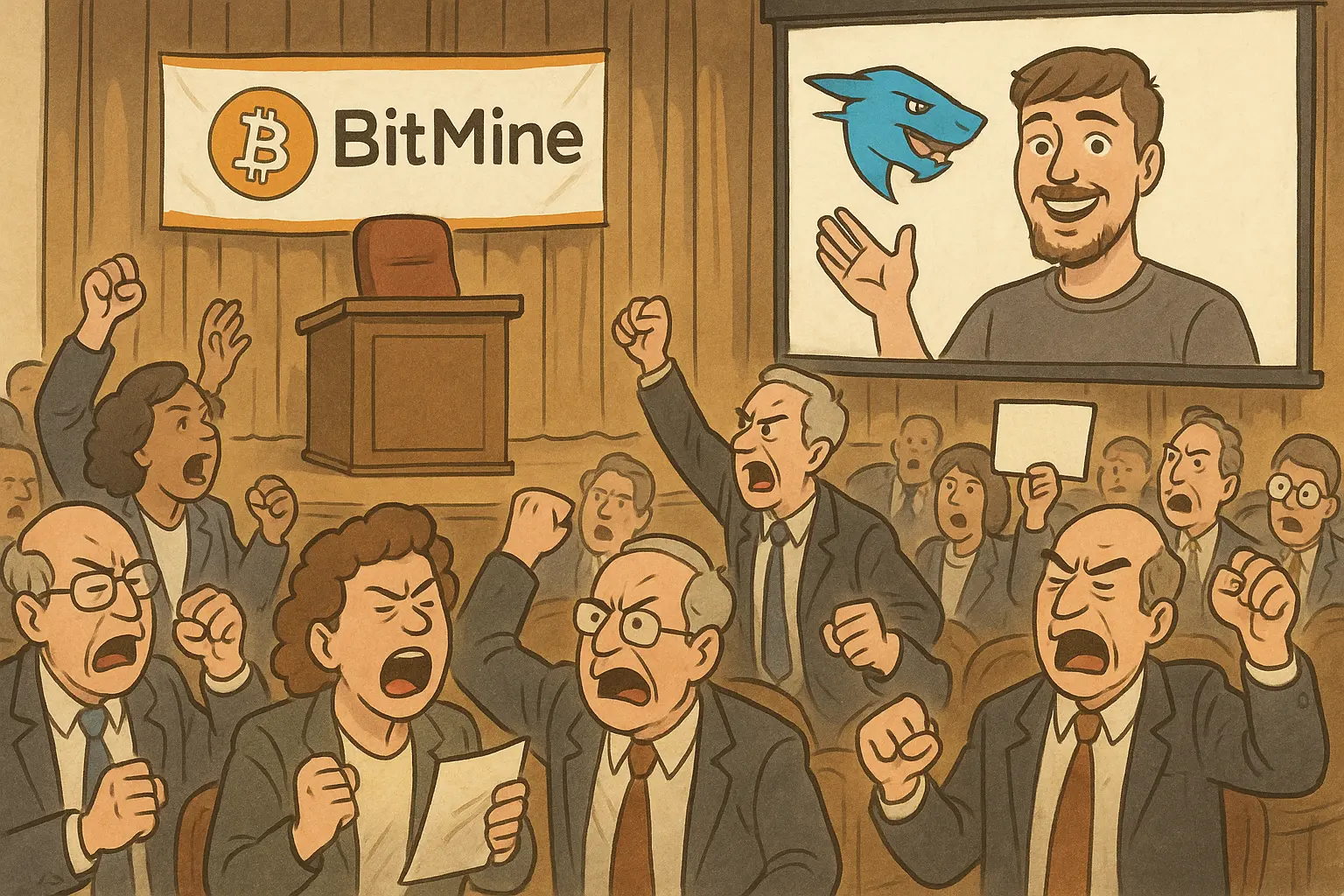
BitMine shareholders’ meeting in Las Vegas sparked controversy, with the absence of the new CEO and CFO criticized as a “clown show.” The company announced a transformation into a “Digital Berkshire,” holding 4 million ETH (approximately $14 billion), and investing $200 million in MrBeast, which is the most contentious aspect.
Shareholders criticize chaotic meeting management, top executives’ collective absence
Just days after the BitMine shareholders’ meeting, disputes erupted, revealing significant disagreements between management and investors. Shareholders criticized issues such as the absence of senior executives, rushed statements, and unclear voting results. Both the new CEO and CFO did not attend, and high-profile guest speakers previously promised also did not appear. As a result, investors viewed the meeting as chaotic and disrespectful, with some likening it to a farce.
A shareholder named Christopher O’Malley openly stated on X platform: “Respect? You and the board need to seriously review what just happened and honestly face the obvious problems. Shareholders’ anger is not without reason. Disrespect is one of them. The BitMine shareholders’ meeting did not satisfy the majority of shareholders.” This public criticism reflects deep dissatisfaction among investors regarding corporate governance.
Tom Lee, who also serves as a leader at Fundstrat, has heightened concerns, raising doubts about whether he can give BitMine adequate attention. Fundstrat is a well-known research and consulting firm, with Tom Lee as its co-founder and research director, handling heavy analysis and client service work. When he simultaneously serves as BitMine’s CEO, the division of time and energy becomes a focal point for shareholders. Critics argue that a company managing $14 billion in assets needs a full-time, dedicated leader rather than a part-time helmsman.
Board member Rob Sechan acknowledged shareholders’ disappointment but emphasized that this BitMine shareholders’ meeting is during a transitional period. Reports indicate that just days earlier, the company had filled several senior management vacancies. He responded on X: “I understand everyone’s disappointment, and I want to address it directly. This annual shareholders’ meeting is during a real transformation for the company. BitMine’s management team is essentially new, with several positions filled just days before the meeting. This is the first annual shareholders’ meeting.”
He defended the board’s oversight, stating that the goal of the annual meeting was to explain the company’s “DAT+” strategy (Digital Asset Treasury Plus) and clarify its long-term potential. However, critics believe that the board’s response failed to address fundamental issues such as planning, transparency, and accountability. Even during a transition, basic organizational capabilities and respect for shareholders should not be compromised.
From staking to capital allocation: a radical transformation
Despite governance criticisms, management emphasized a major strategic shift. BitMine is moving beyond Ethereum staking to become a digital holding company, investing its capital into projects that can expand Ethereum’s adoption. The core logic of this transformation is that holding and staking ETH alone, while generating stable income, does not fully leverage the company’s capital advantage and market influence.
The company holds over 4 million ETH (about $14 billion), earning between $400 million and $430 million annually from staking. This figure is expected to grow to $540 million to $580 million as its total ETH holdings reach 5% of the overall supply. Such a large holding makes BitMine one of the world’s largest ETH holders, second only to the Ethereum Foundation itself.
Sechan likened this strategy to Berkshire Hathaway, calling it a disciplined capital allocation adapted to the digital age. He wrote: “Capital base plus disciplined investment in productive businesses—that’s what BRK does. The same philosophy, different era and trajectory.” This analogy aims to convince shareholders that BitMine is not deviating from its core business but replicating Buffett’s successful formula, just applied to digital assets.
Three pillars of BitMine’s transformation strategy
Continuous staking income: Maintain 4 million ETH staked to generate stable cash flow as a basis for capital allocation
Strategic investments: Use staking income and part of the capital to invest in companies and protocols that can expand Ethereum applications
Ecosystem influence: Promote mainstream adoption of Ethereum through investments and collaborations, thereby increasing the value of held ETH
The theoretical advantage of this model is creating a positive cycle: staking yields generate income, which is invested in projects that can promote ETH adoption, increasing demand and ETH price, leading to asset appreciation and further investment capacity. However, there is often a significant gap between theory and practice, and the MrBeast deal is the first major test of this model.
MrBeast investment sparks major controversy
The most contentious issue is BitMine’s $200 million investment in MrBeast’s Beast Industries. This investment aims to integrate Ethereum into the creator economy through tokenization platforms and distribution networks. MrBeast, whose real name is Jimmy Donaldson, is one of the world’s largest YouTube creators, with over 300 million subscribers, influencing content creation, e-commerce, and charity sectors.
Supporters argue that this deal leverages one of the world’s largest attention engines, accelerating Ethereum’s popularity among Generation Z and Alpha users. If Beast Industries successfully integrates Ethereum into its content and e-commerce ecosystem, hundreds of millions of young users will be exposed to cryptocurrencies for the first time—an unprecedented user acquisition scale that traditional marketing cannot achieve.
Specifically, the plan includes establishing an Ethereum-based creator tokenization platform, allowing content creators to issue their own tokens, NFTs, and memberships. Beast Industries’ distribution network will promote these digital assets, and MrBeast’s participation will bring significant attention to the entire ecosystem. From a business perspective, this is a high-risk, high-reward gamble, betting on the deep integration of creator economy and cryptocurrency.
However, critics argue that this partnership could distract the company from governance and operational priorities, and question whether the company is overextending. First, $200 million accounts for about 1.4% of BitMine’s total assets—relatively modest, but for a company that just announced a transformation, investing heavily in highly experimental projects raises concerns about risk management. Second, collaborating with internet celebrities carries inherent reputation risks; if MrBeast becomes embroiled in scandals or controversies, BitMine could be affected. Third, tokenization of creator economy is an unproven business model, with many similar projects already failing.
Deeper skepticism concerns strategic priorities. When the shareholders’ meeting was disorganized, top management was newly formed, and corporate governance and internal processes are not yet mature, rushing to invest $200 million externally seems misplaced. Many shareholders believe the company should first tidy up its internal affairs, establish sound governance and transparent decision-making, before making external investments.
Challenges to the Berkshire model in the crypto space
Sechan likened BitMine’s strategy to Berkshire Hathaway, but is this analogy valid? Berkshire’s success is built on several key factors: decades of investment wisdom from Buffett and Munger, strict capital allocation discipline, transparent and stable governance, and a long-term culture. BitMine currently exhibits clear gaps in these areas.
In terms of capital allocation, Berkshire’s investment decisions are led by Buffett and Munger, with indisputable track records and market credibility. BitMine’s management team, including Tom Lee and others, has yet to establish a long-term record in digital asset investing. More importantly, the high volatility and uncertainty of the crypto market make directly applying Berkshire’s model questionable—time will tell if it is feasible.
Regarding governance, Berkshire is known for transparency, stability, and shareholder friendliness. Buffett personally writes annual letters explaining investment logic and decision-making. The annual shareholders’ meeting is a major event, with Buffett and Munger spending hours answering questions. In contrast, BitMine’s disorganized meeting and high-level absenteeism are far from Berkshire’s standards.
Future challenges and reform commitments
In summary, the BitMine shareholders’ meeting exposed a stark contrast between ambition and responsibility. While the company’s strategic vision promises long-term growth, stakeholders remain cautious about execution risks and leadership shortcomings. Sechan pledged to improve transparency and engagement, with future meetings expected to be more structured and interactive.
As BitMine seeks to balance governance, investor trust, and bold innovation, it faces a critical test. It must demonstrate that its “Digital Berkshire” model can deliver Ethereum’s returns and realize its broader vision without alienating shareholders. 2026 will be a decisive year—if the company can improve governance, increase transparency, and prove the value of MrBeast’s investment, shareholder confidence may recover. But if governance issues persist, and more investments fail, BitMine could face a severe trust crisis.
Related Articles
Data: In the past 24 hours, the total liquidation across the entire network was $83,637,800,000, with long positions liquidated at $18,636,800,000 and short positions at $65,001,100,000.
Data: If ETH drops below $1,890, the total long liquidation strength on major CEXs will reach $749 million.