


Worst start of the year! U.S. software stocks crashed because Claude Code is too popular
Claude Code’s explosive popularity has intensified market fears of disruption in the software industry. A basket of SaaS stocks tracked by Morgan Stanley has declined a total of 15% since the beginning of the year, following an 11% drop in 2025, marking the worst start to a year since 2022. In terms of valuation, the software stocks tracked by Morgan Stanley are currently trading at 18 times expected earnings over the next 12 months, the lowest level on record, well below the past decade’s average of over 55 times.
Panic sentiments spread rapidly after Anthropic announced a new service called “Claude Cowork” on January 12.
Previously reported by Wallstreet.cn, Claude Code’s latest version, Claude Opus 4.5, demonstrated astonishing capabilities. Some users pointed out that they completed complex projects in a week that would normally take a year using this tool. Many users shared on social media their experiences of developing their first software without prior programming knowledge.
This sell-off has further widened the performance gap between software companies and other sectors of the tech industry. While the Nasdaq 100 index approaches its all-time high, companies like ServiceNow Inc. have seen their stock prices fall to multi-year lows. Last week, Intuit Inc., the parent company of TurboTax, plummeted 16%, the largest weekly decline since 2022; Adobe Inc. and Salesforce Inc. both fell more than 11%.
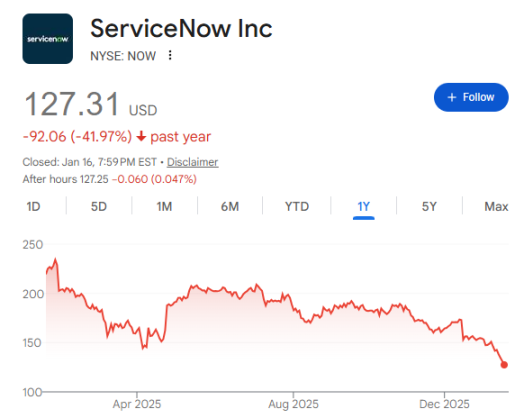
Despite attractive valuations, Wall Street analysts note that faced with the disruptive uncertainty brought by AI, many buy-side institutions believe there is “no reason to hold” software stocks at present, and there are no catalysts for valuation re-rating in the short term.
Claude Code’s Explosive Disruption Fears
The trigger for this sell-off was Anthropic’s release of the “Research Preview” service, Claude Cowork. According to the company, this tool can create spreadsheets via screenshots or draft reports based on various notes, primarily developed through AI rapid development.
Although the tool has not yet undergone comprehensive validation, Mizuho Securities tech industry expert Jordan Klein pointed out that its demonstrated capabilities are exactly what investors have been worried about, reinforcing the increasingly bearish stance on software stocks.
Bloomberg reported that Bryan Wong, portfolio manager at Osterweis Capital Management, said, “Anthropic’s message highlights the difficulty in assessing future growth prospects. The speed of change is unprecedented, and this has pushed future uncertainty to its peak.”
In a report to clients on January 14, Klein bluntly stated that many buy-side investors believe that, regardless of how cheap the stock price or how large the decline, there is currently no reason to hold software stocks because there are no catalysts to drive a valuation rebound.
Slow Progress in Software Companies’ AI Transformation
Most software manufacturers have yet to demonstrate significant appeal of their AI products. Salesforce has been promoting the adoption of its Agentforce product, but its impact on revenue is not obvious. Adobe has integrated generative AI features into its photo and video editing software, but did not update any AI-related metrics in its latest quarterly report in December last year.
Wong said that existing software companies have advantages in distribution and data, but they need to show accelerated growth to drive stock rebounds, which seems unlikely in the short term. According to Bloomberg Intelligence, profit growth for software and services companies in the S&P 500 is expected to slow from about 19% in 2025 to 14% in 2026.
In contrast, the fundamentals of other tech sectors look more optimistic. Major tech giants like Microsoft, Amazon, Alphabet, and Meta Platforms have committed to heavy AI infrastructure investments this year, providing clearer revenue visibility for chipmakers like NVIDIA. Bloomberg Intelligence data shows that semiconductor-related stocks are expected to see nearly 45% profit growth in 2025, accelerating to 59% in 2026.
“The reason chip manufacturers are performing well is that their fundamentals are improving significantly, and given their customer base, growth certainty is higher,” said Jonathan Cofsky, portfolio manager at Janus Henderson Investors. “Meanwhile, the uncertainty about how AI will change the software ecosystem is much greater.”
Valuation Lows Spark Disagreement
Although valuations have fallen to historic lows, market opinions on the outlook for software stocks remain divided.
“The high valuation multiples for software companies are because they are based on subscription models, with recurring revenues that can be almost perpetually extrapolated,” Wong said. “If they are to compete with AI agents capable of continuous operation, task completion, and handling large projects within a day, it’s hard to know what multiple they should trade at.”
However, some Wall Street institutions are optimistic about a rebound in the sector. Barclays expects software stocks to “finally turn around” in 2026, supported by steady customer spending and attractive valuations. Goldman Sachs predicts that rising AI adoption will expand the total addressable market, bringing more tailwinds to software companies. D.A. Davidson believes that, because narratives have overshadowed many software companies’ fundamentals, 2026 will be a good time to selectively re-enter the sector.
“We can’t say the turning point has arrived yet, because concerns about AI’s existence will persist for a while, but the sector does look more attractive,” said Chris Maxey, managing director and chief market strategist at Wealthspire, which manages $580 billion in assets. “This sector is not an obvious buy yet, but we are approaching that point.”