


Kaito's sharp decline still worth 500 million USD! Web3 posting for profit myth shattered, a one-time look

Kaito project launched in 2022, and in 2024, the Yaps product was introduced to encourage users to publish Web3 content for rewards, packaged as an InfoFi concept. However, the product lead of X announced a ban on such products and blocked the API, causing Kaito’s price to plummet to $0.49. The project team was aware in advance and secretly shipped out $2.82 million worth of tokens. The market cap peaked at $500 million, with a circulating market cap of $150 million.
Kaito Business Model: Packaging Mouth-Driven Content as InfoFi
Kaito started in 2022 and remained lukewarm until the launch of Yaps in 2024. On the surface, it’s promoted as encouraging users to share their insights on X; less kindly, it’s just like the English definition of Yaps: incessant chatter and rambling.
The business model of Kaito is straightforward: encourage users to post marketing content about Web3 and reward them for doing so. The type of content depends on what the sponsors want the market to see. This kind of revenue from posting is known in the industry as mouth-driven, meaning no investment is needed—just talk.
This business is actually very simple; such operations have existed in the circle for a long time, but Kaito is the first to productize this service. Based on this, users can earn Kaito points, obtain NFTs, and receive token rewards. So, it’s not that Kaito has no innovation; it’s just playing the same Web3 token issuance game again, packaged as a high-level concept—InfoFi (Information Finance).
The concept of InfoFi itself is highly confusing. It combines content creation with financial incentives, sounding like an innovative business model. But in essence, it’s just replacing traditional advertising fees or content creator revenue sharing with token rewards. Traditional platforms like YouTube or TikTok also share revenue with creators, but they pay in fiat, not tokens. Kaito’s so-called innovation mainly lies in blockchain-izing this process and issuing its own tokens.
From a product perspective, Yaps does provide some value. It offers project teams a decentralized marketing network. Compared to traditional centralized advertising, this community-driven content dissemination might be more authentic and penetrative. Users can indeed earn from posting. The problem is, this model’s sustainability heavily depends on the platform’s (X’s) tolerance and the continuous investment of sponsors.
X Officially Bans Kaito, Project Team Preemptively Sold Off
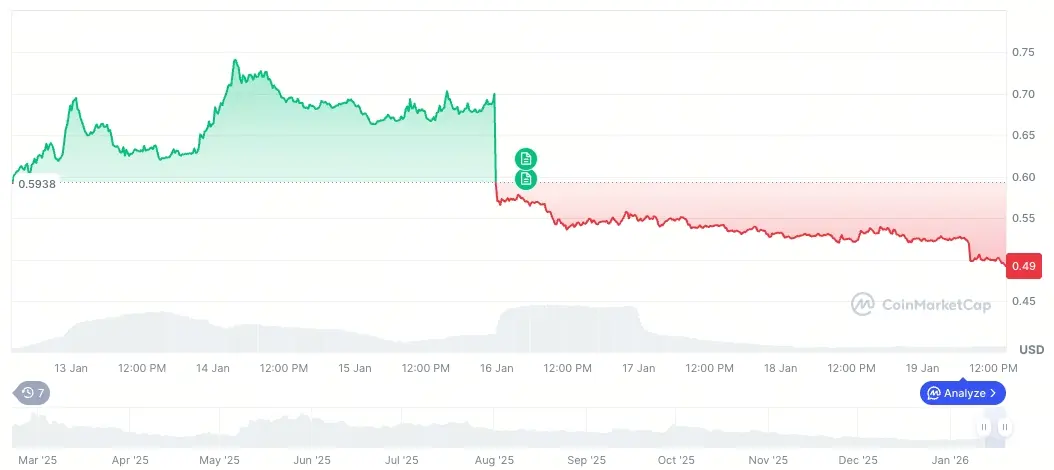
(Source: CMC)
And all of this was overturned three days ago. X’s product lead posted that they would ban these reward-based posting products and stop developers from using X’s API. The reason is simple: over time, instead of more quality content, there’s an increasing amount of spam.
With X stepping in to regulate, Kaito’s good days are over. Its price plummeted 20% in a short period, and continued to fall for several days, currently around $0.49. Such a decline is catastrophic for a project with a market cap in the hundreds of millions. Worse, the downward trend shows no signs of stopping.
What’s even more crushing for retail investors is that the project team knew the news in advance but kept silent, secretly selling off tokens until X’s official announcement. The founder of Kaito also admitted that before this, the team had discussions with X and was aware of the direction, and after the official statement, they announced their business would pivot and gradually shut down Yaps rewards.
During this period, they secretly sold off $2.82 million worth of tokens, which was caught by netizens. Such insider knowledge and preemptive selling could constitute insider trading in traditional finance, but in the relatively unregulated crypto space, project teams have enormous operational freedom. Although on-chain data transparency can reveal such sales, it doesn’t prevent the team from cashing out.
Despite the harsh online criticism, they still managed to cash in tens of millions. This is the reality of Web3: moral condemnation won’t make the funds flow back, and on-chain evidence is hard to turn into legal consequences. For the project team, cashing out $2.82 million is real profit, while retail investors bear the losses with no one to answer.
Kaito Timeline
2022: Kaito project launched, initial performance lukewarm
2024: Yaps product launched, encouraging users to post for rewards
February 2025: Token listed on Binance, peak market cap reached $2 billion
January 2026: X official bans, project team preemptively sold $2.82 million
Current: Market cap plummeted to $500 million, price around $0.49
Market Cap Still $500 Million, Web3 Wealth Creation Efficiency Astonishing
Looking at Kaito’s market cap, it still stands at $500 million, ranked 166. The token issued over a year ago still has a circulating market cap of $150 million. In stark contrast, achieving this in Web2 would require many years of effort.
A traditional Web2 business, even just managing a group, can be solved easily. Turn it into a standardized process, then apply Web3’s model, and package it as InfoFi—suddenly it becomes a leading project, with a peak valuation over $2 billion. If you’re an entrepreneur, what does that feel like?
From the launch of this feature in 2024, to Binance listing in February 2025, and the crash in 2026, the project team made a fortune during this period. I’m not jealous; they achieved it through their own ability. Although morally questionable, legally it’s not illegal.
Given the same amount of time, you couldn’t reach such a market cap. To reach the same valuation in Web2, you’d need years proving a sustainable business model, clear revenue streams, a large user base, and a profitable path. Investors scrutinize every financial detail, demanding real revenue and profit.
But in Web3, you only need a seemingly reasonable concept, a tokenomics model, and a narrative that creates FOMO. Market cap isn’t based on revenue or profit but on token price times total supply. As long as the token price can be pumped, the market cap can easily reach hundreds of millions or billions.
The $500 million figure in the headline is Kaito’s current depressed market cap, not its peak. Do you think such a thing could happen in Web2? If you told investors this business was worth $2 billion, they’d send you straight to a mental hospital with a phone call. But in Web3, it’s actually possible—at least Kaito has already shown you a version.
Web3 Still a Wealth-Building Paradise for Web2 Entrepreneurs
Although Web3 is difficult, competitive, and even hellish at times, it remains a paradise for Web2. Kaito’s case clearly demonstrates Web3’s wealth creation efficiency: from product launch to a $2 billion market cap, it took less than two years. Even after being banned by X and crashing, the market cap still holds at $500 million, which is almost impossible in Web2.
So if you really have a good business logic or model, why not try Web3? No need to be stuck in the old sinking ship. What do you think? The charm of Web3 isn’t in advanced technology or innovative concepts, but in providing a faster path to wealth realization. Of course, this also means higher risks, less regulation, and more gray areas morally.