


No more military action or tax hikes, Trump’s "Greenland TACO" saved the US stock market
Author: Zhou Ailin, Tencent Finance
Editor: Liu Peng
In the early hours of January 22 Beijing time, the US stock market closed sharply higher. The previous day, US stocks experienced their largest single-day decline since “Liberation Day,” but President Trump’s speech at Davos reassuring the market regarding the Greenland crisis helped stabilize sentiment.
At the close, the S&P 500 index rose by 78.76 points, or 1.16%, to 6875.62; the Dow Jones Industrial Average gained 588.64 points, or 1.21%, to 49077.23; the Nasdaq Composite increased by 270.502 points, or 1.18%, to 23224.825; Chinese concept stocks surged even more, with the Nasdaq Golden Dragon China Index up 2.21%, closing at 7776.15. The China concept internet ETF (KWEB) rose by 1.74%; among popular Chinese stocks, Baidu initially gained 8%, China Internet Plus rose 7.4%, GDS Holdings increased 6.1%, Kingsoft Cloud rose 4.6%, WeRide rose 4.3%, Alibaba gained 3.9%, Yum China rose 2.7%, and Pinduoduo increased 1.4%.
Is the alert of the Greenland crisis fully lifted? How will the global markets evolve next?
1. Trump shifts tone to reassure markets
In his keynote speech at the World Economic Forum in Davos, Switzerland, Trump called for “immediate negotiations” over Denmark’s territory Greenland, stating that only the US can ensure its security.
But he also hinted that, “he would not use force to control the island.” “Unless I decide to use excessive force, we might get nothing. Frankly, in that case, we would be unstoppable, but I won’t do that.”
Trump also stated on Wednesday that the US reached a framework for cooperation with NATO regarding Greenland, retracting threats of tariffs on eight European countries. According to The New York Times, three senior officials familiar with the discussions revealed that before the statement was issued, NATO held a meeting on Wednesday where the highest military officials of member countries discussed a compromise: Denmark would transfer sovereignty over a small part of Greenland to the US for military base construction. These officials said the idea was promoted by NATO Secretary General Stoltenberg. Two of the officials compared it to the UK’s military bases in Cyprus—bases considered UK territory. It’s unclear whether this proposal is part of the framework announced by Trump. Trump did not immediately disclose specific details of the framework.
Despite the market once experiencing a “sell-off of US assets,” Tencent News’s “Qianwang” previously learned that the key still lies in observing whether this volatility persists. Traders are still seeking buying opportunities on dips and believe Trump’s measures are more like negotiation tactics. Although the process may be uncomfortable, his style is: “I come out with a big hammer first, then negotiate.”
Earlier this week, Trump proposed imposing a 10% tariff on imports from eight European countries (Germany, France, UK, Netherlands, Denmark, Norway, Sweden, Finland) starting February 1, and threatened that if an agreement on Greenland acquisition could not be reached, tariffs would be raised to 25% on June 1 (implementation remains highly uncertain).
2. US stocks halt decline
The reaction of US stocks already reflects the change in market sentiment. Previously, Tencent News’s “Qianwang” also learned from traders that the Tuesday plunge was less about extreme concern over the Greenland crisis and more about a position-driven shock amplified by rising global yields.
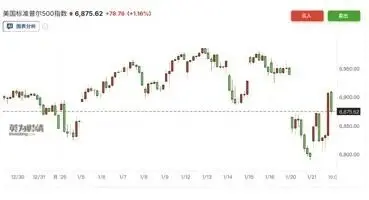
In addition to geopolitical risks, US and Japanese bond yields are also rising simultaneously, which is a deadly blow to stocks. Currently, investors’ long positions and optimism are at high levels, making them more vulnerable to external shocks.
On January 20, the 40-year Japanese government bond yield broke through 4% for the first time, with 20-year and 30-year yields soaring over 20 basis points in a single day. US Treasury Secretary Yellen attributed the surge in US bond yields to Japan, possibly because Japanese Prime Minister Sanae Takaichi proposed a plan to cut food taxes without clear funding sources, leading to a sell-off of Japanese bonds overnight. On that day, the US 10-year Treasury yield rose by 8 basis points to 4.293%.
Tim Sun, senior researcher at HashKey Group, believes that the logic behind this is that, apart from the US, the turmoil in Japan’s bond market is far more dangerous and systemically disruptive than bonds in other countries. Due to Japan’s long-term low interest rates, it has taken on the role of a major liquidity provider in the global financial markets, especially in Europe and the US. When bond yields rise, Japanese investors’ attractiveness of overseas assets declines, potentially triggering repatriation and selling of US and European bonds, which could further increase borrowing costs globally and impact risk assets, possibly spreading to the real economy. Japan is also one of the centers of the global supply chain.
Goldman Sachs’s research indicates that when the US 10-year Treasury yield fluctuates by 2 standard deviations within a month (currently about 50 basis points), US stocks tend to experience corrections (rising interest rates mean valuation compression).
However, market risk sentiment is expected to continue easing. Traders generally believe that, although positions have been overly expanded and market sentiment extremely bullish, which could lead to large swings due to unexpected news, current capital flows still support US stocks. Therefore, the most likely short-term trend is a slight sell-off (Tuesday), followed by a rebound (Wednesday). The key is that capital inflows into equities remain strong (the rotation from money market funds into stocks is finally evident), companies are entering buyback periods, and capital market activity is rebounding.
Interestingly, Goldman Sachs’s global hedge fund head Tony Pasquariello mentioned in Wednesday’s macro note that, the world seems increasingly turbulent, and more risk transfer in the short term is not surprising. But we should not overlook more important factors: the US economy is growing strongly, and the Federal Reserve is increasing liquidity.
“In summary, the US economy is accelerating. Several data points last week were particularly notable, especially the rise in the ISM services index (54.4, the highest in over a year) and the decline in initial unemployment claims (19,800, a significant healthy level). Meanwhile, various housing activity indicators also show signs of stabilization. Overall, our current US activity indicators have risen to their highest levels since late 2024,” he said.
3. Gold’s rally remains difficult to reverse
Due to easing geopolitical risks, silver plummeted, and gold experienced a rapid short-term pullback, but gold prices quickly rebounded afterward. As of 7:00 am Beijing time on January 22, the international spot gold price was $4,831.45 per ounce, up over 11% this year, with an annual increase of about 70%.
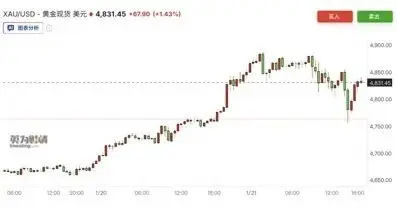
The main reasons for gold’s continued rise include: gold’s correlation with real US dollar interest rates, which show a negative relationship. As real US dollar interest rates decline overall, gold is supported; at the same time, gold is a safe-haven asset, serving as a hedge against concerns over the Federal Reserve’s independence and de-dollarization “special status of the dollar.” This demand is unlikely to change abruptly due to the temporary cooling of the Greenland crisis.
朱良, Vice General Manager and Investment Director of BlackRock China, mentioned that as of the end of Q3 2025, the largest demand for gold is ETF investment, accounting for about 43% of total demand; followed by jewelry/ornaments, about 33%, which also represents part of investment demand; third is reserve demand from central banks and institutions like the Fed, about 17%; and finally, industrial demand, which is small, around 7%.
Adam Berger, multi-asset strategist at Wellington Management, believes that risk appetite and risk aversion are not necessarily mutually exclusive. During gold rallies, stocks can also perform well.
Wall Street’s forecast that gold will hit $5,000 per ounce by 2026 seems to be coming sooner. UBS remains optimistic about gold and has raised its target prices for March, June, and September 2026 from $4,500 to $5,000 per ounce, expecting a slight pullback to $4,800 by the end of 2026 (after the US midterm elections). If political or financial risks further escalate, gold could surge to $5,400 (previously $4,900). Gold remains an attractive asset and an important risk hedge in investment portfolios.