


2026 ARK "Big Ideas" Report Highlights: A Great Acceleration Era, Optimistic about Bitcoin, Tokenization, and DeFi Applications
Author: ARK Invest
Translation: Felix, PANews (Content has been edited)
ARK Invest publishes its flagship research report “Big Ideas” every year. The report filters out short-term disturbances to identify and interpret technologies that are reshaping the global economy. This year’s report explores 13 major concepts spanning AI, robotics, energy, blockchain, space, and biology, which are creating compound effects that redefine productivity, capital allocation, and competitive advantages across industries. Selected sections include AI, blockchain, and other fields. Below are the details.
In the era of great acceleration, AI as the core engine accelerates the development of five major innovation platforms and triggers a macroeconomic growth turning point.
Technology convergence is accelerating. The five major innovative technologies (AI, public blockchains, robotics, energy storage, and multi-omics) are becoming increasingly interdependent, as performance improvements in one unlock new capabilities in others.
Reusable rockets that autonomously deliver Mobility AI chips into orbit could become key to expanding next-generation cloud services. Multi-omics data authorized in digital wallets may power neural networks, driving the development of precision therapies to cure rare diseases.
The world is entering an unprecedented technology investment cycle. Each disruptive technology could have profound macroeconomic impacts.
AI Infrastructure
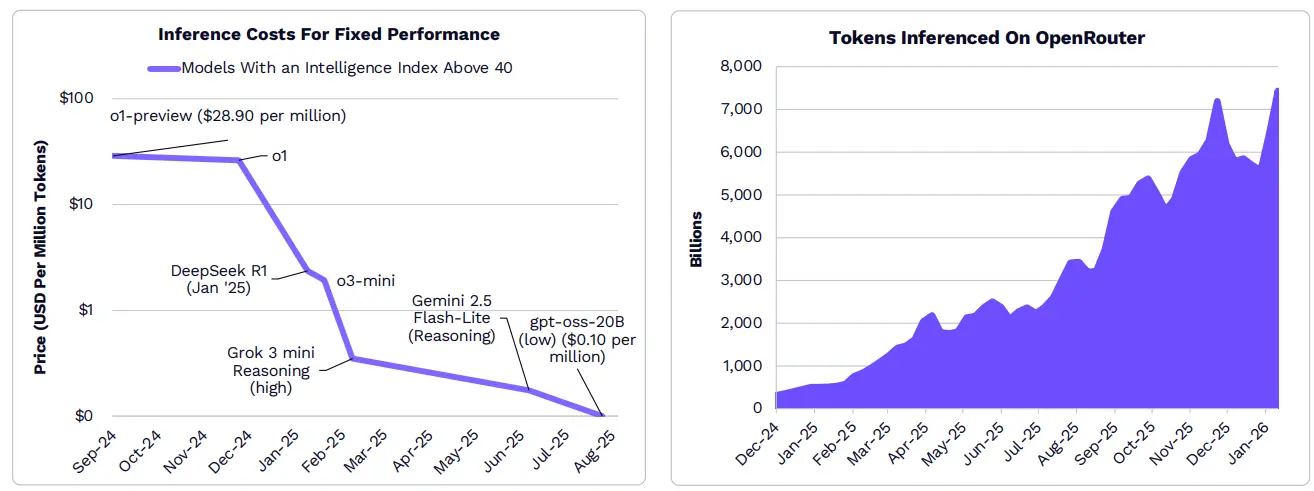
As inference costs decline, demand for AI is rapidly increasing.
From certain indicators, inference costs have fallen over 99% in the past year. With the surge in AI-native applications, the cost reductions are fueling explosive growth in the number of tokens used for inference by developers, businesses, and consumers. Since December 2024, the compute demand for OpenRouter (a unified API for accessing large language models (API)) has increased 25-fold.
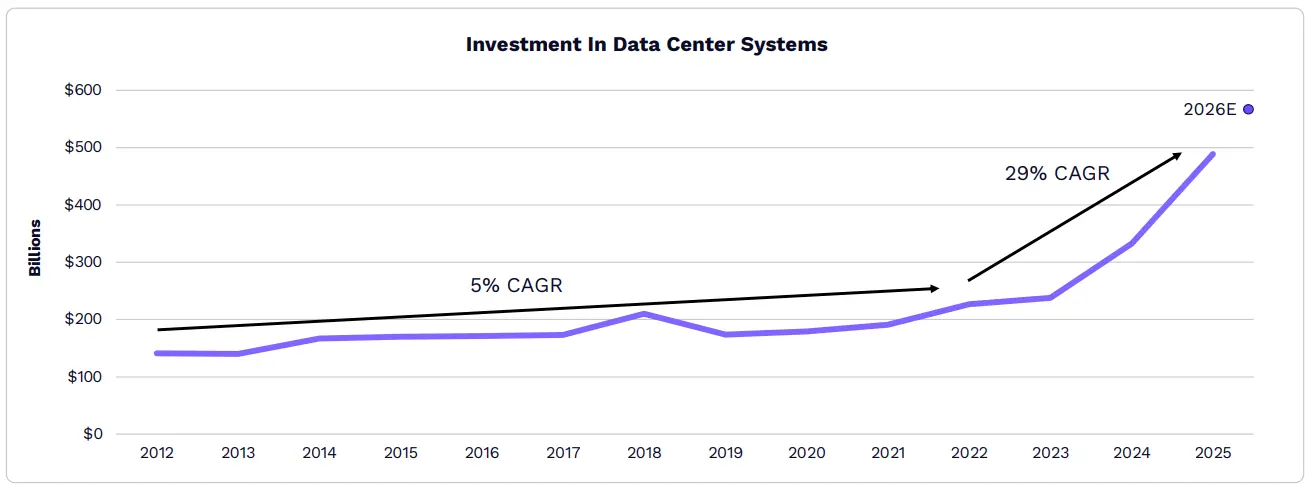
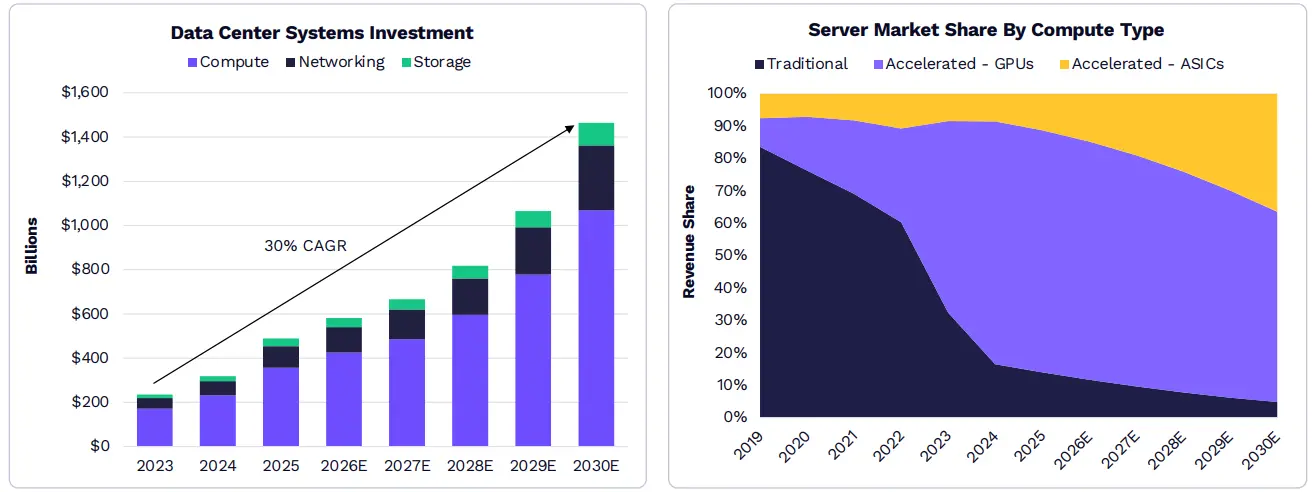
Since the “ChatGPT moment,” the growth rate of data center systems has accelerated from 5% to 29%, with the annual growth rate continuing to climb.
By 2025, annual investment in data center systems will reach approximately $500 billion, nearly 2.5 times the average level from 2012 to 2023. According to ARK research, such investments will continue to grow, potentially doubling by 2030 to about $1.4 trillion.
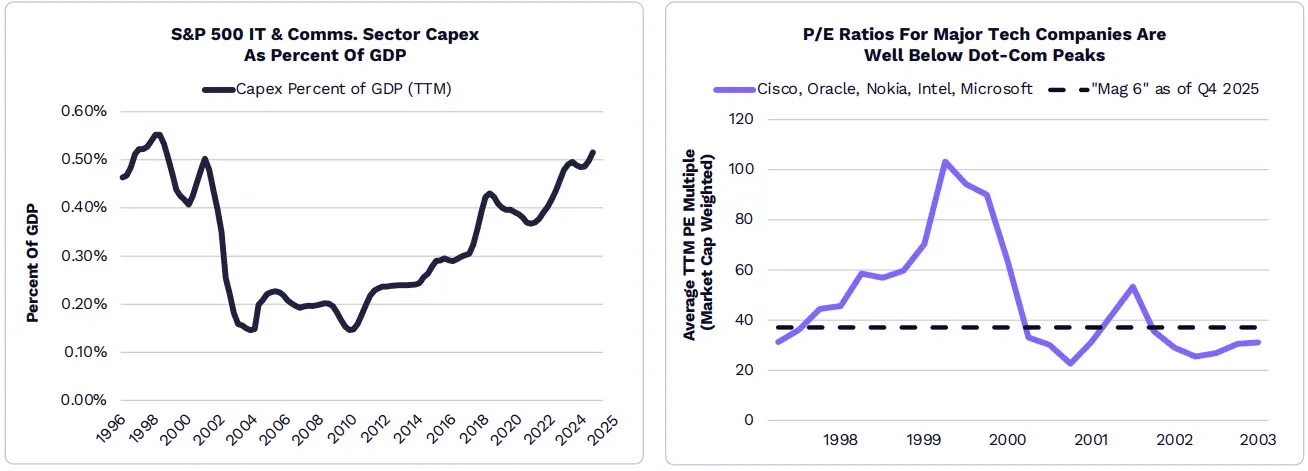
Technology capital expenditures have reached levels seen during the tech and telecom booms, but tech company valuations remain far below those periods.
According to ARK, large-scale data center operators will spend over $500 billion in capital expenditures in 2026, nearly three times the $135 billion in 2021 (before the 2022 ChatGPT boom). Despite the highest proportion of capital expenditure to GDP since 1998 in the IT and telecom sectors, tech industry P/E ratios are still well below the peaks of the tech and telecom bubble era.
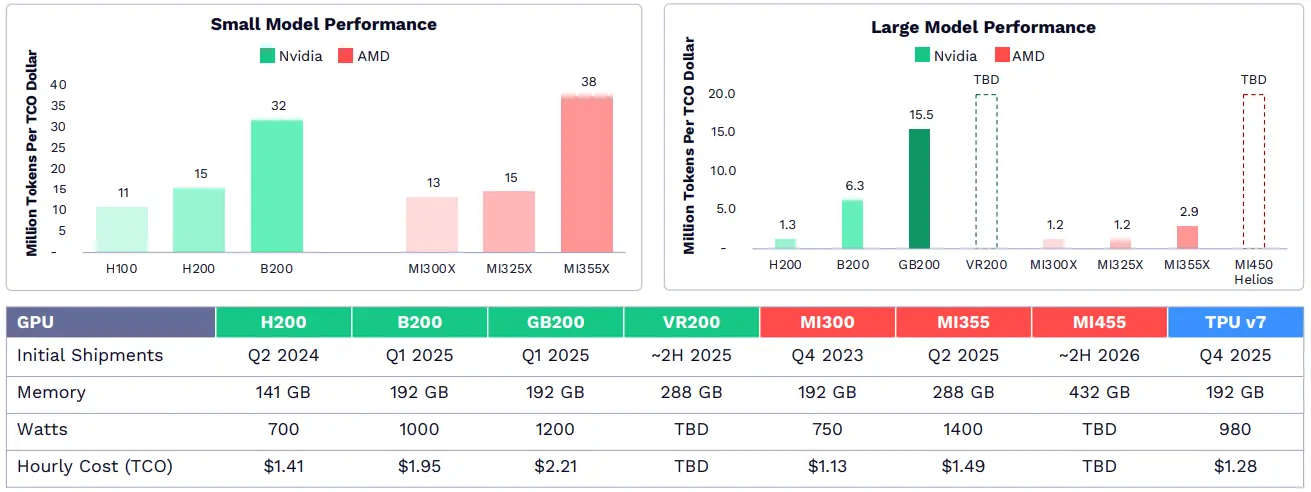
Nvidia faces fiercer competition.
Early investments by Nvidia in AI chip design, software, and networking have given it an 85% market share for GPUs, with a gross margin of 75%. Today, competitors like AMD and Google are catching up in certain areas, such as inference for small language models. Nvidia’s Grace Blackwell rack-mounted systems lead in large model inference, supporting state-of-the-art foundational models.
AI demand will drive sustainable infrastructure growth.
As AI workloads spread across enterprise and consumer environments, AI infrastructure investments could exceed $1.4 trillion by 2030, mostly for accelerating servers. ARK research indicates that ASICs designed by companies like Broadcom and Amazon’s Annapurna Labs will continue to dominate the market, as AI labs and hyperscale enterprises seek cost-effective computing power.
Bitcoin
Bitcoin is gradually becoming a leader in a new institutional asset class.

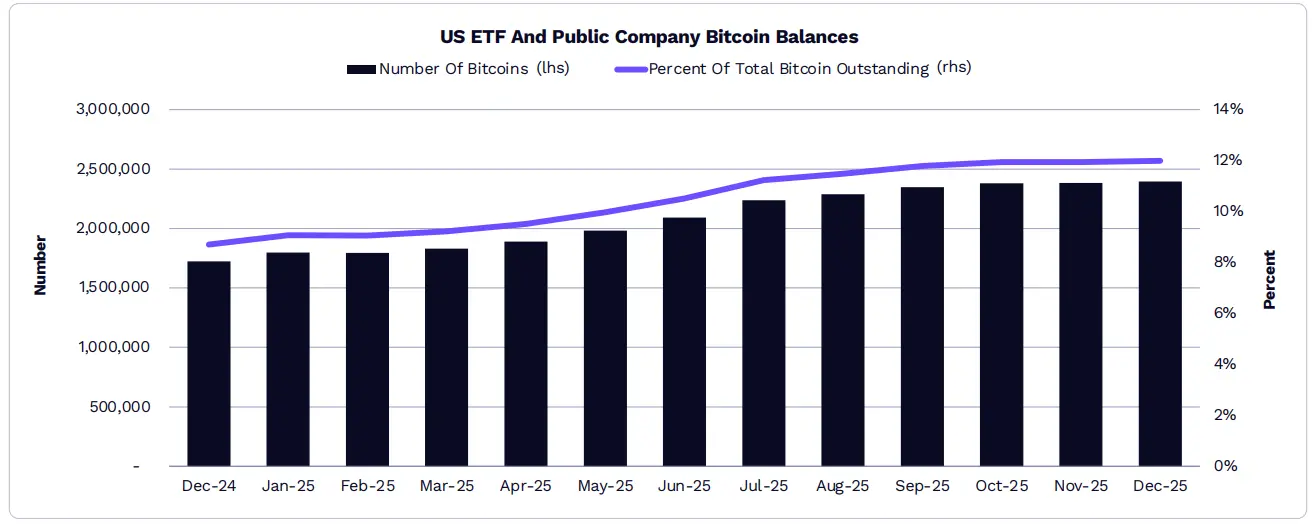
U.S. ETF and publicly listed companies hold 12% of all Bitcoin.
By 2025, Bitcoin ETF holdings will grow 19.7%, from approximately 1.12 million coins to about 1.29 million coins; holdings by listed companies will increase 73%, from about 598,000 coins to approximately 1.09 million coins. As a result, the total Bitcoin held by ETFs and listed companies will rise from 8.7% to 12%.
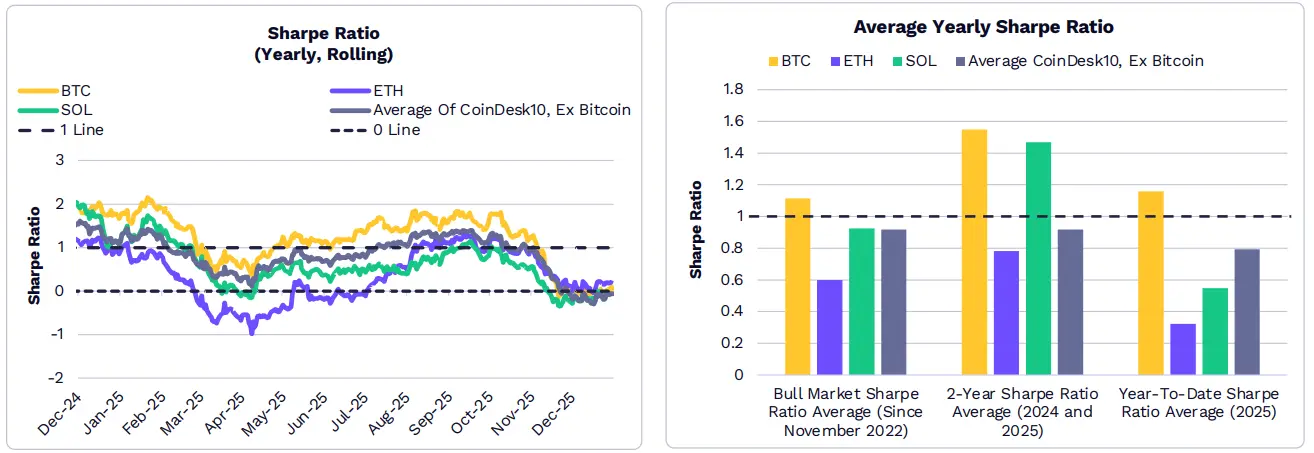
Bitcoin’s long-term risk-adjusted return (Sharpe ratio) has remained higher than the entire crypto market.
Throughout most of 2025, Bitcoin’s risk-adjusted returns outperformed most other large-cap cryptocurrencies and indices. Since the recent cycle lows (November 2022), early 2024, and early 2025, Bitcoin’s average annualized Sharpe ratio has also exceeded that of Ethereum, SOL, and the other nine components of the CoinDesk 10 index.
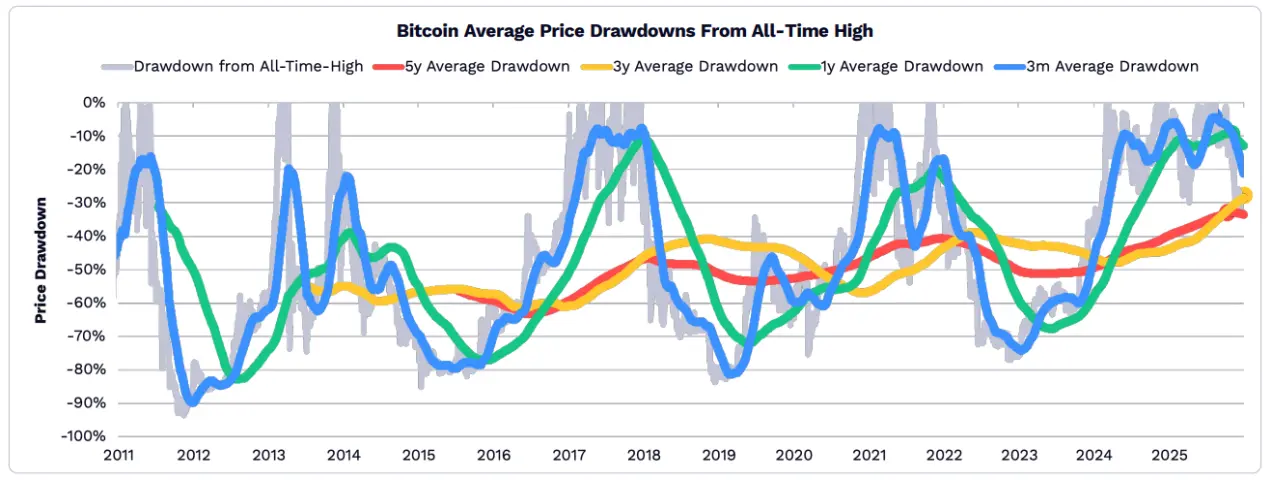
In 2025, Bitcoin’s average decline from its all-time high has eased.
As Bitcoin’s role as a safe-haven asset strengthens, its volatility has decreased. Over time spans of 5 years, 3 years, 1 year, and 3 months, Bitcoin’s declines in 2025 are relatively milder compared to historical levels.
ARK’s assumptions about Bitcoin’s growth have shifted, but forecasts remain largely unchanged.
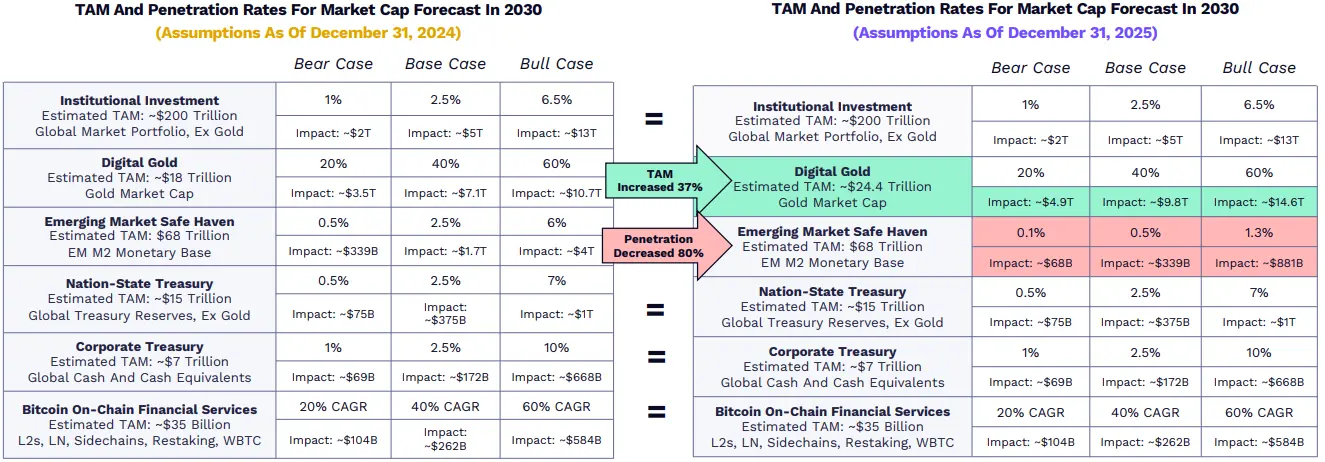
ARK’s 2030 Bitcoin forecast has been quite stable, with two key assumptions changing: as digital gold, its potential market (TAM) grew by 37% after gold market capitalization surged 64.5% in 2025; as an emerging market safe-haven asset, its predicted penetration rate has decreased by 80% to reflect rapid adoption of stablecoins in developing countries.
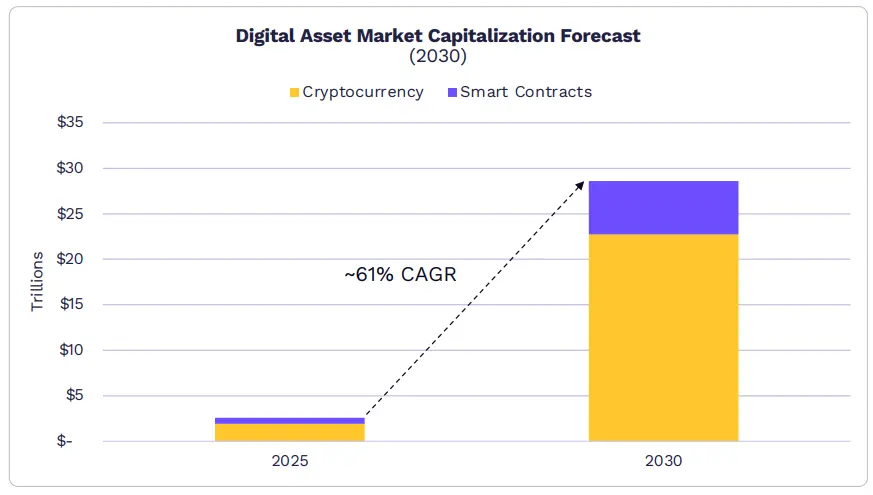
The market capitalization of digital assets could reach $28 trillion by 2030.
The market size of smart contracts and pure digital currencies (which serve as stores of value, mediums of exchange, and accounting units on public blockchains) could grow at about 61% annually, reaching $28 trillion by 2030. ARK estimates Bitcoin could account for 70% of the market, with the rest dominated by smart contract networks like Ethereum and Solana.
- According to ARK’s forecast, Bitcoin is likely to dominate the crypto market over the next five years with a compound annual growth rate (CAGR) of about 63%, growing from nearly $2 trillion to approximately $16 trillion by 2030.
- The market cap of smart contracts may grow at 54% annually, reaching about $6 trillion by 2030, with an annualized revenue of approximately $192 billion and an average fee rate of 0.75%.
- Two to three Layer 1 platforms will capture most of the market share, but their market value will derive more from their currency premiums (value storage and reserve asset characteristics) than from discounted cash flows.
( Tokenized Assets
Thanks to the GENIUS Act, financial institutions are reevaluating their stablecoin and tokenization strategies.
With the regulatory clarity brought by the GENIUS Act, stablecoin activity has surged to record highs. Many companies and institutions have announced their own stablecoins, and BlackRock has revealed plans to develop an internal tokenization platform. Major stablecoin issuers and fintech firms like Tether, Circle, and Stripe are launching or supporting Layer 1 blockchains optimized for stablecoins.
![])https://img-cdn.gateio.im/webp-social/moments-9ebcfcf3955c15ea89572555ea3c1ea0.webp###
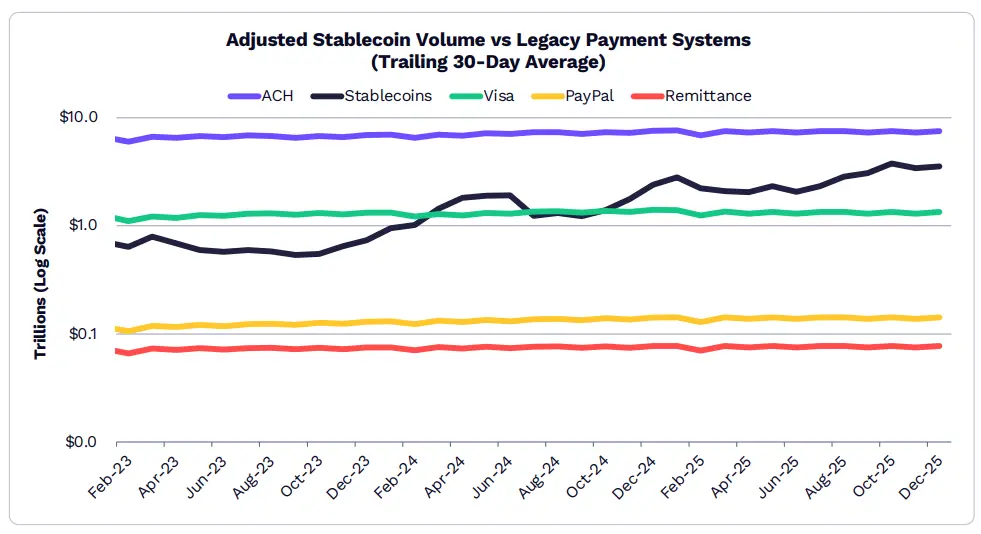
Stablecoin trading volume reached 3.5 trillion USD in 12 months, far surpassing most traditional payment systems.
By December 2025, the 30-day moving average of stablecoin trading volume was $3.5 trillion, 2.3 times the total value of Visa, PayPal, and remittances.
Circle’s stablecoin USDC dominates with about 60% market share, followed by Tether’s USDT with about 35%.
In 2025, stablecoin supply grew approximately 50%, from $210 billion to $307 billion, with USDT and USDC accounting for 61% and 25%, respectively.
Sky Protocol is the only stablecoin issuer besides others, with a market cap exceeding $10 billion at the end of 2025.
Notably, PayPal’s PYUSD market cap increased more than sixfold to $3.4 billion.
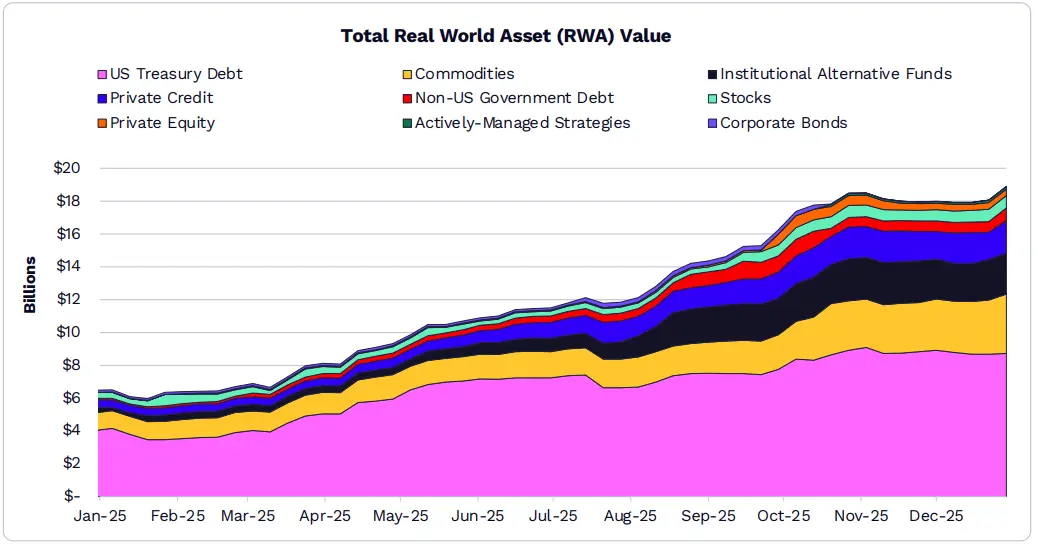
Driven by U.S. Treasuries and commodities, the tokenized asset market doubled in 2025, reaching $19 billion.
The market cap of RWAs grew 208% in 2025, reaching $18.9 billion.
BlackRock’s $1.7 billion BUIDL money market fund is one of the largest products, accounting for 20% of the $900 billion in U.S. Treasuries.
Tokenized gold products from Tether (XAUT) and Paxos (PAXG) lead the tokenized commodities market, with market caps of $1.8 billion and $1.6 billion, respectively, together accounting for 83%.
The tokenized equity market is close to $750 million.
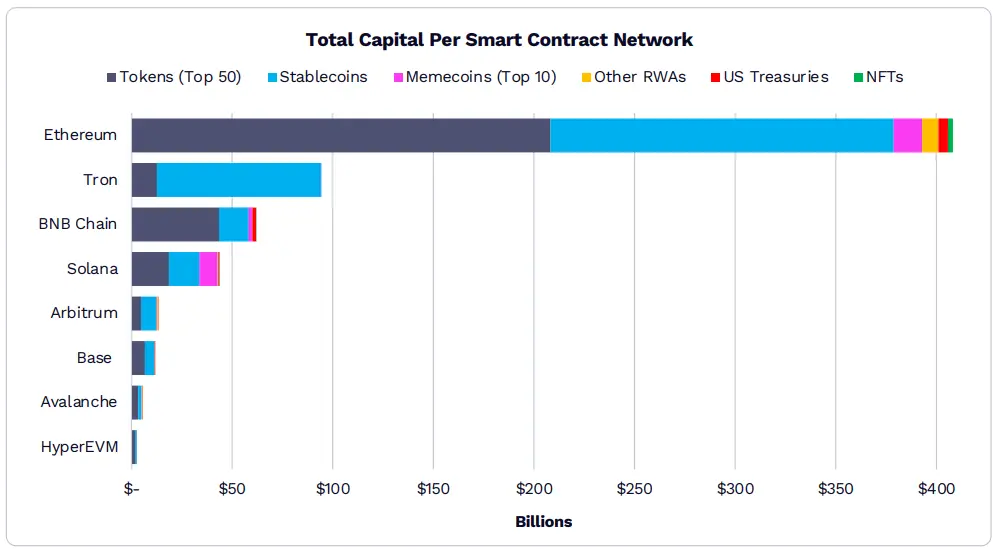
Ethereum remains the preferred blockchain for on-chain assets.
The total value of assets on Ethereum now exceeds $400 billion. Among the eight most popular blockchains, 90% of the market cap on seven chains is supported by stablecoins and the top 50 tokens.
On blockchains other than Solana, meme coins account for about 3% or less of the market cap. On Solana, meme coins account for about 21%.
RWA tokenization is expected to become one of the fastest-growing categories. Since most value is off-chain globally, off-chain assets remain the biggest growth opportunity for on-chain adoption.
By 2030, the global tokenized asset market could exceed $11 trillion.
Our research indicates that the market size of tokenized assets could grow from $1.9 billion to $11 trillion, accounting for about 1.38% of all financial assets at that time.
While sovereign debt currently dominates tokenization, in the next five years, the on-chain value of bank deposits and global listed stocks may surpass current levels.
ARK believes widespread tokenization will depend on regulatory clarity and the development of institutional-grade infrastructure.

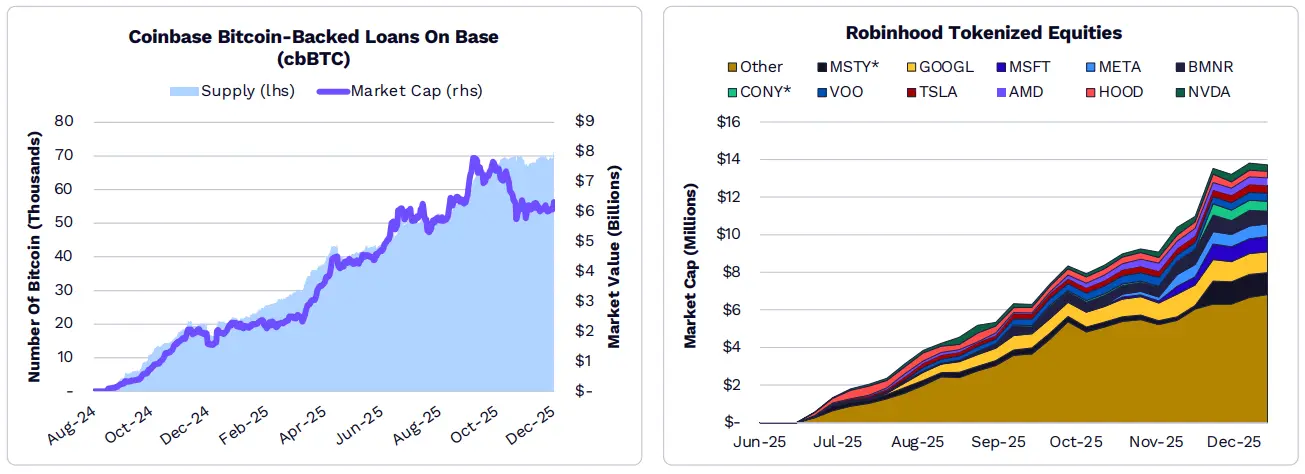
Traditional companies are building their own infrastructure to expand their influence on the chain.
Traditional firms are developing their own on-chain infrastructure. Circle (Arc), Coinbase (Base, cbBTC), Kraken (Ink), OKX (X Layer), Robinhood (Robinhood Chain), and Stripe (Tempo) are launching proprietary Layer 1/Layer 2 networks to support their products, such as Bitcoin-backed loans, tokenized stocks and ETFs, and stablecoin-based payment channels.
( DeFi Applications
Digital asset value capture is shifting from networks to applications.
Networks are gradually transforming into utilities, transferring user economic benefits and profit margins to the application layer.
Led by Hyperliquid, Pump.fun, and Pancakeswap, total application revenue reached a record high of about $3.8 billion in 2025.
One-fifth of all application revenue in 2025 came from January, the highest monthly revenue ever.
Today, 70 applications and protocols have a monthly recurring revenue (MRR) exceeding $1 million.
![])https://img-cdn.gateio.im/webp-social/moments-9dd5a1092fec5f7583d273e2e7f4ca83.webp###
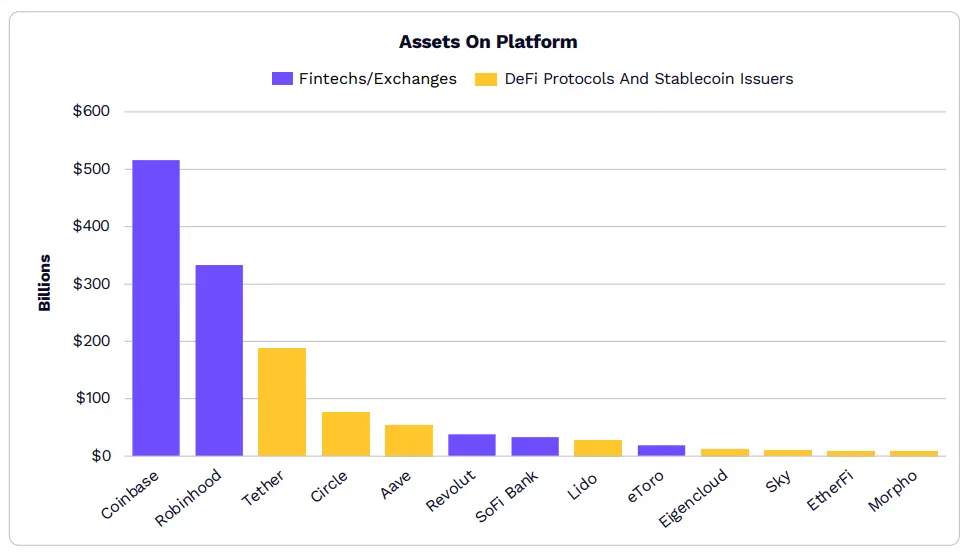
The asset sizes of DeFi and stablecoin issuers are catching up with many fintech companies.
The gap in asset size between traditional fintech platforms and crypto-native platforms is narrowing, indicating a convergence of traditional and on-chain infrastructure.
DeFi protocols such as liquidity staking or lending platforms are attracting institutional capital and expanding rapidly.
The TVL of the top 50 DeFi platforms has entered the billion-dollar club, with the top 12 protocols each exceeding $5 billion in TVL.
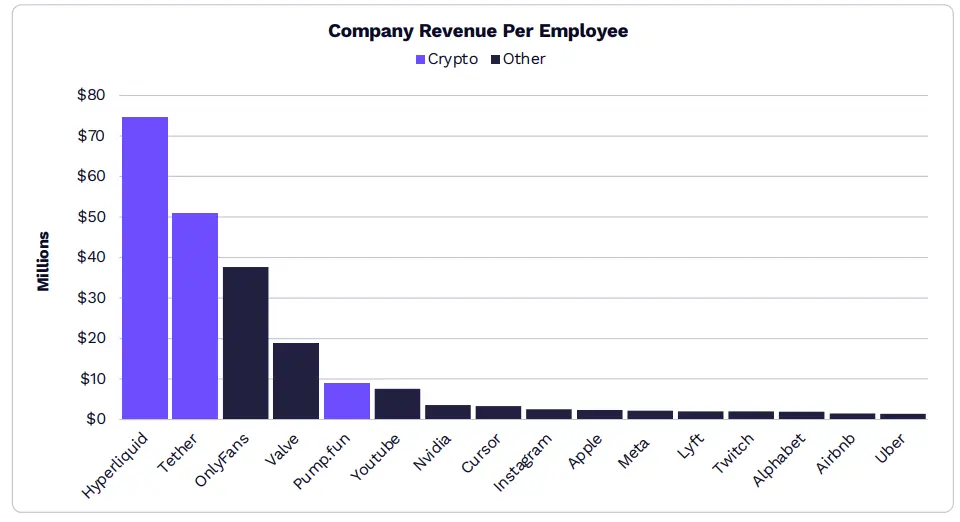
The most revenue-efficient companies globally include Hyperliquid, Tether, and Pump.fun.
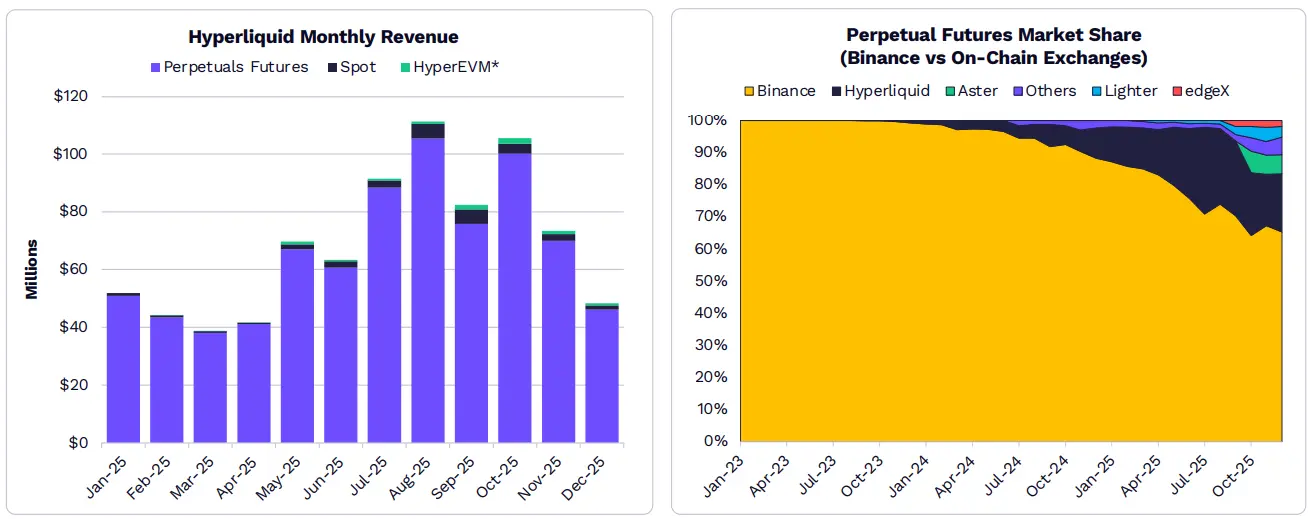
By 2025, Hyperliquid, with only 15 employees, generated over $800 million in annual revenue.
Through on-chain verticals like perpetual contracts, stablecoins, and meme coins, Hyperliquid is attracting users and capital at an astonishing scale, with clear product-market fit.
On-chain businesses and protocols are redefining productivity, with just a handful of people generating revenues and profits comparable to global corporations.
Led by Hyperliquid, DeFi derivatives are capturing market share from Binance’s perpetual contracts.
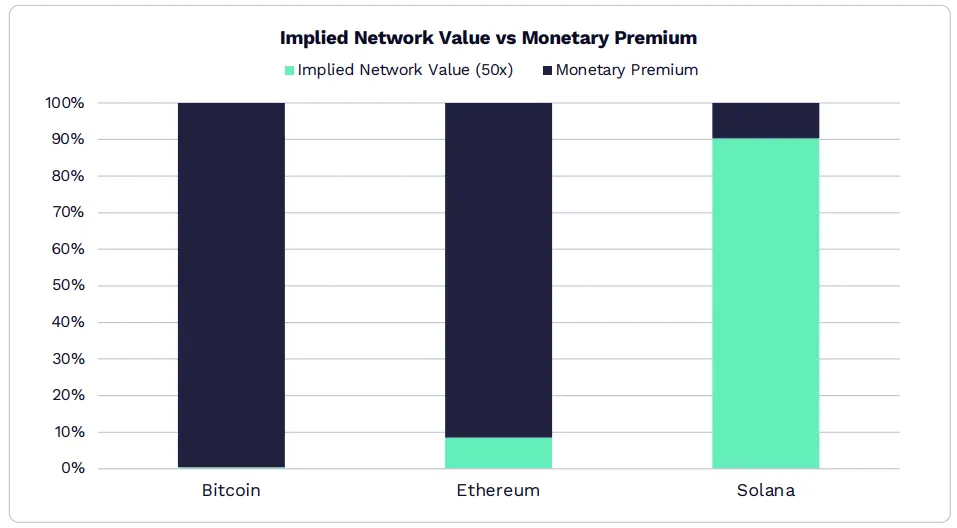
Layer 1 networks are evolving from revenue-generating networks into monetary assets.
Using a 50x revenue multiple, over 90% of Ethereum’s market cap is attributed to its role as a monetary asset.
Solana generated $1.4 billion in revenue, demonstrating that 90% of its valuation derives from network utility.
According to ARK research, only a few digital assets can retain their monetary properties and serve as highly liquid stores of value.
Related: Cathie Wood’s 2026 macro and tech investment roadmap
Related Articles
Crypto Market Struggles as Bitcoin and Ethereum Post Weak Q1 2026 Performance
Strategy Raises STRC Dividend to 11.50% as Bitcoin Buying Strategy Continues.
Bitcoin Eyes Iran Reactions as Oil Triggers 5% US Inflation Forecast
Whale Trader Pension-usdt.eth Secures $466K Profit After Surviving a $3.3M Bitcoin Drawdown