


Polymarket's "God's Hand": Frequent Prediction Disputes and the Black Box of Decision-Making Power in the "Centralized" Dilemma
Article by: imToken
Does the United States actually “invade” Venezuela? This semantic judgment directly determines a bet worth over ten million USD.
Do you find it a bit counterintuitive? After all, in the real world, the US has indeed taken a series of actions against Venezuela, including military deployments and direct operations. In everyday language and media narratives, such actions are easily understood as “invasion.”
However, the final outcome did not align with the expectations of some bettors—Polymarket ultimately did not recognize US military actions as constituting an “invasion” within its rule set, thus invalidating the “Yes” option and provoking protests from bettors.
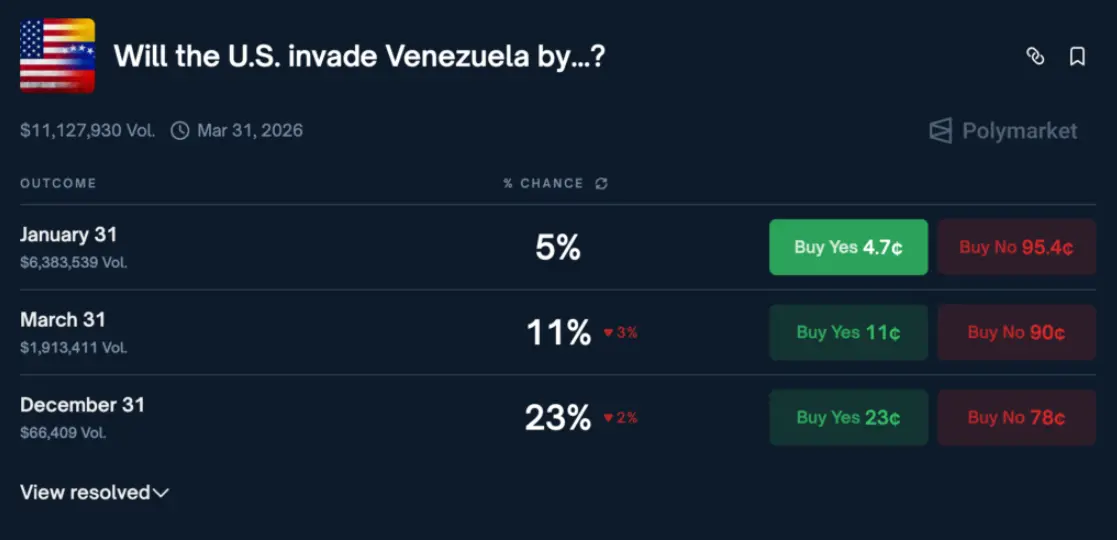
This is actually not a new debate, but a highly representative one, once again exposing a long-standing yet often overlooked structural issue in prediction markets: When dealing with complex real-world events, what justifies and who defines “facts” in decentralized prediction markets?
1. The Frequent “Semantic Traps” in Prediction Markets
The reason it’s “not new” is because similar semantic disputes have occurred multiple times in prediction markets.
Indeed, such situations are common on Polymarket, especially in predictions related to political figures and international affairs. The platform has repeatedly seen rulings that users find “counterintuitive.” Some predictions, which are almost undisputed in reality, become subject to repeated appeals and reversals on-chain; others, despite clear real-world consensus, end up with rulings that diverge significantly from most users’ judgments.
An even more extreme case is during dispute resolution, where oracle mechanisms allow token holders to vote, enabling some high-profile topics to be “twisted” by top players through voting power…
These disputes share a common point: they are often not technical issues but social consensus issues. For example, a widely discussed case involves predicting whether Ukrainian President Zelensky was “wearing a suit” at a specific time:
In reality, last June, Zelensky appeared in formal attire at a public event, and multiple sources like BBC and designers confirmed it was a suit. By normal reasoning, the matter should have been settled. Yet on Polymarket, this seemingly clear fact turned into a tug-of-war involving hundreds of millions of dollars.
During this period, the probabilities for “Yes” and “No” fluctuated wildly, with high-risk arbitrageurs making huge short-term gains, but the final settlement remained delayed.
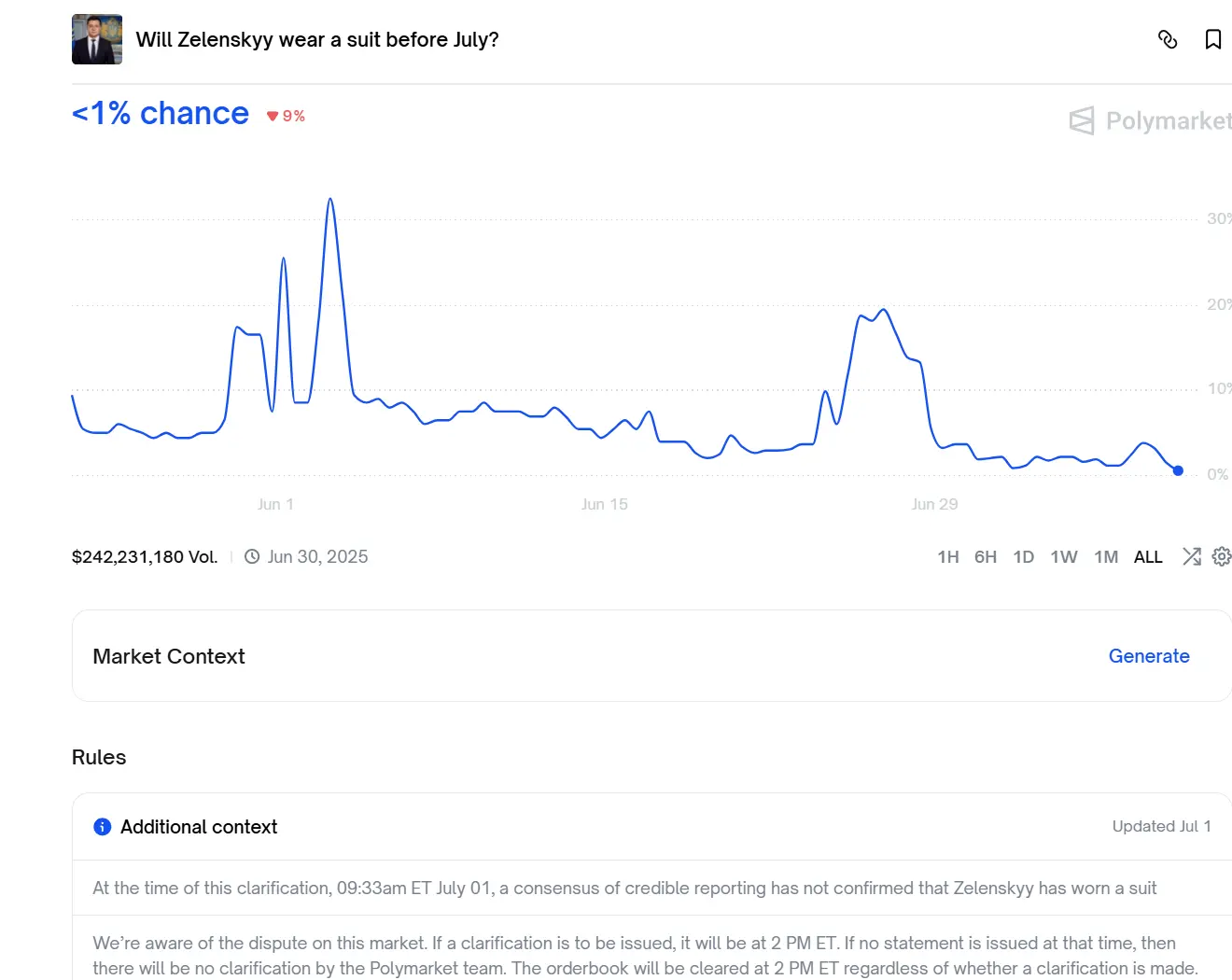
The core issue is that Polymarket relies on the decentralized oracle UMA for result adjudication, and its mechanism allows token holders to participate in dispute voting. This makes it easy for some high-profile topics to be manipulated by top players.
More controversially, the platform has not denied that this mechanism can be exploited but insists “rules are rules,” refusing to adjust rulings retroactively, thus allowing large funds to overturn outcomes through the rules themselves.
Such cases provide a highly illustrative entry point for understanding the institutional boundaries of prediction markets.
2. The “Code is Law” Boundary of Failure
Objectively, prediction markets are now regarded as one of the most imaginative applications of blockchain technology. They are no longer just small tools for “betting” or “predicting the future,” but have become a frontier for institutions, analysts, and even central banks to observe market sentiment (see also “The Moment Prediction Markets Broke Out: ICE Enters, Hyperliquid Increases Investment, Why Are Giants Competing for ‘Pricing Uncertainty’?”).
But all of this presupposes that prediction questions can be answered with clarity.
It’s important to understand that blockchain systems are naturally adept at handling deterministic issues—such as whether assets have arrived, whether states have changed, or whether conditions are met. Once these results are written on-chain, they are almost impossible to tamper with.
However, what prediction markets often face are different kinds of questions: whether a war has broken out, whether an election has concluded, whether a certain political or military action qualifies as a specific judgment. These questions are not inherently codable; they heavily depend on context, interpretation, and social consensus, rather than single, verifiable objective signals.
Because of this, regardless of the oracle or adjudication mechanism used, subjective judgment is almost unavoidable when converting real-world events into settleable outcomes.
This is why, in multiple disputes on Polymarket, the disagreement between users and the platform is not about whether the fact exists, but about which interpretation of reality is the one that can be settled.
Ultimately, when this interpretative authority cannot be fully formalized into code, the grand vision of “code is law” inevitably encounters boundaries in the face of complex social semantics.
3. The “Last Mile” of Truth Is Hard to Decentralize
In many decentralization narratives, “centralization” is often seen as a flaw. However, I believe that in the specific context of prediction markets, the opposite is true.
Because prediction markets do not eliminate the authority to adjudicate; they shift it from one position to another:
- During trading and settlement: highly decentralized, automated;
- During definition and interpretation: highly centralized, dependent on rules and arbiters;
In other words, decentralization solves the credibility of execution but cannot avoid the centralization of interpretative authority. This is why the appealing idea of “code is law” in the blockchain world often falls short in prediction markets—because code cannot generate social consensus on its own; it can only faithfully execute predefined rules.
When the rules themselves cannot encompass all the complexities of reality, the authority to interpret inevitably returns to “humans.” The difference is that this authority no longer appears as an explicit arbiter but is embedded in the definition of issues, rule interpretation, and adjudication processes.
Returning to the dispute on Polymarket, it does not mean prediction markets have failed, nor does it mean that decentralization is an illusion. On the contrary, such disputes remind us to reconsider the boundaries of prediction markets: they are very suitable for outcomes that are clear and well-defined, but inherently ill-suited for highly politicized, semantically fuzzy, and value-laden real-world issues.
From this perspective, prediction markets have never been about “who is right or wrong,” but about how, under given rules, markets can efficiently aggregate expectations. When the rules themselves become a source of dispute, the system exposes its institutional boundaries.
The recent controversy over whether Venezuela was “invaded” essentially illustrates that, when dealing with complex real-world events, decentralization does not mean the absence of adjudicators; rather, adjudication authority exists in a more covert manner.
For ordinary users, what truly matters may not be whether prediction markets are “decentralized,” but who has the power to define the issues when disputes arise—who decides which version of reality can be settled? Are the rules sufficiently clear and predictable?
In this sense, prediction markets are not only an experiment in collective intelligence but also a power struggle over “who has the right to define reality.”
Once we understand this, we can find a closer-to-certain balance point amid uncertain truths.