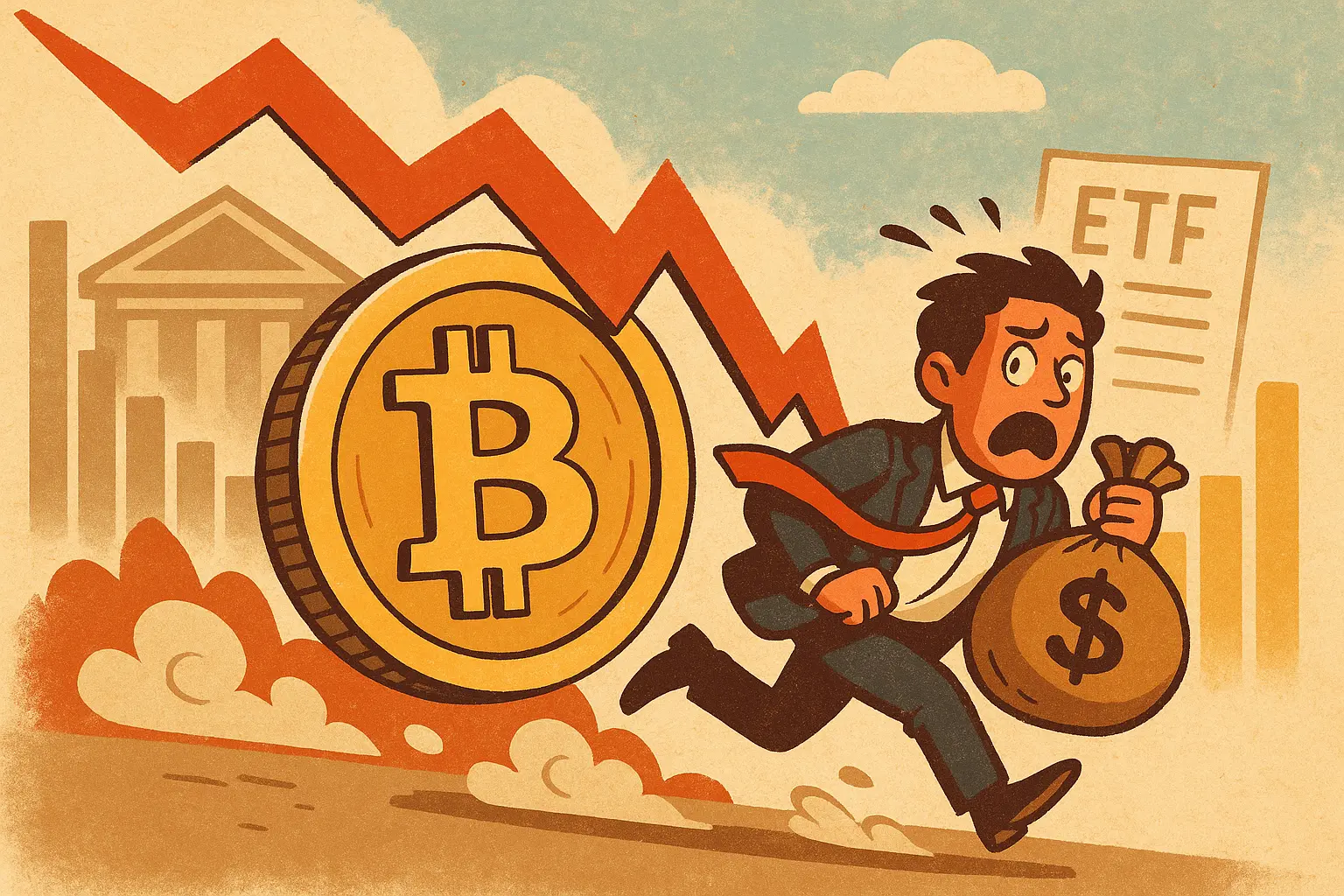
Investors have cashed out over $1.3 billion from Bitcoin ETFs in one week, with BTC falling 7% to $89,225. Trump’s tariff threats triggered a synchronized sell-off across bonds, stocks, and cryptocurrencies, while stablecoins converted to fiat currencies indicate institutional withdrawals. From their October peak, prices have dropped 29%, with experts warning that it may test $75,000 but remain long-term bullish.
U.S. Bitcoin ETF 5-Day Net Outflows Hit Record
Over the past week, due to American investors cashing out more than $1.3 billion from Bitcoin exchange-traded funds, Bitcoin’s price declined nearly 7%. Data from Farside Investors shows that every day this week, investors sold Bitcoin from U.S. funds, a rare continuous outflow pattern since the launch of Bitcoin ETFs. Since the approval of the U.S. spot Bitcoin ETF in January 2024, the market has mostly experienced net inflows, with only brief outflows during extreme market events.
This sustained one-week outflow indicates a systemic shake-up in investor confidence, not just a short-term technical correction. Major holders of Bitcoin ETFs are institutional investors and high-net-worth individuals, who typically do not trade frequently due to daily price fluctuations. Their decision to withdraw en masse at this time reflects deep concerns about macroeconomic conditions and policy risks.
Last weekend, Bitcoin’s price rose—reaching as high as $95,419—before sharply falling due to Trump’s tariff threats. On Wednesday, U.S. leaders reaffirmed claims of sovereignty over Greenland and announced tariffs on European allies, sparking market panic and causing major assets including bonds, stocks, and cryptocurrencies to sell off immediately.
“Continuous ETF outflows, along with increased activity shifting from stablecoins to fiat currencies, suggest a reversal of the trend of rising institutional participation since early this year,” said Jasper De Maere, strategist at market maker Wintermute, in a report sent to DL News on Friday. “Geopolitical turmoil” is the main catalyst. This pattern of moving from stablecoins to fiat indicates that investors are not only exiting Bitcoin but even the entire crypto market.
Although Trump’s Thursday change in tariff threats led to a rebound in stocks on Friday, Bitcoin and other digital currencies and tokens still declined. This decoupling from equities is noteworthy, as it shows the crypto market is digesting its own negative factors independently, rather than merely following traditional financial markets. Earlier this week, experts told DL News that increased volatility could push Bitcoin’s price down to a low of $75,000.
Bitcoin Down 29% from Peak, October Liquidation Shadows Linger
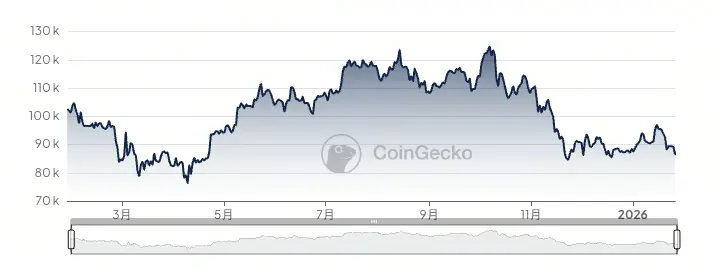
(Source: CoinGecko)
Bitcoin’s price has fallen 29% from its October record high of $126,080 and has struggled to recover from that month’s sell-off wave. Over that month, over $19 billion in leveraged positions were liquidated, the largest such event in digital asset history. This historic liquidation inflicted lasting psychological trauma on the market, with many investors still wary and choosing to exit early when signs of instability appear.
Earlier this year, the crypto market was in a strong position, with U.S. investors injecting over $1.5 billion into Bitcoin and Ethereum ETFs in just two days. Bitcoin surged to $97,538 on Monday, its highest in two months. However, this brief rebound was quickly interrupted by the sell-off triggered by Trump’s tariff threats, revealing the market’s fragility and susceptibility to external shocks.
The outflow pattern of Bitcoin ETFs also reveals changes in investor structure. The large inflows at the start of the year mainly came from institutional investors adjusting their allocations for the new year, but the stickiness of these funds was less than expected. When macro conditions worsen, these institutional funds withdraw rapidly, indicating their Bitcoin holdings are more tactical than strategic. True strategic allocations should remain stable or even increase during market volatility, but the current outflow pattern shows most institutions still view Bitcoin as a high-risk asset rather than a core holding.
Geopolitical headwinds have also failed to support this digital asset—traditionally correlated with other “risk-on” assets. Bitcoin has long been promoted as “digital gold” and a safe haven, but market performance shows that during geopolitical crises, Bitcoin’s behavior aligns more with tech stocks than gold. When investors seek safety, they still prefer gold, the dollar, and U.S. Treasuries over Bitcoin. This disconnect between perception and reality is a key reason why Bitcoin continues to face downward pressure in the current environment.
Experts Recommend Focusing on Annualized Returns, Not Short-Term Volatility
However, experts caution investors to look long-term, as long-term gains are what matter for digital assets. A senior ETF analyst at Bloomberg told DL News: “Sometimes, investing in Bitcoin really requires paying attention to annualized returns.” He added that all conditions are in place—such as increased government debt and liquidity—and Bitcoin is expected to perform well by 2026.
This long-term perspective is especially important amid current panic. Looking back at Bitcoin’s history, each major correction has been followed by a stronger rebound. The 2018 bear market, the March 2020 crash, and the 2022 FTX collapse were all seen as the end of Bitcoin, but each was later proven to be healthy adjustments within a bull market. The current 29% correction, while painful, is not unusual in Bitcoin’s history.
The narrative of rising government debt is particularly relevant. Debt levels in major economies worldwide have continued to climb post-pandemic, with U.S. federal debt exceeding $35 trillion with no signs of slowing. When fiat currency systems are questioned due to excessive debt, Bitcoin’s appeal as a non-sovereign asset with a fixed supply will strengthen. While this macro logic may not immediately reflect in prices, it provides solid support for Bitcoin’s long-term value.
After the COVID-19 outbreak, Bitcoin’s trading trends were highly correlated with tech stocks. But now, its returns are gradually decoupling from other assets. Last year, Bitcoin declined while stocks rose. “If you want Bitcoin to be seen as an alternative, you want its performance to surprise,” said the analyst, adding that investors should pay less attention to short-term news driving Bitcoin’s price down and instead view it as a long-term investment that can deliver returns when other assets do not.
This weakening correlation is highly favorable for Bitcoin’s long-term positioning. If Bitcoin remains highly correlated with stocks, it’s just another risk asset, offering no real diversification benefit. But if Bitcoin can stay flat when stocks rise, fall when stocks fall, or even move independently in certain situations, it truly becomes an “alternative asset,” providing investors with a unique risk diversification function.
Disclaimer: The information on this page may come from third parties and does not represent the views or opinions of Gate. The content displayed on this page is for reference only and does not constitute any financial, investment, or legal advice. Gate does not guarantee the accuracy or completeness of the information and shall not be liable for any losses arising from the use of this information. Virtual asset investments carry high risks and are subject to significant price volatility. You may lose all of your invested principal. Please fully understand the relevant risks and make prudent decisions based on your own financial situation and risk tolerance. For details, please refer to
Disclaimer.


