Weekly decline of PiCoin by 5% to $0.17, cryptocurrency fear and greed index drops to 29, with 1.3 million PiCoins flowing into exchanges over the past 24 hours. RSI at 22 indicates deep oversold conditions, MACD remains bearish. The price is expected to test $0.1502, with a rebound target at $0.2000.
PiCoin Weekly Drop of 13% and Fear Index Falls to 29
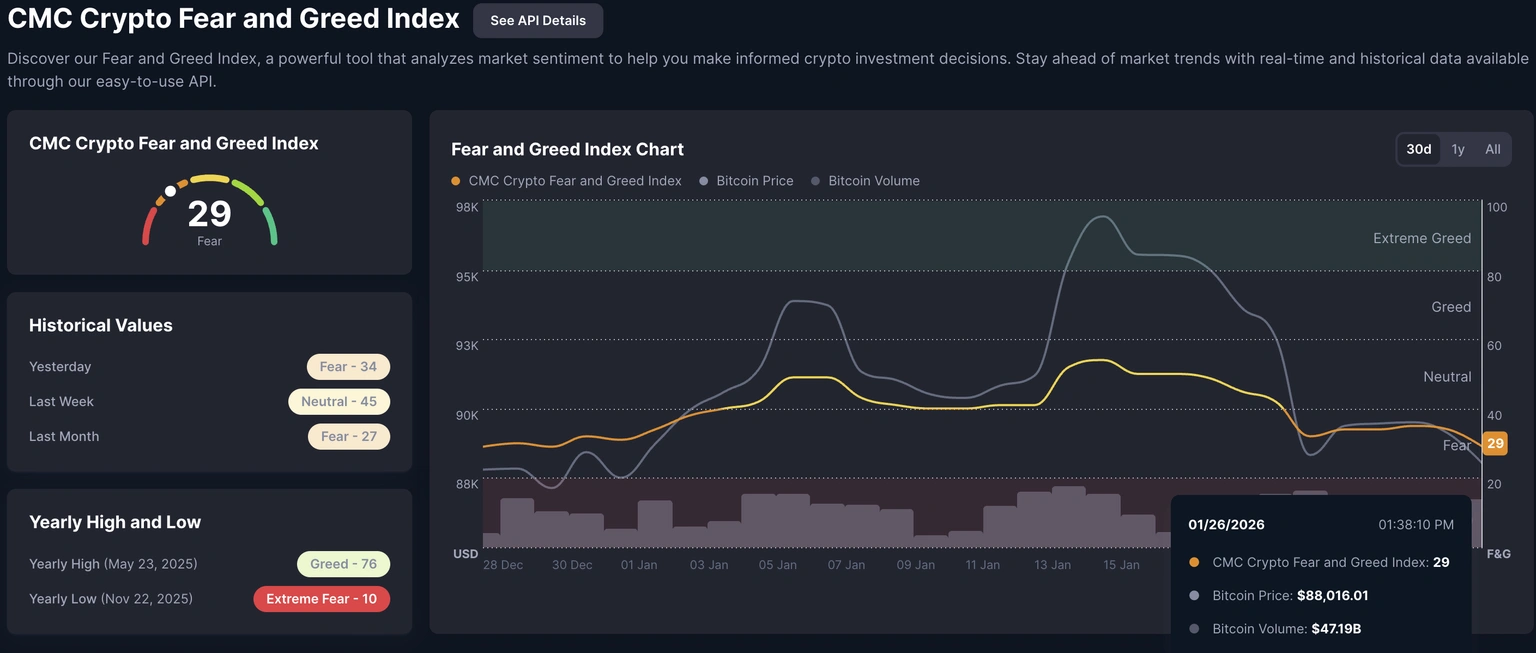
(Source: CMC)
As of Tuesday’s report, PiCoin’s price hovers above $0.1700, stabilizing after a 5% decline on Sunday. Due to heightened risk aversion across the entire crypto market and over 1.3 million tokens flowing into centralized exchanges (CEX) in the past 24 hours, PiCoin continues to face significant pressure. CoinMarketCap’s fear and greed index is currently at 29, indicating investor risk aversion. This reading between 20 and 40 suggests fear, while dropping below 20 indicates extreme fear, potentially signaling a large-scale sell-off in the crypto market.
Amid widespread panic in the crypto space, ongoing deposits into CEXs may lead to further losses for PiCoin. Token inflows to exchanges are often a precursor to selling, as holders need to transfer tokens from wallets to exchanges to sell. The inflow of 1.3 million tokens constitutes a significant portion of PiCoin’s daily trading volume, and this concentrated transfer strongly hints at imminent selling pressure.
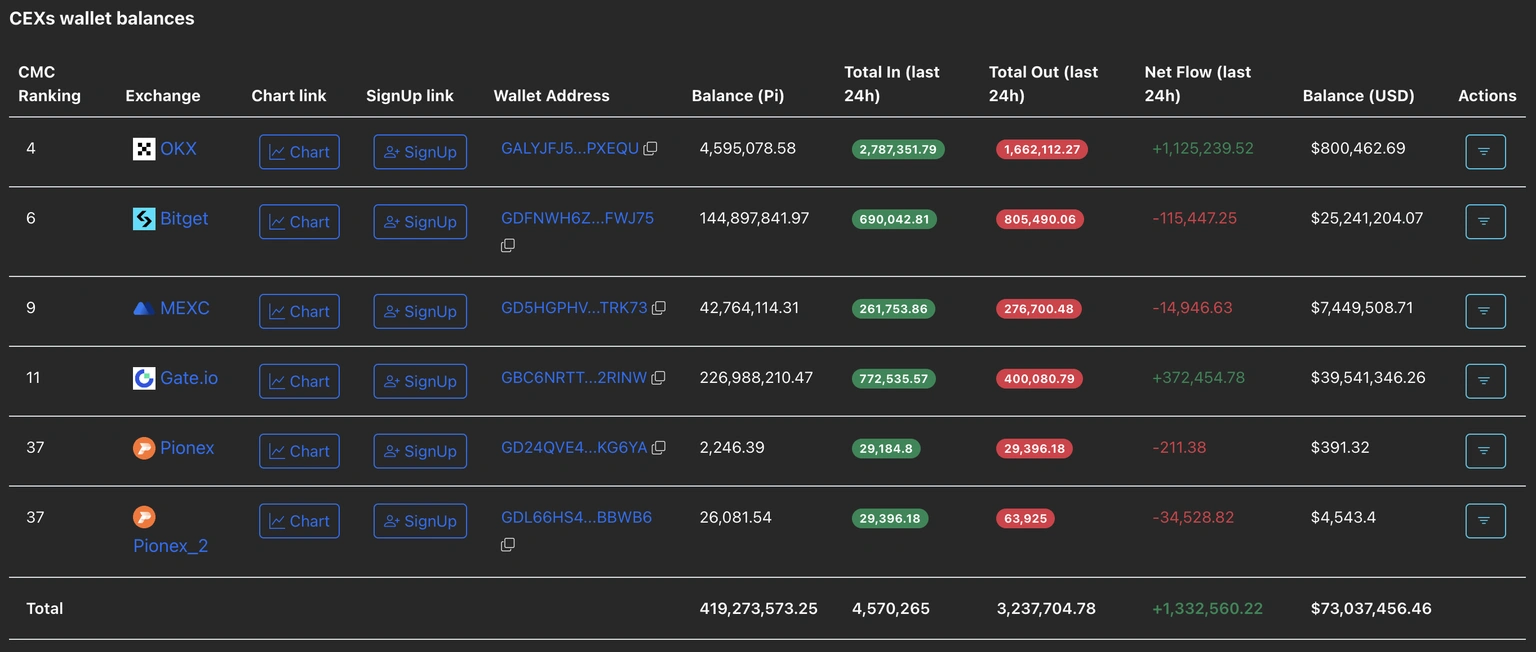
PiScan data shows that in the past 24 hours, deposits of PiCoin into various centralized exchanges have steadily increased, totaling 1.33 million tokens. This highly concentrated inflow pattern may indicate that large holders or institutions are consolidating their sell orders.
PiCoin experienced a slight rebound of 1% on Tuesday, recovering from Sunday’s 5% decline. However, it still faces pressure from the over 13% drop last week. This accumulated decline indicates that PI is in a clear downtrend rather than a short-term correction. Consecutive days of decline can erode market confidence, and each rebound may be viewed as a chance to sell rather than a trend reversal signal.
RSI 22 Deeply Oversold but MACD Still Bearish
(Source: Trading View)
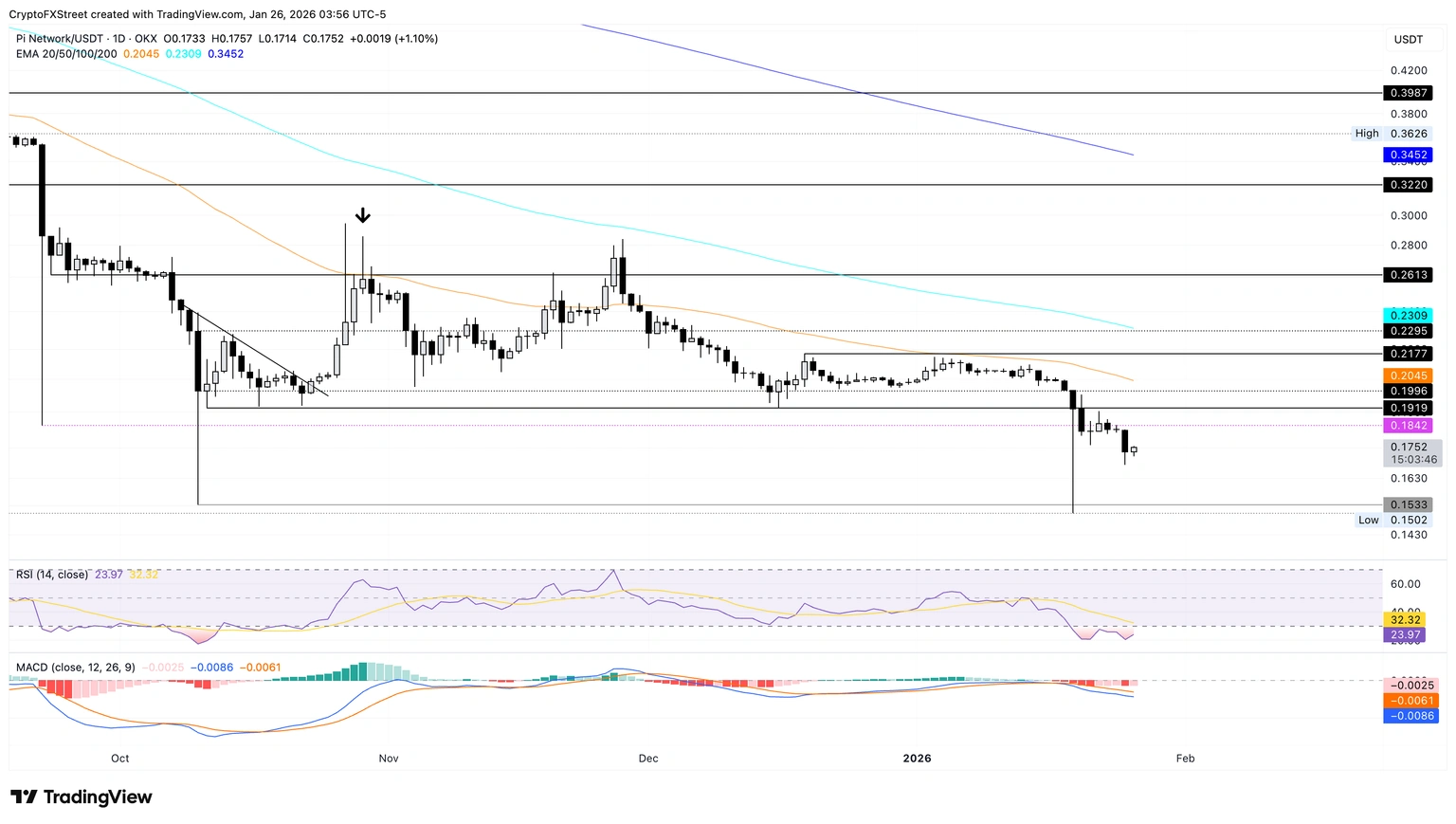
The daily RSI is at 22, indicating deep oversold conditions and significant selling pressure. The MACD remains below the signal line and zero, showing continued bearish momentum. An RSI of 22 is an extremely oversold level, often signaling a potential short-term technical rebound. However, it’s important to note that RSI can stay in oversold territory for a long time, especially in a strong downtrend. PI’s RSI has fallen to 22, and while such extreme levels increase the likelihood of a rebound, they do not guarantee an immediate reversal.
The persistent bearish structure of the MACD is more concerning. As a trend-following indicator, MACD below the signal line and zero indicates the downtrend is ongoing. Only when the MACD fast line crosses above the slow line to form a golden cross, and the overall indicator rises above zero, can a trend reversal be confirmed. Currently, PI’s MACD remains deep in negative territory, suggesting that while downside momentum may weaken, it has not yet disappeared.
If sellers maintain control, PiCoin could continue to decline toward the January 19 low of $0.1502. This target is about 12% below the current price of approximately $0.17. The $0.1502 level represents a recent low, indicating the lowest point of the previous decline. In technical analysis, previous lows often serve as targets for subsequent corrections, as support levels may attract buying interest.
However, a continued recovery in PiCoin might test the psychological barrier at $0.2000, close to the 50-day exponential moving average (EMA) at approximately $0.2045. Breaking above $0.2000 requires a fundamental improvement in market sentiment and substantial buying volume. The 50-day EMA is a key medium-term trend indicator; currently, PI’s price is well below this line, indicating a clear medium-term downtrend. To reverse this pattern, PI must not only break above $0.2000 but also establish itself above the 50-day EMA.
Key Price Levels for PiCoin
Current Price: $0.17
Sunday’s Decline: 5%
Last Week’s Decline: 13%
Downside Target: $0.1502 (-12%)
Rebound Target: $0.2000 psychological level
Key Resistance: $0.2045 (50-day EMA)
1.3 Million Tokens Flow into CEX, Selling Pressure Intensifies
(Source: PiScan)
PiScan data shows that over the past 24 hours, more than 1.3 million PI tokens have flowed into centralized exchanges, reflecting increasing selling pressure. This large-scale exchange inflow is a clear bearish signal. In the crypto market, the principle “Not your keys, not your coins” emphasizes the importance of self-custody; long-term holders typically store tokens in their own wallets. Tokens are only transferred to exchanges when they plan to sell. Therefore, a surge in exchange inflows often foreshadows imminent selling.
From a supply and demand perspective, the 1.3 million tokens inflow represents a significant increase relative to PI’s daily trading volume. If these tokens are sold into the market in the coming days without a corresponding increase in buying, the price will face severe downward pressure. Even more concerning, this inflow might be just the tip of the iceberg. PiScan can only track known KYB-registered exchanges; many untracked exchanges and OTC trades could also be involved in large-scale selling.
Coupled with the earlier mention that 1.5 billion tokens will be unlocked in the next 30 days, the current inflow of 1.3 million tokens may just be the beginning of a wave of unlock sales. If unlockers choose to liquidate en masse, exchange inflows could continue to rise over the coming weeks, creating sustained selling pressure. This supply shock poses a serious threat to PI’s price, and unless demand suddenly surges with strong buying interest, further price declines are almost inevitable.
Disclaimer: The information on this page may come from third parties and does not represent the views or opinions of Gate. The content displayed on this page is for reference only and does not constitute any financial, investment, or legal advice. Gate does not guarantee the accuracy or completeness of the information and shall not be liable for any losses arising from the use of this information. Virtual asset investments carry high risks and are subject to significant price volatility. You may lose all of your invested principal. Please fully understand the relevant risks and make prudent decisions based on your own financial situation and risk tolerance. For details, please refer to
Disclaimer.
Related Articles
Pi Network launches the PiRC1 token framework, banning projects that have no real-world applications from issuing tokens
Pi Network unveiled the Pi Token Design Framework PiRC1 on April 22 as part of the Protocol V22 upgrade. PiRC1’s core rule is: only projects that already have deployable applications within the Pi ecosystem and that have real user demand are eligible to issue tokens. Token proceeds do not flow to the project team; instead, they flow into a perpetual liquidity pool anchored by Pi Coin to prevent rug-pull behavior.
MarketWhisper04-24 03:27
OpenClaw 2026.4.22 Unifies Plugin Lifecycle Across Codex and Pi Harnesses, Reduces Plugin Load Time by Up to 90%
Gate News message, April 23 — OpenClaw, an open-source AI Agent platform, released version 2026.4.22 on April 22, with its biggest change being the alignment of Codex harness and Pi harness lifecycles. Previously, plugins behaved inconsistently across the two harness pathways, with some hooks
GateNews04-23 14:41
Pi Network releases an opinion solicitation draft for PiRC2, opening contract review for the testnet subscription
Pi Network core team released the second Pi Request for Comments draft (PiRC2) on April 23, announcing that the testnet will open subscription smart contracts for technical review and community feedback, and inviting developers to test the subscription feature integration, review contract design, and identify potential vulnerabilities. As of the time of reporting, the PI token is about $0.17, unchanged from the previous day.
MarketWhisper04-23 05:15
Pi Network founder May 7 discussed human identity verification in the AI era at Consensus 2026
Pi Network founder Nicolas Kokkalis will attend the Consensus 2026 conference in Miami on May 7, joining an expert panel to discuss online human identity verification issues in the age of artificial intelligence (AI). According to the official event schedule, this panel discussion will bring together experts in the fields of identity, privacy, and digital trust.
MarketWhisper04-21 06:20
Pi Network issues a node upgrade warning: if you haven’t upgraded by April 27, you risk being disconnected
Pi Network has issued an official notice to node operators, requiring them to complete the mandatory upgrade of the agreement version 22.1 (v22.1) by April 27, 2026; otherwise, they face the risk of their nodes being cut off from network connectivity. According to a Pi Network announcement, this upgrade must be carried out in strict version order. Currently, the system is running on version 21.2; the next step is to upgrade to v22.1, and no versions may be skipped.
MarketWhisper04-20 06:51


