
Polymarket has signed an exclusive multi-year agreement with MLS, covering events like the MLS Cup and promoting second-screen interaction. Kalshi has surpassed Polymarket in trading volume due to its partnership with Robinhood. Polymarket also has exclusive agreements with UFC and the New York Rangers. Three states question whether sports predictions constitute unlicensed gambling.
Polymarket Signs Exclusive MLS Prediction Market Partnership
On-chain prediction platform Polymarket has signed an important sports licensing agreement, this time with the United States’ largest professional soccer league—the Major League Soccer (MLS). Under the agreement, Polymarket will become the league’s exclusive prediction market partner, covering the MLS Cup, its major conference tournaments, and the All-Star Game. The collaboration will also introduce a new “fan experience,” such as second-screen interactive features during live broadcasts.
“As soccer’s audience in the U.S. continues to grow, fans are seeking deeper ways to engage with the games,” said Shane Coplan, founder and CEO of Polymarket, on Monday. “Through our partnership with MLS and the League Cup, we can present real-time reactions to key moments, matches, and the overall season storylines, providing fans with a more interactive, data-driven way to experience the sport and participate in the world’s most popular sport.”
MLS’s position in the U.S. sports market is increasingly important. While American football, basketball, and baseball remain mainstream, soccer’s popularity in the U.S. continues to rise, especially among younger demographics. MLS’s viewership and commercial value are rapidly increasing, with several teams valued at over $1 billion. Choosing MLS as a partner indicates Polymarket’s confidence in soccer’s long-term potential in the U.S. market.
The value of exclusive licensing lies in its exclusivity. This means other prediction platforms, including Kalshi, cannot use MLS’s official branding, logos, or data to create prediction markets. This exclusivity creates a competitive moat for Polymarket, compelling MLS fans to use Polymarket to participate in officially sanctioned prediction markets. The second-screen interaction feature is an innovative attempt, allowing viewers to participate in predictions and betting on their phones or tablets while watching live games—potentially becoming a new norm for sports viewing.
Kalshi Surpasses Trading Volume, Prompting Polymarket to Strike Back
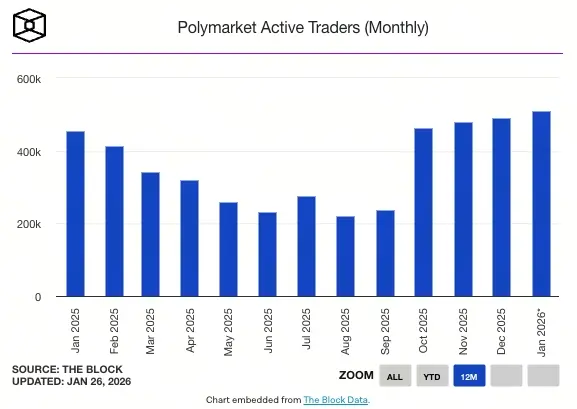
(Source: The Block)
This move comes as leading prediction markets Polymarket and Kalshi have reached a series of licensing agreements, now providing their data to media companies, sports leagues, and search engines. In recent months, Kalshi’s trading volume has surpassed that of Polymarket, mainly due to its partnership with Robinhood and its sports betting products. This shift in competitive dynamics is likely a key motivation for Polymarket’s pursuit of exclusive licenses.
Robinhood’s partnership with Kalshi has brought a massive user base. With tens of millions of Robinhood users integrated with Kalshi’s prediction markets, Kalshi’s trading volume has surged. In contrast, Polymarket, as a crypto-native platform, is well-known within the crypto community but has limited penetration into mainstream financial markets. Kalshi’s sports betting product line is also more comprehensive, covering more sports and bet types.
Polymarket is attempting to regain ground by securing exclusive licenses. Its exclusive partnership with MLS grants it a monopoly in the U.S. soccer market. Previously, Polymarket also signed exclusive agreements with UFC and the New York Rangers, building a sports licensing network that makes it irreplaceable in certain sports markets. Although this strategy is costly—exclusive licensing fees are usually much higher than non-exclusive—it effectively counters Kalshi’s user scale advantage.
Both Polymarket and Kalshi have signed cooperation agreements with sports leagues and teams. The National Hockey League (NHL) has signed multi-year licensing deals with both prediction platforms, and Polymarket also has exclusive agreements with UFC and the New York Rangers. This multi-party licensing competition indicates that sports leagues view prediction markets as a new revenue source and fan engagement tool. For leagues, partnering with prediction markets not only provides licensing fees but also boosts game attention and discussion.
Prediction markets are platforms where users can bet on the likelihood of future events. The data generated is valuable because, in theory, with real money involved, aggregated betting data can more objectively reflect potential outcomes. This “crowd wisdom” mechanism has proven effective in political election predictions and is now being applied to sports event forecasts.
State-Level Regulatory Questions Sports Predictions as Unlicensed Gambling
Although the Commodity Futures Trading Commission (CFTC) has approved prediction platforms to operate nationwide, states like Massachusetts, Ohio, and Tennessee have explicitly questioned whether sports betting contracts constitute unlicensed gambling. This conflict between federal and state regulation casts a shadow over the expansion of prediction markets. The U.S. federal system grants states significant autonomy over gambling regulation. Even if the CFTC approves prediction markets at the federal level, states can prohibit or restrict their operation based on local laws.
The concerns in Massachusetts, Ohio, and Tennessee mainly focus on the blurred line between “prediction markets vs. sports betting.” Traditional sports betting requires a license from state gaming commissions and is heavily regulated. Prediction markets claim to be “information aggregation tools” rather than gambling, but when the betting involves sports events, this distinction becomes practically difficult to uphold. Betting “whether a team will win” can be called either a prediction market or sports betting—resulting in the same outcome: money wagered on sports results.
This regulatory uncertainty poses significant risks to the expansion of Polymarket and Kalshi. If more states follow with bans, both platforms may be forced to cease services in multiple states or face legal challenges. Partnerships between sports leagues and prediction markets could also be affected, as leagues may not want to be associated with platforms involved in legal disputes. Whether MLS’s exclusive agreement with Polymarket can be smoothly executed depends partly on how the regulatory environment evolves.
From a broader perspective, the legalization process of prediction markets in the U.S. remains in an early and uncertain stage. While CFTC approval provides federal legitimacy, opposition at the state level could hinder actual operations. As a crypto-native platform, Polymarket’s decentralized and cross-border nature might make it harder to be fully banned by a single state government but could also attract more regulatory scrutiny.
Disclaimer: The information on this page may come from third parties and does not represent the views or opinions of Gate. The content displayed on this page is for reference only and does not constitute any financial, investment, or legal advice. Gate does not guarantee the accuracy or completeness of the information and shall not be liable for any losses arising from the use of this information. Virtual asset investments carry high risks and are subject to significant price volatility. You may lose all of your invested principal. Please fully understand the relevant risks and make prudent decisions based on your own financial situation and risk tolerance. For details, please refer to
Disclaimer.


