


比特幣跑輸黃金,但加密經濟的黃金時代才剛開始
Author: Ryan Watkins
Translation: Shen Chao TechFlow
Introduction: By 2026, the crypto economy is in the most critical transformation period in 8 years. This article delves into how the market has “soft-landed” from the over-optimism of 2021 and is gradually establishing valuation frameworks based on cash flow and real use cases.
The author explains the pain of the past four years through the “Red Queen’s Effect” and points out that with relaxed US regulations and explosive enterprise applications, crypto assets are shifting from cyclical speculation to long-term secular growth.
Faced with a global trust crisis and currency devaluation, this is not just an industry revival but the rise of a parallel financial system. For investors deeply involved in Web3, this is not only a cognitive reshaping but also an underestimated, cyclical cross-cycle entry opportunity.
The full text is as follows:
Key Points
- This asset class over-anticipated in 2021; since then, valuations have been rationally correcting, and the valuations of quality assets are now reasonable.
- With the easing of US regulatory environment, issues of token alignment and value capture are finally turning positive, making tokens more investment-worthy.
- Growth in the crypto economy is shifting from cyclical to secular, with some valuable use cases emerging beyond Bitcoin.
- Winning blockchains are consolidating their status as standards for startups and large enterprises, becoming hubs for some of the fastest-growing businesses worldwide.
- After a four-year bear market for altcoins, market sentiment hit rock bottom, and multi-year opportunities for top projects are mispriced; few analysts model exponential growth.
- While top projects may thrive in the next era of the crypto economy, increased delivery pressure and corporate competition will eliminate weaker participants.
- Nothing is more powerful than the idea that “the time is ripe”; the crypto economy has never felt more unstoppable than now.
In my eight years in this industry, the crypto economy is experiencing the greatest transformation I have seen. Institutions are accumulating chips, while pioneering cypherpunks are diversifying wealth. Companies are preparing for S-curve growth, and industry-native developers feeling disillusioned are leaving. Governments worldwide are guiding global financial transformation onto blockchain rails, while short-term traders still worry about chart trends. Emerging markets celebrate financial democratization, while American rebels lament it as just a casino game.
Recently, many articles have discussed “which historical period the current crypto economy most resembles.” Optimists compare it to the post-dot-com bubble period, believing the speculative era is over, and long-term winners like Google and Amazon will emerge and climb along the S-curve. Pessimists compare it to emerging markets, such as some markets in the 2010s, implying weak investor protections and long-term capital shortages may lead to poor asset performance, even as the industry flourishes.
Both views have merit. After all, history is the best guide for investors besides experience. However, analogies have limited insights. We still need to understand the crypto economy within its macroeconomic and technological context. The market is not a single entity—it consists of many roles and stories interconnected but distinct.
Below is my best assessment of our past phases and future directions.
The Red Queen’s Cycle
“Now, here, you see, you have to run as fast as you can just to stay in place. If you want to get somewhere else, you must run at least twice as fast!”
— Lewis Carroll
In many ways, expectations are the only thing that matters in financial markets. Surpass expectations, and prices rise; fail to meet them, and prices fall. Over time, expectations swing like a pendulum, and forward returns are often negatively correlated with them.
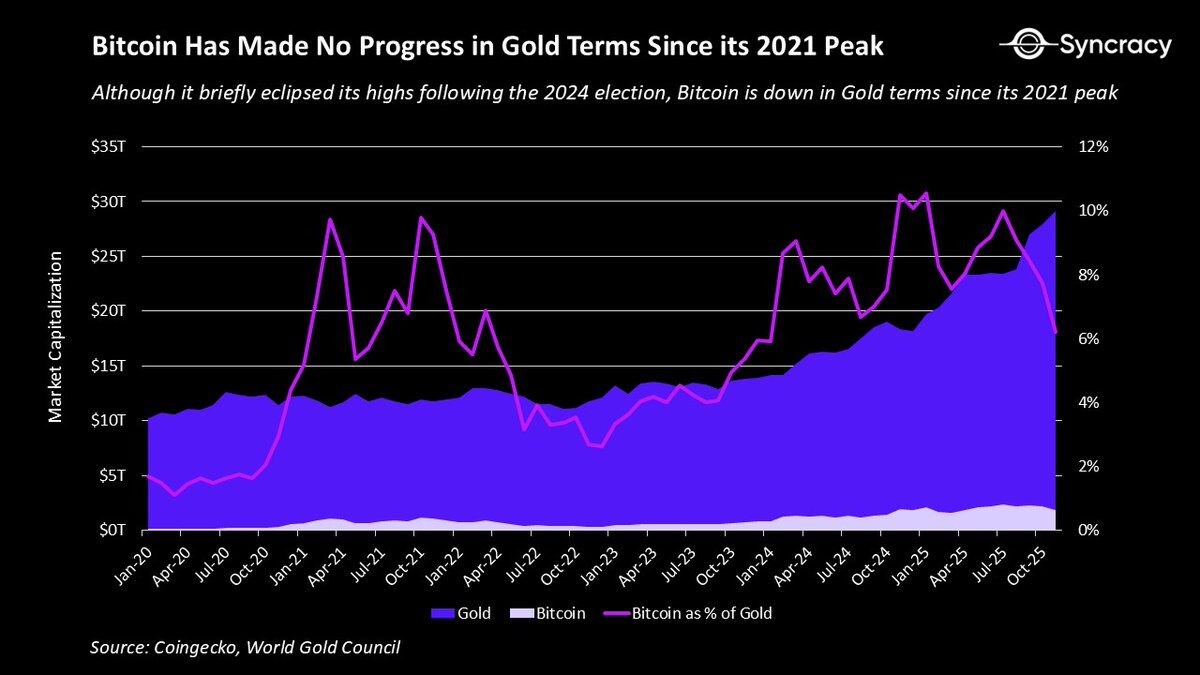
In 2021, the crypto economy vastly overstretched expectations beyond most people’s understanding. In some aspects, this overheating was obvious—for example, DeFi blue chips trading at 500x P/S multiples, or eight smart contract platforms valued over $100 billion at the time. Not to mention the chaos of Metaverse and NFTs. But the chart that best reflects this is the Bitcoin/Gold ratio.
Despite significant progress, the Bitcoin-to-Gold price ratio has never hit a new high since 2021 and remains in a downward trend. Who would have thought that, in the global crypto capital Trump mentioned, after the most successful ETF listing in history, Bitcoin’s success as digital gold is actually worse than four years ago amid systemic dollar devaluation?
As for other assets, the situation is much worse. Most projects entered this cycle with a series of structural issues, exacerbating the challenge of responding to extreme expectations:
- Most projects’ revenues are cyclical, based on asset prices continually rising;
- Regulatory uncertainty hindered institutional and corporate participation;
- Dual ownership structures led to misaligned interests between insiders and public market token investors;
- Lack of disclosure standards caused information asymmetry between project teams and communities;
- Absence of shared valuation frameworks resulted in excessive volatility and a lack of fundamental price bottoms.
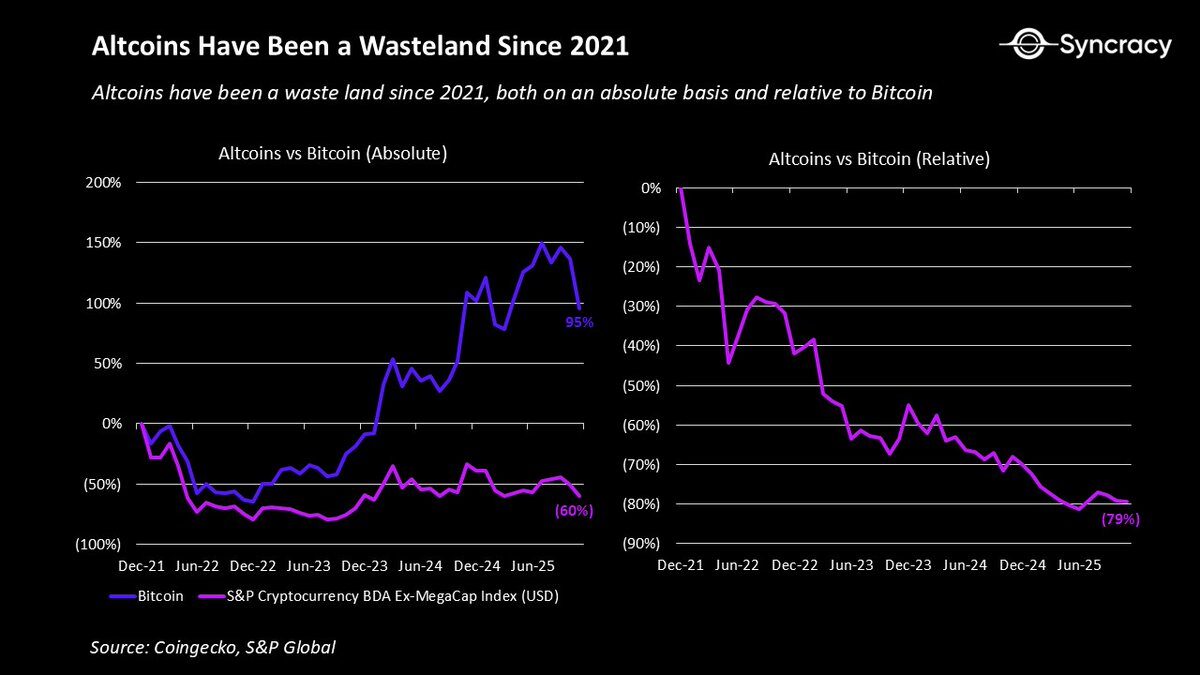
These combined issues caused most tokens to continue “bleeding,” with only a few reaching their 2021 highs. This had a huge psychological impact, as few things are as frustrating as “hard work with no reward.”
For speculators and traders who believed crypto was the easiest way to get rich, this disappointment was especially intense. Over time, this struggle sparked widespread burnout across the industry.
Of course, this is a healthy development. Mediocre efforts should no longer produce extraordinary results as they did before. The era of “vaporware” before 2022, which could generate huge wealth, is clearly unsustainable.
Nevertheless, the one glimmer of hope is that these issues are widely understood, and prices have already reflected these expectations. Today, apart from Bitcoin, few crypto natives are willing to discuss any long-term fundamental arguments. After four years of pain, this asset class now has the necessary conditions to surprise the market again.
Enlightened Crypto Economy
As mentioned earlier, the crypto economy entered this cycle with many structural issues. Fortunately, everyone is now aware of this, and many problems are gradually becoming history.
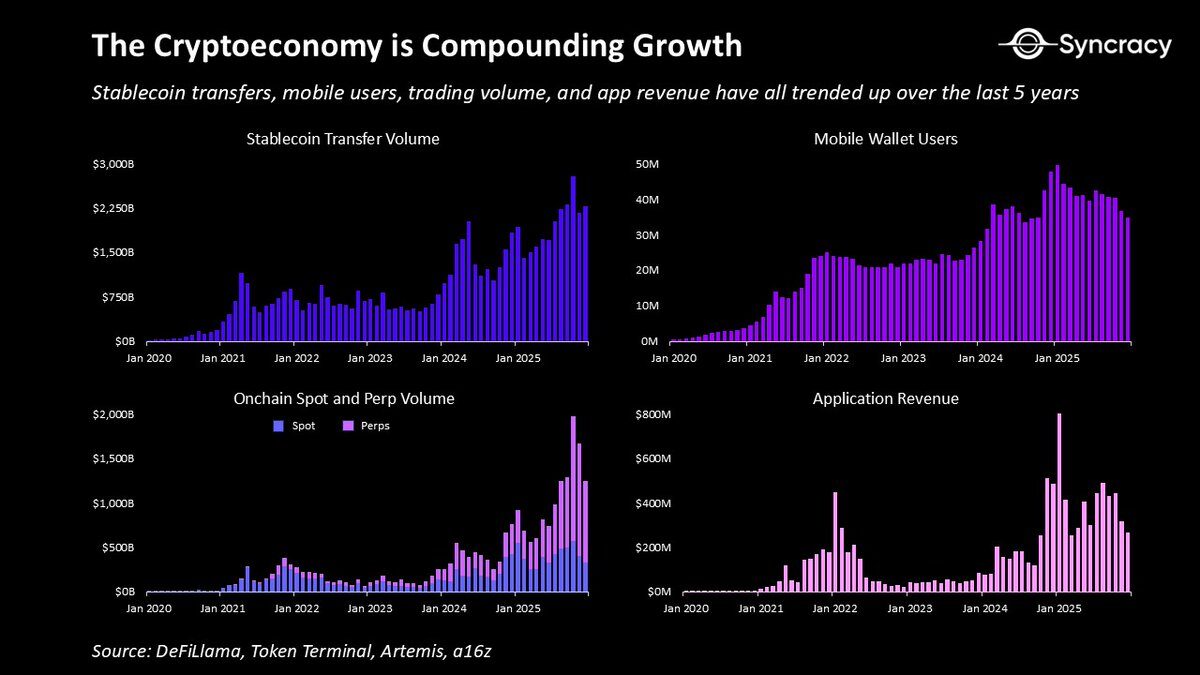
First, besides digital gold, many use cases have shown signs of compound growth, with more in transition. Over the past few years, the crypto economy has produced:
- Peer-to-peer (P2P) networks: enabling users to trade and execute contracts without government or corporate intermediaries.
- Digital dollars: stored and transferred globally over the internet, providing affordable and reliable currency for billions.
- Permissionless exchanges: allowing anyone anywhere to trade top global assets across asset classes 24/7 in a transparent venue.
- New derivative instruments: such as event contracts and perpetual swaps, offering valuable predictive insights and more efficient price discovery.
- Global collateral markets: enabling permissionless credit access through transparent, automated infrastructure, substantially reducing counterparty risk.
- Decentralized asset creation platforms: allowing individuals and institutions to issue tradable assets at very low costs.
- Open financing platforms: enabling anyone worldwide to raise funds for their business, overcoming local economic restrictions.
- Physical infrastructure networks (DePIN): distributing operations to independent operators via crowdsourced capital, creating more scalable and resilient infrastructure.
This is not an exhaustive list of all value use cases built so far. But the key point is that many of these use cases are demonstrating real value, and regardless of crypto asset price movements, they continue to grow.
Meanwhile, with regulatory pressure easing and founders increasingly aware of the costs of misalignment, dual equity–token models are being corrected. Many existing projects are consolidating assets and revenues into a single token, while others explicitly allocate on-chain revenue to token holders and off-chain revenue to equity holders. Additionally, as third-party data providers mature, disclosure practices are improving, reducing information asymmetry and enabling better analysis.
At the same time, there is a growing consensus on a simple, time-tested principle: apart from rare value storage assets like Bitcoin (BTC) and Ethereum (ETH), 99.9% of assets need to generate cash flows. As more fundamental investors enter the space, these frameworks will only be reinforced, increasing rationality.
In fact, given enough time, the concept of “on-chain cash flow sovereignty” might be understood as unlocking a paradigm of “sovereign digital value storage” of the same scale. After all, when have you ever been able to hold an unregistered digital asset that autonomously pays you whenever the program is used, from anywhere on Earth?
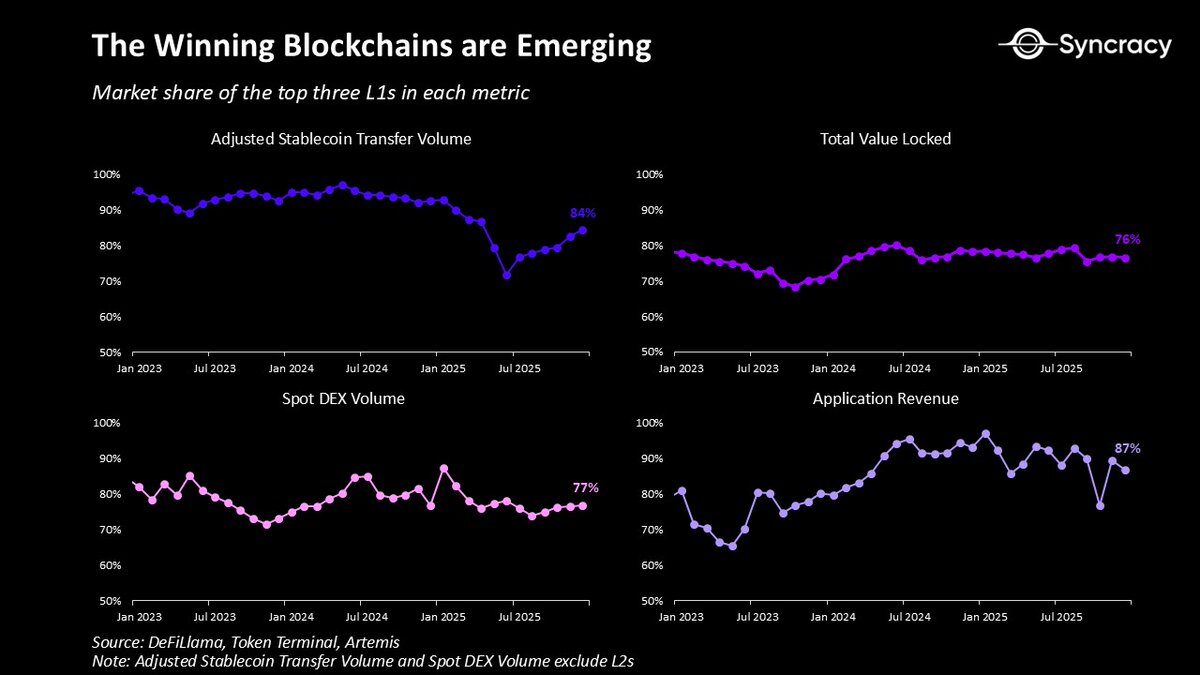
Against this backdrop, the winning blockchains are gradually emerging as the foundation of the network’s currency and financial infrastructure. Over time, the network effects of Ethereum, Solana, and Hyperliquid have strengthened, thanks to their growing assets, applications, ecosystems, and user bases. Their permissionless design and global distribution make their platforms some of the fastest-growing businesses worldwide, with unmatched capital efficiency and revenue turnover. In the long run, these platforms are likely to support the overall market potential (TAM) of financial superapps, an area currently contested by almost all leading fintech companies.
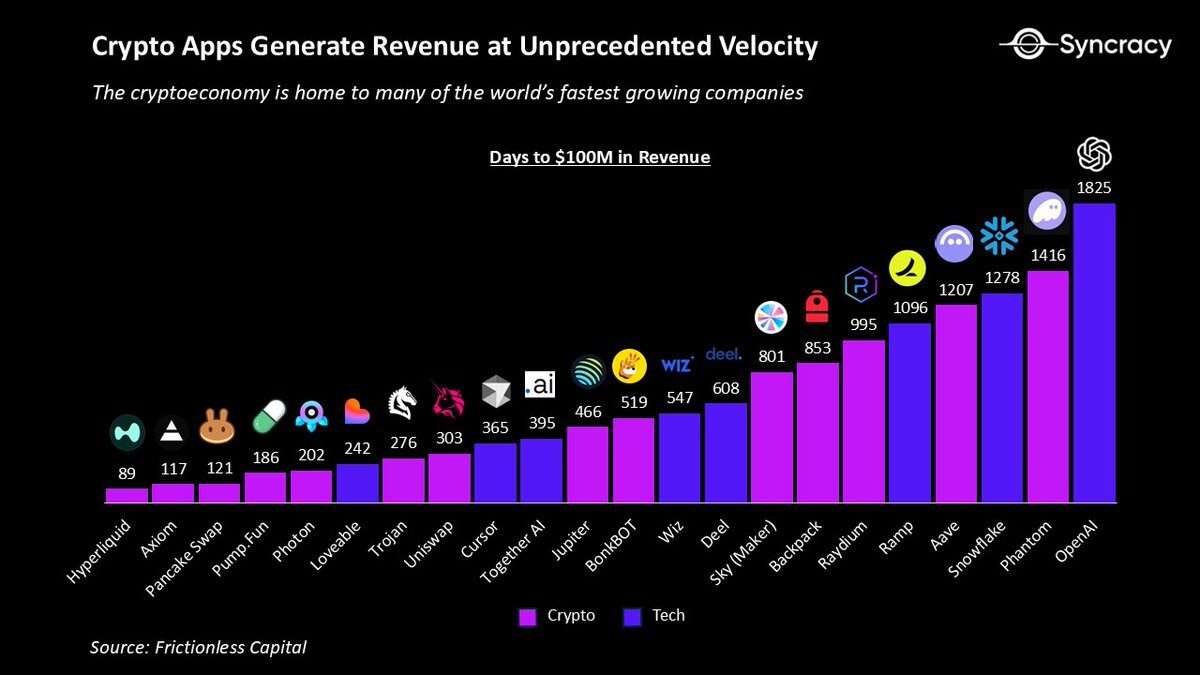
In this context, giants from Wall Street and Silicon Valley are pushing blockchain initiatives at full speed, which is no surprise. Every week, new product announcements emerge, covering tokenization, stablecoins, and everything in between.
Notably, unlike the pre-crypto era, these efforts are no longer experiments but production-grade products, mostly built on public blockchains rather than isolated private systems.
As regulatory lag continues to permeate the system over the coming quarters, these activities will accelerate. With increased clarity, companies and institutions can finally shift focus from “is this legal?” to how blockchain can expand revenue opportunities, reduce costs, and unlock new business models.
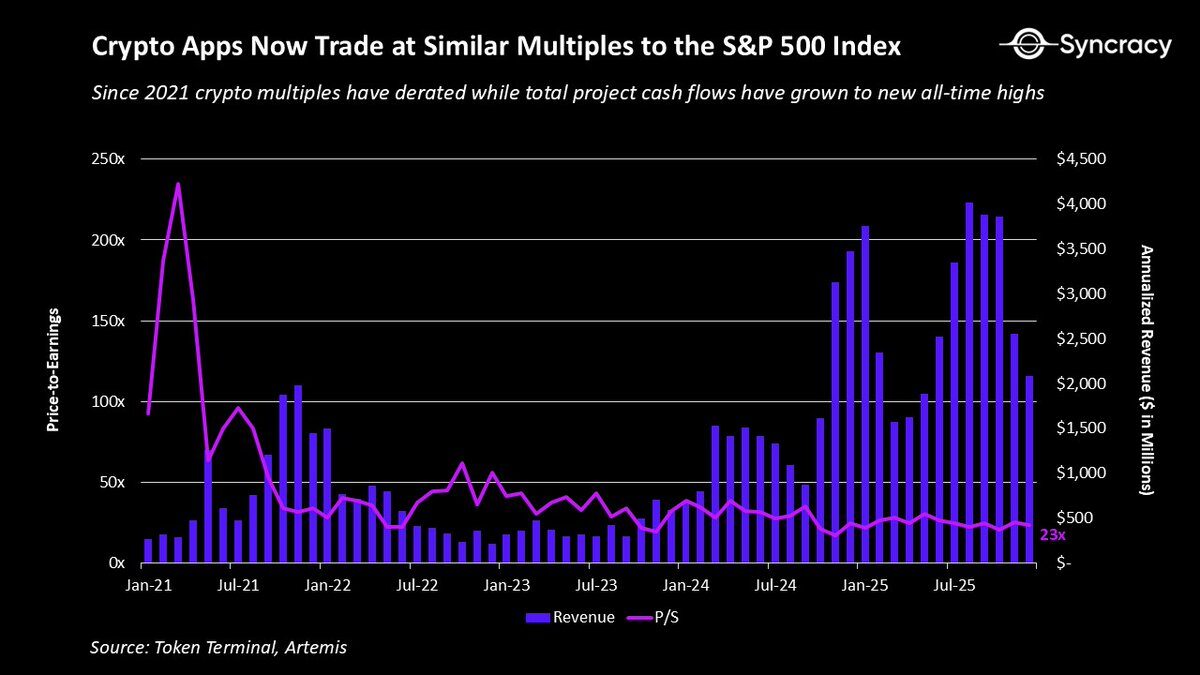
One of the clearest signs of the current state is that very few industry analysts build models for exponential growth. Anecdotal evidence suggests many sell-side and buy-side peers around me dare not consider annual growth rates above 20%, fearing to appear overly optimistic.
After four years of pain and valuation resets, it’s now necessary to ask: what if all this truly achieves exponential growth? What if “daring to dream” again brings returns?
Dusk Moment
“Lighting a candle casts a shadow.”
— Ursula LeGuin
On a cool autumn day in 2018, before starting another exhausting day at the investment bank, I entered an old professor’s office to discuss everything about blockchain. After I sat down, he recounted a conversation with a skeptical hedge fund manager who claimed cryptocurrencies were entering a nuclear winter, a “search for problems’ solutions.”
After giving me a crash course on unsustainable sovereign debt burdens and the disintegrating institutional trust, he finally told me how he countered that skeptic: “10 years from now, the world will thank us for building this parallel system.”
Although it wasn’t quite ten years yet, his prediction seemed prescient, as crypto increasingly looks like a “ripe moment” idea.
In the same spirit, the core message of this article is to prove that the world is still underestimating what is being built here. For all of us investors, the most relevant point is that the multi-year opportunities of leading projects are undervalued.
The last part is crucial because, although crypto may be unstoppable, your favorite tokens might actually be heading toward zero. The flip side of crypto becoming unstoppable is that it attracts fiercer competition, and the pressure to deliver results has never been greater. As I mentioned earlier, with institutional and corporate entry, many weaker players are likely to be cleared out. This doesn’t mean they will win everything and dominate the technology, but it does mean only a few native players will become the major winners around the world’s reorientation.
The focus here is not cynicism. In all emerging tech sectors, 90% of startups fail. There may be more public failures in the coming years, but that shouldn’t distract you from the big picture.
Perhaps no technology better embodies the zeitgeist than cryptocurrencies. Declining trust in institutions in developed societies, unsustainable government spending in G7 countries, blatant currency devaluation by the world’s largest fiat issuer, deglobalization and fragmentation of the international order, and the growing desire for a fairer new system than the old—all these factors make it the perfect time for crypto to break out of its small bubble.
As software continues to consume the world, AI becomes the latest accelerant, and the younger generation inherits wealth from the aging Baby Boomers, there is no better moment for crypto to emerge from its small bubble.
While many analysts frame this moment using classic frameworks like Gartner’s hype cycle and Carlota Perez’s “Post-frenzy” stage, implying that the best returns are behind us and the subsequent phase is more tool-oriented, the reality is much more interesting.
Crypto is not a single mature market but a collection of products and businesses at different points on the adoption curve. More importantly, when a technology enters growth, speculation doesn’t disappear; it just fluctuates with sentiment and innovation pace. Anyone telling you the speculative era is over might just be tired or simply unaware of history.
Maintaining skepticism is reasonable, but don’t be cynical. We are reimagining money, finance, and how our most important economic institutions are governed. This should be challenging but also fun and exciting.
Your next task is to figure out how to best leverage this emerging reality instead of endlessly tweeting about why everything is doomed to fail.
Because those willing to bet on the dawn of a new era, beyond disillusionment and uncertainty, will have once-in-a-lifetime opportunities.