


MicroStrategy stock price plummets 70%! Book value evaporates by $31 billion, marking the largest loss in history

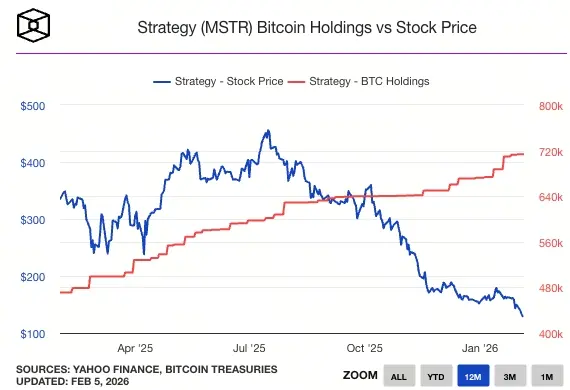
MicroStrategy announced a net loss of $12.6 billion in Q4, marking one of the largest quarterly losses in the history of U.S. publicly traded companies. Bitcoin fell below its average cost basis of $76,000, with a holding of 713,502 BTC shifting from a profit of $31 billion to a loss of $9.2 billion. MSTR’s stock plummeted 70%, and its mNAV dropped below 1, causing a collapse in financing capacity.
Q4 Loss of $12.6 Billion Sets Record
MicroStrategy (formerly MicroStrategy) released its Q4 financial report, shocking the market with an operating loss of approximately $17.4 billion, almost entirely due to unrealized losses on its Bitcoin holdings. The net loss attributable to common shareholders was $12.6 billion, compared to a loss of about $671 million in the same period last year. This expansion from $671 million to $12.6 billion represents an astonishing 18-fold increase.
A researcher at Messari previously estimated that MicroStrategy’s Q4 loss would reach around $17.4 billion, aligning closely with the company’s official results. He compared this quarter’s loss to the losses recorded by companies like AIG, Fannie Mae, and Freddie Mac during the 2008 financial crisis. This historic analogy underscores the severity of MicroStrategy’s predicament—though the nature differs (a liquidity crisis versus unrealized losses), the scale is similarly staggering.
At the time of the announcement, Bitcoin was experiencing one of the most severe single-day declines in history. According to The Block’s price data, Bitcoin opened at about $73,100, with a intraday low of $62,400, nearly a 15% drop. This daily plunge caused MicroStrategy’s paper losses to continue expanding on the day of the earnings release, creating a vicious cycle of “bad news piling on bad news.”
The $12.6 billion loss does not stem from actual Bitcoin sales but from unrealized losses—differences between book value and market value. Under U.S. accounting standards, the company must value its crypto assets at market prices, and when the market price falls below the purchase cost, impairment losses must be recognized in the financial statements. This accounting treatment causes Bitcoin’s price fluctuations to directly translate into huge reported losses.
The researcher added that Bitcoin’s continued weakness since early February implies approximately $14 billion in unrealized losses, bringing the total market value decline since the end of last year to nearly $31 billion. This suggests that if Bitcoin prices remain depressed, MicroStrategy’s Q1 financials could again show hundreds of millions or even billions in losses, leading to consecutive quarters of massive losses.
Bitcoin Falls Below $76,000 Average Cost Line
(Source: The Block)
MicroStrategy remains the largest holder of Bitcoin to date, with its balance sheet showing 713,502 BTC as of early February. Most of these holdings were acquired during Bitcoin’s surge to over $126,000 at the end of 2024. This high-level accumulation strategy was praised as visionary during Bitcoin’s rally but has become a critical weakness during the downturn.
MicroStrategy’s average purchase cost per Bitcoin is approximately $76,000. The recent correction has turned its paper gains from massive profits into an unrealized loss of over $9.2 billion. Just four months ago, when Bitcoin was near its all-time high, the company held unrealized gains exceeding $31 billion. The fluctuation from a profit of $31 billion to a loss of $9.2 billion, a $40.2 billion swing in book value, highlights the extreme risk profile of MicroStrategy’s strategy.
The $76,000 average cost line is now a focal point for the market. When Bitcoin trades above this level, MicroStrategy’s strategy appears successful; when it falls below, all holdings are in the red. Currently, Bitcoin hovers around $70,000, implying an approximate $6,000 per BTC paper loss. Multiplying by 713,502 BTC, the total unrealized loss is about $42.8 billion.
More concerning is that MicroStrategy continued to buy at high prices into late 2024. During Bitcoin’s above-$100,000 rally, the company announced large purchases, which now face even larger paper losses. This “buy high” approach, seen as confidence in a bull market, becomes a burden in a bear market.
MicroStrategy Holdings and Loss Data
Number of Bitcoin held: 713,502 BTC
Average purchase cost: approximately $76,000
Current unrealized loss: over $9.2 billion
Unrealized profit four months ago: over $31 billion
Book value fluctuation: $40.2 billion
Despite the market volatility, Chairman Michael Saylor has made almost no public comments besides a brief “HODL” message on X. This famous crypto slogan means “Hold On for Dear Life,” and Saylor’s silence contrasts with the message, indicating he remains committed to a long-term holding strategy and will not change course due to short-term losses.
Stock Price Drops 70%, Financing Capacity Collapses
MicroStrategy (NASDAQ: MSTR) stock performance has been even more brutal. On the day of the earnings release, the opening price was about $120, closing near $107, and after-hours trading pushed it further down to around $102. The stock has fallen over 70% from levels a year ago, erasing most of the premium investors previously assigned to the company’s Bitcoin accumulation strategy.
Over the past year, Bitcoin’s decline has wiped out much of the premium that once justified the company’s strategy, with MicroStrategy’s stock dropping more than 70%. This decline far exceeds Bitcoin’s own price drop, indicating that the market is not only punishing Bitcoin’s price but also questioning MicroStrategy’s business model itself.
A key warning sign is the sharp decline in market net asset value (mNAV), which compares the company’s equity valuation to the value of its crypto holdings. MicroStrategy’s mNAV is now below 1, meaning the market values its equity less than the value of its assets. This discount prevents the company from raising capital efficiently through issuing new shares without diluting existing shareholders.
This discount hampers its ability to fund further Bitcoin purchases or low-cost refinancing. MicroStrategy’s business model relies on continuous financing to buy Bitcoin; when mNAV drops below 1, issuing new shares would significantly dilute current shareholders. Selling new stock below asset value destroys shareholder value, potentially forcing the company to halt purchases or even sell Bitcoin in extreme cases.
The collapse in equity premium limits financing options and increases dilution risk. This creates a feedback loop: falling stock prices reduce equity value, constraining capital raising and increasing balance sheet pressure. If Bitcoin remains depressed, MicroStrategy could find itself in a “neither able to buy nor sell” predicament.
Related Articles
XRP ETF defies the trend by attracting funds! Institutions are selling Bitcoin but increasing their holdings of Ripple, with a weekly inflow of $39 million
Binance Adds $300M in Bitcoin to SAFU as Market Volatility Grows
BTC whale holdings cause the price to drop below $69,000, a similar situation in 2022 lasted for 7 months
U.S. Bitcoin ETF rebounds after decline, with two consecutive days of net capital inflows signaling market stabilization
Bitcoin Breaks $70K Support as ETFs See $3.1B Exit
Gate Daily (February 10): Jump Trading acquires equity in Polymarket; MicroStrategy adds 1,142 Bitcoins