


Bitcoin's single-day liquidation reaches 2.7 billion, and the cryptocurrency market sentiment hits a new low since 2022.
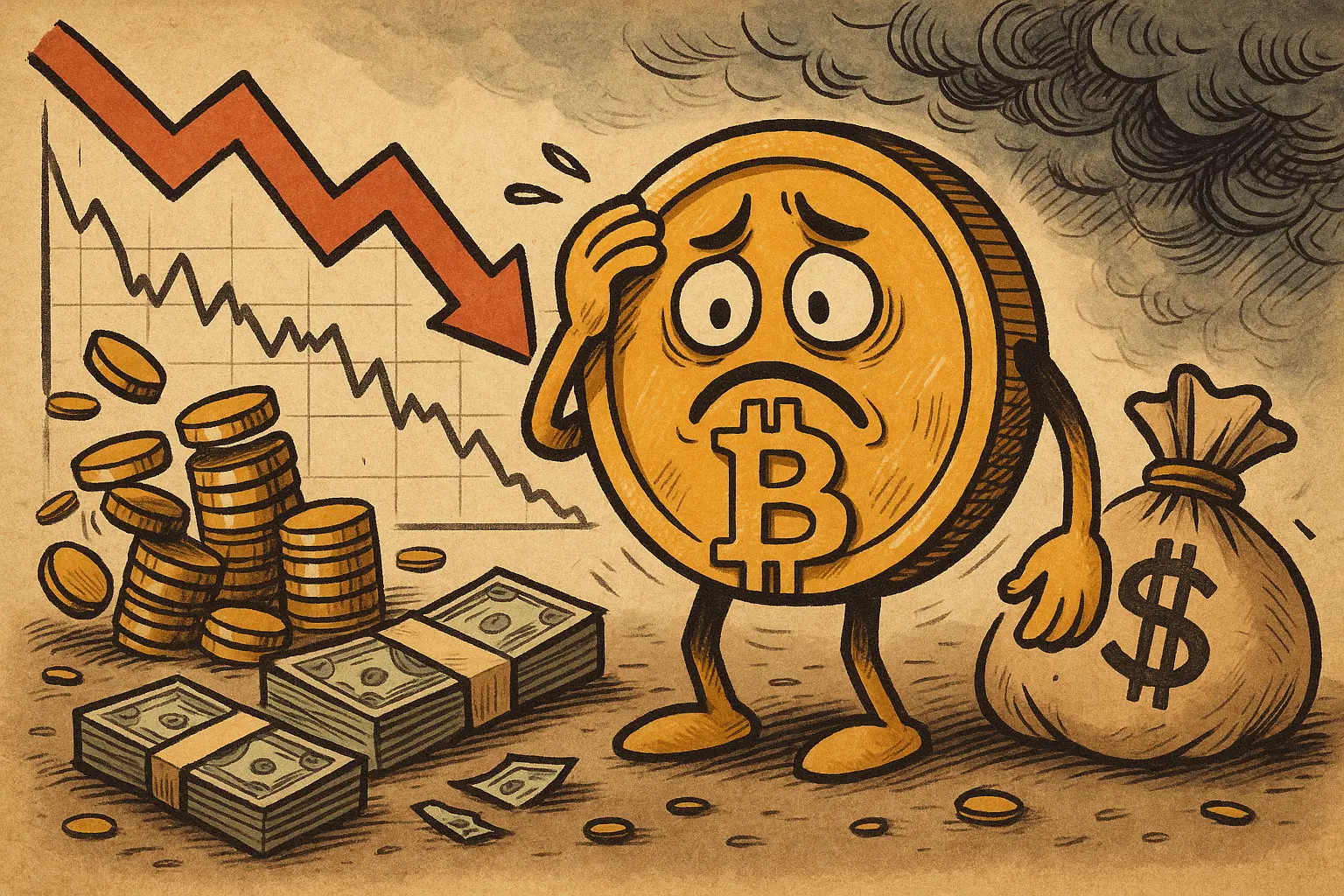
Cryptocurrency market sentiment drops to a three-and-a-half-year low, with Bitcoin briefly falling below $60,000. The Fear & Greed Index drops to 9, the lowest since the Terra collapse in June 2022. In the past 24 hours, it has declined by 13%, with a single-day drop of $10,000, the largest since 2022. Bitcoin has broken below the 200-week exponential moving average (EMA). Over 580,000 traders have been liquidated, losing a total of $2.7 billion, with 85% holding leveraged long positions.
Fear & Greed Index at 9, the Lowest Since Terra Collapse
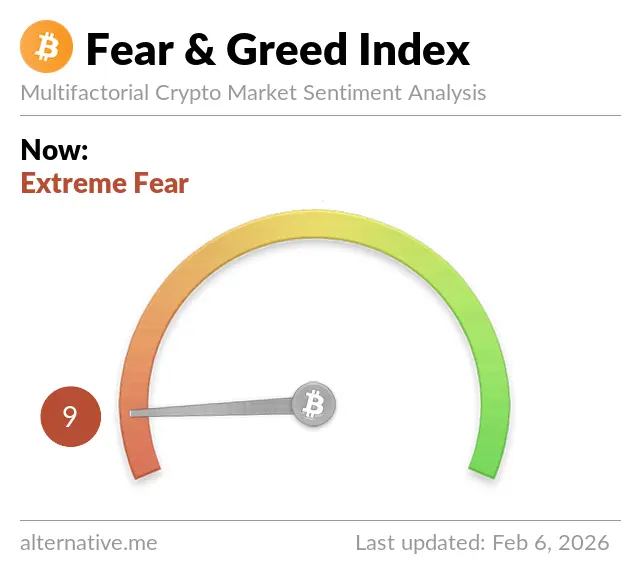
(Source: Alternative.me)
Market sentiment in the crypto space has plummeted to its lowest point in three and a half years, with Bitcoin dropping to around $60,000. On Friday, the Crypto Fear & Greed Index plunged to 9 out of 100, indicating an “extreme fear” state, and marking its lowest since June 2022, when the market sentiment and prices sharply declined following the Terra blockchain collapse a month earlier.
The Fear & Greed Index is a comprehensive indicator that measures overall crypto market sentiment by combining various factors such as volatility, trading volume, social media activity, market momentum, and Bitcoin dominance. Its scale ranges from 0 (extreme fear) to 100 (extreme greed), with 50 representing neutrality. Historically, when the index drops below 10, it often signals extreme panic in the market, which frequently coincides with market bottoms.
A reading of 9 has only appeared during a few historic crash moments. In June 2022, the Terra/Luna collapse triggered a chain of liquidations, with Bitcoin falling from 40,000 to 18,000, and the index hitting single digits. During the March 2020 pandemic panic, the index also reached 8. At the bear market low in late 2018, the index remained below 10 for an extended period. Currently, with a score of 9, Bitcoin’s situation is comparable to these historic crisis points.
However, extreme readings in the Fear & Greed Index serve both as risk signals and opportunity signals. Historical data shows that when the index falls below 10, Bitcoin often experiences a significant rebound within 1 to 3 months. After the June 2022 bottom, Bitcoin rebounded to around 25,000 within months. Following the March 2020 crash, Bitcoin surged to 60,000 within a year. This “extreme fear buying” strategy has historically had a high success rate, but it also involves risks of short-term further declines and psychological stress.
Historical Comparisons of the Fear & Greed Index at 9
- June 2022: Terra collapse, index drops to 9, then rebounds to 25,000
- March 2020: Pandemic panic, index drops to 8, then surges to 60,000
- Late 2018: Bear market bottom, index stays below 10 for a prolonged period, then a new bull market begins
- February 2026: Currently, index at 9; future trend remains to be seen
58,800 Liquidated, $2.7 Billion Bloodbath
During Friday’s early trading session, Bitcoin on Coinbase briefly fell above $60,000, reaching its lowest level since October 2024. The current price is just above $64,000, down 13% over the past 24 hours, with a single-day decline exceeding $10,000—the largest since mid-2022. Bitcoin has now fallen below the 200-week exponential moving average, a long-term trend indicator, which has only been breached during deep bear markets before. From its all-time high of $126,000 set in early October, Bitcoin has declined by approximately 52%.
According to data from CoinGlass, over 588,000 traders were forced to liquidate in the past 24 hours, with total losses reaching $2.7 billion. Of these, 85% held leveraged long positions, primarily in Bitcoin. This level of liquidation is among the most severe in crypto history, second only to the May 2021 “519 crash” (~$10 billion liquidated) and the Luna collapse in 2022.
What does the liquidation of 588,000 traders imply? It’s not just a cold statistic; behind it are hundreds of thousands of families and individuals’ savings evaporating. For many, this could be their entire savings or borrowed funds. The $2.7 billion loss is equivalent to roughly NT$860 billion, enough to build several highways or fund the college education of tens of thousands of students. The brutal reality of the crypto market is fully exposed at such moments.
The fact that 85% of liquidated positions were long indicates a highly unbalanced market before the crash. Most investors used leverage to bet on Bitcoin continuing its upward trend or at least holding support levels. When prices plunged, these leveraged positions were triggered one after another, causing further sell-offs and creating a “liquidation spiral.” This self-reinforcing downward cycle is one of the main reasons for the extreme volatility seen in crypto markets.
Tech Stocks Collapse and the Fed’s Cautious Double Blow
Jeff Ko, Chief Analyst at CoinEx Research, told Cointelegraph that Bitcoin has fallen over 20% in a week, while US tech stocks have also been heavily sold off. “The market has long emphasized that these stocks are overvalued, and there are ongoing concerns about a bubble driven by AI.” He added, “After Amazon released mixed earnings, its stock also dropped double digits overnight. Investors are increasingly reassessing Bitcoin’s role as a safe haven, considering it less reliable than gold.”
Nick Ruck, head of research at LVRG, explained that Bitcoin’s decline alongside the broader market downturn is driven by “rising risk aversion,” which is fueled by “weak signals from the US labor market, including rising unemployment claims, raising doubts about sustained economic growth, and the Federal Reserve’s cautious stance on aggressive rate cuts.”
The synchronized decline of tech stocks and Bitcoin demonstrates that both are viewed as risk assets in the current environment. When investors become worried about economic prospects and lose confidence in overvalued assets, they tend to sell both tech stocks and Bitcoin indiscriminately. The sharp decline following Amazon’s earnings report is particularly symbolic; as a major tech giant and AI investment leader, its disappointing results have prompted a reassessment of the entire tech sector.
Bitcoin’s failure as a safe haven has been reaffirmed. During times of rising economic uncertainty, gold hits new highs while Bitcoin crashes, breaking the narrative of “digital gold.” Bitcoin’s value is highly sensitive to liquidity conditions and risk appetite. During liquidity shortages and risk aversion, it behaves more like a high-risk speculative asset rather than a safe haven.
The Federal Reserve’s cautious approach to rate cuts is another blow. The market had anticipated multiple rate reductions by 2026, which supported risk asset valuations. However, weak employment data combined with persistent inflation has put the Fed in a dilemma, likely delaying rate cuts well beyond market expectations. This “hawkish outlook” is extremely unfavorable for Bitcoin, which does not benefit from interest rate cuts.