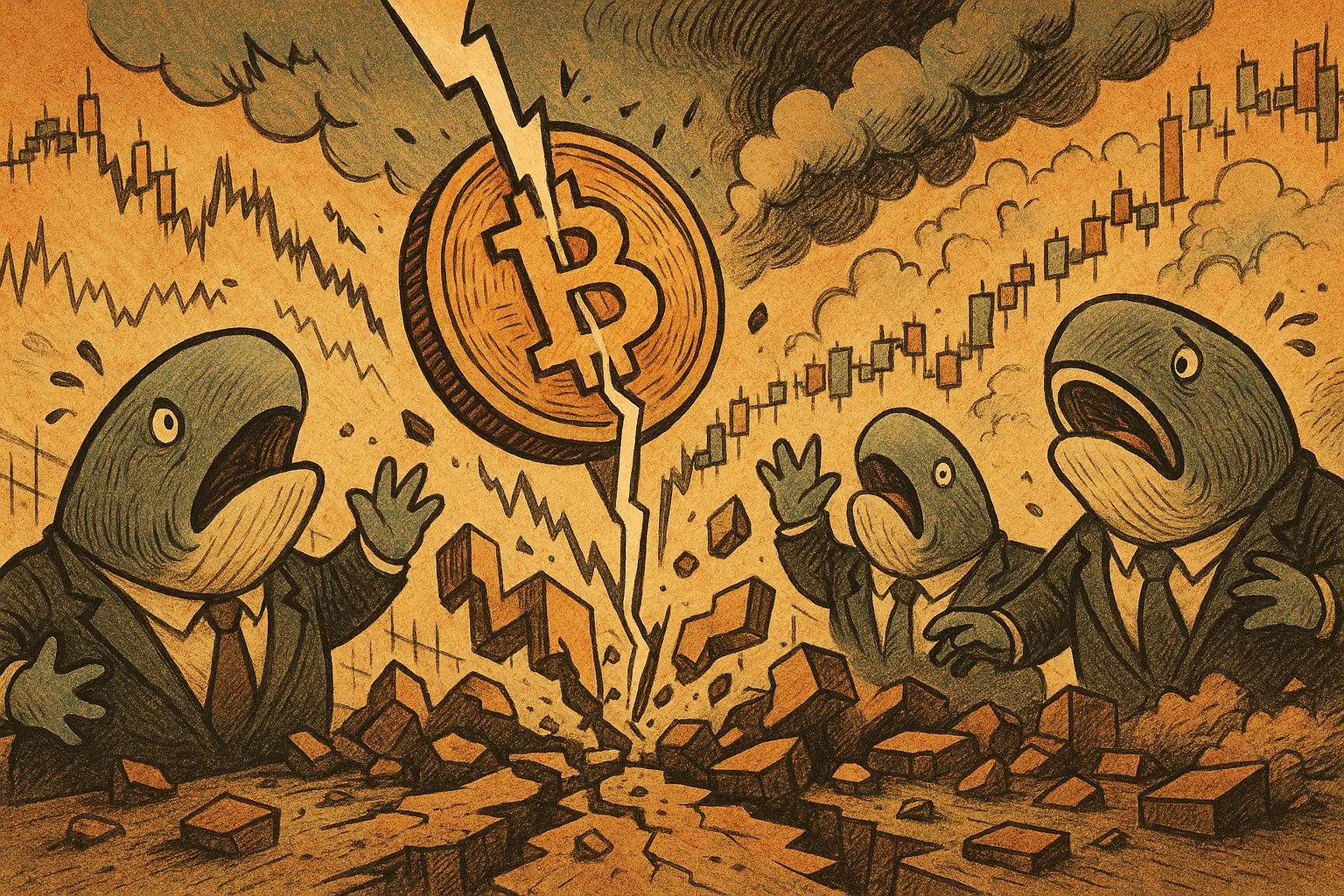
Bitcoin briefly plunged below $60,000, introducing the new concept of the “Whale Kill Line.” A total of 588,000 traders were liquidated, resulting in losses of 2.7 billion USD, with 85% leverage long positions. The trapped whales create a topping effect, and the market is reluctant to provide liquidity for selling.
The Harsh Market Logic of the Whale Kill Line
In this wave of market movement, a new term has emerged called the “Whale Kill Line,” meaning that even the trapped whales face liquidation. This concept reveals the cruelest side of the crypto market: even whales holding hundreds of millions or billions of dollars can be wiped out instantly under extreme volatility and leverage.
The Whale Kill Line usually refers to the liquidation price of these large positions. When Bitcoin or Ethereum prices fall to this level, exchanges or lending platforms will forcibly sell their collateral assets to repay debts. This forced selling generates a large number of sell orders, further lowering the price, which may trigger other whales’ liquidations, forming a “liquidation spiral.” During the Luna crash in 2022, this mechanism caused Bitcoin to drop from 40,000 to 18,000 within days.
When there are so many whales with open positions on Ethereum, Ethereum is doomed not to rise. No one wants to send them money after Ethereum’s price increases, nor do they want to provide liquidity for their sell-offs. This “whale topping” effect is extremely critical. When the market knows that certain large holders are seriously trapped, once the price rebounds near their cost basis, they will definitely sell off massively to reduce losses. Rational investors are unwilling to become the bagholders of these sell-offs, so they choose to wait or short, and this expectation itself suppresses rebound momentum.
The Triple Chain Reaction of the Whale Kill Line
Liquidation Spiral: A whale’s liquidation triggers a price drop, causing other whales to liquidate
Topping Effect: The potential selling pressure from trapped whales suppresses rebound momentum
Liquidity Exhaustion: No one is willing to provide liquidity for whales to sell during rebounds
Some whales now are bleeding whales, and the cruel reality of capital markets is that if others discover you’re hurt, they will take the opportunity to kill you, not lend a helping hand. This “law of the jungle” is vividly reflected in the crypto market. When the financial distress of a large holder becomes known, other traders not only refuse to rescue but may increase short positions, trying to accelerate their liquidation for profit. Although this “trampling on the injured” behavior is brutal, it is very common in zero-sum markets.
The Symbolic Significance of Losing the Last High of $68,000
While writing this article, Bitcoin has already fallen below $68,000, officially breaking the previous high. Losing this technical level is highly symbolic. $68,000 was the peak of Bitcoin’s 2021 bull market and the cost basis for many high-position buyers in 2021. When Bitcoin re-breaks this level in 2024, it signifies confirmation of a new bull market. But the current drop below again suggests that the rally in 2024-2025 may only be a bear market rebound, not the start of a new bull.
From a technical analysis perspective, breaking below the previous high is a strongly bearish signal. It indicates that the market cannot sustain higher prices, and buying momentum is insufficient. More importantly, this breakdown will trigger a large number of stop-loss orders and technical sell-offs, as many traders see the previous high as a key support level; once broken, they believe the technical outlook is thoroughly damaged and will exit to cut losses.
Psychologically, breaking below the previous high will severely damage market confidence. Investors who bought above $68,000 initially expected a new bull market to bring substantial gains, but when the price falls below this threshold, they find themselves not only unprofitable but also deeply trapped. This psychological gap from hope to despair often triggers panic selling.
Every Bull Market Needs Sufficient Sacrifices
Every bull market must have enough sacrifices to start. It sounds like an evil ritual, but it is indeed the case in the crypto market. Looking back, the sacrifices before the 2017 bull run were Mt. Gox’s bankruptcy and the collapse of many altcoins. Before the 2021 bull market, the sacrifices were the long bear market of 2018-2019 and countless project failures. To initiate a new bull market now, it may be necessary to liquidate highly leveraged whales, treasury companies, and speculators, allowing the market to reset.
From a cycle perspective, this kind of sharp short-term decline can actually be beneficial—it’s more comfortable than a dull knife cutting through flesh. It bursts bubbles and illusions, smashing down directly, clearing leverage, and liquidating institutions, whales, and large holders, leading the industry into a rebuilding phase. Although the 2022 bear market was painful, it cleaned out over-leveraged players like FTX, Three Arrows Capital, Celsius, and others, creating conditions for a rebound in 2024. The current sharp decline may be repeating this process.
However, this rebuilding process takes time. From the bottom after FTX’s bankruptcy in November 2022 to the market’s true recovery in early 2024, it took about 15 months. If we are truly entering a cleansing phase now, investors may need to be patient for several quarters or even longer before seeing a real reversal.
The current market feels like there is a big thunderbolt, with those ahead already knowing and fleeing, and the market just doesn’t know yet. This “smart money fleeing first” phenomenon often appears before financial crises. Before the 2008 subprime crisis, some hedge funds shorted real estate assets early. Before FTX’s bankruptcy in 2022, Binance and some institutions withdrew funds early. The extreme volatility and large institutional withdrawals now may indicate that some insiders already know the unseen bad news.
Potential black swans include: undisclosed issues at Binance, traditional tech giants aggressively acquiring or competing with crypto, and tightening regulations by major countries. If any of these risks materialize, they could trigger a new wave of panic. But it’s also possible that these concerns are overly pessimistic, and the market will rebound quickly after extreme fear.
Disclaimer: The information on this page may come from third parties and does not represent the views or opinions of Gate. The content displayed on this page is for reference only and does not constitute any financial, investment, or legal advice. Gate does not guarantee the accuracy or completeness of the information and shall not be liable for any losses arising from the use of this information. Virtual asset investments carry high risks and are subject to significant price volatility. You may lose all of your invested principal. Please fully understand the relevant risks and make prudent decisions based on your own financial situation and risk tolerance. For details, please refer to
Disclaimer.
Related Articles
Ethereum Jumps 25% After $1750 Liquidity Sweep As Traders Eye $2500 Zone
_Ethereum surged about 25% from $1,750 to near $2,200 after a liquidity sweep triggered strong buying activity._
_Around 3.4M ETH is waiting in the validator queue, one of the longest lines since Ethereum moved to proof of stake._
_Trader 0xA5e4 lost $1.53M after a $31M ETH short
LiveBTCNews43m ago
ETH Breaks Through 2150 USDT
Gate News bot message, Gate market display, ETH has broken through 2150 USDT, now priced at 2150.56 USDT.
CryptoRadar2h ago
Data: If ETH drops below $2,039, the total long liquidation strength on major CEXs will reach $979 million.
ChainCatcher Message: According to Coinglass data, if ETH drops below $2,039, the total liquidation strength of long positions on major CEXs will reach $979 million. Conversely, if ETH breaks above $2,249, the total liquidation strength of short positions on major CEXs will reach $735 million.
GateNews2h ago
A whale contract trader's short position reaches $32 million, with an unrealized profit of $4.5 million.
According to Arkham monitoring, 0x58bro profited $4.5 million from shorting altcoins, mainly from shorting ETH, with a gain of $3.04 million. He plans to short an additional $1.3 million when ETH price reaches between $2,220 and $2,490, and his current unrealized profit has already reached $4.5 million.
GateNews2h ago
"ETH Swing Master" unrealized gains have increased to $12 million, with no positions closed yet. Recently, successfully bottomed out BTC at an average price of $68,000.
March 5 news shows that the "ETH Swing Master" address currently holds a 15x leveraged ETH long position, with an unrealized profit of $9.2 million. At the same time, this address also bought the dip in BTC during the short-term bottom for BTC and ETH, with unrealized profits exceeding $2.8 million. The total unrealized profit now exceeds $11 million, and the outlook remains bullish.
GateNews3h ago


