Oracle surges 9.6%, analysts call it a "misjudgment": cloud service revenue shines, but concerns over $130 billion debt remain
Oracle’s single-day surge of 9.64%, with analysts upgrading to a “Buy” rating and setting a $180 target price, comes as the company carries $130 billion in debt and $248 billion in lease commitments, leveraging heavily to bet on AI infrastructure.
(Background: Oracle plunges 40%, will excessive AI infrastructure sink the giants?)
(Additional context: US TikTok sale: Oracle and two other major US investors take control, ByteDance retains the core, did Trump win?)
Table of Contents
- OpenAI’s $30 Billion Annual Fee
- OCI’s impressive growth figures come at a high cost
- TikTok joint venture: an underestimated insurance policy
- Leverage, growth, and faith
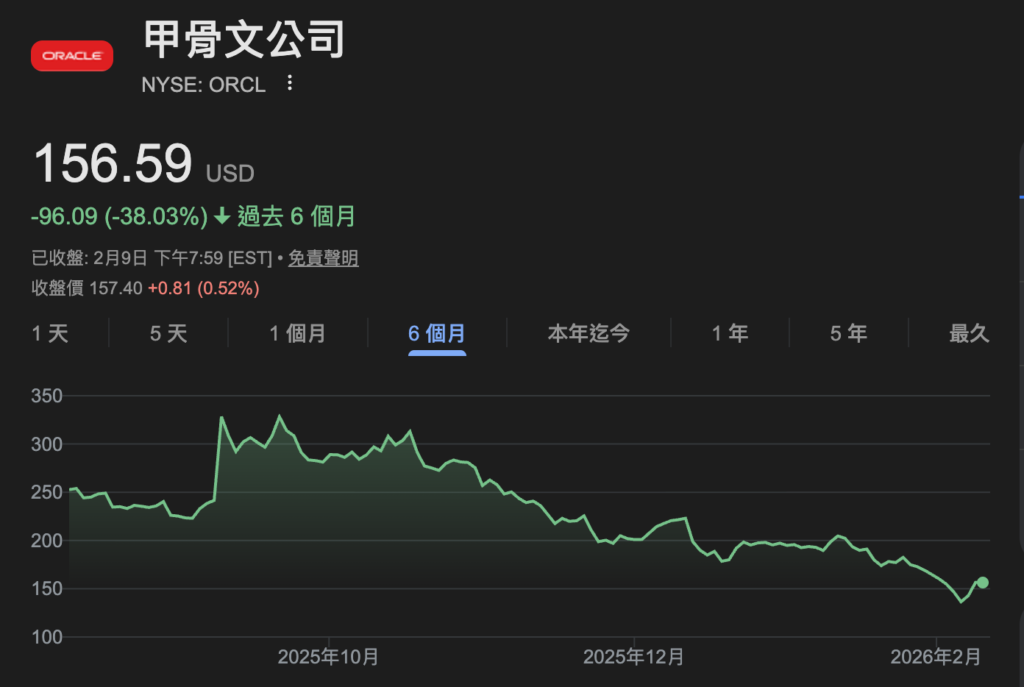
Oracle (ORCL) saw its stock jump 9.64% on Monday, closing at $156.59, adding to a more than 4% gain on Friday, totaling nearly a 14% rebound over two trading days.
However, Oracle’s stock has been cut in half since its peak of $345 in September last year, with the 52-week low touching $118. D.A. Davidson analyst Gil Luria bluntly states: “The market has overreacted; the stock has fallen too far.” He upgraded the rating from Neutral to Buy, with a target price of $180.
Overreactive targets are often overvalued, just in different directions. The question is: Is this correction driven by fear or reality?
OpenAI’s $30 Billion Annual Fee
One core reason for Oracle’s plunge is the market’s loss of confidence in its partnership with OpenAI. In July 2025, OpenAI signed a data center service contract with Oracle worth $30 billion annually, launching the massive “Stargate” project with a total scale exceeding $300 billion, promising to build 4.5 gigawatts of AI computing infrastructure within five years.
This contract transformed Oracle’s cloud infrastructure business (OCI) from a secondary player into a key supplier of AI infrastructure. But as competition from Google Gemini models intensifies, the market questions: Can OpenAI fulfill these astronomical financial commitments?
If OpenAI’s business model falters, the data centers Oracle built for it could turn from assets into liabilities.
Luria counters: Recently, OpenAI has made significant progress in its business model, refocusing on cutting-edge models, exploring ad monetization, and holding about $40 billion in cash, with plans to raise up to $100 billion this quarter. In other words, OpenAI is unlikely to default for now, but “for now” is never a guarantee in the capital markets.
OCI’s Impressive Growth Figures Come at a High Cost
The main bullish thesis for Oracle is its core public cloud service (OCI) growth trajectory. Luria predicts OCI’s annual revenue growth rate of 71%, estimating that in the fiscal year 2030, revenue could reach $144 billion. He describes OCI as “pure additional upside.”
This figure is indeed attractive, but the underlying capital structure is concerning. To support OCI’s expansion, Oracle announced a financing plan of $45 to $50 billion in 2026, roughly half through equity and convertible bonds, and the other half through one-time investment-grade unsecured bonds. This is in addition to its existing $130 billion in accumulated debt.
Plus, with $248 billion in operating lease commitments (a 148% increase from last August), Oracle’s balance sheet is no longer “aggressive.” Luria admits: “Oracle is in a very dangerous situation.” A analyst who gave a “Buy” rating also called it “very dangerous,” which warrants serious reflection.
TikTok Joint Venture: An Underestimated Insurance Policy
An often-overlooked asset is Oracle’s 15% stake in the US TikTok joint venture, valued between $50 and $90 billion. This stake not only has book value but also locks in TikTok as a long-term OCI customer, contributing about $1 billion annually in cloud service revenue.
Further reading: TikTok US joint venture officially established, with US holding 80.1% and ByteDance 19.9%
Along with contracts from top-tier clients like AMD, Meta, NVIDIA, and xAI, Oracle’s customer portfolio in AI infrastructure is considered luxurious. The issue isn’t demand itself but whether Oracle can rapidly build capacity to meet these needs amid heavy debt.
Leverage, Growth, and Faith
Oracle’s $130 billion in debt (including about $100 billion existing debt and plans to raise an additional $25 billion in 2026) and $248 billion in lease commitments are betting that demand for AI infrastructure will continue to grow exponentially. If the bet pays off, OCI’s revenue curve will make all debts seem trivial; if it fails, these numbers could lead to a slow-motion balance sheet crisis.
It’s easy for analysts to call “mispricing,” but the real issue isn’t whether the stock has fallen too far, but whether Oracle’s balance sheet can withstand any slowdown in AI demand. In a world where interest rates remain high and capital is no longer free, leverage is a double-edged sword: it can amplify gains but also accelerate falls.
The market gave Oracle two days of applause, but the numbers on the books won’t decrease because of applause. Investors should carefully evaluate all risks.