ChatGPT starts selling ads: How it works, will AI conversations be affected, and a look at user privacy
OpenAI officially tests ads in the free ChatGPT version and the Go plan, with internal documents showing a goal of $1 billion in ad revenue by 2026 and up to $25 billion by 2029, though the company is burning more money each year than it earns.
(Background: Claude Opus 4.6 is here: writing its own compiler, making PowerPoint, casually discovering 500 zero-day vulnerabilities—your job is just a playground for it.)
(Additional context: AI is starting to hire real humans! RentAHuman launched: robots renting out your physical body for package delivery, errands, photography—tens of thousands signing up.)
Table of Contents
- $1 billion is just the appetizer; $25 billion is the main course
- Burning $17 billion annually makes ads a necessity rather than an option
- The familiar script of tech startups
- Structural impacts on the AI industry
- The cost of free
On February 9, OpenAI officially announced testing ads in ChatGPT’s free version and the Go plan, limited to adult users in the U.S. Ads appear at the bottom of ChatGPT responses, triggered when the conversation relates to a sponsored product or service, clearly marked as an ad. Users can see why they saw the ad and can choose to close it.
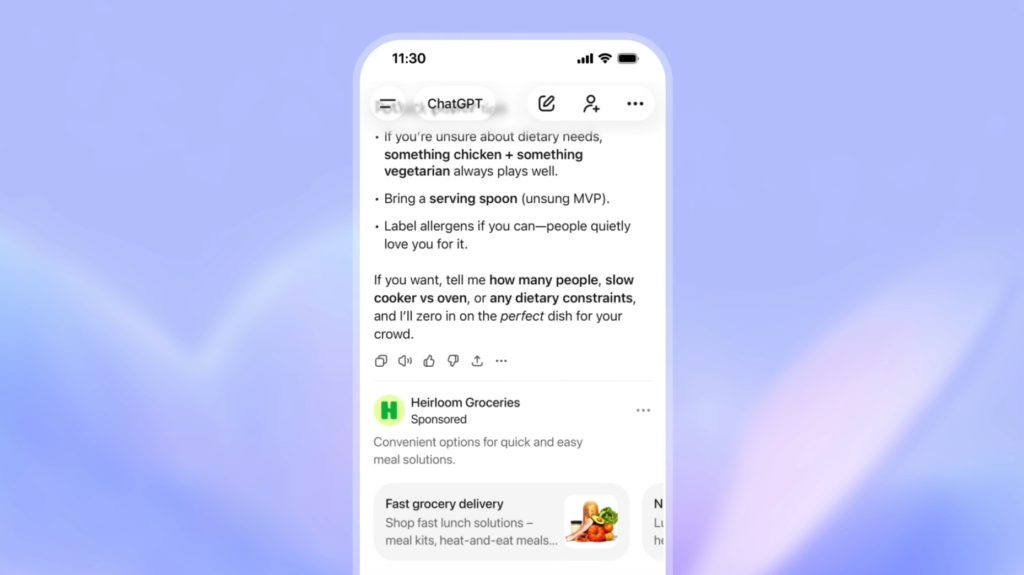
OpenAI emphasizes several red lines:
- Accounts under 18 won’t see ads
- No ads related to sensitive topics like health, mental health, or politics
- ChatGPT’s responses won’t be influenced by ads
- User data will never be sold to advertisers
These guarantees sound comprehensive. But if you’ve seen how ad businesses at Google, Facebook, or any tech company evolve from “testing” to “core revenue,” you’ll know: the red lines tend to shift under revenue pressure.
Currently, paid plans like Pro, Business, and Enterprise don’t have ads (but it’s uncertain whether that will change in the future).

$1 billion is just the appetizer; $25 billion is the main course
OpenAI’s official stance is that ads are part of a diversified revenue model to make AI more accessible. In the long run, ad revenue is expected to account for less than half of total revenue.
But internal documents tell a different story. According to leaked financial forecasts, OpenAI plans to generate $1 billion in revenue from “monetizing free users” by 2026, expanding to nearly $25 billion by 2029. This model assumes about 8.5% of users will convert to paid subscriptions, while over 90% will be monetized through ads and affiliate marketing.
Burning $17 billion annually makes ads a necessity rather than an option
Why does OpenAI need to sell ads? It’s not hard to see: OpenAI’s revenue growth is astonishing—$2 billion annualized in 2023, $6 billion in 2024, surpassing $20 billion in 2025. Enterprise services are the fastest-growing engine, with over 1 million companies paying for enterprise-grade AI products.
But expenses are growing even faster: estimated annual cash burn of $17 billion in 2026, rising to $35 billion in 2027, peaking at $47 billion in 2028. Before turning a profit, cumulative losses could reach as high as $143 billion.
That’s why OpenAI is raising up to $100 billion in funding at a valuation of around $730 billion, with NVIDIA CEO Jensen Huang confirming participation and calling it possibly NVIDIA’s largest single investment ever. Even so, an additional funding gap of $50 to $80 billion remains.
The familiar script of tech startups
The history of tech repeats the same story: a company attracts hundreds of millions of users with free products, promises “user experience first,” then gradually introduces ads under financial pressure, eventually making ads the main revenue source, with product design focused on maximizing ad efficiency rather than user value.
Google Search, Facebook News Feed, YouTube—now, ChatGPT is at the starting point of the same path.
OpenAI’s current stance is cautious: ads only in the free version, only in relevant contexts, only at the bottom, and can be turned off. But when the $25 billion ad revenue target in 2029 looms, will the definition of “relevant contexts” expand? Will “bottom” move upward? Will “can be turned off” become “can be skipped but requires waiting 5 seconds”?
These questions currently have no answers.
Structural impacts on the AI industry
The significance of ChatGPT introducing ads isn’t just about OpenAI’s business model shift; it sets a precedent for the entire AI industry: free access to large language models may ultimately be paid for by ads.
Google has integrated AI responses with ads in search, Meta’s Llama model is backed by the world’s largest ad machine. If the standard commercial model for AI assistants becomes “free + ad monetization,” then competitors without ad infrastructure (including most open-source models) could face severe funding disadvantages.
Conversely, this opens a narrative window for decentralized AI and privacy-focused AI. When ChatGPT starts matching your conversations with targeted ads, “your data won’t be used to make money” becomes a genuinely valuable selling point.
Blockchain and crypto tech exploring data sovereignty and privacy computing—from zero-knowledge proofs to homomorphic encryption—may find more concrete applications.
The cost of free
Almost every successful tech company eventually walks the ad path, because under current capital structures, there’s hardly any other way. When you burn $17 billion a year and have hundreds of millions of free users, ads are not an option—they’re gravity.
But what’s truly worth watching isn’t whether OpenAI will sell ads, but how much those ads will fundamentally change the nature of AI assistants. When AI that answers your questions also serves advertisers, will people be subtly influenced without realizing it?