


WLFI plans to launch the World Swap foreign exchange trading platform! USD1 settlement competing with banking systems
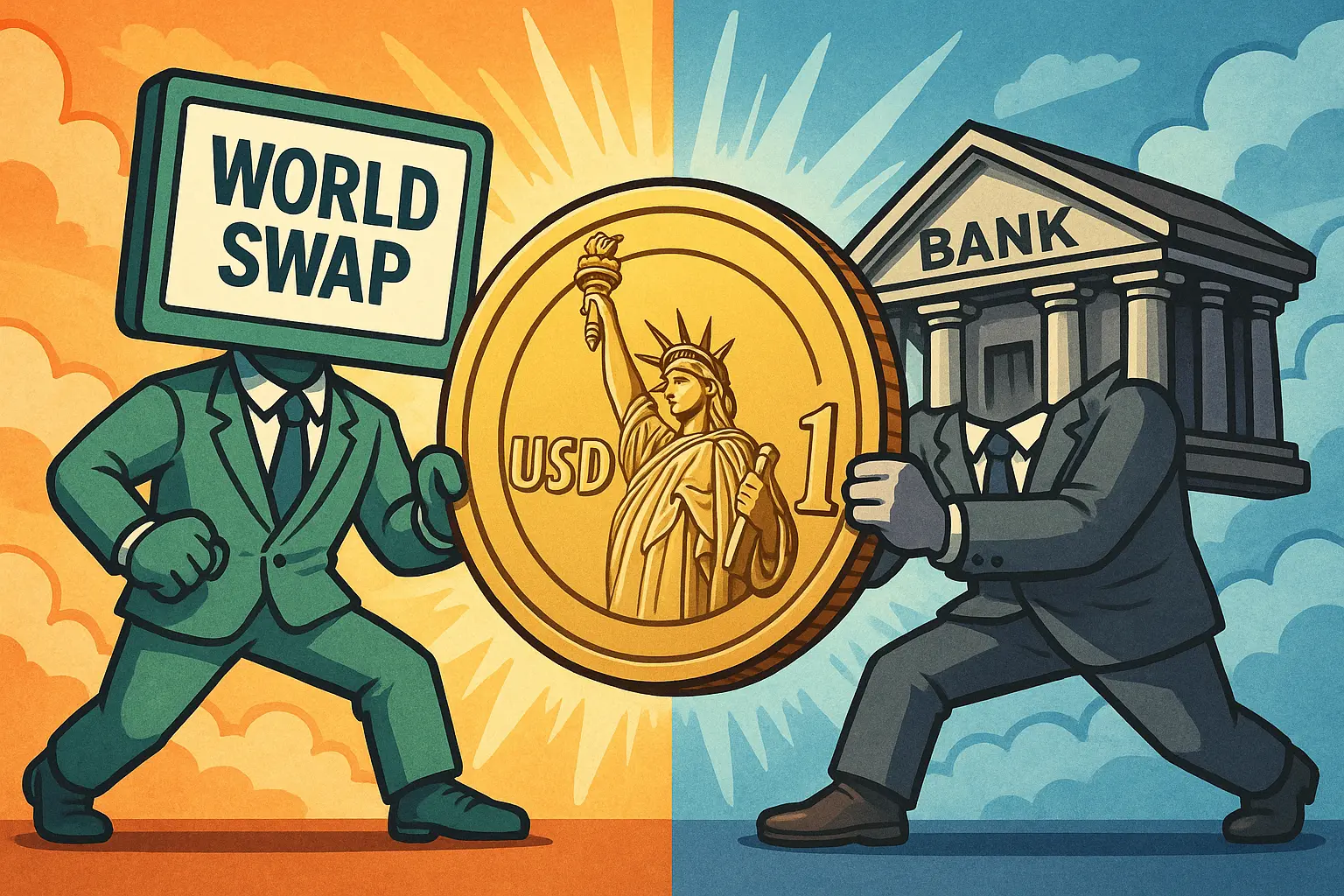
Donald Trump-backed World Liberty Financial (WLFI) plans to launch the World Swap foreign exchange trading platform, announced by co-founder Zak Folkman at the Consensus Hong Kong conference. The platform will use WLFI’s USD1 stablecoin as the settlement currency, aiming to move forex trading onto the blockchain. The global forex market has a daily trading volume exceeding $7 trillion, with most transactions currently conducted off-chain.
The Ambition of World Swap: An On-Chain Revolution in the $7 Trillion Forex Market
Supported publicly by former U.S. President Donald Trump, the decentralized finance (DeFi) project World Liberty Financial (WLFI) announced the upcoming launch of a forex trading platform called World Swap. Co-founder Zak Folkman revealed this at the Consensus Hong Kong event. Folkman stated that World Swap will be fully integrated into WLFI’s stablecoin ecosystem. Specifically, the platform will use WLFI’s USD1 pegged stablecoin as the settlement currency. As a result, the project aims to bring off-chain forex trading onto the blockchain.
The global forex market is the largest financial market, with over $7 trillion traded daily. To date, most of these transactions occur off-chain. WLFI’s proposed World Swap platform seeks to fill this gap. It will facilitate currency swaps, with payments settled via blockchain, eliminating the need for banks and traditional clearing systems. This could significantly reduce friction and lower costs.
What does a $7 trillion daily trading volume mean? It’s roughly 7% of the world’s GDP, flowing through the forex market every day. Traditional forex trading mainly occurs through interbank markets involving central banks, commercial banks, hedge funds, and multinational corporations. Transactions are executed via SWIFT and specialized platforms like EBS and Reuters Dealing, with settlement typically taking T+2 (two business days after the trade).
The revolutionary aspect of World Swap is bringing this massive market onto the blockchain. In theory, blockchain settlement could achieve T+0 (instant settlement), drastically reducing settlement risk and capital lock-up costs. The costs and delays in traditional forex settlement mainly stem from reconciliation, clearing, and regulatory compliance among banks. Blockchain’s transparency and automation could eliminate these intermediaries.
More importantly, it would transform stablecoins from idle value repositories into active operational tools. Currently, most stablecoins are used for trading pairs on crypto exchanges or within on-chain DeFi protocols, with only a small fraction used for real-world payments and settlement. If World Swap successfully attracts real forex trading demand, USD1 could shift from a speculative tool to a foundational infrastructure for cross-border trade and finance.
Three Major Potential Advantages of World Swap
Instant Settlement: Blockchain T+0 vs traditional T+2, reducing settlement risk and capital costs
Lower Costs: Bypassing banks and SWIFT, saving on fees and exchange spreads
24/7 Trading: Blockchain operates around the clock vs traditional forex markets close on weekends
However, realizing this vision faces significant challenges. The participants in the forex market are the world’s largest and most sophisticated financial institutions, with highly developed and efficient trading infrastructure. Convincing these entities to abandon existing systems for blockchain requires overwhelming advantages. Cost savings alone may not suffice; regulatory compliance, trading speed, and liquidity depth must also be comprehensively surpassed by traditional systems.
USD1 Stablecoin: The Settlement Hub of World Swap
World Swap is primarily based on USD1. WLFI will settle all forex transactions on the platform using this stablecoin. This design choice is crucial. Currently, stablecoins dominate on-chain payments and liquidity in DeFi. WLFI aims to introduce stablecoins into the forex market, leveraging one of the world’s most liquid financial markets. If successful, USD1 could become more than just another stablecoin; it could serve as a cross-border currency exchange and settlement layer.
The logic of using USD1 as the settlement currency is: all currency pairs are first converted into USD1, then into the target currency. For example, EUR to JPY would be routed as EUR → USD1 → JPY, rather than direct EUR/JPY. This “dollar intermediary” approach is standard in traditional forex markets because the dollar is the global reserve currency with the highest liquidity. World Swap’s use of USD1 seeks to capture this intermediary role’s value.
From a business model perspective, each forex transaction involves two conversions involving USD1 (target currency to USD1, then USD1 to the target currency). WLFI can earn fees or spreads on each conversion. If World Swap attracts large forex trading volumes, USD1 transaction volume could grow exponentially, generating enormous revenue for WLFI. This partly explains why the Trump family is so invested in this project.
However, for USD1 to become a true forex settlement hub, several core issues must be addressed. First is liquidity depth: while USD1 stablecoin sales have reached $2.71 billion, this is far from enough to support the $7 trillion daily forex market. Even capturing 1% of the market would require a daily volume of $70 billion, necessitating tens of billions of dollars in USD1 liquidity reserves.
Second is price stability. Stablecoins must maintain a 1:1 peg to the dollar, requiring sufficient reserves and efficient arbitrage mechanisms. During volume surges, short-term deviations (e.g., $0.98 or $1.02) could occur. While such deviations are tolerable in crypto trading, they could cause significant losses in forex. Institutional forex traders demand much higher price accuracy.
Third is regulatory compliance. Forex trading is heavily regulated worldwide. Offering forex services typically requires licenses as a forex broker, adhering to AML, client fund segregation, leverage restrictions, and other regulations. WLFI claims to have applied for a banking license in the U.S., but this is different from a forex broker license.
The Trump Family’s 75% Share and Conflict of Interest Concerns
WLFI has direct financial ties to the Trump family. Reports indicate that entities associated with Trump received 75% of the total proceeds from token sales. Critics argue this could create conflicts of interest. Supporters claim that political exposure could accelerate token adoption. Regardless, WLFI is at the intersection of crypto, finance, and politics. The 75% share is staggering—meaning for every $100 earned, the Trump family takes $75.
This high profit-sharing ratio raises serious ethical and legal questions. When the family of a U.S. president profits so heavily from a fintech project, any regulatory leniency or policy support could be viewed as favoritism. If WLFI obtains a forex broker license or other regulatory approval, it will likely face scrutiny from Democrats and regulators over fairness.
WLFI has previously taken high-risk steps. It reportedly submitted a bank license application to the U.S. in January 2026. Around the same time, it received a $500 million investment from a UAE royal family. These moves demonstrate rapid growth and suggest ambitions far beyond typical DeFi startups. Folkman has also hinted that more details about World Swap will be disclosed at upcoming events at Mar-a-Lago, ensuring market attention.
From a geopolitical perspective, the $500 million investment from the UAE royal family is sensitive. While the UAE is an ally of the U.S., it remains a foreign power. When foreign government entities invest in companies linked to the U.S. president’s family, concerns about national security and diplomatic influence arise. Democratic lawmakers like Stephen Lynch have publicly questioned the motives and implications of such investments.
From a commercial viability standpoint, World Swap is still in the announcement phase, with limited technical details and an unclear timeline. Its development trajectory is evident: WLFI aims to bring forex onto the blockchain, introduce stablecoins as intermediaries, and promote institutional adoption. Future success depends on market acceptance and regulatory responses.
World Swap represents another bold move integrating DeFi, stablecoins, and the global currency market. It also signals increasing political influence in crypto innovation. Ultimately, its progress will depend on execution. The traditional forex market has evolved over decades and is highly mature. To truly disrupt it, World Swap needs not only technological innovation but also regulatory support, institutional adoption, and time to prove itself.
For crypto investors, success could generate enormous value for USD1 and WLFI’s ecosystem. However, the risks are equally high. When a project’s success hinges on the political status of a single individual (Trump), political risks become the greatest uncertainty. Midterm elections in 2026 and the 2028 presidential race could fundamentally alter WLFI’s fate.
Related Articles
CME Group adds ADA, LINK, XLM futures, and states that its crypto products cover over 75% of the crypto market capitalization
Mt. Gox Bankruptcy Case May See Resolution with Proposed Bitcoin Hard Fork
Sanae Takashi Denies Connection! Japanese media NoBorder issues tokens, claiming inspiration from Audrey Tang's digital democracy mechanism
Data: Today, the US Bitcoin ETF experienced a net outflow of 548 BTC, and the Ethereum ETF experienced a net outflow of 12,307 ETH.
Pi Network Rolls Out Phase 2 Protocol Upgrades With Mandatory Node Deadline
CoinShares: Digital asset investment products saw approximately $1 billion in net inflows last week
